WATER
WATER IS PRECIOUS
GLOBAL OWERVIEW
While 67% of Earth’s surface is
covered by water, only less than
2.7% of global water is freshwater.
Most of the freshwater (2.05%)
are locked in ice caps and
glaciers. Only less than 0.7% is
available for human use.
WATER STRUCTURE ON
EARTH
Over two thirds of the
earth's surface is covered
with water, 97.2% of which
is contained in the five
oceans. The Antarctic ice
sheet, containing 90% of
all fresh water on the
planet, is visible at the
bottom. Atmospheric water
vapour can be seen as
clouds, contributing to the
earth's albedo.
Iceberg and Polar cap store most of
the fresh water
on Earth
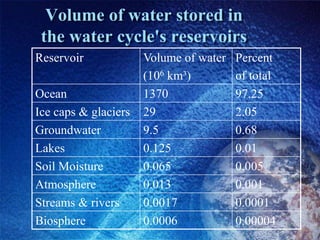
Volume of water stored in
the water cycle's reservoirs
Reservoir Volume of water
(106 km³)
Percent
of total
Ocean 1370 97.25
Ice caps & glaciers 29 2.05
Groundwater 9.5 0.68
Lakes 0.125 0.01
Soil Moisture 0.065 0.005
Atmosphere 0.013 0.001
Streams & rivers 0.0017 0.0001
Biosphere 0.0006 0.00004
WATER CYCLE
• On a global basis, fresh water is a
increasingly scarce resource. It is partially
caused by increasing population coupled
by change of consumption pattern and
climate changes.
Scarcity of fresh water
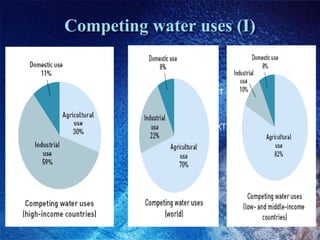
Competing water uses (I)
TEXT
TEXT
TEXT
TEXT
TEXT
Competing water uses (II)
• Industrialized / developed countries tend
to use more water in their industrial
production.
• Other countries tend to use more water for
agricultural uses.
Fresh Water supply
Problems related to Water crisis
• Inadequate access to safe drinking water
by over 1.1 billion people
• Groundwater overdrafting leading to
diminished agricultural yields
• Overuse and pollution of water resources
harming biodiversity
• Regional conflicts over scarce water
resources sometimes resulting in warfare.
Threats to fresh water resources
• Climate change causes change in
frequencies of droughts and floods.
• Depletion of aquifers caused by over-
consumption as a result of population
growth.
• Pollution and contamination by sewage,
agricultural and industrial runoff.
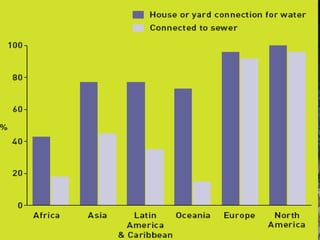
Distribution of population and water
resources
Pressure of freshwater ecosystem
Fresh Water Outlook
• Estimated from existing data, some
countries are going to experience serious
shortage of fresh water supply in the
coming 20 years time.
• China, India and South Africa and Middle
East countries may among the most
adversely affected countries.
INDIA WATER AND SANITATION
• Access to improved source of water
(Urban/Rural/Total)96%/89%/92%
(2011)[1]
• Access to improved sanitation
(Urban/Rural/Total)60%/24%/35%
(2011)
• Average urban water use
(liter/capita/day)126 (2006]
• Average urban water and sewer bill for
20m3US$2 (2007)
• Share of householdmetering55% in
urban areas (1999)
• Share of collectedwastewater
treated27% (2003)
• Annual investment in water supply and
sanitationUS$5 / capita[6]
Desalination of sea water as fresh
water supply
• Desalination of sea water can be done
either via distillation or membrane process.
• Both process requires large amount of
energy and thus costly, which means
desalination remains an expensive option
for providing reliable fresh water supply,
restricted to only economically well-off
countries.
water a precious resource for all

water a precious resource for all

  • 1.
  • 2.
    GLOBAL OWERVIEW While 67%of Earth’s surface is covered by water, only less than 2.7% of global water is freshwater. Most of the freshwater (2.05%) are locked in ice caps and glaciers. Only less than 0.7% is available for human use.
  • 3.
    WATER STRUCTURE ON EARTH Overtwo thirds of the earth's surface is covered with water, 97.2% of which is contained in the five oceans. The Antarctic ice sheet, containing 90% of all fresh water on the planet, is visible at the bottom. Atmospheric water vapour can be seen as clouds, contributing to the earth's albedo.
  • 4.
    Iceberg and Polarcap store most of the fresh water on Earth
  • 5.
    Volume of waterstored in the water cycle's reservoirs Reservoir Volume of water (106 km³) Percent of total Ocean 1370 97.25 Ice caps & glaciers 29 2.05 Groundwater 9.5 0.68 Lakes 0.125 0.01 Soil Moisture 0.065 0.005 Atmosphere 0.013 0.001 Streams & rivers 0.0017 0.0001 Biosphere 0.0006 0.00004
  • 6.
  • 7.
    • On aglobal basis, fresh water is a increasingly scarce resource. It is partially caused by increasing population coupled by change of consumption pattern and climate changes. Scarcity of fresh water
  • 8.
    Competing water uses(I) TEXT TEXT TEXT TEXT TEXT
  • 10.
    Competing water uses(II) • Industrialized / developed countries tend to use more water in their industrial production. • Other countries tend to use more water for agricultural uses.
  • 11.
  • 12.
    Problems related toWater crisis • Inadequate access to safe drinking water by over 1.1 billion people • Groundwater overdrafting leading to diminished agricultural yields • Overuse and pollution of water resources harming biodiversity • Regional conflicts over scarce water resources sometimes resulting in warfare.
  • 13.
    Threats to freshwater resources • Climate change causes change in frequencies of droughts and floods. • Depletion of aquifers caused by over- consumption as a result of population growth. • Pollution and contamination by sewage, agricultural and industrial runoff.
  • 15.
    Distribution of populationand water resources
  • 16.
  • 18.
    Fresh Water Outlook •Estimated from existing data, some countries are going to experience serious shortage of fresh water supply in the coming 20 years time. • China, India and South Africa and Middle East countries may among the most adversely affected countries.
  • 21.
    INDIA WATER ANDSANITATION • Access to improved source of water (Urban/Rural/Total)96%/89%/92% (2011)[1] • Access to improved sanitation (Urban/Rural/Total)60%/24%/35% (2011) • Average urban water use (liter/capita/day)126 (2006]
  • 22.
    • Average urbanwater and sewer bill for 20m3US$2 (2007) • Share of householdmetering55% in urban areas (1999) • Share of collectedwastewater treated27% (2003) • Annual investment in water supply and sanitationUS$5 / capita[6]
  • 29.
    Desalination of seawater as fresh water supply • Desalination of sea water can be done either via distillation or membrane process. • Both process requires large amount of energy and thus costly, which means desalination remains an expensive option for providing reliable fresh water supply, restricted to only economically well-off countries.