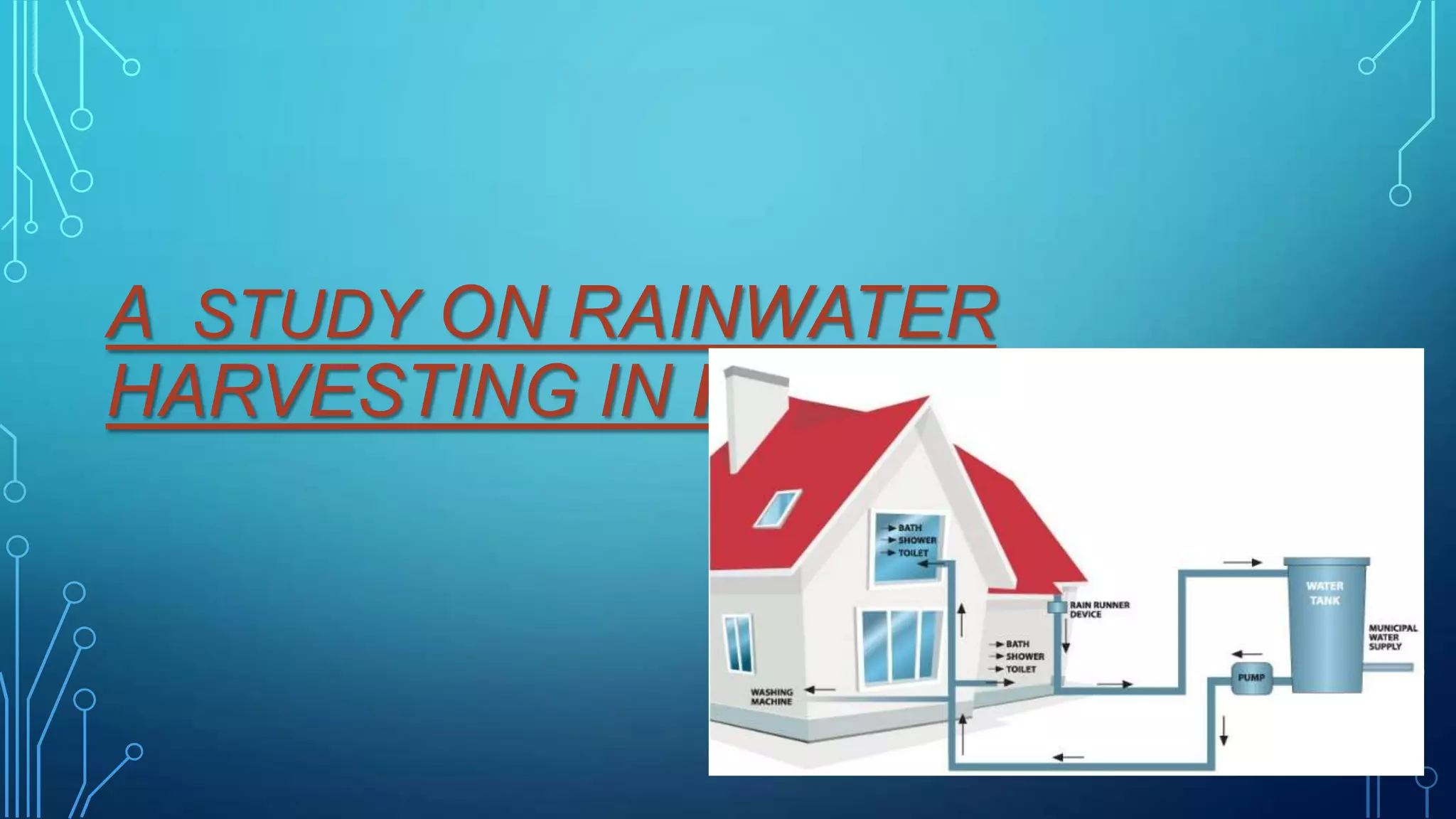
A STUDY ON RAINWATER
HARVESTING IN IRAN
Acknowledgement
Through the means of PowerPoint presentation slides,
we students of Batch 2011-15, Civil Engineering
Department, MANIT, have made a small effort to study
the employed techniques in the field of Rainwater
Harvesting in IRAN. We express gratitude towards our
respective professor „Dr. Ruchi Khare‟, Civil Engg.
Dept, MANIT for guiding us to complete the
NAME OF STUDENT
SCH.NO
assignment.
Mayank Mishra

Thank you 

111111037

Tarun Bhatia

111111038

Tarun Solanki

111111039

Palash Jain

111111040

Deepak Munda

111111041
Why do we need water harvesting?
“Earth provides enough to satisfy every man's needs, but not a single
man's greed.”
-Mahatma Gandhi
Water scarcity is the lack of sufficient available water resources to meet the demands of water
usage within a region. According to United Nations Development Programme, this currently
affects around 2.8 billion people around the world, on all continents, at least one month out of
every year and more than 1.2 billion people lack the access to clean drinking water.
Over-consumption/excessive or unnecessary use of resources, Overpopulation, Slash and
burn agricultural practices in developing countries, Technological and industrial development,
Erosion, Habitat degradation leads to the loss of Biodiversity (i.e. species and ecosystems with
its ecosystem services), Irrigation, Mining for oil and minerals, Aquifer depletion, Pollution or
contamination of resources are the major factors responsible for the eminent water crisis.
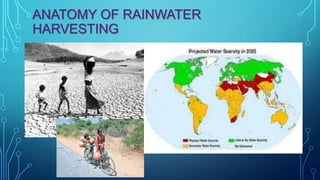
ANATOMY OF RAINWATER
HARVESTING
SO WHAT IS THE SOLUTION?.........

WATER HARVESTING TECHNIQUES
Water Harvesting refers to collection and storage of rainwater and also other activity such as
harvesting surface water extracting ground water , prevention of loss through evaporation and
seepage.
Rainwater harvesting has been practiced for more than 4,000 years, it is also a good
option in areas where good quality fresh surface water or ground water is lacking. In doing so,
water harvesting assures a continuous and reliable access to water. The role of rainwater
harvesting systems as sources of supplementary, back-up, or emergency water supply will
become more important especially in view of increased climate variability and the possibility of
greater frequencies of droughts and floods in many areas.
MULTIPLE BENEFITS
1. Improvement in the quality of ground water
2. Rise in the water levels in wells and bore wells that are drying up
3. Mitigation of the effects of drought.
4. Attainment of drought proofing
5. An ideal solution to water problems in areas having
6. inadequate water resources
7. Reduction in the soil erosion as the surface runoff is reduced
8. Decrease in the choking of storm water drains and flooding of roads
9. Saving of energy, to lift ground water. (One-meter rise in
water level saves 0.40-kilowatt hour of electricity)
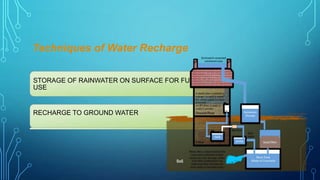
Techniques of Water Recharge
STORAGE OF RAINWATER ON SURFACE FOR FUTURE
USE

RECHARGE TO GROUND WATER
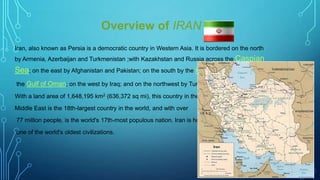
Overview of IRAN
Iran, also known as Persia is a democratic country in Western Asia. It is bordered on the north
by Armenia, Azerbaijan and Turkmenistan ;with Kazakhstan and Russia across the Caspian

Sea; on the east by Afghanistan and Pakistan; on the south by the Persian Gulf and
the Gulf of Oman; on the west by Iraq; and on the northwest by Turkey.
With a land area of 1,648,195 km2 (636,372 sq mi), this country in the
Middle East is the 18th-largest country in the world, and with over
77 million people, is the world's 17th-most populous nation. Iran is home to
one of the world's oldest civilizations.
WATER RESOURCES OF IRAN
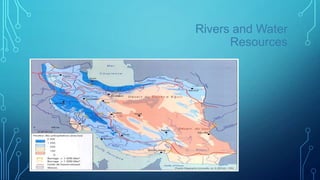
Arid and semi-arid regions occupy more than 80 percent of Iran‟s land. The average annual precipitation
is estimated to be 250 mm and the range varies from 50 mm in some parts of the central water basin to more
than 1600 mm in some coastal areas near the Caspian Sea. Meanwhile with respect to the average annual
precipitation in the world with average rainfall of more than 830 mm, Iran is classified among the semi-arid and
arid countries.
High density, short duration rainfall often generates destructive floods. At present in many
parts of the country, the water levels have been falling rapidly. The demand for drinking water is also
has been increasing manifold in the last three decades due to rapid increase in the population.
THUS, Meeting the water demand is a major challenge in Iran.
Rivers and Water
Resources
Water Resource Potential of Iran
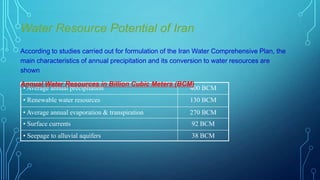
According to studies carried out for formulation of the Iran Water Comprehensive Plan, the
main characteristics of annual precipitation and its conversion to water resources are
shown
Annual Water Resources in Billion Cubic Meters (BCM)
• Average annual precipitation
400 BCM
• Renewable water resources

130 BCM

• Average annual evaporation & transpiration

270 BCM

• Surface currents

92 BCM

• Seepage to alluvial aquifers

38 BCM
Percentage

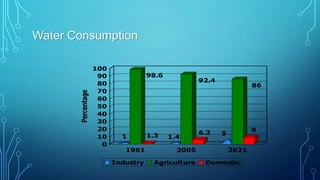
Water Consumption
100
90
80
70
60
50
40
30
20
10
0

98.6

1

1.3

92.4

1.4

1961

2005

Industry

Agriculture

6.2

86

9

5
2021

Domestic
FRESHWATER CONSUMPTION
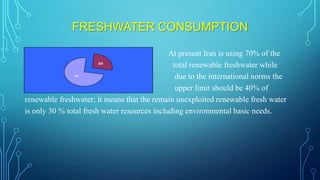
At present Iran is using 70% of the
t
total renewable freshwater while
u
due to the international norms the
u
upper limit should be 40% of
renewable freshwater; it means that the remain unexploited renewable fresh water
is only 30 % total fresh water resources including environmental basic needs.
30

70
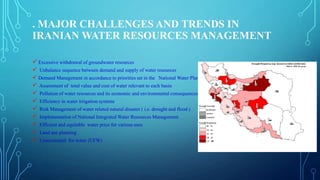
. MAJOR CHALLENGES AND TRENDS IN
IRANIAN WATER RESOURCES MANAGEMENT
 Excessive withdrawal of groundwater resources
 Unbalance sequence between demand and supply of water resources
 Demand Management in accordance to priorities set in the National Water Plan
 Assessment of total value and cost of water relevant to each basin
 Pollution of water resources and its economic and environmental consequences
 Efficiency in water irrigation systems
 Risk Management of water related natural disaster ( i.e. drought and flood )
 Implementation of National Integrated Water Resources Management
 Efficient and equitable water price for various uses
 Land use planning
 Unaccounted for water (UFW)
Iranian Solution to Water Crisis
Iranians have a long and notable history of water resources
development relying on traditional techniques. The exploitation of floods
and rainwater harvesting have been practiced through flood spreading
and groundwater recharge systems using BandSars, recharge ponds
and Ab- Anbars by ancient Iranians
Major Accomplishments
1. Construction of a 50 Km water transfer tunnel (Aqueduct) from the Karkheh River
to Chogha-Zanbil south west of Iran more than 3000 years ago;

2. Hydraulic structures - Chogha-Zanbil temple, 3000 years ago;
3. Invention and development of 80000 Qanats for groundwater extraction and
utilizationover the last 3000 years;

4. Dam construction over the last 2000 years;
5. Mizan dam in Shooshtar and bridge-dam of Shooshtar, 500 meters long with 40
bays;

6. Bahram dam on Gharah-Aghage, south of the city of Shiraz, 2000 years ago;
7. Sheikh-Bahaii water allocation scheme, 400 years ago.
8. In recent years, dams with a total capacity of around 20000 MCM have been built
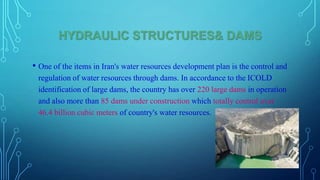
HYDRAULIC STRUCTURES& DAMS
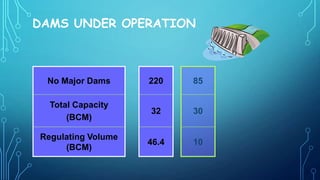
• One of the items in Iran's water resources development plan is the control and
regulation of water resources through dams. In accordance to the ICOLD
identification of large dams, the country has over 220 large dams in operation
and also more than 85 dams under construction which totally control over
46.4 billion cubic meters of country's water resources.
DAMS UNDER OPERATION

No Major Dams

220

85

Total Capacity
(BCM)

32

30

Regulating Volume
(BCM)

46.4

10
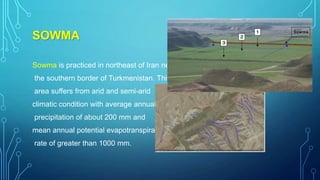
SOWMA
Sowma is practiced in northeast of Iran near
the southern border of Turkmenistan. This
area suffers from arid and semi-arid
climatic condition with average annual
precipitation of about 200 mm and
mean annual potential evapotranspiration
rate of greater than 1000 mm.
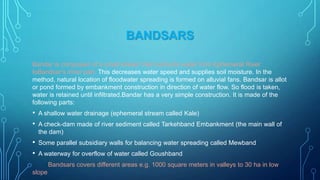
BANDSARS
Bandar is composed of a small stream that conducts water from Ephemeral River
toBandsar‟s inner part. This decreases water speed and supplies soil moisture. In the
method, natural location of floodwater spreading is formed on alluvial fans. Bandsar is allot
or pond formed by embankment construction in direction of water flow. So flood is taken,
water is retained until infiltrated.Bandar has a very simple construction. It is made of the
following parts:

•
•

A shallow water drainage (ephemeral stream called Kale)

•
•

Some parallel subsidiary walls for balancing water spreading called Mewband

A check-dam made of river sediment called Tarkehband Embankment (the main wall of
the dam)

A waterway for overflow of water called Goushband
Bandsars covers different areas e.g. 1000 square meters in valleys to 30 ha in low

slope
Thank you for your attention

Rain water harvesting ppt

  • 1.
    A STUDY ONRAINWATER HARVESTING IN IRAN
  • 2.
    Acknowledgement Through the meansof PowerPoint presentation slides, we students of Batch 2011-15, Civil Engineering Department, MANIT, have made a small effort to study the employed techniques in the field of Rainwater Harvesting in IRAN. We express gratitude towards our respective professor „Dr. Ruchi Khare‟, Civil Engg. Dept, MANIT for guiding us to complete the NAME OF STUDENT SCH.NO assignment. Mayank Mishra Thank you  111111037 Tarun Bhatia 111111038 Tarun Solanki 111111039 Palash Jain 111111040 Deepak Munda 111111041
  • 3.
    Why do weneed water harvesting? “Earth provides enough to satisfy every man's needs, but not a single man's greed.” -Mahatma Gandhi Water scarcity is the lack of sufficient available water resources to meet the demands of water usage within a region. According to United Nations Development Programme, this currently affects around 2.8 billion people around the world, on all continents, at least one month out of every year and more than 1.2 billion people lack the access to clean drinking water. Over-consumption/excessive or unnecessary use of resources, Overpopulation, Slash and burn agricultural practices in developing countries, Technological and industrial development, Erosion, Habitat degradation leads to the loss of Biodiversity (i.e. species and ecosystems with its ecosystem services), Irrigation, Mining for oil and minerals, Aquifer depletion, Pollution or contamination of resources are the major factors responsible for the eminent water crisis.
  • 5.
  • 6.
    SO WHAT ISTHE SOLUTION?......... WATER HARVESTING TECHNIQUES Water Harvesting refers to collection and storage of rainwater and also other activity such as harvesting surface water extracting ground water , prevention of loss through evaporation and seepage. Rainwater harvesting has been practiced for more than 4,000 years, it is also a good option in areas where good quality fresh surface water or ground water is lacking. In doing so, water harvesting assures a continuous and reliable access to water. The role of rainwater harvesting systems as sources of supplementary, back-up, or emergency water supply will become more important especially in view of increased climate variability and the possibility of greater frequencies of droughts and floods in many areas.
  • 7.
    MULTIPLE BENEFITS 1. Improvementin the quality of ground water 2. Rise in the water levels in wells and bore wells that are drying up 3. Mitigation of the effects of drought. 4. Attainment of drought proofing 5. An ideal solution to water problems in areas having 6. inadequate water resources 7. Reduction in the soil erosion as the surface runoff is reduced 8. Decrease in the choking of storm water drains and flooding of roads 9. Saving of energy, to lift ground water. (One-meter rise in water level saves 0.40-kilowatt hour of electricity)
  • 8.
    Techniques of WaterRecharge STORAGE OF RAINWATER ON SURFACE FOR FUTURE USE RECHARGE TO GROUND WATER
  • 9.
    Overview of IRAN Iran,also known as Persia is a democratic country in Western Asia. It is bordered on the north by Armenia, Azerbaijan and Turkmenistan ;with Kazakhstan and Russia across the Caspian Sea; on the east by Afghanistan and Pakistan; on the south by the Persian Gulf and the Gulf of Oman; on the west by Iraq; and on the northwest by Turkey. With a land area of 1,648,195 km2 (636,372 sq mi), this country in the Middle East is the 18th-largest country in the world, and with over 77 million people, is the world's 17th-most populous nation. Iran is home to one of the world's oldest civilizations.
  • 10.
    WATER RESOURCES OFIRAN Arid and semi-arid regions occupy more than 80 percent of Iran‟s land. The average annual precipitation is estimated to be 250 mm and the range varies from 50 mm in some parts of the central water basin to more than 1600 mm in some coastal areas near the Caspian Sea. Meanwhile with respect to the average annual precipitation in the world with average rainfall of more than 830 mm, Iran is classified among the semi-arid and arid countries. High density, short duration rainfall often generates destructive floods. At present in many parts of the country, the water levels have been falling rapidly. The demand for drinking water is also has been increasing manifold in the last three decades due to rapid increase in the population. THUS, Meeting the water demand is a major challenge in Iran.
  • 11.
  • 12.
    Water Resource Potentialof Iran According to studies carried out for formulation of the Iran Water Comprehensive Plan, the main characteristics of annual precipitation and its conversion to water resources are shown Annual Water Resources in Billion Cubic Meters (BCM) • Average annual precipitation 400 BCM • Renewable water resources 130 BCM • Average annual evaporation & transpiration 270 BCM • Surface currents 92 BCM • Seepage to alluvial aquifers 38 BCM
  • 13.
  • 14.
    FRESHWATER CONSUMPTION At presentIran is using 70% of the t total renewable freshwater while u due to the international norms the u upper limit should be 40% of renewable freshwater; it means that the remain unexploited renewable fresh water is only 30 % total fresh water resources including environmental basic needs. 30 70
  • 15.
    . MAJOR CHALLENGESAND TRENDS IN IRANIAN WATER RESOURCES MANAGEMENT  Excessive withdrawal of groundwater resources  Unbalance sequence between demand and supply of water resources  Demand Management in accordance to priorities set in the National Water Plan  Assessment of total value and cost of water relevant to each basin  Pollution of water resources and its economic and environmental consequences  Efficiency in water irrigation systems  Risk Management of water related natural disaster ( i.e. drought and flood )  Implementation of National Integrated Water Resources Management  Efficient and equitable water price for various uses  Land use planning  Unaccounted for water (UFW)
  • 16.
    Iranian Solution toWater Crisis Iranians have a long and notable history of water resources development relying on traditional techniques. The exploitation of floods and rainwater harvesting have been practiced through flood spreading and groundwater recharge systems using BandSars, recharge ponds and Ab- Anbars by ancient Iranians
  • 17.
    Major Accomplishments 1. Constructionof a 50 Km water transfer tunnel (Aqueduct) from the Karkheh River to Chogha-Zanbil south west of Iran more than 3000 years ago; 2. Hydraulic structures - Chogha-Zanbil temple, 3000 years ago; 3. Invention and development of 80000 Qanats for groundwater extraction and utilizationover the last 3000 years; 4. Dam construction over the last 2000 years; 5. Mizan dam in Shooshtar and bridge-dam of Shooshtar, 500 meters long with 40 bays; 6. Bahram dam on Gharah-Aghage, south of the city of Shiraz, 2000 years ago; 7. Sheikh-Bahaii water allocation scheme, 400 years ago. 8. In recent years, dams with a total capacity of around 20000 MCM have been built
  • 18.
    HYDRAULIC STRUCTURES& DAMS •One of the items in Iran's water resources development plan is the control and regulation of water resources through dams. In accordance to the ICOLD identification of large dams, the country has over 220 large dams in operation and also more than 85 dams under construction which totally control over 46.4 billion cubic meters of country's water resources.
  • 19.
    DAMS UNDER OPERATION NoMajor Dams 220 85 Total Capacity (BCM) 32 30 Regulating Volume (BCM) 46.4 10
  • 20.
    SOWMA Sowma is practicedin northeast of Iran near the southern border of Turkmenistan. This area suffers from arid and semi-arid climatic condition with average annual precipitation of about 200 mm and mean annual potential evapotranspiration rate of greater than 1000 mm.
  • 21.
    BANDSARS Bandar is composedof a small stream that conducts water from Ephemeral River toBandsar‟s inner part. This decreases water speed and supplies soil moisture. In the method, natural location of floodwater spreading is formed on alluvial fans. Bandsar is allot or pond formed by embankment construction in direction of water flow. So flood is taken, water is retained until infiltrated.Bandar has a very simple construction. It is made of the following parts: • • A shallow water drainage (ephemeral stream called Kale) • • Some parallel subsidiary walls for balancing water spreading called Mewband A check-dam made of river sediment called Tarkehband Embankment (the main wall of the dam) A waterway for overflow of water called Goushband Bandsars covers different areas e.g. 1000 square meters in valleys to 30 ha in low slope
  • 22.
    Thank you foryour attention