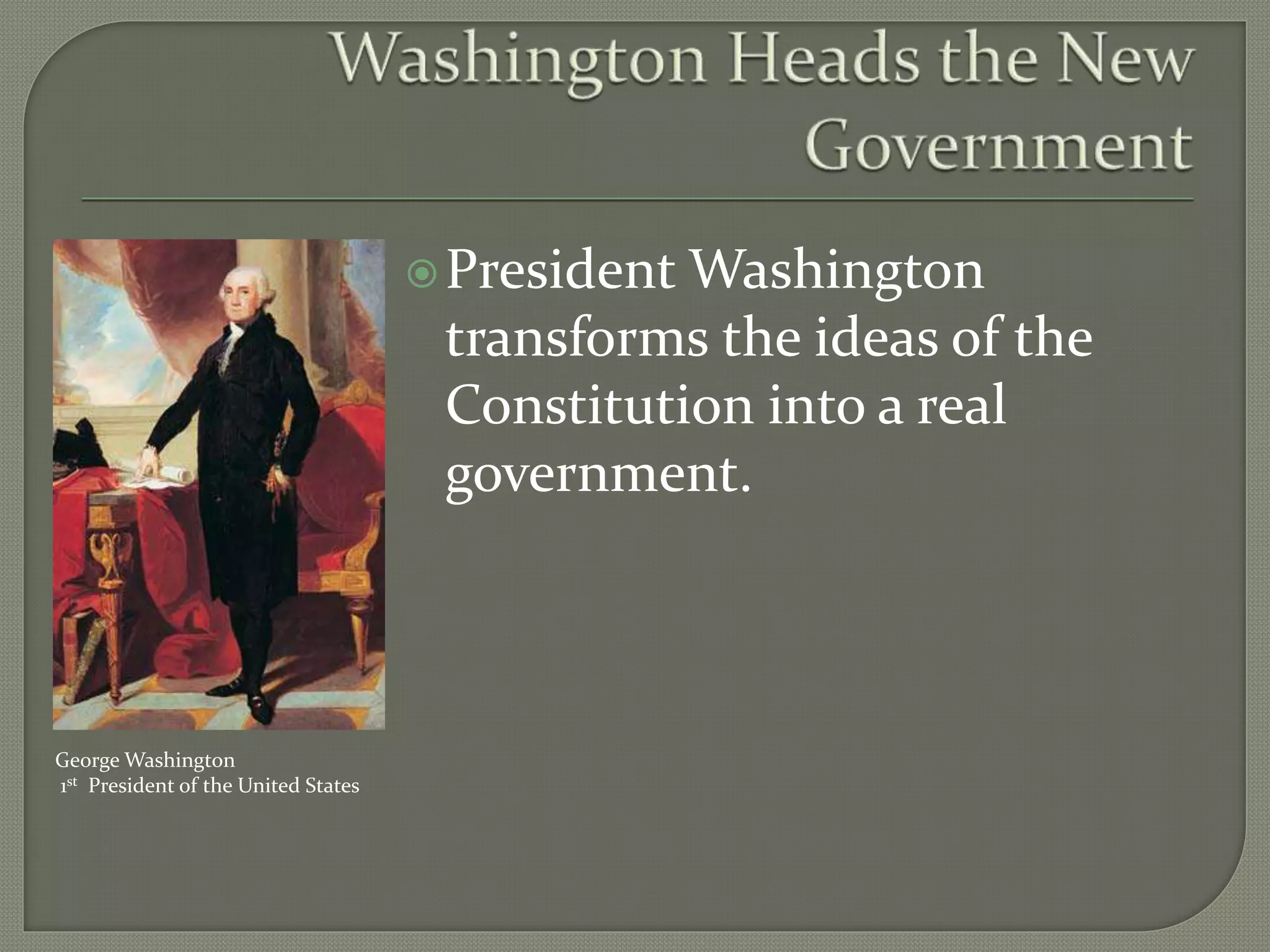
President Washington
transforms the ideas of the
Constitution into a real
government.
George Washington
1st President of the United States
 State court decisions may be appealed to federal courts
 Judiciary Act of 1789
• Creates Supreme Court
• 3 circuit courts
• 13 district courts
 Washington Shapes the Executive Branch
 Washington elected first president of U.S. in 1789
 Executive branch is president, vice president
 Congress creates State, War, Treasury
Departments
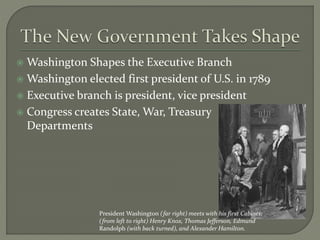
President Washington (far right) meets with his first Cabinet:
(from left to right) Henry Knox, Thomas Jefferson, Edmund
Randolph (with back turned), and Alexander Hamilton.
 Alexander Hamilton becomes Secretary of Treasury
 Washington adds Attorney General
 These Department heads are Cabinet
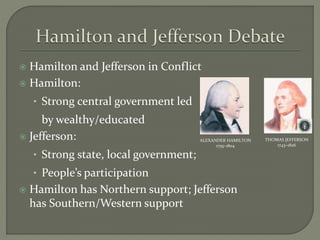
 Hamilton and Jefferson in Conflict
 Hamilton:
• Strong central government led
by wealthy/educated
 Jefferson:
• Strong state, local government;
• People’s participation
 Hamilton has Northern support; Jefferson
has Southern/Western support
ALEXANDER HAMILTON
1755–1804
THOMAS JEFFERSON
1743–1826
 Hamilton’s Economic Plan
• U.S. owes millions to foreign countries,
• Private citizens
 Plan
• Pay foreign debt with money collected from excise
taxes and protective tariffs
• Create a National Bank
• Assume states’ debt
 Some Southern states have paid debts, against taxes to
pay for North
 Plan for a National Bank
 Hamilton proposes Bank of the United States:
• Funded by government/ private investors
• Issue paper money/handle taxes
 Disagreement over Congressional authority to
establish bank
 Debate begins over strict and loose interpretation of
Constitution
 Strict interpretation (Jefferson):
If it doesn't specifically say you can then you can't.
 Loose interpretation (Hamilton):
If it doesn't specifically say you can't then you can.
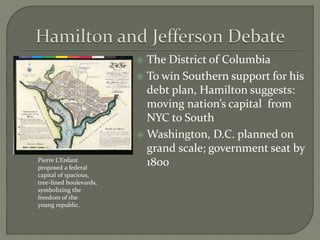
 The District of Columbia
 To win Southern support for his
debt plan, Hamilton suggests:
moving nation’s capital from
NYC to South
 Washington, D.C. planned on
grand scale; government seat by
1800Pierre L’Enfant
proposed a federal
capital of spacious,
tree-lined boulevards,
symbolizing the
freedom of the
young republic.
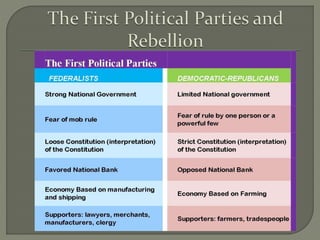
 Split in Washington’s cabinet leads to first U.S.
political parties
 Federalists and Democratic-Republicans
 Jefferson’s allies: Democratic-Republicans
 Hamilton’s allies: Federalists
 Two-party system established as two major parties
compete for power
 Protective tariff
• Import tax on goods produced overseas
 Excise tax
• Charged on product’s manufacture, sale, or
distribution
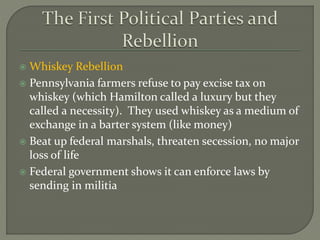
 Whiskey Rebellion
 Pennsylvania farmers refuse to pay excise tax on
whiskey (which Hamilton called a luxury but they
called a necessity). They used whiskey as a medium of
exchange in a barter system (like money)
 Beat up federal marshals, threaten secession, no major
loss of life
 Federal government shows it can enforce laws by
sending in militia
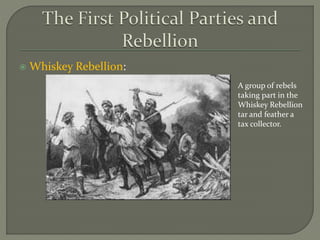
 Whiskey Rebellion:
A group of rebels
taking part in the
Whiskey Rebellion
tar and feather a
tax collector.
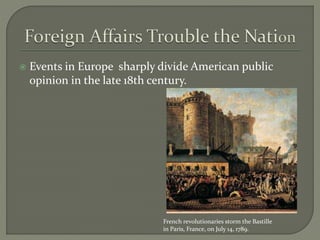
 Events in Europe sharply divide American public
opinion in the late 18th century.
French revolutionaries storm the Bastille
in Paris, France, on July 14, 1789.
 Reactions to the French Revolution
• Federalists pro-British
• Democratic-Republicans pro-French
 Washington declares neutrality, will not support either
side
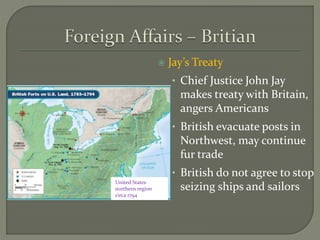
 Jay’s Treaty
• Chief Justice John Jay
makes treaty with Britain,
angers Americans
• British evacuate posts in
Northwest, may continue
fur trade
• British do not agree to stop
seizing ships and sailors
United States
northern region
circa 1794
 Treaty with Spain
 Pinckney’s Treaty of 1795, or Treaty of San Lorenzo,
signed.
 Spain gives up claims to western U.S.
 Florida-U.S. boundary set at 31st parallel
 Mississippi River open to U.S. traffic
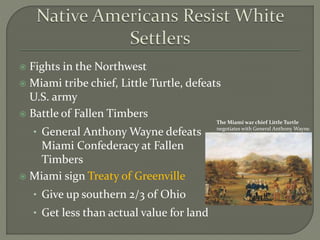
 Fights in the Northwest
 Miami tribe chief, Little Turtle, defeats
U.S. army
 Battle of Fallen Timbers
• General Anthony Wayne defeats
Miami Confederacy at Fallen
Timbers
 Miami sign Treaty of Greenville
• Give up southern 2/3 of Ohio
• Get less than actual value for land
The Miami war chief Little Turtle
negotiates with General Anthony Wayne.
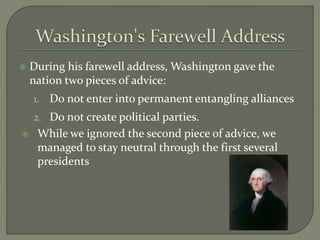
 During his farewell address, Washington gave the
nation two pieces of advice:
1. Do not enter into permanent entangling alliances
2. Do not create political parties.
 While we ignored the second piece of advice, we
managed to stay neutral through the first several
presidents

Washington's Presidency

  • 1.
    President Washington transforms theideas of the Constitution into a real government. George Washington 1st President of the United States
  • 2.
     State courtdecisions may be appealed to federal courts  Judiciary Act of 1789 • Creates Supreme Court • 3 circuit courts • 13 district courts
  • 3.
     Washington Shapesthe Executive Branch  Washington elected first president of U.S. in 1789  Executive branch is president, vice president  Congress creates State, War, Treasury Departments President Washington (far right) meets with his first Cabinet: (from left to right) Henry Knox, Thomas Jefferson, Edmund Randolph (with back turned), and Alexander Hamilton.
  • 4.
     Alexander Hamiltonbecomes Secretary of Treasury  Washington adds Attorney General  These Department heads are Cabinet
  • 5.
     Hamilton andJefferson in Conflict  Hamilton: • Strong central government led by wealthy/educated  Jefferson: • Strong state, local government; • People’s participation  Hamilton has Northern support; Jefferson has Southern/Western support ALEXANDER HAMILTON 1755–1804 THOMAS JEFFERSON 1743–1826
  • 6.
     Hamilton’s EconomicPlan • U.S. owes millions to foreign countries, • Private citizens  Plan • Pay foreign debt with money collected from excise taxes and protective tariffs • Create a National Bank • Assume states’ debt  Some Southern states have paid debts, against taxes to pay for North
  • 7.
     Plan fora National Bank  Hamilton proposes Bank of the United States: • Funded by government/ private investors • Issue paper money/handle taxes
  • 8.
     Disagreement overCongressional authority to establish bank  Debate begins over strict and loose interpretation of Constitution  Strict interpretation (Jefferson): If it doesn't specifically say you can then you can't.  Loose interpretation (Hamilton): If it doesn't specifically say you can't then you can.
  • 9.
     The Districtof Columbia  To win Southern support for his debt plan, Hamilton suggests: moving nation’s capital from NYC to South  Washington, D.C. planned on grand scale; government seat by 1800Pierre L’Enfant proposed a federal capital of spacious, tree-lined boulevards, symbolizing the freedom of the young republic.
  • 10.
     Split inWashington’s cabinet leads to first U.S. political parties  Federalists and Democratic-Republicans  Jefferson’s allies: Democratic-Republicans  Hamilton’s allies: Federalists  Two-party system established as two major parties compete for power
  • 12.
     Protective tariff •Import tax on goods produced overseas  Excise tax • Charged on product’s manufacture, sale, or distribution
  • 13.
     Whiskey Rebellion Pennsylvania farmers refuse to pay excise tax on whiskey (which Hamilton called a luxury but they called a necessity). They used whiskey as a medium of exchange in a barter system (like money)  Beat up federal marshals, threaten secession, no major loss of life  Federal government shows it can enforce laws by sending in militia
  • 14.
     Whiskey Rebellion: Agroup of rebels taking part in the Whiskey Rebellion tar and feather a tax collector.
  • 15.
     Events inEurope sharply divide American public opinion in the late 18th century. French revolutionaries storm the Bastille in Paris, France, on July 14, 1789.
  • 16.
     Reactions tothe French Revolution • Federalists pro-British • Democratic-Republicans pro-French  Washington declares neutrality, will not support either side
  • 17.
     Jay’s Treaty •Chief Justice John Jay makes treaty with Britain, angers Americans • British evacuate posts in Northwest, may continue fur trade • British do not agree to stop seizing ships and sailors United States northern region circa 1794
  • 18.
     Treaty withSpain  Pinckney’s Treaty of 1795, or Treaty of San Lorenzo, signed.  Spain gives up claims to western U.S.  Florida-U.S. boundary set at 31st parallel  Mississippi River open to U.S. traffic
  • 19.
     Fights inthe Northwest  Miami tribe chief, Little Turtle, defeats U.S. army  Battle of Fallen Timbers • General Anthony Wayne defeats Miami Confederacy at Fallen Timbers  Miami sign Treaty of Greenville • Give up southern 2/3 of Ohio • Get less than actual value for land The Miami war chief Little Turtle negotiates with General Anthony Wayne.
  • 20.
     During hisfarewell address, Washington gave the nation two pieces of advice: 1. Do not enter into permanent entangling alliances 2. Do not create political parties.  While we ignored the second piece of advice, we managed to stay neutral through the first several presidents