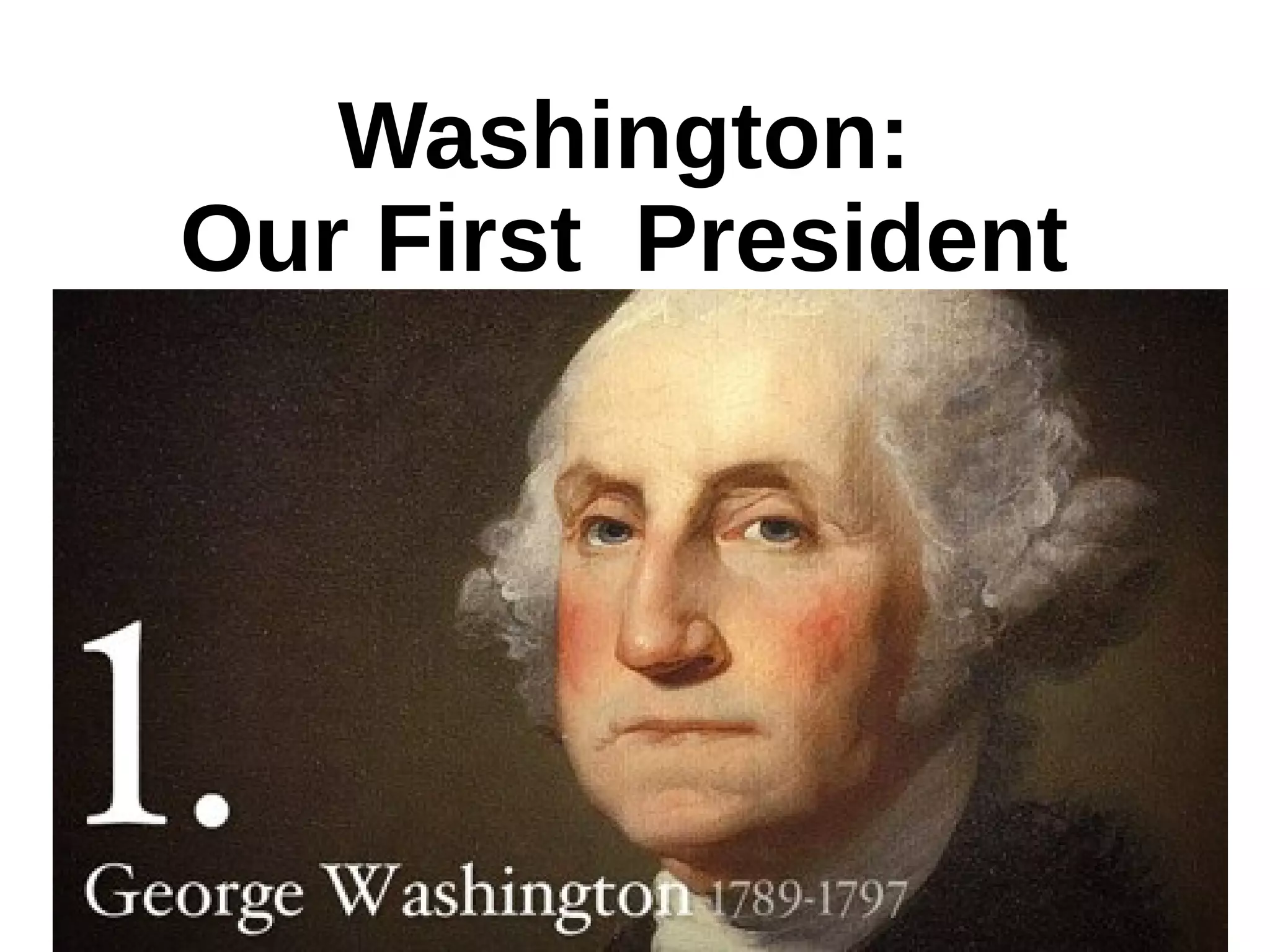
Washington:
Our First President
Objectives:Objectives:
1) Analyze how the U.S. confronted the
difficult task of forming a new government
2) List and Explain how the political ideas of
Hamilton and Jefferson differed
3) Describe how Washington’s leadership
brought legitimacy to the presidency
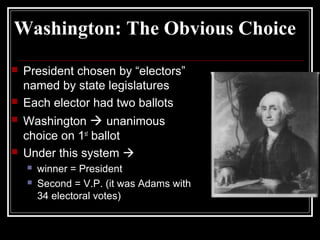
Washington: The Obvious Choice
 President chosen by “electors”
named by state legislatures
 Each elector had two ballots
 Washington  unanimous
choice on 1st
ballot
 Under this system 
 winner = President
 Second = V.P. (it was Adams with
34 electoral votes)
Washington’s challengesWashington’s challenges
► Everything Washington did was a “first”Everything Washington did was a “first”
► ““We are in a wilderness without a singleWe are in a wilderness without a single
footstep to guide us.”footstep to guide us.” – Washington– Washington
► U.S. at the time easy preyU.S. at the time easy prey
 U.S. armyU.S. army  less than 700 officers andless than 700 officers and
soldiers; no navysoldiers; no navy
Washington Needs HelpWashington Needs Help
1.1. Washington creates ExecutiveWashington creates Executive
positionspositions
 Becomes first “Cabinet”Becomes first “Cabinet”
1.1. Washington brings clarity to theWashington brings clarity to the
Judicial BranchJudicial Branch
 Judiciary Act of 1789Judiciary Act of 1789
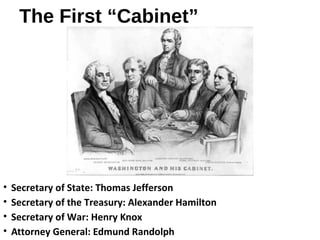
The First “Cabinet”
• Secretary of State: Thomas Jefferson
• Secretary of the Treasury: Alexander Hamilton
• Secretary of War: Henry Knox
• Attorney General: Edmund Randolph
Judiciary Act of 1789
• Provided more details about Judicial Branch
• 6 Supreme Court justices (John Jay is first Chief Justice) (#s
went up over time)
• Other lower federal courts
• Affirmed “supremacy clause” of Constitution (Article 6,
Section 2):
• states could appeal to a federal court if constitutional issues were
raised
Check for understanding
•How did Washington confront the difficult
task of running a new government?
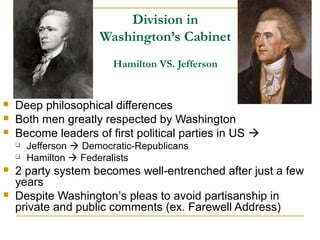
Division in
Washington’s Cabinet
Hamilton VS. Jefferson
 Deep philosophical differences
 Both men greatly respected by Washington
 Become leaders of first political parties in US 
 Jefferson  Democratic-Republicans
 Hamilton  Federalists
 2 party system becomes well-entrenched after just a few
years
 Despite Washington’s pleas to avoid partisanship in
private and public comments (ex. Farewell Address)
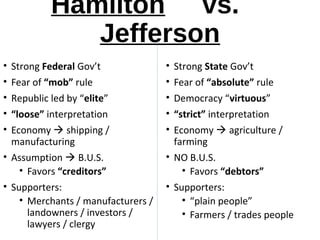
Hamilton vs.
Jefferson
• Strong Federal Gov’t
• Fear of “mob” rule
• Republic led by “elite”
• “loose” interpretation
• Economy  shipping /
manufacturing
• Assumption  B.U.S.
• Favors “creditors”
• Supporters:
• Merchants / manufacturers /
landowners / investors /
lawyers / clergy
• Strong State Gov’t
• Fear of “absolute” rule
• Democracy “virtuous”
• “strict” interpretation
• Economy  agriculture /
farming
• NO B.U.S.
• Favors “debtors”
• Supporters:
• “plain people”
• Farmers / trades people
Check for understanding
• Give at least 3 examples of how Hamilton and
Jefferson differed.
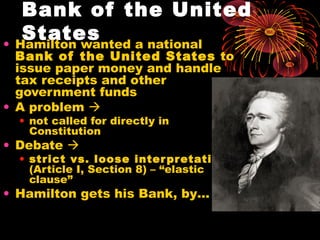
Bank of the United
States• Hamilton wanted a national
Bank of the United States to
issue paper money and handle
tax receipts and other
government funds
• A problem 
• not called for directly in
Constitution
• Debate 
• strict vs. loose interpretation
(Article I, Section 8) – “elastic
clause”
• Hamilton gets his Bank, by…
Our Nation’s Capital
• Philadelphia
• In 1789, it’s New York City (then back to Philly)
• Plans made to create a new city
• Centrally located to appeal to Northerners and Southerners:
the District of Columbia
• Built on a swamp along Potomac River between Maryland
and Virginia
• Pierre L’Enfant and Benjamin Banneker (African American)
 engineers (designers)
• Becomes nation’s capital in 1800 (Adams the first president
to live in White House – the “President’s House”)
• To this day, unique relationship to U.S.; not a state
Washington faces Obstacles
at Home & Abroad
1.French Revolution
2.Jays Treaty
3.Pinckney’s Treaty
4.Whiskey Rebellion
5.Natives
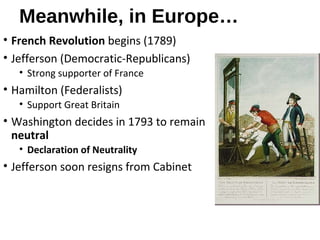
Meanwhile, in Europe…
• French Revolution begins (1789)
• Jefferson (Democratic-Republicans)
• Strong supporter of France
• Hamilton (Federalists)
• Support Great Britain
• Washington decides in 1793 to remain
neutral
• Declaration of Neutrality
• Jefferson soon resigns from Cabinet
Jay’s Treaty
The Jay TreatyThe Jay Treaty (1794)(1794)
Between U.S. and Great Britain afterBetween U.S. and Great Britain after
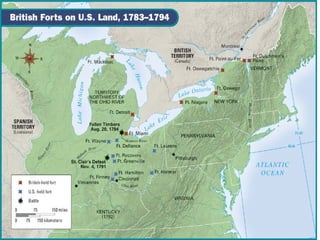
Battle of Fallen Timbers;Battle of Fallen Timbers;
many Americans angry with detailsmany Americans angry with details 
no assurance that Americansno assurance that Americans
could not be “pressed” into servicecould not be “pressed” into service
in British navyin British navy
British allowed to continue furBritish allowed to continue fur
trade along Canadian bordertrade along Canadian border
BUT Britain did agree to leaveBUT Britain did agree to leave
Northwest territory andNorthwest territory and war hadwar had
been avertedbeen averted
Pinckney’s Treaty
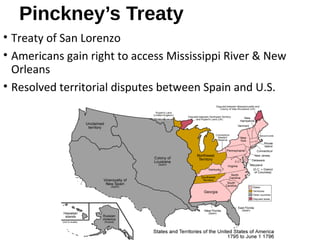
• Treaty of San Lorenzo
• Americans gain right to access Mississippi River & New
Orleans
• Resolved territorial disputes between Spain and U.S.
http://education-
portal.com/academy/lesson
/the-french-revolution-jay-
treaty-and-treaty-of-san-
lorenzo.html#lesson
The Whiskey Rebellion
• The federal government needed
money
• The 1st
federal tax on Americans 
excise tax on distilleries (alcohol
producers)
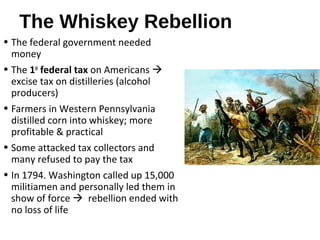
• Farmers in Western Pennsylvania
distilled corn into whiskey; more
profitable & practical
• Some attacked tax collectors and
many refused to pay the tax
• In 1794. Washington called up 15,000
militiamen and personally led them in
show of force  rebellion ended with
no loss of life
War with Native Americans, Britain?
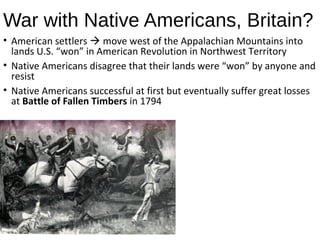
• American settlers  move west of the Appalachian Mountains into
lands U.S. “won” in American Revolution in Northwest Territory
• Native Americans disagree that their lands were “won” by anyone and
resist
• Native Americans successful at first but eventually suffer great losses
at Battle of Fallen Timbers in 1794
http://education-
portal.com/academy/lesson/the
-whiskey-rebellion-and-battle-
of-fallen-timbers.html#lesson
Check for understanding
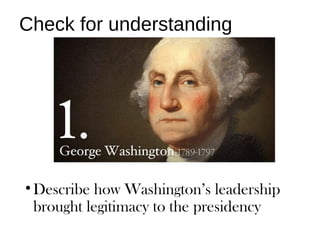
•Describe how Washington’s leadership
brought legitimacy to the presidency
Goodbye George 
• Washington Farewell Address 1796
• "The unity of government...is a main pillar in the edifice of your real
independence...of your tranquility at home, your peace abroad; of your safety;
of your prosperity; of that very liberty which you so highly prize."
• "It serves to distract the Public Councils, and enfeeble the Public
Administration....agitates the Community with ill-founded jealousies and false
alarms; kindles the animosity of one....against another....it opens the door to
foreign influence and corruption...”
• "Where is the security for property, for reputation, for life, if the sense of
religious obligation desert the oaths, which are the instruments of investigation
in Courts of Justice?"
• "It is our true policy to steer clear of permanent alliances with any portion of
the foreign world..."
• "...avoid the necessity of those overgrown military establishments, which,
under any form of government, are inauspicious to liberty, and which are to be
regarded as particularly hostile to Republican Liberty.“
• ".......the name of American, which belongs to you, in your national capacity,
must always exalt the just pride of Patriotism..."

Washington pp

  • 1.
  • 2.
    Objectives:Objectives: 1) Analyze howthe U.S. confronted the difficult task of forming a new government 2) List and Explain how the political ideas of Hamilton and Jefferson differed 3) Describe how Washington’s leadership brought legitimacy to the presidency
  • 3.
    Washington: The ObviousChoice  President chosen by “electors” named by state legislatures  Each elector had two ballots  Washington  unanimous choice on 1st ballot  Under this system   winner = President  Second = V.P. (it was Adams with 34 electoral votes)
  • 4.
    Washington’s challengesWashington’s challenges ►Everything Washington did was a “first”Everything Washington did was a “first” ► ““We are in a wilderness without a singleWe are in a wilderness without a single footstep to guide us.”footstep to guide us.” – Washington– Washington ► U.S. at the time easy preyU.S. at the time easy prey  U.S. armyU.S. army  less than 700 officers andless than 700 officers and soldiers; no navysoldiers; no navy
  • 5.
    Washington Needs HelpWashingtonNeeds Help 1.1. Washington creates ExecutiveWashington creates Executive positionspositions  Becomes first “Cabinet”Becomes first “Cabinet” 1.1. Washington brings clarity to theWashington brings clarity to the Judicial BranchJudicial Branch  Judiciary Act of 1789Judiciary Act of 1789
  • 6.
    The First “Cabinet” •Secretary of State: Thomas Jefferson • Secretary of the Treasury: Alexander Hamilton • Secretary of War: Henry Knox • Attorney General: Edmund Randolph
  • 7.
    Judiciary Act of1789 • Provided more details about Judicial Branch • 6 Supreme Court justices (John Jay is first Chief Justice) (#s went up over time) • Other lower federal courts • Affirmed “supremacy clause” of Constitution (Article 6, Section 2): • states could appeal to a federal court if constitutional issues were raised
  • 8.
    Check for understanding •Howdid Washington confront the difficult task of running a new government?
  • 9.
    Division in Washington’s Cabinet HamiltonVS. Jefferson  Deep philosophical differences  Both men greatly respected by Washington  Become leaders of first political parties in US   Jefferson  Democratic-Republicans  Hamilton  Federalists  2 party system becomes well-entrenched after just a few years  Despite Washington’s pleas to avoid partisanship in private and public comments (ex. Farewell Address)
  • 10.
    Hamilton vs. Jefferson • StrongFederal Gov’t • Fear of “mob” rule • Republic led by “elite” • “loose” interpretation • Economy  shipping / manufacturing • Assumption  B.U.S. • Favors “creditors” • Supporters: • Merchants / manufacturers / landowners / investors / lawyers / clergy • Strong State Gov’t • Fear of “absolute” rule • Democracy “virtuous” • “strict” interpretation • Economy  agriculture / farming • NO B.U.S. • Favors “debtors” • Supporters: • “plain people” • Farmers / trades people
  • 11.
    Check for understanding •Give at least 3 examples of how Hamilton and Jefferson differed.
  • 12.
    Bank of theUnited States• Hamilton wanted a national Bank of the United States to issue paper money and handle tax receipts and other government funds • A problem  • not called for directly in Constitution • Debate  • strict vs. loose interpretation (Article I, Section 8) – “elastic clause” • Hamilton gets his Bank, by…
  • 13.
    Our Nation’s Capital •Philadelphia • In 1789, it’s New York City (then back to Philly) • Plans made to create a new city • Centrally located to appeal to Northerners and Southerners: the District of Columbia • Built on a swamp along Potomac River between Maryland and Virginia • Pierre L’Enfant and Benjamin Banneker (African American)  engineers (designers) • Becomes nation’s capital in 1800 (Adams the first president to live in White House – the “President’s House”) • To this day, unique relationship to U.S.; not a state
  • 14.
    Washington faces Obstacles atHome & Abroad 1.French Revolution 2.Jays Treaty 3.Pinckney’s Treaty 4.Whiskey Rebellion 5.Natives
  • 15.
    Meanwhile, in Europe… •French Revolution begins (1789) • Jefferson (Democratic-Republicans) • Strong supporter of France • Hamilton (Federalists) • Support Great Britain • Washington decides in 1793 to remain neutral • Declaration of Neutrality • Jefferson soon resigns from Cabinet
  • 16.
    Jay’s Treaty The JayTreatyThe Jay Treaty (1794)(1794) Between U.S. and Great Britain afterBetween U.S. and Great Britain after Battle of Fallen Timbers;Battle of Fallen Timbers; many Americans angry with detailsmany Americans angry with details  no assurance that Americansno assurance that Americans could not be “pressed” into servicecould not be “pressed” into service in British navyin British navy British allowed to continue furBritish allowed to continue fur trade along Canadian bordertrade along Canadian border BUT Britain did agree to leaveBUT Britain did agree to leave Northwest territory andNorthwest territory and war hadwar had been avertedbeen averted
  • 17.
    Pinckney’s Treaty • Treatyof San Lorenzo • Americans gain right to access Mississippi River & New Orleans • Resolved territorial disputes between Spain and U.S. http://education- portal.com/academy/lesson /the-french-revolution-jay- treaty-and-treaty-of-san- lorenzo.html#lesson
  • 18.
    The Whiskey Rebellion •The federal government needed money • The 1st federal tax on Americans  excise tax on distilleries (alcohol producers) • Farmers in Western Pennsylvania distilled corn into whiskey; more profitable & practical • Some attacked tax collectors and many refused to pay the tax • In 1794. Washington called up 15,000 militiamen and personally led them in show of force  rebellion ended with no loss of life
  • 19.
    War with NativeAmericans, Britain? • American settlers  move west of the Appalachian Mountains into lands U.S. “won” in American Revolution in Northwest Territory • Native Americans disagree that their lands were “won” by anyone and resist • Native Americans successful at first but eventually suffer great losses at Battle of Fallen Timbers in 1794 http://education- portal.com/academy/lesson/the -whiskey-rebellion-and-battle- of-fallen-timbers.html#lesson
  • 20.
    Check for understanding •Describehow Washington’s leadership brought legitimacy to the presidency
  • 21.
    Goodbye George  •Washington Farewell Address 1796 • "The unity of government...is a main pillar in the edifice of your real independence...of your tranquility at home, your peace abroad; of your safety; of your prosperity; of that very liberty which you so highly prize." • "It serves to distract the Public Councils, and enfeeble the Public Administration....agitates the Community with ill-founded jealousies and false alarms; kindles the animosity of one....against another....it opens the door to foreign influence and corruption...” • "Where is the security for property, for reputation, for life, if the sense of religious obligation desert the oaths, which are the instruments of investigation in Courts of Justice?" • "It is our true policy to steer clear of permanent alliances with any portion of the foreign world..." • "...avoid the necessity of those overgrown military establishments, which, under any form of government, are inauspicious to liberty, and which are to be regarded as particularly hostile to Republican Liberty.“ • ".......the name of American, which belongs to you, in your national capacity, must always exalt the just pride of Patriotism..."