Turn and Talk
What qualities does a good leader
need to possess?
Be able explain at least 3 qualities a leader must
possess.
LAUNCHING A NEW
REPUBLIC

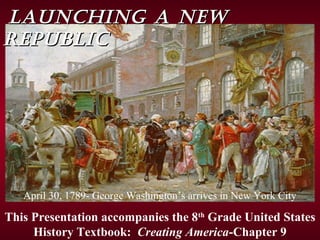
April 30, 1789- George Washington’s arrives in New York City

This Presentation accompanies the 8th Grade United States
History Textbook: Creating America-Chapter 9
Washington’s Inauguration
•George Washington knew that he
would be setting the example for
all President’s after him.
•Crowds lined the street on April
30, 1789. Washington made his
way to his inauguration ceremony
in New York at Federal Hall.
When finished, the crowd yelled
“God bless our President”.
•Washington defined the the role
of the office of the President.
Presidents today still follow many
examples he sat down.

Washington Meets with Foreign
Visitors to America

Click on the Federal Hall Memorial
as it looks today to view a 13 minute
presentation on George Washington
as President of the U.S.
DUTIES OF FIRST PRESIDENT
• The first duty of Washington was
to “fill in the blanks” of the
constitution.
• The constitution does not focus on
all of the details of the
government.
• The first focus was put on the
Supreme Court. Congress passed
the Judiciary Act of 1789 which
declared that the Supreme Court
would consist of 5 justices and a
chief justice.
• This law also set up several other
federal courts.

John Jay
First Chief Justice of
the Supreme Court
PRESIDENTIAL
CABINET

•Congress created three
departments to help the
President. The head of each of
those departments, plus the
attorney general made up
Washington’s Cabinet.
Dept. of State: Thomas Jefferson
Attorney Gen: Edmund Randolph
Dept-Treasury: Alexander Hamilton
Department of War: Henry Knox
(Clockwise from top left)
Washington’s Cabinet
• Attorney General (Edmond Randolph) to advise
the government on legal matters.
• Secretary of the Treasury (Alexander Hamilton) to
manage the government’s money.
• Secretary of State (Thomas Jefferson) oversee the
relations between the U.S. and other countries.
• Secretary of War (Henry Knox) oversee the
nation’s defenses.
•The Constitution does not mention
the President’s cabinet, but
Washington gathered these men to
help advise him, just as Presidents do
today.
•The presidential Cabinet has grown
from 4 to 15 today. The newest
cabinet position was the Homeland
Security Department.
•Each president chooses how much to
use the cabinet. Andrew Jackson
called together his cabinet only 16
times in 8 years. However, Presidents
today meet usually every week.

Abraham Lincoln and his
Cabinet during the Civil War

George W. Bush meets with
Advisors in September 12, 2001
The U.S. government and many states still owed a lot of
money from the Revolutionary War.

HAMILTON GOES TO WORK
•George Washington turned to his new Secretary
of the Treasury, Alexander Hamilton, to deal with
the nearly $52 Million in debt.
•Hamilton developed a 3 step plan to improve the
new country’s finances:
1. Pay off the debt
2. Raise government revenue
3. Creating a national bank
HAMILTON’S ECONOMIC SYSTEM
• Hamilton’s philosophies on economics were
developed from the teachings of Adam Smith in his
book, “The Wealth of Nations”.
• Smith’s writings about the Free Enterprise System
were based on the idea that people are free to buy
and sell as the market drives the need. In other
words, the government does not interfere with it’s
people’s right to buy and sell unless public safety is
threatened or Capitalism is threatened.
• After rebelling against the British Mercantilism, the
new United States was naturally set up for free
enterprise.
PROTECTIVE TARIFFS
•A tariff is a tax on an imported good.
•Another part of Hamilton’s plan depended upon
the use of protective tariffs.
•These taxes on imported goods from other
countries raised money for the government and
encouraged citizens to buy American made goods.
On Your Own
Read page 279 -281 ‘Hamilton’s Financial Plan’
Why did Hamilton favor imposing high tariffs on
foreign goods and creating a national bank?
HAMILTON’S PLAN & JEFFERSON’S RESPONSE

• Hamilton believed that all of the new country’s debt should
be paid off. He attempted to combine the state and
federal debt into one bond to be paid off all at once.
• Hamilton knew that this plan would only pass with
southern support, which was unlikely because much of the
south had already paid off its debt. Hamilton turned to a
political enemy, Thomas Jefferson. Jefferson was leading
Democratic-Republican in the government.
• Jefferson (and the south) eventually supported Hamilton’s
plan because Hamilton promised to support the move of
the capital out of New York and into the south. (Wash.
D.C.).
ALEXANDER
HAMILTON

• Washington appointed Alexander
Hamilton as the first Secretary of
the Treasury, and his influence
on the United States economic
system can still be seen today.
• Hamilton’s philosophy was based
on the idea that American
success depended upon
businesses. Therefore he often
favored businesses over farmers
or artisans
• Hamilton subscribed to a “loose
constructionist” view of the
constitution, and he felt that the
Federal Government should be
much stronger than the states.
• Thomas Jefferson was the first
Secretary of the Department of
the State. Like George
Washington, he was a Virginian
and well liked by many in
Congress.
• Jefferson was well schooled in
agriculture He felt that the future
of the United States was in its
agricultural base.
• Unlike Hamilton he subscribed to
a “Strict Constructionist” view of
the Constitution, and he felt the
states should maintain as much
power as possible over any federal
government.

THOMAS
JEFFERSON
Interpreting the Constitution
• STRICT CONSTRUCTION: only what the
Constitution clearly states – favored by
Jefferson and Madison.
• LOOSE CONSTRUCTION: the Constitution
should be flexible to meet the needs of the
country (Elastic Clause) – favored by Hamilton
and Adams.
Jefferson and Hamilton argued these points
on the creation of the National Bank.
NATIONAL •During Washington’s Presidency, a
split between those in the government
BANK DEBATE

slowly developed based on beliefs about
the power of the Federal government.
•Alexander Hamilton’s attempts to
develop a National Bank were argued
against by Strict Constructionist such as
Thomas Jefferson and James Madison.
They believed the Constitution did not
allow for the creation of such a bank
and the Federal government did not
have power to create the bank.
•George Washington agreed with
Hamilton and the National Bank was set
up in 1791.
• The British had never truly removed
their forts from the Ohio valley
after the Revolution.
• Jay’s Treaty attempted to create a
new treaty with Britain. After the
American victory over a large Indian
force at Fallen Timbers, the British
agreed to leave the Ohio Valley and
allow Americans to trade in the
West Indies.
• The U.S. also organized a treaty
with Spain. Pinkney’s Treaty
guaranteed the U.S. the right to
have boats on the Mississippi river
and Spain agreed to American
borders.

NATIONAL
SECURITY

“Mad”Anthony Wayne
Leader of the victorious
American forces at the
Battle of Fallen Timbers
WHISKEY
REBELLION

• In 1793, Alexander Hamilton had proposed a tax on
Whiskey sold and made in the U.S.
• Farmers in Western Pennsylvania began to attack tax
collectors and revolt against local authority.
***There was never actually a fight, the rebels ran back
home and gave up before the troops arrived,
but these federal Troops proved that the federal
government had the power and will to enforce its laws.
• Many Americans were in favor of
allying with a European power.
They felt it would be in America’s
best interest to be associated with
a strong power from Europe.
• George Washington was in favor of
maintaining neutrality, however,
when the French Revolution
began, American neutrality was
put to the test.
• Many well know Americans had
spent time in France such as
Thomas Jefferson and Ben
Franklin. None the less, America
was able to stay committed to
neutrality for the next 150 years.

Foreign Policy
and the French
Revolution

An executioner, during
the French Revolution
WASHINGTON SAYS GOODBYE
•George Washington choose not to
serve as President for a 3rd term.
He believed that it was appropriate
for a President to serve no more
than 8 years. As Washington was
leaving office, he gave a speech
that has come to be called,
“Washington’s Farewell Address”.
In the Address, Washington ask 3 things of the county:
1. Try to avoid political party politics.
2. Avoid influences of foreign governments
3. Avoid any permanent alliances with other countries.
WASHINGTON’S RETIREMENT
•Washington Retired to his
home at Mt. Vernon, Virginia,
with his wife Martha and the
rest of his family. He died in
1798.

Want to see what Washington really
looked like? Click Mt. Vernon.

•Washington had set
examples (or precedents) for
American Presidents that
came after him. His ideas
such as America remaining
neutral, using a cabinet, and
serving only two terms lasted
well over 100 years.
BIRTH OF POLITICAL PARTIES
•Even as Washington argued against political parties, they
continued to grow in strength during and after his
Presidency. Leaders emerged for each and those in the
government take sides based on their political beliefs.
Leaders of the Federalist

HAMILTON

ADAMS

Leaders of the Dem. Republicans

MADISON

JEFFERSON

**Political parties, in America, were born out of
disagreements about the power of the Federal government
and disagreements over foreign policy.
Political “Platform” of the First Political Parties

•
•
•

•

Federalist Party
Leaders: John Adams and
Alexander Hamilton
Typical Followers: Business
owners from the Northeast
Philosophy: Strong central
government benefits the
economy / The federal
government should maintain
most of the power.
Constitutional View: Loose
Constructionist

Democratic Republican Party
• Leaders: Thomas Jefferson and
James Madison
• Typical Followers: Farmers and
Artisans
• Philosophy: Low Taxes and
Small Government / The states
should control the majority of
government.
• Constitutional View: Strict
Constructionist
John Adams

• John Adams, Vice President under
Washington was victorious in the
election of 1796. Thomas
Jefferson, who had the second
most votes, became the Vice
President
• John Adams was the first President
to live in the White House. He also
had to avert a full scale war with
France.
• Adams would only be president 1
term before he would be defeated
by his own Vice-President, Thomas
Jefferson, in 1800.
XYZ AFFAIR

• President John Adams sent peace envoys to France to deal
with some diplomatic problems. After weeks, 3 men (later
called X, Y, and Z) ask for a bribe and for the US to “loan”
France $10 million.
• When Adams, Congress and the American people found out,
they were furious. Congress cancelled its Treaties with
France and prepared for war. America and France began
fighting an “Undeclared War” on the ocean. The U.S. was
very successful, and by 1800, Napoleon Bonaparte had
taken control of France. He wanted peace with the US.
• The Agreement of 1800, secured peace for the US and
France to travel on the oceans.
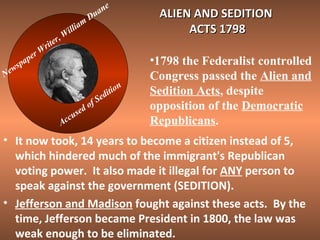
N

spa
ew

r
pe

W

r
ite
r

m
lia
l
Wi
,

n
ua
D

o
ed
s
ccu
A

f

e

n
tio
i
ed
S

ALIEN AND SEDITION
ACTS 1798
•1798 the Federalist controlled
Congress passed the Alien and
Sedition Acts, despite
opposition of the Democratic
Republicans.

• It now took, 14 years to become a citizen instead of 5,
which hindered much of the immigrant's Republican
voting power. It also made it illegal for ANY person to
speak against the government (SEDITION).
• Jefferson and Madison fought against these acts. By the
time, Jefferson became President in 1800, the law was
weak enough to be eliminated.
Peace with France
•The two political parties were arguing and “fighting”
for power at home. Adams attempted to make peace
with France, even though it made him many enemies
in both parties.
•France and the U.S. signed the Agreement of 1800
which led to peace on the oceans. Adams felt that
avoiding this war was his most important act as
President.
Election of
1800

•In election of 1800, old
friends, Jefferson and
Adams, insulted and
criticized each other
the likes of which the
country had never seen.
•Jefferson was
eventually the winner
of the election, but it
was so close that bitter
and often insulting
campaigns became a
part of American
politics that still remain

Ch 9 Notes

  • 1.
    Turn and Talk Whatqualities does a good leader need to possess? Be able explain at least 3 qualities a leader must possess.
  • 2.
    LAUNCHING A NEW REPUBLIC April30, 1789- George Washington’s arrives in New York City This Presentation accompanies the 8th Grade United States History Textbook: Creating America-Chapter 9
  • 3.
    Washington’s Inauguration •George Washingtonknew that he would be setting the example for all President’s after him. •Crowds lined the street on April 30, 1789. Washington made his way to his inauguration ceremony in New York at Federal Hall. When finished, the crowd yelled “God bless our President”. •Washington defined the the role of the office of the President. Presidents today still follow many examples he sat down. Washington Meets with Foreign Visitors to America Click on the Federal Hall Memorial as it looks today to view a 13 minute presentation on George Washington as President of the U.S.
  • 4.
    DUTIES OF FIRSTPRESIDENT • The first duty of Washington was to “fill in the blanks” of the constitution. • The constitution does not focus on all of the details of the government. • The first focus was put on the Supreme Court. Congress passed the Judiciary Act of 1789 which declared that the Supreme Court would consist of 5 justices and a chief justice. • This law also set up several other federal courts. John Jay First Chief Justice of the Supreme Court
  • 7.
    PRESIDENTIAL CABINET •Congress created three departmentsto help the President. The head of each of those departments, plus the attorney general made up Washington’s Cabinet. Dept. of State: Thomas Jefferson Attorney Gen: Edmund Randolph Dept-Treasury: Alexander Hamilton Department of War: Henry Knox (Clockwise from top left)
  • 8.
    Washington’s Cabinet • AttorneyGeneral (Edmond Randolph) to advise the government on legal matters. • Secretary of the Treasury (Alexander Hamilton) to manage the government’s money. • Secretary of State (Thomas Jefferson) oversee the relations between the U.S. and other countries. • Secretary of War (Henry Knox) oversee the nation’s defenses.
  • 9.
    •The Constitution doesnot mention the President’s cabinet, but Washington gathered these men to help advise him, just as Presidents do today. •The presidential Cabinet has grown from 4 to 15 today. The newest cabinet position was the Homeland Security Department. •Each president chooses how much to use the cabinet. Andrew Jackson called together his cabinet only 16 times in 8 years. However, Presidents today meet usually every week. Abraham Lincoln and his Cabinet during the Civil War George W. Bush meets with Advisors in September 12, 2001
  • 10.
    The U.S. governmentand many states still owed a lot of money from the Revolutionary War. HAMILTON GOES TO WORK •George Washington turned to his new Secretary of the Treasury, Alexander Hamilton, to deal with the nearly $52 Million in debt. •Hamilton developed a 3 step plan to improve the new country’s finances: 1. Pay off the debt 2. Raise government revenue 3. Creating a national bank
  • 11.
    HAMILTON’S ECONOMIC SYSTEM •Hamilton’s philosophies on economics were developed from the teachings of Adam Smith in his book, “The Wealth of Nations”. • Smith’s writings about the Free Enterprise System were based on the idea that people are free to buy and sell as the market drives the need. In other words, the government does not interfere with it’s people’s right to buy and sell unless public safety is threatened or Capitalism is threatened. • After rebelling against the British Mercantilism, the new United States was naturally set up for free enterprise.
  • 12.
    PROTECTIVE TARIFFS •A tariffis a tax on an imported good. •Another part of Hamilton’s plan depended upon the use of protective tariffs. •These taxes on imported goods from other countries raised money for the government and encouraged citizens to buy American made goods.
  • 13.
    On Your Own Readpage 279 -281 ‘Hamilton’s Financial Plan’ Why did Hamilton favor imposing high tariffs on foreign goods and creating a national bank?
  • 14.
    HAMILTON’S PLAN &JEFFERSON’S RESPONSE • Hamilton believed that all of the new country’s debt should be paid off. He attempted to combine the state and federal debt into one bond to be paid off all at once. • Hamilton knew that this plan would only pass with southern support, which was unlikely because much of the south had already paid off its debt. Hamilton turned to a political enemy, Thomas Jefferson. Jefferson was leading Democratic-Republican in the government. • Jefferson (and the south) eventually supported Hamilton’s plan because Hamilton promised to support the move of the capital out of New York and into the south. (Wash. D.C.).
  • 15.
    ALEXANDER HAMILTON • Washington appointedAlexander Hamilton as the first Secretary of the Treasury, and his influence on the United States economic system can still be seen today. • Hamilton’s philosophy was based on the idea that American success depended upon businesses. Therefore he often favored businesses over farmers or artisans • Hamilton subscribed to a “loose constructionist” view of the constitution, and he felt that the Federal Government should be much stronger than the states.
  • 16.
    • Thomas Jeffersonwas the first Secretary of the Department of the State. Like George Washington, he was a Virginian and well liked by many in Congress. • Jefferson was well schooled in agriculture He felt that the future of the United States was in its agricultural base. • Unlike Hamilton he subscribed to a “Strict Constructionist” view of the Constitution, and he felt the states should maintain as much power as possible over any federal government. THOMAS JEFFERSON
  • 17.
    Interpreting the Constitution •STRICT CONSTRUCTION: only what the Constitution clearly states – favored by Jefferson and Madison. • LOOSE CONSTRUCTION: the Constitution should be flexible to meet the needs of the country (Elastic Clause) – favored by Hamilton and Adams. Jefferson and Hamilton argued these points on the creation of the National Bank.
  • 18.
    NATIONAL •During Washington’sPresidency, a split between those in the government BANK DEBATE slowly developed based on beliefs about the power of the Federal government. •Alexander Hamilton’s attempts to develop a National Bank were argued against by Strict Constructionist such as Thomas Jefferson and James Madison. They believed the Constitution did not allow for the creation of such a bank and the Federal government did not have power to create the bank. •George Washington agreed with Hamilton and the National Bank was set up in 1791.
  • 19.
    • The Britishhad never truly removed their forts from the Ohio valley after the Revolution. • Jay’s Treaty attempted to create a new treaty with Britain. After the American victory over a large Indian force at Fallen Timbers, the British agreed to leave the Ohio Valley and allow Americans to trade in the West Indies. • The U.S. also organized a treaty with Spain. Pinkney’s Treaty guaranteed the U.S. the right to have boats on the Mississippi river and Spain agreed to American borders. NATIONAL SECURITY “Mad”Anthony Wayne Leader of the victorious American forces at the Battle of Fallen Timbers
  • 20.
    WHISKEY REBELLION • In 1793,Alexander Hamilton had proposed a tax on Whiskey sold and made in the U.S. • Farmers in Western Pennsylvania began to attack tax collectors and revolt against local authority. ***There was never actually a fight, the rebels ran back home and gave up before the troops arrived, but these federal Troops proved that the federal government had the power and will to enforce its laws.
  • 21.
    • Many Americanswere in favor of allying with a European power. They felt it would be in America’s best interest to be associated with a strong power from Europe. • George Washington was in favor of maintaining neutrality, however, when the French Revolution began, American neutrality was put to the test. • Many well know Americans had spent time in France such as Thomas Jefferson and Ben Franklin. None the less, America was able to stay committed to neutrality for the next 150 years. Foreign Policy and the French Revolution An executioner, during the French Revolution
  • 22.
    WASHINGTON SAYS GOODBYE •GeorgeWashington choose not to serve as President for a 3rd term. He believed that it was appropriate for a President to serve no more than 8 years. As Washington was leaving office, he gave a speech that has come to be called, “Washington’s Farewell Address”. In the Address, Washington ask 3 things of the county: 1. Try to avoid political party politics. 2. Avoid influences of foreign governments 3. Avoid any permanent alliances with other countries.
  • 23.
    WASHINGTON’S RETIREMENT •Washington Retiredto his home at Mt. Vernon, Virginia, with his wife Martha and the rest of his family. He died in 1798. Want to see what Washington really looked like? Click Mt. Vernon. •Washington had set examples (or precedents) for American Presidents that came after him. His ideas such as America remaining neutral, using a cabinet, and serving only two terms lasted well over 100 years.
  • 24.
    BIRTH OF POLITICALPARTIES •Even as Washington argued against political parties, they continued to grow in strength during and after his Presidency. Leaders emerged for each and those in the government take sides based on their political beliefs. Leaders of the Federalist HAMILTON ADAMS Leaders of the Dem. Republicans MADISON JEFFERSON **Political parties, in America, were born out of disagreements about the power of the Federal government and disagreements over foreign policy.
  • 25.
    Political “Platform” ofthe First Political Parties • • • • Federalist Party Leaders: John Adams and Alexander Hamilton Typical Followers: Business owners from the Northeast Philosophy: Strong central government benefits the economy / The federal government should maintain most of the power. Constitutional View: Loose Constructionist Democratic Republican Party • Leaders: Thomas Jefferson and James Madison • Typical Followers: Farmers and Artisans • Philosophy: Low Taxes and Small Government / The states should control the majority of government. • Constitutional View: Strict Constructionist
  • 26.
    John Adams • JohnAdams, Vice President under Washington was victorious in the election of 1796. Thomas Jefferson, who had the second most votes, became the Vice President • John Adams was the first President to live in the White House. He also had to avert a full scale war with France. • Adams would only be president 1 term before he would be defeated by his own Vice-President, Thomas Jefferson, in 1800.
  • 27.
    XYZ AFFAIR • PresidentJohn Adams sent peace envoys to France to deal with some diplomatic problems. After weeks, 3 men (later called X, Y, and Z) ask for a bribe and for the US to “loan” France $10 million. • When Adams, Congress and the American people found out, they were furious. Congress cancelled its Treaties with France and prepared for war. America and France began fighting an “Undeclared War” on the ocean. The U.S. was very successful, and by 1800, Napoleon Bonaparte had taken control of France. He wanted peace with the US. • The Agreement of 1800, secured peace for the US and France to travel on the oceans.
  • 28.
    N spa ew r pe W r ite r m lia l Wi , n ua D o ed s ccu A f e n tio i ed S ALIEN AND SEDITION ACTS1798 •1798 the Federalist controlled Congress passed the Alien and Sedition Acts, despite opposition of the Democratic Republicans. • It now took, 14 years to become a citizen instead of 5, which hindered much of the immigrant's Republican voting power. It also made it illegal for ANY person to speak against the government (SEDITION). • Jefferson and Madison fought against these acts. By the time, Jefferson became President in 1800, the law was weak enough to be eliminated.
  • 29.
    Peace with France •Thetwo political parties were arguing and “fighting” for power at home. Adams attempted to make peace with France, even though it made him many enemies in both parties. •France and the U.S. signed the Agreement of 1800 which led to peace on the oceans. Adams felt that avoiding this war was his most important act as President.
  • 30.
    Election of 1800 •In electionof 1800, old friends, Jefferson and Adams, insulted and criticized each other the likes of which the country had never seen. •Jefferson was eventually the winner of the election, but it was so close that bitter and often insulting campaigns became a part of American politics that still remain

Editor's Notes

  • #3 This presentation was created for the benefit of the teachers and students of the Garland Independent School District and the State of Texas. No compensation is to be exchanged in regards to this presentation under any circumstances. This is a free resource. All pictures, animation and text were obtained with permission or are public domain. All individual rights are reserved and are not released by the authors of the presentation. Should any part of this presentation be identified as other than public domain, please notify the authors and it will be removed immediately (if appropriate). Thank You Much of the text for this presentation was gathered from the following textbooks: Jacobs, Ludlum, and Lorna Mason. History of the United States. Houghton Company; Boston: 1992. Creating America. McDougal Littell Inc., 2003
  • #4 8.23A Analyze the leadership qualities of elected and appointed leaders of the United States such as Abraham Lincoln, John Marshall, and George Washington 8.01B Apply absolute and relative chronology through the sequencing of significant individuals, events, and time periods.
  • #5 8.05A Describe major domestic problems faced by the leaders of the new Republic such as maintaining national security, creating a stable economic system, setting up the court system, and defining the authority of the central government. 8.01B Apply absolute and relative chronology through the sequencing of significant individuals, events, and time periods. Visual supplied by: http://earlyamerica.com/portraits/jay.html
  • #8 8.05A Describe major domestic problems faced by the leaders of the new Republic such as maintaining national security, creating a stable economic system, setting up the court system, and defining the authority of the central government.
  • #10 8.05A Describe major domestic problems faced by the leaders of the new Republic such as maintaining national security, creating a stable economic system, setting up the court system, and defining the authority of the central government.
  • #11 8.05A Describe major domestic problems faced by the leaders of the new Republic such as maintaining national security, creating a stable economic system, setting up the court system, and defining the authority of the central government. 8.15A Explain why a free enterprise system of economics developed in the new nation ***TAKS 8.05B Summarize arguments regarding protective tariffs, taxation ***TAKS
  • #12 8.15A Explain why a free enterprise system of economics developed in the new nation ***TAKS 8.15B Describe the characteristics and the benefits of the U.S. free enterprise system during the 18th and 19th centuries
  • #13 8.05B Summarize arguments regarding protective tariffs, taxation ***TAKS
  • #15 8.05A Describe major domestic problems faced by the leaders of the new Republic such as maintaining national security, creating a stable economic system, setting up the court system, and defining the authority of the central government. Visual Supplied By: http://www.boogaholler.com/webart/dcmap/
  • #16 8.23B Describe the contributions of significant political, social, and military leaders of the United States such as Frederick Douglass, James Monroe, and Elizabeth Cady Stanton. ***TAKS 8.01B Apply absolute and relative chronology through the sequencing of significant individuals, events, and time periods. 8.05C Explain the origin and development of American political parties.***TAKS
  • #17 8.23B Describe the contributions of significant political, social, and military leaders of the United States such as Frederick Douglass, James Monroe, and Elizabeth Cady Stanton. ***TAKS 8.01B Apply absolute and relative chronology through the sequencing of significant individuals, events, and time periods. 8.05C Explain the origin and development of American political parties.***TAKS
  • #19 8.05A Describe major domestic problems faced by the leaders of the new Republic such as maintaining national security, creating a stable economic system, setting up the court system, and defining the authority of the central government. 8.23B Describe the contributions of significant political, social, and military leaders of the United States such as Frederick Douglass, James Monroe, and Elizabeth Cady Stanton. ***TAKS 8.05C Explain the origin and development of American political parties.***TAKS
  • #20 8.05A Describe major domestic problems faced by the leaders of the new Republic such as maintaining national security, creating a stable economic system, setting up the court system, and defining the authority of the central government.
  • #21 8.05A Describe major domestic problems faced by the leaders of the new Republic such as maintaining national security, creating a stable economic system, setting up the court system, and defining the authority of the central government. Visual Supplied By: http://www.heritagestudio.com/whiskey.htm
  • #22 8.05A Describe major domestic problems faced by the leaders of the new Republic such as maintaining national security, creating a stable economic system, setting up the court system, and defining the authority of the central government.
  • #23 8.05E Explain the impact of Washington's Farewell Address and the Monroe Doctrine. ***TAKS
  • #24 8.05E Explain the impact of Washington's Farewell Address and the Monroe Doctrine. ***TAKS 8.23B Describe the contributions of significant political, social, and military leaders of the United States such as Frederick Douglass, James Monroe, and Elizabeth Cady Stanton. ***TAKS
  • #25 8.05C Explain the origin and development of American political parties.***TAKS 8.23B Describe the contributions of significant political, social, and military leaders of the United States such as Frederick Douglass, James Monroe, and Elizabeth Cady Stanton. ***TAKS
  • #26 8.05B Summarize arguments regarding protective tariffs, taxation ***TAKS 8.05C Explain the origin and development of American political parties.***TAKS 8.18A Analyze the arguments of the Federalists and Anti-Federalists, including those of Alexander Hamilton, Patrick Henry, James Madison ***TAKS
  • #27 8.05A Describe major domestic problems faced by the leaders of the new Republic such as maintaining national security, creating a stable economic system, setting up the court system, and defining the authority of the central government. 8.01B Apply absolute and relative chronology through the sequencing of significant individuals, events, and time periods. Visual Provided By: http://earlyamerica.com/portraits/johnadams.html
  • #28 8.01B Apply absolute and relative chronology through the sequencing of significant individuals, events, and time periods.
  • #29 8.05A Describe major domestic problems faced by the leaders of the new Republic such as maintaining national security, creating a stable economic system, setting up the court system, and defining the authority of the central government. 8.05C Explain the origin and development of American political parties.***TAKS 8.22B Describe the importance of free speech and press in a democratic society ***TAKS
  • #30 8.01B Apply absolute and relative chronology through the sequencing of significant individuals, events, and time periods. 8.05A Describe major domestic problems faced by the leaders of the new Republic such as maintaining national security, creating a stable economic system, setting up the court system, and defining the authority of the central government. 8.05C Explain the origin and development of American political parties.***TAKS
  • #31 8.05A Describe major domestic problems faced by the leaders of the new Republic such as maintaining national security, creating a stable economic system, setting up the court system, and defining the authority of the central government. 8.05C Explain the origin and development of American political parties.***TAKS Visual Provided By: http://www.multied.com/elections/1800.html