 Analyze the excerpt from Washington’s farewell address on
your note sheet.
 Answer the following two questions:
 How does Washington feel about political parties and factions?
(underline and label in the text)
 How does Washington feel about alliances with foreign countries?
(underline and label in the text)
BELL RINGER
Essential Question:
What problems
faced the nation
during the Adams’
presidency?
Tennessee
Standard: 8.37
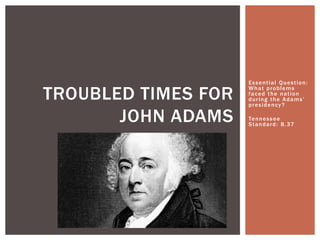
TROUBLED TIMES FOR
JOHN ADAMS
This was the first
election dominated by
political parties
The President
(Adams) and Vice
President (Thomas
Jefferson) were of two
different political
parties
Adams was a
Federalist, Jefferson
was a Democratic-
Republican
ADAMS IS ELECTED
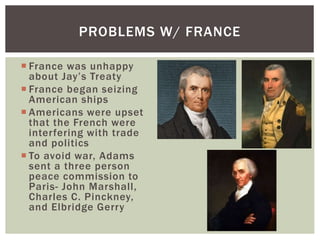
 France was unhappy
about Jay’s Treaty
 France began seizing
American ships
 Americans were upset
that the French were
interfering with trade
and politics
 To avoid war, Adams
sent a three person
peace commission to
Paris- John Marshall,
Charles C. Pinckney,
and Elbridge Gerry
PROBLEMS W/ FRANCE
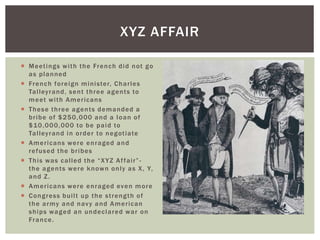
 Meetings with the French did not go
as planned
 French foreign minister, Charles
Talleyrand, sent three agents to
meet with Americans
 These three agents demanded a
bribe of $250,000 and a loan of
$10,000,000 to be paid to
Talleyrand in order to negotiate
 Americans were enraged and
refused the bribes
 This was called the “XYZ Affair”-
the agents were known only as X, Y,
and Z.
 Americans were enraged even more
 Congress built up the strength of
the army and navy and American
ships waged an undeclared war on
France.
XYZ AFFAIR
 Why was France upset with America?
 How did France respond?
 How did Adams’ try to make peace with France?
 How did France respond to America’s attempts at making
peace?
CHECKPOINT
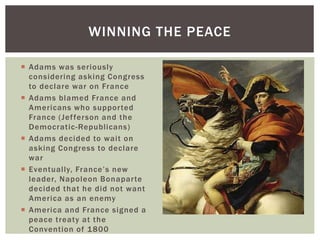
 Adams was seriously
considering asking Congress
to declare war on France
 Adams blamed France and
Americans who supported
France (Jefferson and the
Democratic-Republicans)
 Adams decided to wait on
asking Congress to declare
war
 Eventually, France’s new
leader, Napoleon Bonaparte
decided that he did not want
America as an enemy
 America and France signed a
peace treaty at the
Convention of 1800
WINNING THE PEACE
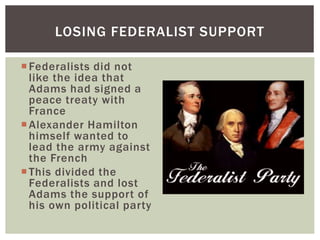
Federalists did not
like the idea that
Adams had signed a
peace treaty with
France
Alexander Hamilton
himself wanted to
lead the army against
the French
This divided the
Federalists and lost
Adams the support of
his own political party
LOSING FEDERALIST SUPPORT
 Why were Federalists upset with Adams?
CHECKPOINT
 Federalist-controlled
Congress began
passing controversial
laws
 These laws were aimed
at stopping the growth
of the Democratic-
Republican party
 Three of these acts
were aimed at
protecting the country
from aliens (foreigners
living in the U.S.)
ALIEN AND SEDITION ACTS
 Naturalization Act- increased
the amount of time to become
a U.S. citizen from 5 to 14
years.
 Alien Act- Gave the president
the power to deport any
foreigner
 Alien Enemies Act- Allowed
the government to arrest and
deport all aliens who were
citizens of enemy nations
 Sedition Act- Made it a crime
to speak or write critically
about the President, members
of Congress, the federal
government, or federal laws
ALIEN AND SEDITION ACTS
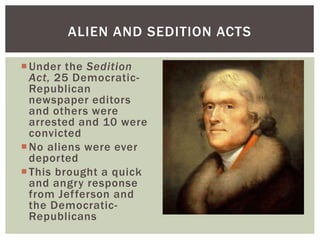
Under the Sedition
Act, 25 Democratic-
Republican
newspaper editors
and others were
arrested and 10 were
convicted
No aliens were ever
deported
This brought a quick
and angry response
from Jefferson and
the Democratic-
Republicans
ALIEN AND SEDITION ACTS
 Which law allowed the deportation of any foreigner?
 Which law criminalized criticism of the government?
CHECKPOINT
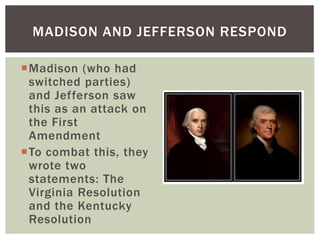
Madison (who had
switched parties)
and Jefferson saw
this as an attack on
the First
Amendment
To combat this, they
wrote two
statements: The
Virginia Resolution
and the Kentucky
Resolution
MADISON AND JEFFERSON RESPOND
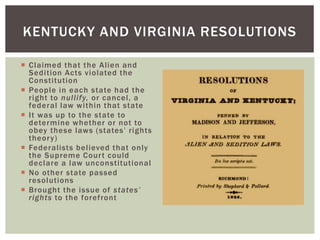
 Claimed that the Alien and
Sedition Acts violated the
Constitution
 People in each state had the
right to nullify, or cancel, a
federal law within that state
 It was up to the state to
determine whether or not to
obey these laws (states’ rights
theory)
 Federalists believed that only
the Supreme Court could
declare a law unconstitutional
 No other state passed
resolutions
 Brought the issue of states’
rights to the forefront
KENTUCKY AND VIRGINIA RESOLUTIONS
 What issue was brought to the forefront because of the
Virginia and Kentucky Resolutions?
CHECKPOINT
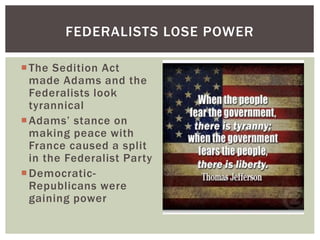
The Sedition Act
made Adams and the
Federalists look
tyrannical
Adams’ stance on
making peace with
France caused a split
in the Federalist Party
Democratic-
Republicans were
gaining power
FEDERALISTS LOSE POWER

John Adams' presidency 8.37

  • 1.
     Analyze theexcerpt from Washington’s farewell address on your note sheet.  Answer the following two questions:  How does Washington feel about political parties and factions? (underline and label in the text)  How does Washington feel about alliances with foreign countries? (underline and label in the text) BELL RINGER
  • 2.
    Essential Question: What problems facedthe nation during the Adams’ presidency? Tennessee Standard: 8.37 TROUBLED TIMES FOR JOHN ADAMS
  • 3.
    This was thefirst election dominated by political parties The President (Adams) and Vice President (Thomas Jefferson) were of two different political parties Adams was a Federalist, Jefferson was a Democratic- Republican ADAMS IS ELECTED
  • 4.
     France wasunhappy about Jay’s Treaty  France began seizing American ships  Americans were upset that the French were interfering with trade and politics  To avoid war, Adams sent a three person peace commission to Paris- John Marshall, Charles C. Pinckney, and Elbridge Gerry PROBLEMS W/ FRANCE
  • 5.
     Meetings withthe French did not go as planned  French foreign minister, Charles Talleyrand, sent three agents to meet with Americans  These three agents demanded a bribe of $250,000 and a loan of $10,000,000 to be paid to Talleyrand in order to negotiate  Americans were enraged and refused the bribes  This was called the “XYZ Affair”- the agents were known only as X, Y, and Z.  Americans were enraged even more  Congress built up the strength of the army and navy and American ships waged an undeclared war on France. XYZ AFFAIR
  • 6.
     Why wasFrance upset with America?  How did France respond?  How did Adams’ try to make peace with France?  How did France respond to America’s attempts at making peace? CHECKPOINT
  • 7.
     Adams wasseriously considering asking Congress to declare war on France  Adams blamed France and Americans who supported France (Jefferson and the Democratic-Republicans)  Adams decided to wait on asking Congress to declare war  Eventually, France’s new leader, Napoleon Bonaparte decided that he did not want America as an enemy  America and France signed a peace treaty at the Convention of 1800 WINNING THE PEACE
  • 8.
    Federalists did not likethe idea that Adams had signed a peace treaty with France Alexander Hamilton himself wanted to lead the army against the French This divided the Federalists and lost Adams the support of his own political party LOSING FEDERALIST SUPPORT
  • 9.
     Why wereFederalists upset with Adams? CHECKPOINT
  • 10.
     Federalist-controlled Congress began passingcontroversial laws  These laws were aimed at stopping the growth of the Democratic- Republican party  Three of these acts were aimed at protecting the country from aliens (foreigners living in the U.S.) ALIEN AND SEDITION ACTS
  • 11.
     Naturalization Act-increased the amount of time to become a U.S. citizen from 5 to 14 years.  Alien Act- Gave the president the power to deport any foreigner  Alien Enemies Act- Allowed the government to arrest and deport all aliens who were citizens of enemy nations  Sedition Act- Made it a crime to speak or write critically about the President, members of Congress, the federal government, or federal laws ALIEN AND SEDITION ACTS
  • 12.
    Under the Sedition Act,25 Democratic- Republican newspaper editors and others were arrested and 10 were convicted No aliens were ever deported This brought a quick and angry response from Jefferson and the Democratic- Republicans ALIEN AND SEDITION ACTS
  • 13.
     Which lawallowed the deportation of any foreigner?  Which law criminalized criticism of the government? CHECKPOINT
  • 14.
    Madison (who had switchedparties) and Jefferson saw this as an attack on the First Amendment To combat this, they wrote two statements: The Virginia Resolution and the Kentucky Resolution MADISON AND JEFFERSON RESPOND
  • 15.
     Claimed thatthe Alien and Sedition Acts violated the Constitution  People in each state had the right to nullify, or cancel, a federal law within that state  It was up to the state to determine whether or not to obey these laws (states’ rights theory)  Federalists believed that only the Supreme Court could declare a law unconstitutional  No other state passed resolutions  Brought the issue of states’ rights to the forefront KENTUCKY AND VIRGINIA RESOLUTIONS
  • 16.
     What issuewas brought to the forefront because of the Virginia and Kentucky Resolutions? CHECKPOINT
  • 17.
    The Sedition Act madeAdams and the Federalists look tyrannical Adams’ stance on making peace with France caused a split in the Federalist Party Democratic- Republicans were gaining power FEDERALISTS LOSE POWER