THE EARLY REPUBLIC AND THE
EMERGENCE OF A MARKET
ECONOMY 1800-1850
Chapters 7-8
Political Parties
◦ Debates over ratification of the Constitution led to the rise of the first political parties:
◦ Federalists
◦ Democratic Republicans or Jeffersonian Republicans
◦ Reflected different visions of American life
◦ Federalists were urban dwellers in cities who promoted trade, banking, finance, and manufacturing as the
most essential elements of the future economy
◦ Led by Alexander Hamilton ( a protégé of George Washington)
◦ Democratic Republicans led by Thomas Jefferson and James Madison wanted America to remain
a nation of small farmers and few cities
◦ Jefferson believed that farming reinforced self reliance and individualism while factory work made a man
dependent on wage labor and subject to political manipulation
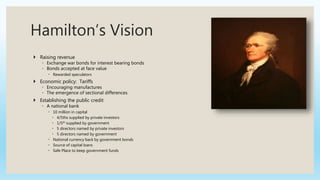
Hamilton’s Vision
 Raising revenue
◦ Exchange war bonds for interest bearing bonds
◦ Bonds accepted at face value
 Rewarded speculators
 Economic policy: Tariffs
◦ Encouraging manufactures
◦ The emergence of sectional differences
 Establishing the public credit
◦ A national bank
 10 million in capital
 4/5ths supplied by private investors
 1/5th supplied by government
 5 directors named by private investors
 5 directors named by government
 National currency back by government bonds
 Source of capital loans
 Safe Place to keep government funds
The Republican Alternative
◦ Republicans or Democratic Republicans
◦ Opposed to monarchy
◦ Strict construction of Constitution
◦ If it’s not spelled-out in the Constitution, the Federal government can’t do it.
◦ No National Bank
George Washington Elected
◦ George Washington became 1st President
◦ John Adams with the 2nd highest vote count became Vice President
◦ Washington put both Hamilton and Jefferson in his cabinet despite their opposing views
◦ Washington had a larger staff on his plantation in Virginia than he did as President
Crises Foreign and Domestic
◦ Citizen Genet
◦ French Revolution 1789
◦ King Louis XVI executed in 1793
◦ Britain, Spain, Austria, Prussia allied against France
◦ US treaty with France following Revolutionary War (perpetual allies)
◦ Citizen Genet hired Spanish privateers to harass British shipping off Florida coast
◦ Washington revoked his Diplomatic privilege and was sending him back to France when Jacobins seized
power from the National Assembly
◦ Genet requested and was granted asylum
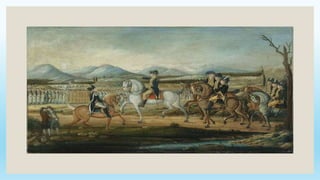
Whiskey Rebellion
◦ Federal Tax on Liquor (1791)
◦ Western Territories: Cheaper to ship liquor than grain or corn
◦ Bushel of corn worth $.25= 2.5 gallons of liquor worth $2.50
◦ Farmers saw tax as a scheme by Hamilton to enrich urban speculators
by “picking the pockets of farmers.”
◦ 1794 in PA “Whiskey Boys”
◦ burned stills of farmers who paid the tax
◦ Threatened federal revenue officers
◦ Robbed the mails
◦ Interrupted court proceedings
◦ Threatened to assault Pittsburgh
Washington Proclamation
◦ Called out 12,000 men in militias from Virginia, Maryland, Pennsylvania and New
Jersey
◦ General Henry Lee commanded 13,000 men
◦ Whiskey Boys vanished
◦ 20 men captured
◦ 2 convicted of treason
◦ Both pardoned by Washington
◦ Simpleton
◦ Insane
America, 8th Edition
Copyright © 2010 W.W. Norton & Company
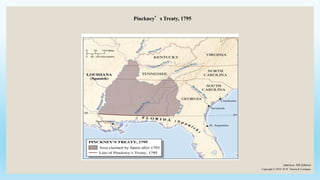
Pinckney’s Treaty, 1795
Settlement of New Land
◦ Land policy
◦ Cost of land
◦ Parcels
◦ Land Act of 1796: Townships-- 640 acre sections @ $2/acre
◦ Land Act of 1804: Minimum unit 160 acre sections @ $1.64/acre
◦ Daniel Boone and the Wilderness Road
◦ 1769 discovery of “Warriors Path” foot path through the Cumberland
Gap (over the Appalachian Mountains)
◦ 1771 Boone and 30 woodsmen cut a larger road called “Wilderness
Road” 300,000 settlers used the Wilderness Road over the next 25
years.
Transfer of Power
◦ Washington’s farewell
◦ Avoid political parties
◦ Avoid the entanglements of Europe
◦ The election of 1796
◦ Federalist Candidates
◦ John Adams (President)
◦ Thomas Pinckney (Vice President)
◦ Democratic Republicans
◦ Thomas Jefferson (President)
◦ Aaron Burr (Vice President)
Campaign of 1796
◦ Democratic Republicans called John Adams “his rotundity”
◦ Federalists called Jefferson “a French loving atheist”
◦ French ambassador public appeal for Jefferson
◦ Foreign interference in US election
◦ Adams elected: 70 electoral votes to 68 electoral votes
Quasi-War with France (1798-1800)
◦ Europe: 1789 French Revolution- European Monarchies allied against
Republican France
◦ George Washington: U.S. stay out of affairs of Europe
◦ War between America’s two most important trading partners: Great Britain
and France
◦ Perpetual Alliance with France of 1787 required both countries to aid the
other in event of war
◦ Caribbean: Jay Treaty with Great Britain required US to intercept ships
bound for French ports
◦ French considered the Jay treaty to mean that U.S. sided with Britain
◦ French intercepted American shipping 300 times and broke diplomatic relations with
Americans by 1797
◦ American delegation to Paris in 1797:
◦ Thomas Pinckney; John Marshall, Eldridge Gerry
Quasi-War with France
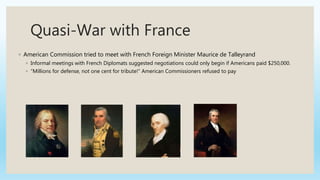
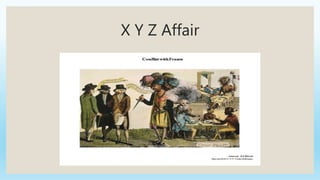
◦ American Commission tried to meet with French Foreign Minister Maurice de Talleyrand
◦ Informal meetings with French Diplomats suggested negotiations could only begin if Americans paid $250,000.
◦ “Millions for defense, not one cent for tribute!” American Commissioners refused to pay
X Y Z Affair
American & French Alliance
 American Navy 1797: The Constitution, The United States, The Constellation
 1797 Congress authorized an army of 10,000 men to serve 3 years each
 George Washington called from retirement to command
◦ Washington demanded that Hamilton be 2nd in command
 Convention of Mortefontaine:1800
◦ French & Americans agreed:
◦ Suspension of quasi-naval war with France’
◦ French would recognize American neutrality/ Americans would not trade war materials with Britain
◦ Suspension of Perpetual Alliance of 1778
◦ Maintain “most favored nation” trade relationships
◦ US did not enter another formal alliance with a foreign power until 1850
◦ US had agreements with foreign governments that did not rise to the level of an alliance
Alien & Sedition Acts
◦ Passed by Congress and Signed by President Adams in 1798
◦ Federalists claimed laws were to protect National Security
◦ Democratic Republicans claimed they were designed to stifle dissent
◦ Naturalization Act increased residency requirement for citizenship from 5 years to 8 years
◦ Alien Friends Act allowed president to arrest and deport non-citizens (Aliens) who were deemed
“dangerous to the peace and security of the United States”
◦ Sedition Act limited speech that was critical of the federal government
◦ Many newspaper editors were imprisoned under Sedition Act.
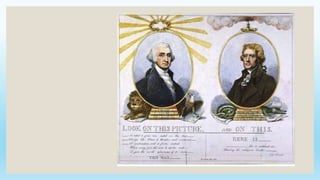
Election of 1800
◦ Federalists vs. Democratic Republicans
◦ Adams vs. Jefferson
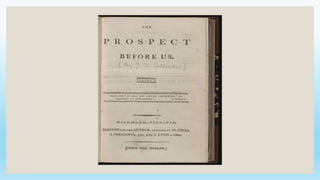
◦ James Callender: Muckraker & sex scandals
◦ Maria Reynolds & Alexander Hamilton
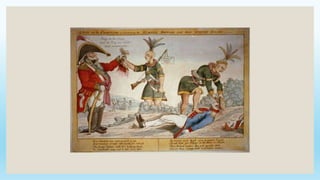
◦ The Prospect Before Us
◦ Jailed for Sedition under Alien and Sedition Acts
◦ Pardoned by Jefferson but refused position as Postmaster General
◦ Published letters between Callender and Jefferson that proved Jefferson
funded Callender’s pamphlets against Federalists
◦ Jefferson supporters accused Callender of abandoning his wife to die of a
venereal disease
◦ Callender broke story of Thomas Jefferson & Sally Hemings
Election of 1800
◦ Although the Democratic Republicans won the election, both Jefferson and his running mate, Arron
Burr received the failed to get the necessary majority in the House of Representatives.
◦ The House of Representatives voted on who should be the next president 35 times before a decision
was made.
◦ Even though their candidate lost the election, the Federalists were still in power until the Democratic
Republicans took office.
◦ Alexander Hamilton considered Thomas Jefferson less of a threat than Aaron Burr and convinced
Federalists to abstain.
◦ Abstention was counted as a vote in favor of the majority so Jefferson won 10 votes to 4.
◦ Angered that Hamilton swayed the election to Jefferson, Burr challenged Hamilton to a duel.
◦ Hamilton died as a result of the wounds he received.
Fake News: 1800 Variety
◦ Federalist pastors in New England argued that if Jefferson were elected, he would confiscate
everyone's Bibles.
◦ One Connecticut woman was so fearful that her Bible would be confiscated that she gave it to a
neighbor who had voted for Jefferson.
◦ The man argued that her Bible would not be confiscated and that if it were, the Bible would not
be safe in his home either.
◦ The woman responded, “It will be perfectly safe with you. They’ll never think of looking in the
house of a Democrat for a Bible.”
Federalist Poem 1801
And lo! In meritorious dress
Forth comes a strumpet called THE PRESS
Whose haggard, unrequested charms
Rush into every blaggard’s arms
Ye weak, deluded minds, beware!
Naught but the outside here is fair!
Then spurn the offers of her sway
And kick the loathsome hag away.
Jefferson in Office
◦ Adams’s Midnight Appointments
◦ Federalists wanted Federalist Judges
◦ Appointed Federalist Judges to positions before midnight on Adams’s last
day in office
◦ Marbury v. Madison
◦ Jefferson’s administration refused to deliver the appointments
◦ Marbury requested Mandamus
◦ Court ruled:
◦ Jefferson could not withhold appointment
◦ Court had no jurisdiction to hear the case under the Constitution
◦ Supreme Court assumed the right of “Judicial Review”
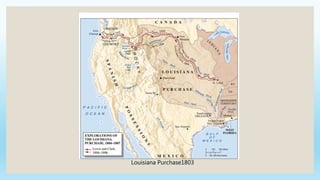
Louisiana Purchase1803
War in Europe
◦ Harassment by Britain and France
◦ Trade with one led to harassment by the other
◦ Impressment
◦ The embargo 1807
◦ Commerce clause
◦ Hurt only U.S. Shipping (repealed in 1809)
◦ The drift to war
◦ The Chesapeake
◦ “…a dish of skim milk curdling at the head of our nation.”
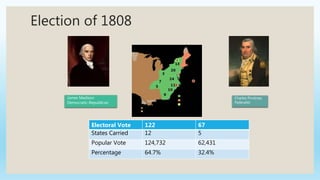
Election of 1808
Electoral Vote 122 67
States Carried 12 5
Popular Vote 124,732 62,431
Percentage 64.7% 32.4%
James Madison
Democratic-Republican
Charles Pinckney
Federalist
The War of 1812
◦ British strategy
◦ Invasion from Canada stopped by Naval battle on Lake Champlain
◦ Fighting in the Chesapeake
◦ British invaded and burned Washington D.C.
◦ Battle of Baltimore: Fort McHenry 1814
◦ “The Star Spangled Banner”
The War of 1812
◦ Causes
◦ Violation of American shipping rights
◦ Seizure of cargo
◦ Impressment of seamen
◦ Incitement of Indians along the border with Canada
◦ Supported by the Northern States
◦ Opposed by the South who relied on British purchases
◦ Preparations
◦ Congress adjourned without providing for payment
◦ Madison unprepared for fight over whether to go to war
The War of 1812
◦ The war in the south
◦ General Andrew Jackson fought the Cherokees and broke their power at the Battle of Horseshoe Bend.
The War of 1812
◦ The Battle of New Orleans
◦ Jackson outnumbered 2:1
◦ “The Rifles of Kentucky”
◦ The Hartford Convention
◦ Federalists and “Democrats” proposed demands that if not met would result in New England’s secession
from the Union.
◦ Demands arrived at the same time as news of the victory at the Battle of New Orleans
◦ Federalist Party did not survive the embarrassment
◦ The Treaty of Ghent
◦ 1814
War of 1812-Aftermath
 The aftermath
 2nd War for Independence
 Demonstrated that small nation could defeat a great power
 Spurred industrialization
 US could depend on internal rather than international markets
 Era of Good Feeling
Economic Nationalism
◦ An unexpected benefit of the War of 1812
◦ Jefferson’s embargo forced Americans to look inward for the production of their finished goods. This led to the first American Industrial Revolution and a surge
of economic growth.
◦ The Bank of the United States
◦ The charter for the first Bank of the United States ended in 1811 and was not immediately renewed. Without the financial control the central bank, economic
turmoil ensued.
◦ State chartered local banks with no control flooded the channels of commerce with bank notes
◦ Initial economic boom
◦ Runaway inflation
◦ Bursting bubble caused deep recession
◦ Banks stopped exchanging coins for paper money
◦ National government could not float loans or transfer funds across the country
◦ To stabilize the economy, a second bank was chartered, which would last for 20 years.
◦ 1816
◦ Bank of the United States (B.U.S.)
Economic Nationalism
◦ A protective tariff
◦ Protect the fledgling American industrial sector from competing British imports, the Tariff of 1816 was enacted.
◦ North, where most of the manufacturing base was located, was for it,
◦ South was against it.
◦ The agrarian economy of the south depended on shipping goods abroad to agents who sold them, purchased needed items, and shipped them
back to America.
◦ Southerners were upset because they were forced to pay the import tax.
◦ Internal improvements
◦ War of 1812 revealed several shortcomings of the United States.
◦ Transportation infrastructure.
◦ The first attempt to fix this problem was the construction of the Cumberland, or National, Road.
◦ Canals
◦ Railroads
Economic Nationalism
◦ Clay’s American System
◦ High tariffs to impede the import of European products and protect fledgling American industries
◦ Higher prices for federal lands
◦ Proceeds to be distributed to states to finance internal improvements to facilitate delivery of goods to markets
◦ Strong national bank to regulate the nation’s money supply and ensure sustained economic growth
Economic Nationalism
◦ Opponents of Clay’s American System
◦ Higher prices for federal lands would discourage western migration
◦ Tariffs benefitted industrialists at the expense of farmers and “common folk”.
◦ B.U.S. a potentially tyrannical force, dictating the nations economic future
◦ Centralizing power in the Federal Government
◦ Limiting States’ rights
◦ Limiting individual freedoms
Good Feelings
◦ James Monroe
◦ Relations with Britain
◦ After the War of 1812, the United States never fought another war with Great Britain
◦ close diplomatic ties.
◦ Rush-Bagot Treaty of 1817, which ended the naval arms race on the Great Lakes.
◦ Both sides agreed to limit the number of warships in the lakes.
◦ Convention of 1818,
◦ Settled the northern limit of the Louisiana Territory at the 49th parallel
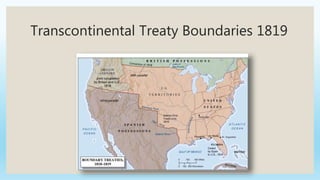
Transcontinental Treaty Boundaries 1819
Good Feelings
◦ The extension of boundaries
◦ 1819
◦ Financial Panic
◦ Debate over extension of slavery to new territories
◦ Concerns over Spanish sovereignty over Florida
◦ Seminole Indians and Runaway slaves
◦ 1817 Americans burned Seminole settlement in Florida Panhandle; Seminoles responded with raids of
their own against white settlers
◦ Secretary of War: John C. Calhoun appointed Andrew Jackson to take command of American troops
◦ Orders: pursue attackers into Spanish territory but do not attack Spanish posts
◦ 1818 Jackson ordered troops to cross border and assault the Spanish fort at Saint. Marks, destroying
Seminole villages also.
◦ Jackson ordered execution of two British traders accused of inciting the Seminoles to war.
◦ Captured Pensacola and established a provisional American government then Jackson returned to
Tennessee
◦ Jackson’s actions strengthened American bargaining position with Spain over Florida purchase
◦ Transcontinental Treaty of 1819
Crises and Compromises
◦ The Panic of 1819
◦ In 1819, Great Britain, still the chief importer of the South’s cotton, turned to its colony of India to obtain cheaper
cotton.
◦ To enlarge their loans, state banks issued more bank notes than they could redeem with gold or silver coins.
◦ Extensive fraud and embezzlement in the Baltimore Branch of the B.U.S. by Bank officials
◦ Langdon Cheves: reduced bank salaries, dividends, reduced extension of credit and presented bank notes for
redemption.
◦ These actions put pressure on the state banks who put pressure on their debtors, making it more difficult to renew old
loans or get new loans.
◦ The Missouri Compromise
◦ After the Revolution, the United States followed an alternating pattern when admitting states into the union: one
slave then one free state.
◦ When Missouri requested admittance, there were twenty-two states—eleven free, eleven slave.
◦ The Northwest Ordinance of 1787 had dictated that there were to be no slave states there
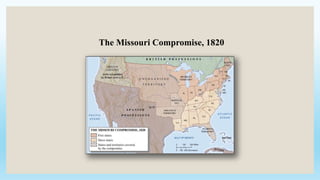
◦ Missouri gained statehood under a compromise: no more slave states would be allowed north of the 36⁰ 30’ line.
The Missouri Compromise, 1820
Judicial Nationalism
◦ John Marshall, chief justice
◦ Strengthening the federal government
◦ McCulloch v. Maryland (1819).
◦ Did the Federal government have the right to create a bank when this was not specifically mentioned as a power
given to Congress in the Constitution.
◦ Marshall ruled that a clause in Article I, section 8 was purposefully left vague to allow Congress to create “necessary
and proper” entities for them.
◦ “To make all laws which are necessary and proper into execution of the foregoing powers and all other powers
vested by this Constitution in the government of the United States or in any department or officer thereof.”
◦ Gibbons v. Ogden (1824) , Marshall exerted the right of the nation to regulate state commerce.
Nationalist Diplomacy
◦ The Pacific Northwest
◦ John Quincy Adams to Russia, “the American continents are no longer subjects for any new
European colonial establishments.”
◦ Treaty of 1824
◦ The Monroe Doctrine
◦ The American continents are not subject to any further expansion of European colonial power
◦ The political system of European powers is different from that of the United States who will
consider any attempt on their part to extend their system to any portion of the Western
hemisphere as “dangerous to our peace and safety”
◦ U.S. would not interfere with existing European colonies
◦ U.S. will keep out of the internal affairs of European nations and their wars.
◦ Monroe Doctrine could not be unilaterally enforced and depended on naval supremacy of
Great Britain. European powers at the time did not acknowledge it.
One-Party Politics
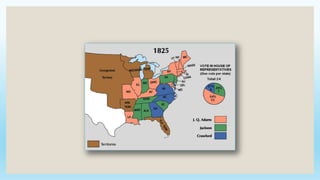
◦ Presidential nominations in 1824
◦ Snatching defeat from the jaws of victory: with no political party to contend against, the
Democratic-Republicans turned on themselves and ran four candidates for the presidency.
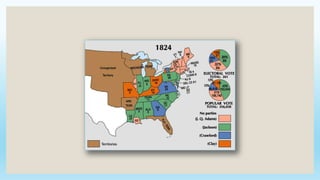
◦ No candidate won an electoral majority, and the election was sent to the House of
Representatives.
◦ The corrupt bargain
◦ Each state got one vote, regardless of how its citizens voted.
◦ John Quincy Adams won the presidency, though he had lost the popular vote and had
come in second to Jackson in the electoral vote.
◦ He nominated his fellow candidate Henry Clay, the speaker of the house, to be his
secretary of state.
◦ Because most past presidents had served as secretary of state, Jackson took this as a
“corrupt bargain” struck by the two by which Clay would use his influence in the House to
secure Adams the presidency and thus would be made heir apparent.
One-Party Politics
◦ John Quincy Adams
◦ Bold programs which would expand power of federal government
◦ Promote internal improvements
◦ Set up a national university
◦ Finance scientific explorations
◦ Build astronomical observatories
◦ Create a department of the interior
◦ Praised the example of “the nations of Europe and of their rulers” which confirmed suspicions that the Adams’s were
“closet monarchists”
◦ The election of Andrew Jackson
◦ Jacksonian Democrats
◦ The Sequester is NOT new! Presented an alternative tariff bill with such outrageously high duties on raw materials that
the manufacturers in the Mid-Atlantic states would join the South and the Southwest to defeat the tariff allowing
Jacksonian supporters in the North could still support the tariff and retain voter loyalty while Jacksonian supporters in
the South could take credit for opposing the tariff.
◦ The tariff passed.
◦ Doctrine of Nullification: John C. Calhoun changes sides and opposes a tariff
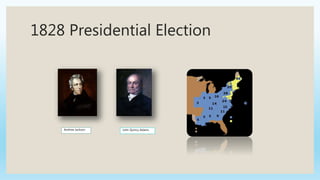
◦ Jackson elected President in 1828
1828 Presidential Election
Andrew Jackson John Quincy Adams

His 121 ch 7 8 2017

  • 1.
    THE EARLY REPUBLICAND THE EMERGENCE OF A MARKET ECONOMY 1800-1850 Chapters 7-8
  • 2.
    Political Parties ◦ Debatesover ratification of the Constitution led to the rise of the first political parties: ◦ Federalists ◦ Democratic Republicans or Jeffersonian Republicans ◦ Reflected different visions of American life ◦ Federalists were urban dwellers in cities who promoted trade, banking, finance, and manufacturing as the most essential elements of the future economy ◦ Led by Alexander Hamilton ( a protégé of George Washington) ◦ Democratic Republicans led by Thomas Jefferson and James Madison wanted America to remain a nation of small farmers and few cities ◦ Jefferson believed that farming reinforced self reliance and individualism while factory work made a man dependent on wage labor and subject to political manipulation
  • 3.
    Hamilton’s Vision  Raisingrevenue ◦ Exchange war bonds for interest bearing bonds ◦ Bonds accepted at face value  Rewarded speculators  Economic policy: Tariffs ◦ Encouraging manufactures ◦ The emergence of sectional differences  Establishing the public credit ◦ A national bank  10 million in capital  4/5ths supplied by private investors  1/5th supplied by government  5 directors named by private investors  5 directors named by government  National currency back by government bonds  Source of capital loans  Safe Place to keep government funds
  • 4.
    The Republican Alternative ◦Republicans or Democratic Republicans ◦ Opposed to monarchy ◦ Strict construction of Constitution ◦ If it’s not spelled-out in the Constitution, the Federal government can’t do it. ◦ No National Bank
  • 5.
    George Washington Elected ◦George Washington became 1st President ◦ John Adams with the 2nd highest vote count became Vice President ◦ Washington put both Hamilton and Jefferson in his cabinet despite their opposing views ◦ Washington had a larger staff on his plantation in Virginia than he did as President
  • 6.
    Crises Foreign andDomestic ◦ Citizen Genet ◦ French Revolution 1789 ◦ King Louis XVI executed in 1793 ◦ Britain, Spain, Austria, Prussia allied against France ◦ US treaty with France following Revolutionary War (perpetual allies) ◦ Citizen Genet hired Spanish privateers to harass British shipping off Florida coast ◦ Washington revoked his Diplomatic privilege and was sending him back to France when Jacobins seized power from the National Assembly ◦ Genet requested and was granted asylum
  • 8.
    Whiskey Rebellion ◦ FederalTax on Liquor (1791) ◦ Western Territories: Cheaper to ship liquor than grain or corn ◦ Bushel of corn worth $.25= 2.5 gallons of liquor worth $2.50 ◦ Farmers saw tax as a scheme by Hamilton to enrich urban speculators by “picking the pockets of farmers.” ◦ 1794 in PA “Whiskey Boys” ◦ burned stills of farmers who paid the tax ◦ Threatened federal revenue officers ◦ Robbed the mails ◦ Interrupted court proceedings ◦ Threatened to assault Pittsburgh
  • 9.
    Washington Proclamation ◦ Calledout 12,000 men in militias from Virginia, Maryland, Pennsylvania and New Jersey ◦ General Henry Lee commanded 13,000 men ◦ Whiskey Boys vanished ◦ 20 men captured ◦ 2 convicted of treason ◦ Both pardoned by Washington ◦ Simpleton ◦ Insane
  • 10.
    America, 8th Edition Copyright© 2010 W.W. Norton & Company Pinckney’s Treaty, 1795
  • 11.
    Settlement of NewLand ◦ Land policy ◦ Cost of land ◦ Parcels ◦ Land Act of 1796: Townships-- 640 acre sections @ $2/acre ◦ Land Act of 1804: Minimum unit 160 acre sections @ $1.64/acre ◦ Daniel Boone and the Wilderness Road ◦ 1769 discovery of “Warriors Path” foot path through the Cumberland Gap (over the Appalachian Mountains) ◦ 1771 Boone and 30 woodsmen cut a larger road called “Wilderness Road” 300,000 settlers used the Wilderness Road over the next 25 years.
  • 12.
    Transfer of Power ◦Washington’s farewell ◦ Avoid political parties ◦ Avoid the entanglements of Europe ◦ The election of 1796 ◦ Federalist Candidates ◦ John Adams (President) ◦ Thomas Pinckney (Vice President) ◦ Democratic Republicans ◦ Thomas Jefferson (President) ◦ Aaron Burr (Vice President)
  • 13.
    Campaign of 1796 ◦Democratic Republicans called John Adams “his rotundity” ◦ Federalists called Jefferson “a French loving atheist” ◦ French ambassador public appeal for Jefferson ◦ Foreign interference in US election ◦ Adams elected: 70 electoral votes to 68 electoral votes
  • 14.
    Quasi-War with France(1798-1800) ◦ Europe: 1789 French Revolution- European Monarchies allied against Republican France ◦ George Washington: U.S. stay out of affairs of Europe ◦ War between America’s two most important trading partners: Great Britain and France ◦ Perpetual Alliance with France of 1787 required both countries to aid the other in event of war ◦ Caribbean: Jay Treaty with Great Britain required US to intercept ships bound for French ports ◦ French considered the Jay treaty to mean that U.S. sided with Britain ◦ French intercepted American shipping 300 times and broke diplomatic relations with Americans by 1797 ◦ American delegation to Paris in 1797: ◦ Thomas Pinckney; John Marshall, Eldridge Gerry
  • 15.
    Quasi-War with France ◦American Commission tried to meet with French Foreign Minister Maurice de Talleyrand ◦ Informal meetings with French Diplomats suggested negotiations could only begin if Americans paid $250,000. ◦ “Millions for defense, not one cent for tribute!” American Commissioners refused to pay
  • 16.
    X Y ZAffair
  • 17.
    American & FrenchAlliance  American Navy 1797: The Constitution, The United States, The Constellation  1797 Congress authorized an army of 10,000 men to serve 3 years each  George Washington called from retirement to command ◦ Washington demanded that Hamilton be 2nd in command  Convention of Mortefontaine:1800 ◦ French & Americans agreed: ◦ Suspension of quasi-naval war with France’ ◦ French would recognize American neutrality/ Americans would not trade war materials with Britain ◦ Suspension of Perpetual Alliance of 1778 ◦ Maintain “most favored nation” trade relationships ◦ US did not enter another formal alliance with a foreign power until 1850 ◦ US had agreements with foreign governments that did not rise to the level of an alliance
  • 18.
    Alien & SeditionActs ◦ Passed by Congress and Signed by President Adams in 1798 ◦ Federalists claimed laws were to protect National Security ◦ Democratic Republicans claimed they were designed to stifle dissent ◦ Naturalization Act increased residency requirement for citizenship from 5 years to 8 years ◦ Alien Friends Act allowed president to arrest and deport non-citizens (Aliens) who were deemed “dangerous to the peace and security of the United States” ◦ Sedition Act limited speech that was critical of the federal government ◦ Many newspaper editors were imprisoned under Sedition Act.
  • 19.
    Election of 1800 ◦Federalists vs. Democratic Republicans ◦ Adams vs. Jefferson ◦ James Callender: Muckraker & sex scandals ◦ Maria Reynolds & Alexander Hamilton ◦ The Prospect Before Us ◦ Jailed for Sedition under Alien and Sedition Acts ◦ Pardoned by Jefferson but refused position as Postmaster General ◦ Published letters between Callender and Jefferson that proved Jefferson funded Callender’s pamphlets against Federalists ◦ Jefferson supporters accused Callender of abandoning his wife to die of a venereal disease ◦ Callender broke story of Thomas Jefferson & Sally Hemings
  • 21.
    Election of 1800 ◦Although the Democratic Republicans won the election, both Jefferson and his running mate, Arron Burr received the failed to get the necessary majority in the House of Representatives. ◦ The House of Representatives voted on who should be the next president 35 times before a decision was made. ◦ Even though their candidate lost the election, the Federalists were still in power until the Democratic Republicans took office. ◦ Alexander Hamilton considered Thomas Jefferson less of a threat than Aaron Burr and convinced Federalists to abstain. ◦ Abstention was counted as a vote in favor of the majority so Jefferson won 10 votes to 4. ◦ Angered that Hamilton swayed the election to Jefferson, Burr challenged Hamilton to a duel. ◦ Hamilton died as a result of the wounds he received.
  • 22.
    Fake News: 1800Variety ◦ Federalist pastors in New England argued that if Jefferson were elected, he would confiscate everyone's Bibles. ◦ One Connecticut woman was so fearful that her Bible would be confiscated that she gave it to a neighbor who had voted for Jefferson. ◦ The man argued that her Bible would not be confiscated and that if it were, the Bible would not be safe in his home either. ◦ The woman responded, “It will be perfectly safe with you. They’ll never think of looking in the house of a Democrat for a Bible.”
  • 23.
    Federalist Poem 1801 Andlo! In meritorious dress Forth comes a strumpet called THE PRESS Whose haggard, unrequested charms Rush into every blaggard’s arms Ye weak, deluded minds, beware! Naught but the outside here is fair! Then spurn the offers of her sway And kick the loathsome hag away.
  • 24.
    Jefferson in Office ◦Adams’s Midnight Appointments ◦ Federalists wanted Federalist Judges ◦ Appointed Federalist Judges to positions before midnight on Adams’s last day in office ◦ Marbury v. Madison ◦ Jefferson’s administration refused to deliver the appointments ◦ Marbury requested Mandamus ◦ Court ruled: ◦ Jefferson could not withhold appointment ◦ Court had no jurisdiction to hear the case under the Constitution ◦ Supreme Court assumed the right of “Judicial Review”
  • 26.
  • 28.
    War in Europe ◦Harassment by Britain and France ◦ Trade with one led to harassment by the other ◦ Impressment ◦ The embargo 1807 ◦ Commerce clause ◦ Hurt only U.S. Shipping (repealed in 1809) ◦ The drift to war ◦ The Chesapeake ◦ “…a dish of skim milk curdling at the head of our nation.”
  • 29.
    Election of 1808 ElectoralVote 122 67 States Carried 12 5 Popular Vote 124,732 62,431 Percentage 64.7% 32.4% James Madison Democratic-Republican Charles Pinckney Federalist
  • 30.
    The War of1812 ◦ British strategy ◦ Invasion from Canada stopped by Naval battle on Lake Champlain ◦ Fighting in the Chesapeake ◦ British invaded and burned Washington D.C. ◦ Battle of Baltimore: Fort McHenry 1814 ◦ “The Star Spangled Banner”
  • 31.
    The War of1812 ◦ Causes ◦ Violation of American shipping rights ◦ Seizure of cargo ◦ Impressment of seamen ◦ Incitement of Indians along the border with Canada ◦ Supported by the Northern States ◦ Opposed by the South who relied on British purchases ◦ Preparations ◦ Congress adjourned without providing for payment ◦ Madison unprepared for fight over whether to go to war
  • 32.
    The War of1812 ◦ The war in the south ◦ General Andrew Jackson fought the Cherokees and broke their power at the Battle of Horseshoe Bend.
  • 33.
    The War of1812 ◦ The Battle of New Orleans ◦ Jackson outnumbered 2:1 ◦ “The Rifles of Kentucky” ◦ The Hartford Convention ◦ Federalists and “Democrats” proposed demands that if not met would result in New England’s secession from the Union. ◦ Demands arrived at the same time as news of the victory at the Battle of New Orleans ◦ Federalist Party did not survive the embarrassment ◦ The Treaty of Ghent ◦ 1814
  • 34.
    War of 1812-Aftermath The aftermath  2nd War for Independence  Demonstrated that small nation could defeat a great power  Spurred industrialization  US could depend on internal rather than international markets  Era of Good Feeling
  • 35.
    Economic Nationalism ◦ Anunexpected benefit of the War of 1812 ◦ Jefferson’s embargo forced Americans to look inward for the production of their finished goods. This led to the first American Industrial Revolution and a surge of economic growth. ◦ The Bank of the United States ◦ The charter for the first Bank of the United States ended in 1811 and was not immediately renewed. Without the financial control the central bank, economic turmoil ensued. ◦ State chartered local banks with no control flooded the channels of commerce with bank notes ◦ Initial economic boom ◦ Runaway inflation ◦ Bursting bubble caused deep recession ◦ Banks stopped exchanging coins for paper money ◦ National government could not float loans or transfer funds across the country ◦ To stabilize the economy, a second bank was chartered, which would last for 20 years. ◦ 1816 ◦ Bank of the United States (B.U.S.)
  • 36.
    Economic Nationalism ◦ Aprotective tariff ◦ Protect the fledgling American industrial sector from competing British imports, the Tariff of 1816 was enacted. ◦ North, where most of the manufacturing base was located, was for it, ◦ South was against it. ◦ The agrarian economy of the south depended on shipping goods abroad to agents who sold them, purchased needed items, and shipped them back to America. ◦ Southerners were upset because they were forced to pay the import tax. ◦ Internal improvements ◦ War of 1812 revealed several shortcomings of the United States. ◦ Transportation infrastructure. ◦ The first attempt to fix this problem was the construction of the Cumberland, or National, Road. ◦ Canals ◦ Railroads
  • 37.
    Economic Nationalism ◦ Clay’sAmerican System ◦ High tariffs to impede the import of European products and protect fledgling American industries ◦ Higher prices for federal lands ◦ Proceeds to be distributed to states to finance internal improvements to facilitate delivery of goods to markets ◦ Strong national bank to regulate the nation’s money supply and ensure sustained economic growth
  • 38.
    Economic Nationalism ◦ Opponentsof Clay’s American System ◦ Higher prices for federal lands would discourage western migration ◦ Tariffs benefitted industrialists at the expense of farmers and “common folk”. ◦ B.U.S. a potentially tyrannical force, dictating the nations economic future ◦ Centralizing power in the Federal Government ◦ Limiting States’ rights ◦ Limiting individual freedoms
  • 39.
    Good Feelings ◦ JamesMonroe ◦ Relations with Britain ◦ After the War of 1812, the United States never fought another war with Great Britain ◦ close diplomatic ties. ◦ Rush-Bagot Treaty of 1817, which ended the naval arms race on the Great Lakes. ◦ Both sides agreed to limit the number of warships in the lakes. ◦ Convention of 1818, ◦ Settled the northern limit of the Louisiana Territory at the 49th parallel
  • 40.
  • 41.
    Good Feelings ◦ Theextension of boundaries ◦ 1819 ◦ Financial Panic ◦ Debate over extension of slavery to new territories ◦ Concerns over Spanish sovereignty over Florida ◦ Seminole Indians and Runaway slaves ◦ 1817 Americans burned Seminole settlement in Florida Panhandle; Seminoles responded with raids of their own against white settlers ◦ Secretary of War: John C. Calhoun appointed Andrew Jackson to take command of American troops ◦ Orders: pursue attackers into Spanish territory but do not attack Spanish posts ◦ 1818 Jackson ordered troops to cross border and assault the Spanish fort at Saint. Marks, destroying Seminole villages also. ◦ Jackson ordered execution of two British traders accused of inciting the Seminoles to war. ◦ Captured Pensacola and established a provisional American government then Jackson returned to Tennessee ◦ Jackson’s actions strengthened American bargaining position with Spain over Florida purchase ◦ Transcontinental Treaty of 1819
  • 42.
    Crises and Compromises ◦The Panic of 1819 ◦ In 1819, Great Britain, still the chief importer of the South’s cotton, turned to its colony of India to obtain cheaper cotton. ◦ To enlarge their loans, state banks issued more bank notes than they could redeem with gold or silver coins. ◦ Extensive fraud and embezzlement in the Baltimore Branch of the B.U.S. by Bank officials ◦ Langdon Cheves: reduced bank salaries, dividends, reduced extension of credit and presented bank notes for redemption. ◦ These actions put pressure on the state banks who put pressure on their debtors, making it more difficult to renew old loans or get new loans. ◦ The Missouri Compromise ◦ After the Revolution, the United States followed an alternating pattern when admitting states into the union: one slave then one free state. ◦ When Missouri requested admittance, there were twenty-two states—eleven free, eleven slave. ◦ The Northwest Ordinance of 1787 had dictated that there were to be no slave states there ◦ Missouri gained statehood under a compromise: no more slave states would be allowed north of the 36⁰ 30’ line.
  • 43.
  • 44.
    Judicial Nationalism ◦ JohnMarshall, chief justice ◦ Strengthening the federal government ◦ McCulloch v. Maryland (1819). ◦ Did the Federal government have the right to create a bank when this was not specifically mentioned as a power given to Congress in the Constitution. ◦ Marshall ruled that a clause in Article I, section 8 was purposefully left vague to allow Congress to create “necessary and proper” entities for them. ◦ “To make all laws which are necessary and proper into execution of the foregoing powers and all other powers vested by this Constitution in the government of the United States or in any department or officer thereof.” ◦ Gibbons v. Ogden (1824) , Marshall exerted the right of the nation to regulate state commerce.
  • 45.
    Nationalist Diplomacy ◦ ThePacific Northwest ◦ John Quincy Adams to Russia, “the American continents are no longer subjects for any new European colonial establishments.” ◦ Treaty of 1824 ◦ The Monroe Doctrine ◦ The American continents are not subject to any further expansion of European colonial power ◦ The political system of European powers is different from that of the United States who will consider any attempt on their part to extend their system to any portion of the Western hemisphere as “dangerous to our peace and safety” ◦ U.S. would not interfere with existing European colonies ◦ U.S. will keep out of the internal affairs of European nations and their wars. ◦ Monroe Doctrine could not be unilaterally enforced and depended on naval supremacy of Great Britain. European powers at the time did not acknowledge it.
  • 46.
    One-Party Politics ◦ Presidentialnominations in 1824 ◦ Snatching defeat from the jaws of victory: with no political party to contend against, the Democratic-Republicans turned on themselves and ran four candidates for the presidency. ◦ No candidate won an electoral majority, and the election was sent to the House of Representatives. ◦ The corrupt bargain ◦ Each state got one vote, regardless of how its citizens voted. ◦ John Quincy Adams won the presidency, though he had lost the popular vote and had come in second to Jackson in the electoral vote. ◦ He nominated his fellow candidate Henry Clay, the speaker of the house, to be his secretary of state. ◦ Because most past presidents had served as secretary of state, Jackson took this as a “corrupt bargain” struck by the two by which Clay would use his influence in the House to secure Adams the presidency and thus would be made heir apparent.
  • 49.
    One-Party Politics ◦ JohnQuincy Adams ◦ Bold programs which would expand power of federal government ◦ Promote internal improvements ◦ Set up a national university ◦ Finance scientific explorations ◦ Build astronomical observatories ◦ Create a department of the interior ◦ Praised the example of “the nations of Europe and of their rulers” which confirmed suspicions that the Adams’s were “closet monarchists” ◦ The election of Andrew Jackson ◦ Jacksonian Democrats ◦ The Sequester is NOT new! Presented an alternative tariff bill with such outrageously high duties on raw materials that the manufacturers in the Mid-Atlantic states would join the South and the Southwest to defeat the tariff allowing Jacksonian supporters in the North could still support the tariff and retain voter loyalty while Jacksonian supporters in the South could take credit for opposing the tariff. ◦ The tariff passed. ◦ Doctrine of Nullification: John C. Calhoun changes sides and opposes a tariff ◦ Jackson elected President in 1828
  • 50.
    1828 Presidential Election AndrewJackson John Quincy Adams