Colonial NorthColonial North
AmericaAmerica
Goal 1.01:Goal 1.01:
Describe how geographic diversity influenced
economic, social, and political
life in colonial North America.
ColonyColony
A group of people inA group of people in
one place ruled by aone place ruled by a
parent countryparent country
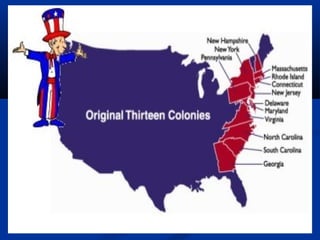
 New England ColoniesNew England Colonies
 ConnecticutConnecticut
 Massachusetts BayMassachusetts Bay
 Massachusetts and MaineMassachusetts and Maine
 New HampshireNew Hampshire
 Rhode IslandRhode Island
 Middle ColoniesMiddle Colonies
 DelawareDelaware
 New JerseyNew Jersey
 New YorkNew York
 PennsylvaniaPennsylvania
 Southern ColoniesSouthern Colonies
 GeorgiaGeorgia
 MarylandMaryland
 North CarolinaNorth Carolina
 South CarolinaSouth Carolina
 VirginiaVirginia
 Kentucky, Virginia, West VirginiaKentucky, Virginia, West Virginia
Why were the Europeans leavingWhy were the Europeans leaving
their homes and coming to America?their homes and coming to America?
 The Renaissance created a growingThe Renaissance created a growing
interest in geography, exploration, andinterest in geography, exploration, and
colonization.colonization.
 To increase their wealthTo increase their wealth
 To have their own landTo have their own land
 To escape religious persecutionTo escape religious persecution
 To escape overpopulationTo escape overpopulation
 To escape political oppressionTo escape political oppression
Ethnic and Religious PluralismEthnic and Religious Pluralism
 Nationalities of individuals coming toNationalities of individuals coming to
America in the 17America in the 17thth
and 18and 18thth
centuries:centuries:
EnglishEnglish
SpanishSpanish
DutchDutch
GermanGerman
SwedishSwedish
Ethnic and Religious Pluralism:Ethnic and Religious Pluralism:
Colonial ReligionsColonial Religions
 PuritansPuritans
 Beliefs:Beliefs:
Strict morals regulationStrict morals regulation
Emphasis on private Bible studyEmphasis on private Bible study
Belief in simplicity of worshipBelief in simplicity of worship
Desire to improve society throughDesire to improve society through
educationeducation
 Pilgrims (Massachusetts) were the mostPilgrims (Massachusetts) were the most
famous Puritan sect.famous Puritan sect.
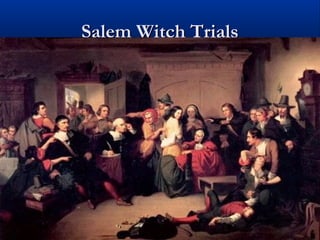
 Salem Witch TrialsSalem Witch Trials
Ethnic and Religious Pluralism:Ethnic and Religious Pluralism:
Colonial ReligionsColonial Religions
 QuakersQuakers
 Members of the Religious Society of FriendsMembers of the Religious Society of Friends
 A form of Protestant Christianity that uses noA form of Protestant Christianity that uses no
scripturescripture
 Emphasizes simplicity in life and worshipEmphasizes simplicity in life and worship
 EgalitarianismEgalitarianism
 Resistance to swearing oathsResistance to swearing oaths
 Heavily involved Pacifism, Women’s Equality, andHeavily involved Pacifism, Women’s Equality, and
Abolition of SlaveryAbolition of Slavery
Ethnic and Religious Pluralism:Ethnic and Religious Pluralism:
Colonial ReligionsColonial Religions
 CatholicismCatholicism
 Largest single domination of ChristianityLargest single domination of Christianity
 Stresses hierarchical, tightly controlled worship.Stresses hierarchical, tightly controlled worship.
 Belief that Jesus Christ is the only son of God andBelief that Jesus Christ is the only son of God and
that his death led to grace among those on Earth.that his death led to grace among those on Earth.
 Common Practices: Baptism, Confirmation,Common Practices: Baptism, Confirmation,
Confession, Communion, StrongConfession, Communion, Strong
Priesthood/Monastic traditionPriesthood/Monastic tradition
 Maryland was founded specifically as a safe havenMaryland was founded specifically as a safe haven
for Catholicsfor Catholics
Salem Witch TrialsSalem Witch Trials
SlaverySlavery
 The first African-American slaves wereThe first African-American slaves were
brought to America in…brought to America in…
 16071607
……and how did they get here?and how did they get here?
 To Jamestown, on a Dutch trading ship asTo Jamestown, on a Dutch trading ship as
indentured servantsindentured servants
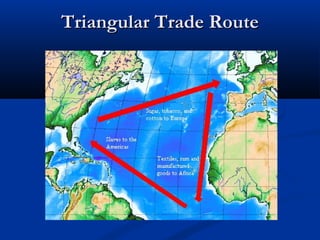
Triangular Trade RouteTriangular Trade Route
A trade route betweenA trade route between
America, Europe, and AfricaAmerica, Europe, and Africa
Triangular Trade RouteTriangular Trade Route
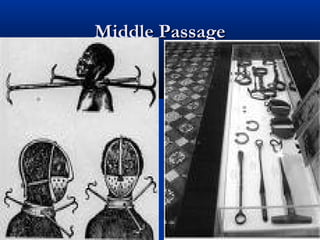
Middle PassageMiddle Passage
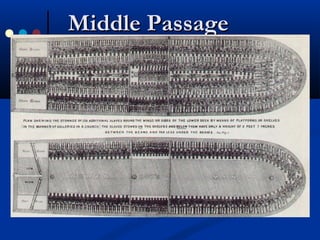
 The voyage lasted 2-5 monthsThe voyage lasted 2-5 months
 The ships were designed for goods, notThe ships were designed for goods, not
people, so the travel was crowded andpeople, so the travel was crowded and
inhumane.inhumane.
 Tightly packed slaves = spread ofTightly packed slaves = spread of
diseases, deathdiseases, death
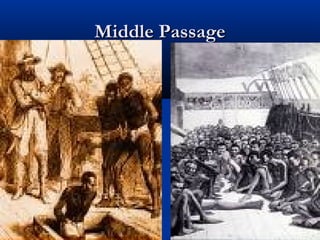
 Slaves fed very little. Many slaves triedSlaves fed very little. Many slaves tried
to starve themselves.to starve themselves.
Middle PassageMiddle Passage
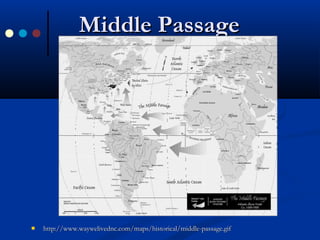
 http://www.waywelivednc.com/maps/historical/middle-passage.gifhttp://www.waywelivednc.com/maps/historical/middle-passage.gif
Middle PassageMiddle Passage
 http://faculty.lacitycollege.edu/moonmc/html/slavery1b.jpghttp://faculty.lacitycollege.edu/moonmc/html/slavery1b.jpg
Middle PassageMiddle Passage
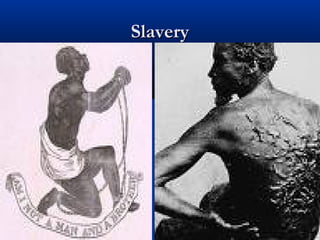
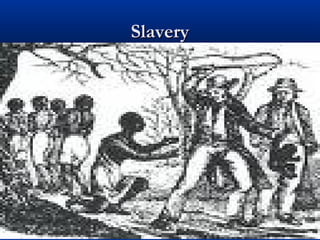
What isWhat is slaveryslavery??
 An institution where people areAn institution where people are
held against their will as propertyheld against their will as property
and forced to carry out the will ofand forced to carry out the will of
their ownertheir owner
SlaverySlavery
SlaverySlavery
How is a slave different from anHow is a slave different from an
indentured servant?indentured servant?
 Indentured servants were bound byIndentured servants were bound by
contract for a certain amount ofcontract for a certain amount of
time, and had choicetime, and had choice
 Slavery was against your will for lifeSlavery was against your will for life
Plantation SystemPlantation System
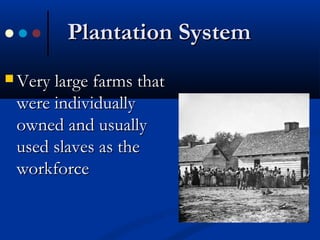
 Very large farms thatVery large farms that
were individuallywere individually
owned and usuallyowned and usually
used slaves as theused slaves as the
workforceworkforce
Plantation SystemPlantation System
NegativesNegatives
 Had to use slaves to be profitableHad to use slaves to be profitable
 Only large farmers were successfulOnly large farmers were successful
 Dominated economy, so held backDominated economy, so held back
industrializationindustrialization
Plantation SystemPlantation System
Economic BenefitsEconomic Benefits
 Allowed new goods to be produced inAllowed new goods to be produced in
mass quantitiesmass quantities
 Allowed owners to become veryAllowed owners to become very
wealthywealthy
Plantation SystemPlantation System
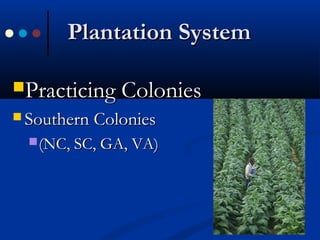
Practicing ColoniesPracticing Colonies
 Southern ColoniesSouthern Colonies
(NC, SC, GA, VA)(NC, SC, GA, VA)
MercantilismMercantilism
 An economic system that relied onAn economic system that relied on
exportsexports
 Export more than you importExport more than you import
 Ruling countries used colonies as aRuling countries used colonies as a
source of raw materials to makesource of raw materials to make
finished goods & sell for high profits,finished goods & sell for high profits,
usually in coloniesusually in colonies
MercantilismMercantilism
 Colonial ProductsColonial Products
 Sugar, tobacco, cotton, gold, rice,Sugar, tobacco, cotton, gold, rice,
lumber, indigolumber, indigo
 Found in Southern colonies; related toFound in Southern colonies; related to
plantation systemplantation system
JOINT STOCKJOINT STOCK
COLONIESCOLONIES
ColoniesColonies
funded byfunded by
investorsinvestors
PROPRIETARYPROPRIETARY
COLONIESCOLONIES
Colony ownedColony owned
by one personby one person
ROYAL COLONYROYAL COLONY
 Colony with aColony with a
charter grantedcharter granted
by the king.by the king.
SELF-GOVERING COLONYSELF-GOVERING COLONY

Colony thatColony that
exercises politicalexercises political
authority overauthority over
itself.itself.
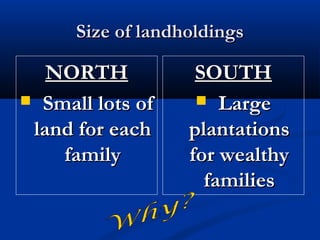
Size of landholdingsSize of landholdings
NORTHNORTH
 Small lots ofSmall lots of
land for eachland for each
familyfamily
SOUTHSOUTH
 LargeLarge
plantationsplantations
for wealthyfor wealthy
familiesfamilies
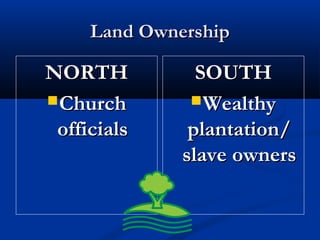
Land OwnershipLand Ownership
NORTHNORTH
ChurchChurch
officialsofficials
SOUTHSOUTH
WealthyWealthy
plantation/plantation/
slave ownersslave owners
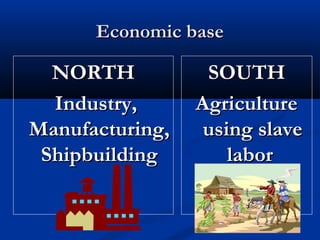
Economic baseEconomic base
NORTHNORTH
Industry,Industry,
Manufacturing,Manufacturing,
ShipbuildingShipbuilding
SOUTHSOUTH
AgricultureAgriculture
using slaveusing slave
laborlabor
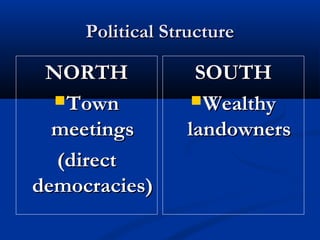
Political StructurePolitical Structure
NORTHNORTH
TownTown
meetingsmeetings
(direct(direct
democracies)democracies)
SOUTHSOUTH
WealthyWealthy
landownerslandowners
SUFFRAGESUFFRAGE
Right to voteRight to vote
EGALITARIANISMEGALITARIANISM
The spread of equalityThe spread of equality
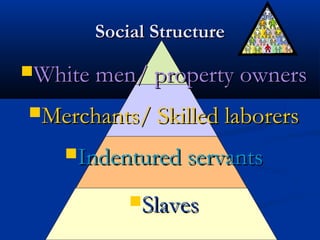
Social StructureSocial Structure
White men/ property ownersWhite men/ property owners
Merchants/ Skilled laborersMerchants/ Skilled laborers
Indentured servantsIndentured servants
SlavesSlaves
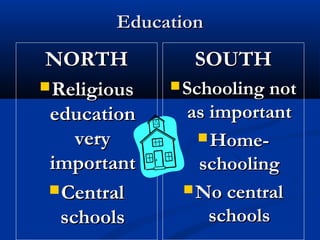
EducationEducation
NORTHNORTH
ReligiousReligious
educationeducation
veryvery
importantimportant
CentralCentral
schoolsschools
SOUTHSOUTH
 Schooling notSchooling not
as importantas important
 Home-Home-
schoolingschooling
 No centralNo central
schoolsschools
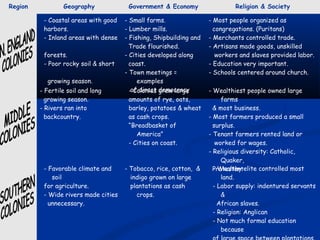
Region Geography Government & Economy Religion & Society
- Coastal areas with good
harbors.
- Inland areas with dense
forests.
- Poor rocky soil & short
growing season.
- Small farms.
- Lumber mills.
- Fishing, Shipbuilding and
Trade flourished.
- Cities developed along
coast.
- Town meetings =
examples
of direct democracy
- Most people organized as
congregations. (Puritans)
- Merchants controlled trade.
- Artisans made goods, unskilled
workers and slaves provided labor.
- Education very important.
- Schools centered around church.
- Fertile soil and long
growing season.
- Rivers ran into
backcountry.
- Colonies grew large
amounts of rye, oats,
barley, potatoes & wheat
as cash crops.
“Breadbasket of
America”
- Cities on coast.
- Wealthiest people owned large
farms
& most business.
- Most farmers produced a small
surplus.
- Tenant farmers rented land or
worked for wages.
- Religious diversity: Catholic,
Quaker,
Protestant- Favorable climate and
soil
for agriculture.
- Wide rivers made cities
unnecessary.
- Tobacco, rice, cotton, &
indigo grown on large
plantations as cash
crops.
- Wealthy elite controlled most
land.
- Labor supply: indentured servants
&
African slaves.
- Religion: Anglican
- Not much formal education
because

Colonial north america_ch3

  • 1.
    Colonial NorthColonial North AmericaAmerica Goal1.01:Goal 1.01: Describe how geographic diversity influenced economic, social, and political life in colonial North America.
  • 2.
    ColonyColony A group ofpeople inA group of people in one place ruled by aone place ruled by a parent countryparent country
  • 4.
     New EnglandColoniesNew England Colonies  ConnecticutConnecticut  Massachusetts BayMassachusetts Bay  Massachusetts and MaineMassachusetts and Maine  New HampshireNew Hampshire  Rhode IslandRhode Island  Middle ColoniesMiddle Colonies  DelawareDelaware  New JerseyNew Jersey  New YorkNew York  PennsylvaniaPennsylvania  Southern ColoniesSouthern Colonies  GeorgiaGeorgia  MarylandMaryland  North CarolinaNorth Carolina  South CarolinaSouth Carolina  VirginiaVirginia  Kentucky, Virginia, West VirginiaKentucky, Virginia, West Virginia
  • 5.
    Why were theEuropeans leavingWhy were the Europeans leaving their homes and coming to America?their homes and coming to America?  The Renaissance created a growingThe Renaissance created a growing interest in geography, exploration, andinterest in geography, exploration, and colonization.colonization.  To increase their wealthTo increase their wealth  To have their own landTo have their own land  To escape religious persecutionTo escape religious persecution  To escape overpopulationTo escape overpopulation  To escape political oppressionTo escape political oppression
  • 6.
    Ethnic and ReligiousPluralismEthnic and Religious Pluralism  Nationalities of individuals coming toNationalities of individuals coming to America in the 17America in the 17thth and 18and 18thth centuries:centuries: EnglishEnglish SpanishSpanish DutchDutch GermanGerman SwedishSwedish
  • 7.
    Ethnic and ReligiousPluralism:Ethnic and Religious Pluralism: Colonial ReligionsColonial Religions  PuritansPuritans  Beliefs:Beliefs: Strict morals regulationStrict morals regulation Emphasis on private Bible studyEmphasis on private Bible study Belief in simplicity of worshipBelief in simplicity of worship Desire to improve society throughDesire to improve society through educationeducation  Pilgrims (Massachusetts) were the mostPilgrims (Massachusetts) were the most famous Puritan sect.famous Puritan sect.  Salem Witch TrialsSalem Witch Trials
  • 8.
    Ethnic and ReligiousPluralism:Ethnic and Religious Pluralism: Colonial ReligionsColonial Religions  QuakersQuakers  Members of the Religious Society of FriendsMembers of the Religious Society of Friends  A form of Protestant Christianity that uses noA form of Protestant Christianity that uses no scripturescripture  Emphasizes simplicity in life and worshipEmphasizes simplicity in life and worship  EgalitarianismEgalitarianism  Resistance to swearing oathsResistance to swearing oaths  Heavily involved Pacifism, Women’s Equality, andHeavily involved Pacifism, Women’s Equality, and Abolition of SlaveryAbolition of Slavery
  • 9.
    Ethnic and ReligiousPluralism:Ethnic and Religious Pluralism: Colonial ReligionsColonial Religions  CatholicismCatholicism  Largest single domination of ChristianityLargest single domination of Christianity  Stresses hierarchical, tightly controlled worship.Stresses hierarchical, tightly controlled worship.  Belief that Jesus Christ is the only son of God andBelief that Jesus Christ is the only son of God and that his death led to grace among those on Earth.that his death led to grace among those on Earth.  Common Practices: Baptism, Confirmation,Common Practices: Baptism, Confirmation, Confession, Communion, StrongConfession, Communion, Strong Priesthood/Monastic traditionPriesthood/Monastic tradition  Maryland was founded specifically as a safe havenMaryland was founded specifically as a safe haven for Catholicsfor Catholics
  • 10.
  • 11.
    SlaverySlavery  The firstAfrican-American slaves wereThe first African-American slaves were brought to America in…brought to America in…  16071607 ……and how did they get here?and how did they get here?  To Jamestown, on a Dutch trading ship asTo Jamestown, on a Dutch trading ship as indentured servantsindentured servants
  • 12.
    Triangular Trade RouteTriangularTrade Route A trade route betweenA trade route between America, Europe, and AfricaAmerica, Europe, and Africa
  • 13.
  • 14.
    Middle PassageMiddle Passage The voyage lasted 2-5 monthsThe voyage lasted 2-5 months  The ships were designed for goods, notThe ships were designed for goods, not people, so the travel was crowded andpeople, so the travel was crowded and inhumane.inhumane.  Tightly packed slaves = spread ofTightly packed slaves = spread of diseases, deathdiseases, death  Slaves fed very little. Many slaves triedSlaves fed very little. Many slaves tried to starve themselves.to starve themselves.
  • 15.
    Middle PassageMiddle Passage http://www.waywelivednc.com/maps/historical/middle-passage.gifhttp://www.waywelivednc.com/maps/historical/middle-passage.gif
  • 16.
    Middle PassageMiddle Passage http://faculty.lacitycollege.edu/moonmc/html/slavery1b.jpghttp://faculty.lacitycollege.edu/moonmc/html/slavery1b.jpg
  • 17.
  • 18.
  • 19.
    What isWhat isslaveryslavery??  An institution where people areAn institution where people are held against their will as propertyheld against their will as property and forced to carry out the will ofand forced to carry out the will of their ownertheir owner
  • 20.
  • 21.
  • 22.
    How is aslave different from anHow is a slave different from an indentured servant?indentured servant?  Indentured servants were bound byIndentured servants were bound by contract for a certain amount ofcontract for a certain amount of time, and had choicetime, and had choice  Slavery was against your will for lifeSlavery was against your will for life
  • 23.
    Plantation SystemPlantation System Very large farms thatVery large farms that were individuallywere individually owned and usuallyowned and usually used slaves as theused slaves as the workforceworkforce
  • 24.
    Plantation SystemPlantation System NegativesNegatives Had to use slaves to be profitableHad to use slaves to be profitable  Only large farmers were successfulOnly large farmers were successful  Dominated economy, so held backDominated economy, so held back industrializationindustrialization
  • 25.
    Plantation SystemPlantation System EconomicBenefitsEconomic Benefits  Allowed new goods to be produced inAllowed new goods to be produced in mass quantitiesmass quantities  Allowed owners to become veryAllowed owners to become very wealthywealthy
  • 26.
    Plantation SystemPlantation System PracticingColoniesPracticing Colonies  Southern ColoniesSouthern Colonies (NC, SC, GA, VA)(NC, SC, GA, VA)
  • 27.
    MercantilismMercantilism  An economicsystem that relied onAn economic system that relied on exportsexports  Export more than you importExport more than you import  Ruling countries used colonies as aRuling countries used colonies as a source of raw materials to makesource of raw materials to make finished goods & sell for high profits,finished goods & sell for high profits, usually in coloniesusually in colonies
  • 28.
    MercantilismMercantilism  Colonial ProductsColonialProducts  Sugar, tobacco, cotton, gold, rice,Sugar, tobacco, cotton, gold, rice, lumber, indigolumber, indigo  Found in Southern colonies; related toFound in Southern colonies; related to plantation systemplantation system
  • 29.
  • 30.
  • 31.
    ROYAL COLONYROYAL COLONY Colony with aColony with a charter grantedcharter granted by the king.by the king.
  • 32.
    SELF-GOVERING COLONYSELF-GOVERING COLONY  ColonythatColony that exercises politicalexercises political authority overauthority over itself.itself.
  • 33.
    Size of landholdingsSizeof landholdings NORTHNORTH  Small lots ofSmall lots of land for eachland for each familyfamily SOUTHSOUTH  LargeLarge plantationsplantations for wealthyfor wealthy familiesfamilies
  • 34.
  • 35.
  • 36.
  • 37.
    SUFFRAGESUFFRAGE Right to voteRightto vote EGALITARIANISMEGALITARIANISM The spread of equalityThe spread of equality
  • 38.
    Social StructureSocial Structure Whitemen/ property ownersWhite men/ property owners Merchants/ Skilled laborersMerchants/ Skilled laborers Indentured servantsIndentured servants SlavesSlaves
  • 39.
  • 40.
    Region Geography Government& Economy Religion & Society
  • 41.
    Region Geography Government& Economy Religion & Society - Coastal areas with good harbors. - Inland areas with dense forests. - Poor rocky soil & short growing season. - Small farms. - Lumber mills. - Fishing, Shipbuilding and Trade flourished. - Cities developed along coast. - Town meetings = examples of direct democracy - Most people organized as congregations. (Puritans) - Merchants controlled trade. - Artisans made goods, unskilled workers and slaves provided labor. - Education very important. - Schools centered around church. - Fertile soil and long growing season. - Rivers ran into backcountry. - Colonies grew large amounts of rye, oats, barley, potatoes & wheat as cash crops. “Breadbasket of America” - Cities on coast. - Wealthiest people owned large farms & most business. - Most farmers produced a small surplus. - Tenant farmers rented land or worked for wages. - Religious diversity: Catholic, Quaker, Protestant- Favorable climate and soil for agriculture. - Wide rivers made cities unnecessary. - Tobacco, rice, cotton, & indigo grown on large plantations as cash crops. - Wealthy elite controlled most land. - Labor supply: indentured servants & African slaves. - Religion: Anglican - Not much formal education because