a. Explain how weaknesses in the Articles of
Confederation and Daniel Shays’ Rebellion
led to a call for a stronger central
government.
   Colonial government during and
    immediately after the American Revolution.
   ―Confederation‖– a loose agreement
   Land Ordinance of 1785 – determined how
    land would be sold – 640 acres for no less
    than $640
   Northwest Ordinance of 1787 – when any
    territory had population of 5000 free male
    adults, it could choose an assembly and
    Congress would name a governing council –
    reach 60,000, apply to become a state –
    done with OH, IN, IL, MI, and WI
   1 vote for each state, regardless of size
   Congress was powerless to regulate foreign
    and interstate commerce
   No executive or judicial branches
   Amended only with consent of ALL states
   9/13 majority required to pass laws
   Farmers arm themselves to prevent courts
    from opening and foreclosing on their land.
   Rebellion put down by military; 4 killed.
   Shays’ Rebellion showed weaknesses in
    government & need for change.
   Congress in 1787 passed resolution
    endorsing convention ―for the sole and
    express purpose of revising the Articles
    of Confederation‖
   55 came, only 39 stayed to end, 36
    signers – ave age 42 – Franklin oldest at
    81
   Sworn to secrecy
   Washington presiding officer, Madison
    secretary – Father of Constitution
   No Jefferson, Adams, or Hamilton
b. Evaluate the major arguments of the anti-
Federalists and Federalists during the debate
on ratification of the Constitution as put forth
in The Federalist concerning form of
government, factions, checks and balances, and
the power of the executive, including the roles
of Alexander Hamilton and James Madison.
   Article VII said would be effective when
    approved by 9 states – submitted in 1787
   Debate b/t Federalists who wanted
    Constitution and strong central govt and Anti-
    Federalists who didn’t
   Anti-Feds saw no advantage for them in new
    Constitution and were afraid strong central
    govt would violate their rights
   Aka The Federalist Papers – series of essays
    published b/t 1787 and 1788 –
   Alexander Hamilton, John Jay, and James
    Madison
   Defended Constitution –
   9th state to ratify was New Hampshire, in
    1788, but needed VA and NY to be successful
   When Bill of Rights promised, VA came in, soon
    followed by New York – RI was last
   Sept 13, 1788, NY City picked as capital
   Oct 10, 1788 Confederation Congress
    disbanded with Franklin saying, ―nothing is
    certain but death and taxes‖
c. Explain the key features of the
Constitution, specifically the Great
Compromise, separation of powers, limited
government, and the issue of slavery.
   Unicameral legislature based on equal
    representation
   Congress have power to tax, regulate
    commerce, have plural executive with no veto
    and a supreme court
   Presented by James Madison
   Separate branches
   Federal system
   Bicameral legislature – based on population –
    ◦ lower house based on popular vote –
    ◦ upper house elected by state legislatures
   Great Compromise aka Connecticut
    Compromise (Roger Sherman) –
    ◦ lower house by population,
    ◦ upper by equality – each state gets
      2, vote as individuals
   3/5 Compromise – 3/5 slaves count for
    taxation and representation
    ◦ No slave trade after 20 years (1808)

   No discussion of women’s rights
   Nat’l govt could: tax, regulate
    commerce, raise an army and navy, make
    laws binding to citizens
   States denied power to issue money, void
    contracts, make treaties or wage
    war, and levy tariffs
   Preamble—Introduction
   Articles— Body
   Amendments 1-10 are known as the Bill of
    Rights, all ratified in 1791.
    ◦ Federalists had to agree to add these to the
      Constitution in order to have it ratified by all of
      the states.
   There are 27 Amendments in total, each
    reflects changes in American society.
    ◦ See handout for a list of Amendments.
   Government is based on the idea of popular
    sovereignty.
   The Legislative branch is first in the
    Constitution because it is closest to the
    American people.
   Requirements for the House of Reps:
    ◦ 25 years old
    ◦ U.S. citizen for 7 years
    ◦ Resident of the state in which you were elected
   Requirements for the Senate:
    ◦ 30 years old
    ◦ U.S. citizen for 9 years
    ◦ Resident of the state in which you were elected
   Requirements to be President
    ◦ Natural Born citizen of the U.S.
    ◦ 35 years old
    ◦ Live in U.S. for 14 years
 Cabinet—President’s advisors (15
  departments)
 22nd Amendment limits to 2 terms; 10
  years max
   Supreme Court
   Justices serve for ―life or good behavior‖
   Power to declare laws ―Constitutional or
    Unconstitutional‖ comes from Marbury v.
    Madison Case
    ◦ (we will talk about court cases later in the unit)
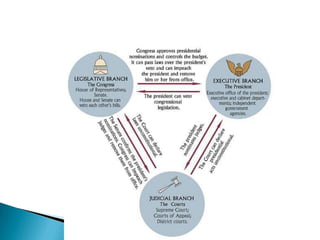
   The writers of the Constitution knew that
    the limits of the powers and responsibilities
    of each branch were not always clear.
   To keep the branches equal in power, the
    writers developed a system of checks and
    balances
   This system of checks and balances
    has several pros and cons:
    ◦ slows the process of making decisions and
      taking action.
    ◦ It gives American citizens time to learn
      about the issues and to give their
      opinions.
    ◦ It also gives the government time to think
      about the effects of any new law.
Explain the importance of the
Presidencies of George
Washington and John Adams;
include the Whiskey Rebellion,
non-intervention in Europe,
and the development of
political parties (Alexander
Hamilton).
   Temp president of Senate counted ballots and
    pronounced Washington unanimous choice of
    Electoral College for president
   Adams second-most votes so VP
   Congress created executive departments:
   Dept of State=foreign affairs=Jefferson
   Dept of Treasury=financial affairs= Hamilton
   Attorney General=legal affairs=Edmund
    Randolph
   Made up Cabinet to advise president
   Chief Justice=John Jay
   Federal and state govt in debt from war
   Hamilton said all debts were a national
    responsibility
   States with lower debts or who had paid
    debts didn’t want it – usually Southern
   Compromise – agree to plan and get national
    capital on Potomac—Washington, D.C.
   Would issue bank notes (paper money) as a
    natl currency, expand capital
   But was this constitutional? Led to division
    between strict and broad constructionism –
    how closely do we follow the Constitution?
   Washington signed bill for a bank
   Excise tax on alcoholic beverages
   National mint to provide money
   Govt encourage manufacturing
   So set up protective tariffs
   Believed even agricultural areas would benefit
    from increased manufacturing
   Began retiring war debt
   Enhanced value of American currency
   Secured gov’t credit
   Attracted foreign capital
   Helped create prosperity in new nation at end
    of 1700s
   Get two political parties: Feds:
    Hamilton, Washington, Adams
   Republicans: Madison and Jefferson – aka
    Democratic Republicans –
   Main issue was power of federal govt –
   Brit and France at war beginning in 1793 –
    lasted until Waterloo in 1815
   1778 Treaty of Alliance had US perpetual
    allies of France- but we didn’t want to –
   Washington issues neutrality proclamation on
    April 22, 1793 which declared US ―friendly
    and impartial toward the belligerent powers‖
   Washington recognized France’s new govt
    and received ambassador Edmond Genet
   Genet outfitted privateers to capture British
    ships and conspired with others to attack Fla
    and LA b/c Spain opposed French Rev
   Cabinet decided unanimously that he had to
    go – hard to sympathize with French
   Hard with Britain too b/c they began to seize
    our ships in Caribbean
   Jay was named special envoy to Britain w/
    orders:
    ◦   Get British out of forts on our land
    ◦   Win payment for lost American ships
    ◦   Win payment for lost American slaves in 1783
    ◦   Get commercial treaty which would allow us to
        trade in British West Indies
   Got two: forts and damages for ships
   In return, Jay agreed to list of demands from
    the British
   Not a good treaty, but way to avoid war so
    Washington signed it
   Tax on liquor had farmers mad
   Rebellion in W PA where they terrorized tax
    collectors and taxpayers – robbed mail,
    stopped courts, and threatened attack on
    Pittsburgh
   1794 Washington ordered them dispersed
   called militia from VA, MD, PA and NJ – led by
    Gen. Henry Lee
   could catch only a few whom Washington
    pardoned
   mixed reaction: some said showed new
    gov’t’s ability to enforce law – others thought
    sign of heavy-handed federal govt
   Spain claimed land up into GA, AL, and TN
    but couldn’t consolidate control
   Paid Indians to attack us
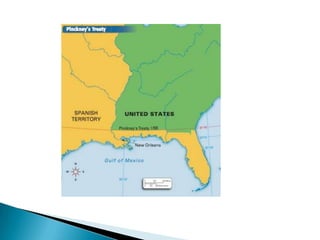
   US ambassador Thomas Pinckney got Spain to
    accept 31st parallel as boundary, allow US to
    use Miss River and New Orleans for free, and
    a promise to stop having Indians attack us
   Very popular
   In Farewell Address
   Warned against sectionalism
   Warned against partisanship
   Warned against permanent alliances
   Feds: John Adams and Thomas Pinckney
   Reps: Thomas Jefferson and Aaron Burr
   Not quite fully developed political parties, but
    this is essential breakdown
   Adams wins presidency, Jefferson has second
    most votes so he is vice president
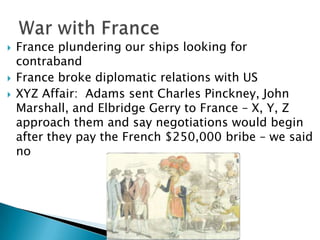
   France plundering our ships looking for
    contraband
   France broke diplomatic relations with US
   XYZ Affair: Adams sent Charles Pinckney, John
    Marshall, and Elbridge Gerry to France – X, Y, Z
    approach them and say negotiations would begin
    after they pay the French $250,000 bribe – we said
    no
   We were in undeclared naval war from 1798-
    1800
   Congress authorized capture of armed French
    ships, suspended commerce and renounced
    1778 Treaty of Alliance
   Congress created Dept of Navy and increased
    number of ships
   French want peace so war stops
   Feds and Reps called each other traitors
   1797 Jefferson hired ―journalist‖ James
    Callender to write pamphlet showing Adams
    wanted monarchy with him as king
   Adams took higher road and asked Jefferson
    to join him in creating bipartisan
    administration but Jefferson declined
   Naturalization Act incr # of years you had to
    live in US to be citizen from 5-14
   Alien Act gave president power to deport
    ―dangerous‖ aliens
   Sedition Act made it illegal to conspire
    against government, including insurrection or
    rioting – also no ―false, scandalous and
    malicious‖ speech against govt
   Very anti-foreign
   Purpose was to punish Reps – new
    immigrant/citizens tended to vote Rep
   All 10 convictions were Republicans
   To counter, Jefferson and Madison wrote KY
    and VA Resolutions
    ◦ Said Alien and Sedition Acts were violations of
      constitutional rights and said states could ―nullify‖
      them if necess
   Complaints against Feds:
   taxes to support an unnecessary army,
   Alien and Sedition Acts,
   fears about Adams and monarchism,
   anger at Hamilton’s economic program,
   suppression of Whiskey Rebellion
   Jay’s Treaty
   Feds: John Adams and Charles Pinckney-
   Reps: Jefferson and Burr
   tied so went to House of Reps – Hamilton
    supported Jefferson
   Revolution of 1800 because party changed
   Before leaving office, Federalists in Congress
    passed Judiciary Act of 1801
   Created 16 circuit courts and increased
    numbers of other judge positions
   Adams named John Marshall chief justice of
    Supreme Court

Ssush05 2011

  • 1.
    a. Explain howweaknesses in the Articles of Confederation and Daniel Shays’ Rebellion led to a call for a stronger central government.
  • 2.
    Colonial government during and immediately after the American Revolution.  ―Confederation‖– a loose agreement
  • 3.
    Land Ordinance of 1785 – determined how land would be sold – 640 acres for no less than $640  Northwest Ordinance of 1787 – when any territory had population of 5000 free male adults, it could choose an assembly and Congress would name a governing council – reach 60,000, apply to become a state – done with OH, IN, IL, MI, and WI
  • 4.
    1 vote for each state, regardless of size  Congress was powerless to regulate foreign and interstate commerce  No executive or judicial branches  Amended only with consent of ALL states  9/13 majority required to pass laws
  • 5.
    Farmers arm themselves to prevent courts from opening and foreclosing on their land.  Rebellion put down by military; 4 killed.  Shays’ Rebellion showed weaknesses in government & need for change.
  • 6.
    Congress in 1787 passed resolution endorsing convention ―for the sole and express purpose of revising the Articles of Confederation‖  55 came, only 39 stayed to end, 36 signers – ave age 42 – Franklin oldest at 81  Sworn to secrecy  Washington presiding officer, Madison secretary – Father of Constitution  No Jefferson, Adams, or Hamilton
  • 7.
    b. Evaluate themajor arguments of the anti- Federalists and Federalists during the debate on ratification of the Constitution as put forth in The Federalist concerning form of government, factions, checks and balances, and the power of the executive, including the roles of Alexander Hamilton and James Madison.
  • 8.
    Article VII said would be effective when approved by 9 states – submitted in 1787  Debate b/t Federalists who wanted Constitution and strong central govt and Anti- Federalists who didn’t
  • 9.
    Anti-Feds saw no advantage for them in new Constitution and were afraid strong central govt would violate their rights
  • 10.
    Aka The Federalist Papers – series of essays published b/t 1787 and 1788 –  Alexander Hamilton, John Jay, and James Madison  Defended Constitution –
  • 11.
    9th state to ratify was New Hampshire, in 1788, but needed VA and NY to be successful  When Bill of Rights promised, VA came in, soon followed by New York – RI was last
  • 12.
    Sept 13, 1788, NY City picked as capital  Oct 10, 1788 Confederation Congress disbanded with Franklin saying, ―nothing is certain but death and taxes‖
  • 13.
    c. Explain thekey features of the Constitution, specifically the Great Compromise, separation of powers, limited government, and the issue of slavery.
  • 14.
    Unicameral legislature based on equal representation  Congress have power to tax, regulate commerce, have plural executive with no veto and a supreme court
  • 15.
    Presented by James Madison  Separate branches  Federal system  Bicameral legislature – based on population – ◦ lower house based on popular vote – ◦ upper house elected by state legislatures
  • 16.
    Great Compromise aka Connecticut Compromise (Roger Sherman) – ◦ lower house by population, ◦ upper by equality – each state gets 2, vote as individuals
  • 17.
    3/5 Compromise – 3/5 slaves count for taxation and representation ◦ No slave trade after 20 years (1808)  No discussion of women’s rights
  • 18.
    Nat’l govt could: tax, regulate commerce, raise an army and navy, make laws binding to citizens  States denied power to issue money, void contracts, make treaties or wage war, and levy tariffs
  • 20.
    Preamble—Introduction  Articles— Body  Amendments 1-10 are known as the Bill of Rights, all ratified in 1791. ◦ Federalists had to agree to add these to the Constitution in order to have it ratified by all of the states.
  • 21.
    There are 27 Amendments in total, each reflects changes in American society. ◦ See handout for a list of Amendments.  Government is based on the idea of popular sovereignty.
  • 22.
    The Legislative branch is first in the Constitution because it is closest to the American people.  Requirements for the House of Reps: ◦ 25 years old ◦ U.S. citizen for 7 years ◦ Resident of the state in which you were elected  Requirements for the Senate: ◦ 30 years old ◦ U.S. citizen for 9 years ◦ Resident of the state in which you were elected
  • 23.
    Requirements to be President ◦ Natural Born citizen of the U.S. ◦ 35 years old ◦ Live in U.S. for 14 years  Cabinet—President’s advisors (15 departments)  22nd Amendment limits to 2 terms; 10 years max
  • 24.
    Supreme Court  Justices serve for ―life or good behavior‖  Power to declare laws ―Constitutional or Unconstitutional‖ comes from Marbury v. Madison Case ◦ (we will talk about court cases later in the unit)
  • 25.
    The writers of the Constitution knew that the limits of the powers and responsibilities of each branch were not always clear.  To keep the branches equal in power, the writers developed a system of checks and balances
  • 27.
    This system of checks and balances has several pros and cons: ◦ slows the process of making decisions and taking action. ◦ It gives American citizens time to learn about the issues and to give their opinions. ◦ It also gives the government time to think about the effects of any new law.
  • 28.
    Explain the importanceof the Presidencies of George Washington and John Adams; include the Whiskey Rebellion, non-intervention in Europe, and the development of political parties (Alexander Hamilton).
  • 29.
    Temp president of Senate counted ballots and pronounced Washington unanimous choice of Electoral College for president  Adams second-most votes so VP
  • 30.
    Congress created executive departments:  Dept of State=foreign affairs=Jefferson  Dept of Treasury=financial affairs= Hamilton  Attorney General=legal affairs=Edmund Randolph  Made up Cabinet to advise president  Chief Justice=John Jay
  • 31.
    Federal and state govt in debt from war  Hamilton said all debts were a national responsibility  States with lower debts or who had paid debts didn’t want it – usually Southern  Compromise – agree to plan and get national capital on Potomac—Washington, D.C.
  • 32.
    Would issue bank notes (paper money) as a natl currency, expand capital  But was this constitutional? Led to division between strict and broad constructionism – how closely do we follow the Constitution?  Washington signed bill for a bank
  • 33.
    Excise tax on alcoholic beverages  National mint to provide money  Govt encourage manufacturing  So set up protective tariffs  Believed even agricultural areas would benefit from increased manufacturing
  • 34.
    Began retiring war debt  Enhanced value of American currency  Secured gov’t credit  Attracted foreign capital  Helped create prosperity in new nation at end of 1700s
  • 35.
    Get two political parties: Feds: Hamilton, Washington, Adams  Republicans: Madison and Jefferson – aka Democratic Republicans –  Main issue was power of federal govt –
  • 36.
    Brit and France at war beginning in 1793 – lasted until Waterloo in 1815  1778 Treaty of Alliance had US perpetual allies of France- but we didn’t want to –  Washington issues neutrality proclamation on April 22, 1793 which declared US ―friendly and impartial toward the belligerent powers‖
  • 37.
    Washington recognized France’s new govt and received ambassador Edmond Genet  Genet outfitted privateers to capture British ships and conspired with others to attack Fla and LA b/c Spain opposed French Rev  Cabinet decided unanimously that he had to go – hard to sympathize with French  Hard with Britain too b/c they began to seize our ships in Caribbean
  • 38.
    Jay was named special envoy to Britain w/ orders: ◦ Get British out of forts on our land ◦ Win payment for lost American ships ◦ Win payment for lost American slaves in 1783 ◦ Get commercial treaty which would allow us to trade in British West Indies
  • 39.
    Got two: forts and damages for ships  In return, Jay agreed to list of demands from the British  Not a good treaty, but way to avoid war so Washington signed it
  • 40.
    Tax on liquor had farmers mad  Rebellion in W PA where they terrorized tax collectors and taxpayers – robbed mail, stopped courts, and threatened attack on Pittsburgh
  • 41.
    1794 Washington ordered them dispersed  called militia from VA, MD, PA and NJ – led by Gen. Henry Lee  could catch only a few whom Washington pardoned  mixed reaction: some said showed new gov’t’s ability to enforce law – others thought sign of heavy-handed federal govt
  • 42.
    Spain claimed land up into GA, AL, and TN but couldn’t consolidate control  Paid Indians to attack us  US ambassador Thomas Pinckney got Spain to accept 31st parallel as boundary, allow US to use Miss River and New Orleans for free, and a promise to stop having Indians attack us  Very popular
  • 44.
    In Farewell Address  Warned against sectionalism  Warned against partisanship  Warned against permanent alliances
  • 45.
    Feds: John Adams and Thomas Pinckney  Reps: Thomas Jefferson and Aaron Burr  Not quite fully developed political parties, but this is essential breakdown  Adams wins presidency, Jefferson has second most votes so he is vice president
  • 46.
    France plundering our ships looking for contraband  France broke diplomatic relations with US  XYZ Affair: Adams sent Charles Pinckney, John Marshall, and Elbridge Gerry to France – X, Y, Z approach them and say negotiations would begin after they pay the French $250,000 bribe – we said no
  • 47.
    We were in undeclared naval war from 1798- 1800  Congress authorized capture of armed French ships, suspended commerce and renounced 1778 Treaty of Alliance  Congress created Dept of Navy and increased number of ships  French want peace so war stops
  • 48.
    Feds and Reps called each other traitors  1797 Jefferson hired ―journalist‖ James Callender to write pamphlet showing Adams wanted monarchy with him as king  Adams took higher road and asked Jefferson to join him in creating bipartisan administration but Jefferson declined
  • 49.
    Naturalization Act incr # of years you had to live in US to be citizen from 5-14  Alien Act gave president power to deport ―dangerous‖ aliens  Sedition Act made it illegal to conspire against government, including insurrection or rioting – also no ―false, scandalous and malicious‖ speech against govt  Very anti-foreign
  • 50.
    Purpose was to punish Reps – new immigrant/citizens tended to vote Rep  All 10 convictions were Republicans  To counter, Jefferson and Madison wrote KY and VA Resolutions ◦ Said Alien and Sedition Acts were violations of constitutional rights and said states could ―nullify‖ them if necess
  • 51.
    Complaints against Feds:  taxes to support an unnecessary army,  Alien and Sedition Acts,  fears about Adams and monarchism,  anger at Hamilton’s economic program,  suppression of Whiskey Rebellion  Jay’s Treaty
  • 52.
    Feds: John Adams and Charles Pinckney-  Reps: Jefferson and Burr  tied so went to House of Reps – Hamilton supported Jefferson  Revolution of 1800 because party changed
  • 53.
    Before leaving office, Federalists in Congress passed Judiciary Act of 1801  Created 16 circuit courts and increased numbers of other judge positions  Adams named John Marshall chief justice of Supreme Court

Editor's Notes

  • #42 Feds(should remind you of) Federalists Wanted Strong National Government  Broad Interp. Of ConstitutionRepublicans Anti-Feds Stronger State governments Loose interpretation of the Constitution.