The Early Republic Launching the New Government
Chapter 9, Section 1: Washington Takes Office
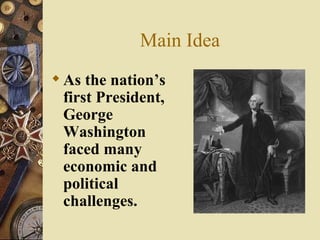
Main Idea As the nation’s first President, George Washington faced many economic and political challenges.
I. Washington’s First Steps Everything he did set a  precedent  for those who followed Stepped down after 2 terms First Cabinet Federal Court System
I. Washington’s First Steps Washington’s Cabinet: Made up by: Heads of departments Two most influential leaders: Alexander Hamilton Thomas Jefferson Job of the Cabinet To give advice to Washington
I. Washington’s First Steps Federal Court System: Set up by the Judiciary Act 1 chief justice and 5 associate justices First Chief Justice of the U.S.: John Jay
II. Hamilton’s Plan Proposed paying off  national debt   Debt of Federal goovernment and states 1790 - Compromise put US capital in District of Columbia and paid off debt 1791- Established  Bank of the United States  and  protective tariffs
II. Hamilton’s Plan Job of the Bank: Pay off gvn’t bills Make loans Protective Tariffs: Purpose: to protect local industry from foreign compitition
III.The Whiskey Rebellion (1794) Backcountry farmers refused to pay the tax Washington showed the strength, and mercy of the new gvn’t by:   Pardoning all people involved
Chapter 9, Section 2: Creating a Foreign Policy
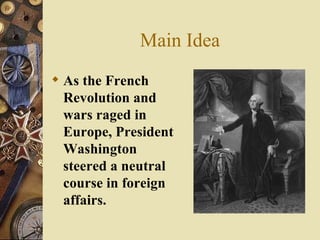
Main Idea As the French Revolution and wars raged in Europe, President Washington steered a neutral course in foreign affairs.
I. Foreign Policy Washington advocated a policy of  neutrality  in foreign affairs Neutrality Proclamation: Not support either side
I. Foreign Policy Jay’s Treaty: Britain must pay for damages to U.S. ships Britain must give up forts in the west (U.S.) U.S. must pay debts to British Merchants
Chapter 9, Section 3: Political Parties Emerge
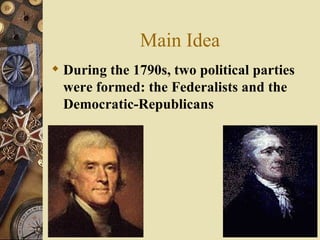
Main Idea During the 1790s, two political parties were formed: the Federalists and the Democratic-Republicans
I. Federalists Led by: ___________ Believed wealthy and well-educated should lead nation Favored strong central government Favored manufacturing, trade, cities
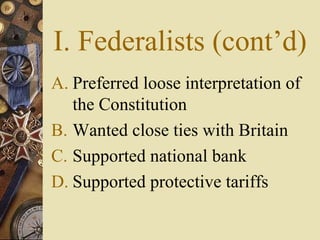
I. Federalists (cont’d) Preferred loose interpretation of the Constitution Wanted close ties with Britain Supported national bank Supported protective tariffs
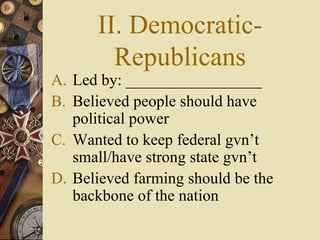
II. Democratic-Republicans Led by: _________________ Believed people should have political power Wanted to keep federal gvn’t small/have strong state gvn’t Believed farming should be the backbone of the nation
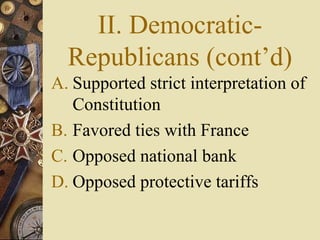
II. Democratic-Republicans (cont’d) Supported strict interpretation of Constitution Favored ties with France Opposed national bank Opposed protective tariffs
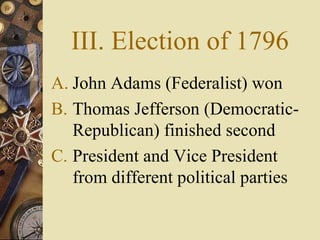
III. Election of 1796 John Adams (Federalist) won Thomas Jefferson (Democratic-Republican) finished second President and Vice President from different political parties

The Early Republic

  • 1.
    The Early RepublicLaunching the New Government
  • 2.
    Chapter 9, Section1: Washington Takes Office
  • 3.
    Main Idea Asthe nation’s first President, George Washington faced many economic and political challenges.
  • 4.
    I. Washington’s FirstSteps Everything he did set a precedent for those who followed Stepped down after 2 terms First Cabinet Federal Court System
  • 5.
    I. Washington’s FirstSteps Washington’s Cabinet: Made up by: Heads of departments Two most influential leaders: Alexander Hamilton Thomas Jefferson Job of the Cabinet To give advice to Washington
  • 6.
    I. Washington’s FirstSteps Federal Court System: Set up by the Judiciary Act 1 chief justice and 5 associate justices First Chief Justice of the U.S.: John Jay
  • 7.
    II. Hamilton’s PlanProposed paying off national debt Debt of Federal goovernment and states 1790 - Compromise put US capital in District of Columbia and paid off debt 1791- Established Bank of the United States and protective tariffs
  • 8.
    II. Hamilton’s PlanJob of the Bank: Pay off gvn’t bills Make loans Protective Tariffs: Purpose: to protect local industry from foreign compitition
  • 9.
    III.The Whiskey Rebellion(1794) Backcountry farmers refused to pay the tax Washington showed the strength, and mercy of the new gvn’t by: Pardoning all people involved
  • 10.
    Chapter 9, Section2: Creating a Foreign Policy
  • 11.
    Main Idea Asthe French Revolution and wars raged in Europe, President Washington steered a neutral course in foreign affairs.
  • 12.
    I. Foreign PolicyWashington advocated a policy of neutrality in foreign affairs Neutrality Proclamation: Not support either side
  • 13.
    I. Foreign PolicyJay’s Treaty: Britain must pay for damages to U.S. ships Britain must give up forts in the west (U.S.) U.S. must pay debts to British Merchants
  • 14.
    Chapter 9, Section3: Political Parties Emerge
  • 15.
    Main Idea Duringthe 1790s, two political parties were formed: the Federalists and the Democratic-Republicans
  • 16.
    I. Federalists Ledby: ___________ Believed wealthy and well-educated should lead nation Favored strong central government Favored manufacturing, trade, cities
  • 17.
    I. Federalists (cont’d)Preferred loose interpretation of the Constitution Wanted close ties with Britain Supported national bank Supported protective tariffs
  • 18.
    II. Democratic-Republicans Ledby: _________________ Believed people should have political power Wanted to keep federal gvn’t small/have strong state gvn’t Believed farming should be the backbone of the nation
  • 19.
    II. Democratic-Republicans (cont’d)Supported strict interpretation of Constitution Favored ties with France Opposed national bank Opposed protective tariffs
  • 20.
    III. Election of1796 John Adams (Federalist) won Thomas Jefferson (Democratic-Republican) finished second President and Vice President from different political parties