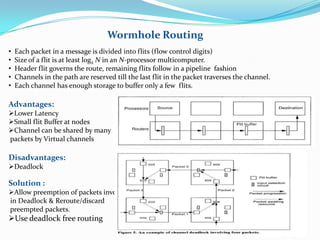
• Each packet in a message is divided into flits (flow control digits)
• Size of a flit is at least log2 N in an N-processor multicomputer.
• Header flit governs the route, remaining flits follow in a pipeline fashion
• Channels in the path are reserved till the last flit in the packet traverses the channel.
• Each channel has enough storage to buffer only a few flits.
Advantages:
Lower Latency
Small flit Buffer at nodes
Channel can be shared by many
packets by Virtual channels
Disadvantages:
Deadlock
Solution :
Allow preemption of packets involved
in Deadlock & Reroute/discard
preempted packets.
Use deadlock free routing
Wormhole Routing
Handshaking and Latency
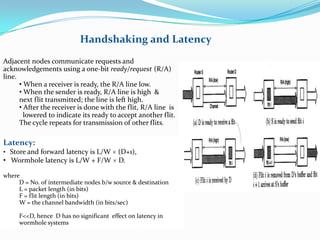
Adjacent nodes communicate requests and
acknowledgements using a one-bit ready/request (R/A)
line.
• When a receiver is ready, the R/A line low.
• When the sender is ready, R/A line is high &
next flit transmitted; the line is left high.
• After the receiver is done with the flit, R/A line is
lowered to indicate its ready to accept another flit.
The cycle repeats for transmission of other flits.
Latency:
• Store and forward latency is L/W (D+1),
• Wormhole latency is L/W + F/W D.
where
D = No. of intermediate nodes b/w source & destination
L = packet length (in bits)
F = flit length (in bits)
W = the channel bandwidth (in bits/sec)
F<<D, hence D has no significant effect on latency in
wormhole systems
Virtual Channels
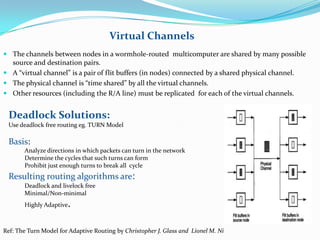
 The channels between nodes in a wormhole-routed multicomputer are shared by many possible
source and destination pairs.
 A “virtual channel” is a pair of flit buffers (in nodes) connected by a shared physical channel.
 The physical channel is “time shared” by all the virtual channels.
 Other resources (including the R/A line) must be replicated for each of the virtual channels.
Deadl0ck Solutions:
Use deadlock free routing eg. TURN Model
Basis:
Analyze directions in which packets can turn in the network
Determine the cycles that such turns can form
Prohibit just enough turns to break all cycle
Resulting routing algorithms are:
Deadlock and livelock free
Minimal/Non-minimal
Highly Adaptive.
Ref: The Turn Model for Adaptive Routing by Christopher J. Glass and Lionel M. Ni

Warmhole routing ppt

  • 1.
    • Each packetin a message is divided into flits (flow control digits) • Size of a flit is at least log2 N in an N-processor multicomputer. • Header flit governs the route, remaining flits follow in a pipeline fashion • Channels in the path are reserved till the last flit in the packet traverses the channel. • Each channel has enough storage to buffer only a few flits. Advantages: Lower Latency Small flit Buffer at nodes Channel can be shared by many packets by Virtual channels Disadvantages: Deadlock Solution : Allow preemption of packets involved in Deadlock & Reroute/discard preempted packets. Use deadlock free routing Wormhole Routing
  • 2.
    Handshaking and Latency Adjacentnodes communicate requests and acknowledgements using a one-bit ready/request (R/A) line. • When a receiver is ready, the R/A line low. • When the sender is ready, R/A line is high & next flit transmitted; the line is left high. • After the receiver is done with the flit, R/A line is lowered to indicate its ready to accept another flit. The cycle repeats for transmission of other flits. Latency: • Store and forward latency is L/W (D+1), • Wormhole latency is L/W + F/W D. where D = No. of intermediate nodes b/w source & destination L = packet length (in bits) F = flit length (in bits) W = the channel bandwidth (in bits/sec) F<<D, hence D has no significant effect on latency in wormhole systems
  • 3.
    Virtual Channels  Thechannels between nodes in a wormhole-routed multicomputer are shared by many possible source and destination pairs.  A “virtual channel” is a pair of flit buffers (in nodes) connected by a shared physical channel.  The physical channel is “time shared” by all the virtual channels.  Other resources (including the R/A line) must be replicated for each of the virtual channels. Deadl0ck Solutions: Use deadlock free routing eg. TURN Model Basis: Analyze directions in which packets can turn in the network Determine the cycles that such turns can form Prohibit just enough turns to break all cycle Resulting routing algorithms are: Deadlock and livelock free Minimal/Non-minimal Highly Adaptive. Ref: The Turn Model for Adaptive Routing by Christopher J. Glass and Lionel M. Ni