Proximity Preserving Labeling Schemes
and Their Applications
By – David Peleg
Presented By – Meenakshi Tripathi
Here comes your footer  Page 2
Features
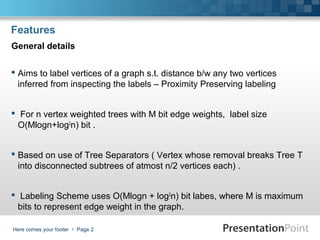
 Aims to label vertices of a graph s.t. distance b/w any two vertices
inferred from inspecting the labels – Proximity Preserving labeling
 For n vertex weighted trees with M bit edge weights, label size
O(Mlogn+log2
n) bit .
 Based on use of Tree Separators ( Vertex whose removal breaks Tree T
into disconnected subtrees of atmost n/2 vertices each) .
 Labeling Scheme uses O(Mlogn + log2
n) bit labes, where M is maximum
bits to represent edge weight in the graph.
General details
Here comes your footer  Page 3
The Labeling System
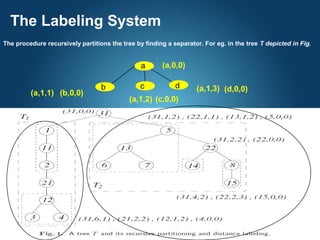
The procedure recursively partitions the tree by finding a separator. For eg. in the tree T depicted in Fig.
(a,0,0)a
b dc
(a,1,1)
(a,1,3)
(a,1,2)
(b,0,0) (d,0,0)
(c,0,0)
Labeling Algorithm : Proc1
Label Description
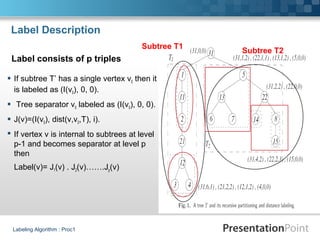
 If subtree T’ has a single vertex v0 then it
is labeled as (I(v0), 0, 0).
 Tree separator v0 labeled as (I(v0), 0, 0).
 J(v)=(I(v0), dist(v,v0,T), i).
 If vertex v is internal to subtrees at level
p-1 and becomes separator at level p
then
Label(v)= J1(v) . J2(v)…….Jp(v)
Label consists of p triples
Subtree T2
Subtree T1
Distance Finding Algorithm  Proc2
Computing the Distances–
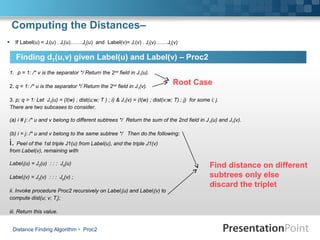
 If Label(u) = J1(u) . J2(u)…….Jp(u) and Label(v)= J1(v) . J2(v)…….Jp(v)
Finding dT(u,v) given Label(u) and Label(v) – Proc2
1. p = 1: /* v is the separator */ Return the 2nd
field in J1(u).
2. q = 1: /* u is the separator */ Return the 2nd
field in J1(v).
3. p; q > 1: Let J1(u) = (I(w) ; dist(u;w; T ) ; i) & J1(v) = (I(w) ; dist(v;w; T) ; j) for some i; j.
There are two subcases to consider.
(a) i # j: /* u and v belong to different subtrees */ Return the sum of the 2nd field in J1(u) and J1(v).
(b) i = j: /* u and v belong to the same subtree */ Then do the following:
i. Peel of the 1st triple J1(u) from Label(u), and the triple J1(v)
from Label(v), remaining with
Labeli(u) = J2(u) : : : Jq(u)
Labeli(v) = J2(v) : : : Jp(v) ;
ii. Invoke procedure Proc2 recursively on Labeli(u) and Labeli(v) to
compute dist(u; v; Ti);
iii. Return this value.
Root Case
Find distance on different
subtrees only else
discard the triplet
Distance approx. labelings
Distance- Approximating Labelings
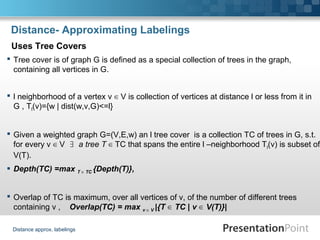
 Tree cover is of graph G is defined as a special collection of trees in the graph,
containing all vertices in G.
 l neighborhood of a vertex v V is collection of vertices at distance l or less from it in∈
G , Tl(v)={w | dist(w,v,G)<=l}
 Given a weighted graph G=(V,E,w) an l tree cover is a collection TC of trees in G, s.t.
for every v V∈ ∃ a tree T TC that spans the entire l –neighborhood T∈ l(v) is subset of
V(T).
 Depth(TC) =max T TC∈ {Depth(T)},
 Overlap of TC is maximum, over all vertices of v, of the number of different trees
containing v , Overlap(TC) = max v V∈ |{T TC |∈ v V(T)}|∈
Uses Tree Covers
Here comes your footer  Page 7
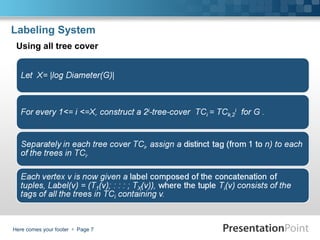
Labeling System
Using all tree cover
Here comes your footer  Page 8
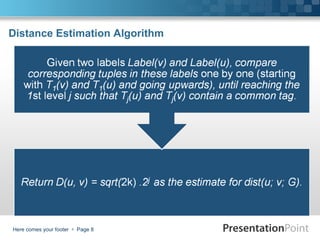
Distance Estimation Algorithm
THANKS
THANKS

Compact routing peleg paper

  • 1.
    Proximity Preserving LabelingSchemes and Their Applications By – David Peleg Presented By – Meenakshi Tripathi
  • 2.
    Here comes yourfooter  Page 2 Features  Aims to label vertices of a graph s.t. distance b/w any two vertices inferred from inspecting the labels – Proximity Preserving labeling  For n vertex weighted trees with M bit edge weights, label size O(Mlogn+log2 n) bit .  Based on use of Tree Separators ( Vertex whose removal breaks Tree T into disconnected subtrees of atmost n/2 vertices each) .  Labeling Scheme uses O(Mlogn + log2 n) bit labes, where M is maximum bits to represent edge weight in the graph. General details
  • 3.
    Here comes yourfooter  Page 3 The Labeling System The procedure recursively partitions the tree by finding a separator. For eg. in the tree T depicted in Fig. (a,0,0)a b dc (a,1,1) (a,1,3) (a,1,2) (b,0,0) (d,0,0) (c,0,0)
  • 4.
    Labeling Algorithm :Proc1 Label Description  If subtree T’ has a single vertex v0 then it is labeled as (I(v0), 0, 0).  Tree separator v0 labeled as (I(v0), 0, 0).  J(v)=(I(v0), dist(v,v0,T), i).  If vertex v is internal to subtrees at level p-1 and becomes separator at level p then Label(v)= J1(v) . J2(v)…….Jp(v) Label consists of p triples Subtree T2 Subtree T1
  • 5.
    Distance Finding Algorithm Proc2 Computing the Distances–  If Label(u) = J1(u) . J2(u)…….Jp(u) and Label(v)= J1(v) . J2(v)…….Jp(v) Finding dT(u,v) given Label(u) and Label(v) – Proc2 1. p = 1: /* v is the separator */ Return the 2nd field in J1(u). 2. q = 1: /* u is the separator */ Return the 2nd field in J1(v). 3. p; q > 1: Let J1(u) = (I(w) ; dist(u;w; T ) ; i) & J1(v) = (I(w) ; dist(v;w; T) ; j) for some i; j. There are two subcases to consider. (a) i # j: /* u and v belong to different subtrees */ Return the sum of the 2nd field in J1(u) and J1(v). (b) i = j: /* u and v belong to the same subtree */ Then do the following: i. Peel of the 1st triple J1(u) from Label(u), and the triple J1(v) from Label(v), remaining with Labeli(u) = J2(u) : : : Jq(u) Labeli(v) = J2(v) : : : Jp(v) ; ii. Invoke procedure Proc2 recursively on Labeli(u) and Labeli(v) to compute dist(u; v; Ti); iii. Return this value. Root Case Find distance on different subtrees only else discard the triplet
  • 6.
    Distance approx. labelings Distance-Approximating Labelings  Tree cover is of graph G is defined as a special collection of trees in the graph, containing all vertices in G.  l neighborhood of a vertex v V is collection of vertices at distance l or less from it in∈ G , Tl(v)={w | dist(w,v,G)<=l}  Given a weighted graph G=(V,E,w) an l tree cover is a collection TC of trees in G, s.t. for every v V∈ ∃ a tree T TC that spans the entire l –neighborhood T∈ l(v) is subset of V(T).  Depth(TC) =max T TC∈ {Depth(T)},  Overlap of TC is maximum, over all vertices of v, of the number of different trees containing v , Overlap(TC) = max v V∈ |{T TC |∈ v V(T)}|∈ Uses Tree Covers
  • 7.
    Here comes yourfooter  Page 7 Labeling System Using all tree cover
  • 8.
    Here comes yourfooter  Page 8 Distance Estimation Algorithm
  • 9.
  • 10.

Editor's Notes

  • #3 Achieves stretch (1, d) using O(elog2n) bit local Routing tables &amp; message headers. TZ achieves (3,0) stretch with O(n^1/2 log 2 n) table size Hybrid Scheme achieves stretch min { (1,d), (3,0)}
  • #8 Tree cover – Data struc to speedup nearest neighbor search, tree = hierarchy of levels; level c associated with i decreases by 1 as tree is descended. Properties of level C : 1) Nesting C i IS SUBSET OF C i-1 2) for all q ∈ C i-1 there exist p ∈ C i s.t. dis p.q&lt;=2^i and only one such p, called parent of q; 3) Separation : for all p,q ∈ C i , dis p.q &gt; 2^i