Multiprotocol Label Switching (MPLS)
By Sumita Das
Isha Pandya
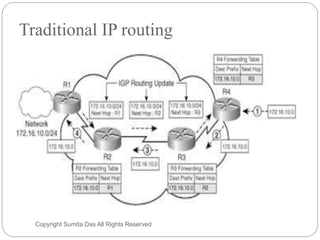
Traditional IP routing
Created by Sumita Das
IP routing
 Data is routed from source to destination through series of
routers
 Each router has routing table
 Disadvantages:
1. Routing protocols are used on all devices
2. Routing lookups are performed on every router
3. Each router in network makes an independent decision
when forwarding packets
Created by Sumita Das
IP Routing
4. connectionless. Eg. No QoS
5.Larger IP header
Why MPLS
1. Makes IP routing fast
2. Reduces number of routing lookups
3. Eliminates to run a particular routing protocol on all the
devices
Created by Sumita Das
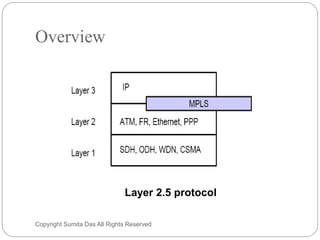
Overview
Layer 2.5 protocol
Created by Sumita Das
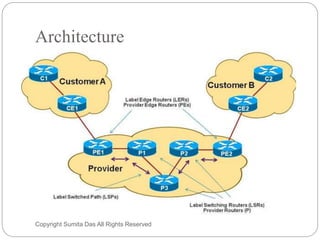
Architecture
Components:
1. Provider router
2.Provider edge router
3.Customer edge router
1. Provider router/ Label switching routers
- Service provider’s router
-located in the middle of an MPLS network
-uses the label included in the packet header as an index to
determine the next hop
Created by Sumita Das
Architecture
2. Provider Edge Routers/ Label Edge Routers
-operates at the edge of an MPLS network
-entry and exit points for the network
-PUSH to add label on incoming packet
-POP to remove label from outgoing packet
3. Customer edge router
- routers on customer side
Created by Sumita Das
Architecture
Created by Sumita Das
MPLS Header
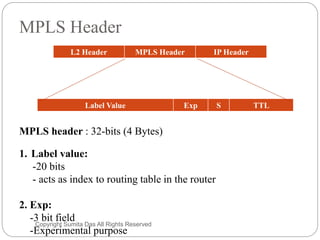
L2 Header MPLS Header IP Header
Label Value Exp S TTL
MPLS header : 32-bits (4 Bytes)
1. Label value:
-20 bits
- acts as index to routing table in the router
2. Exp:
-3 bit field
-Experimental purpose
Created by Sumita Das
MPLS Header
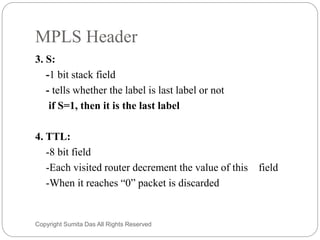
3. S:
-1 bit stack field
- tells whether the label is last label or not
if S=1, then it is the last label
4. TTL:
-8 bit field
-Each visited router decrement the value of this field
-When it reaches “0” packet is discarded
Created by Sumita Das
Forwarding Equivalence Class (FEC)
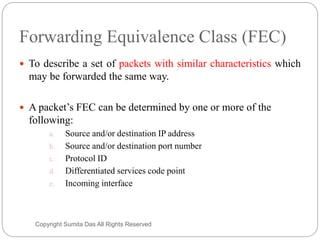
 To describe a set of packets with similar characteristics which
may be forwarded the same way.
 A packet’s FEC can be determined by one or more of the
following:
a. Source and/or destination IP address
b. Source and/or destination port number
c. Protocol ID
d. Differentiated services code point
e. Incoming interface
Created by Sumita Das
Forwarding Equivalence Class (FEC)
 The FEC can implicitly indicate such information, and routing
decisions in the network can automatically take that information
into account.
 A given FEC can force a packet to take a particular route through
the network.
Created by Sumita Das
Label-switched path (LSP)
 The path through a network is determined solely by the
FEC that applies at the point of ingress.
 A path is established before the data transmission starts.
Created by Sumita Das
Label Distribution Protocol(LDP)
 A protocol that enables the routers to automatically share
FEC/label bindings.
 The primary function of LDP-
Establishment and maintenance of LSPs
Created by Sumita Das
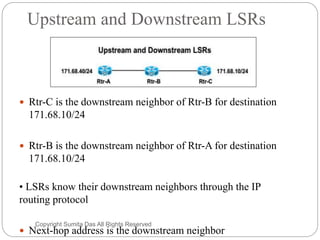
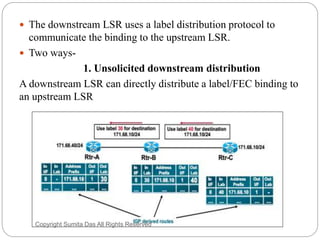
Upstream and Downstream LSRs
 Rtr-C is the downstream neighbor of Rtr-B for destination
171.68.10/24
 Rtr-B is the downstream neighbor of Rtr-A for destination
171.68.10/24
• LSRs know their downstream neighbors through the IP
routing protocol
 Next-hop address is the downstream neighbor
Created by Sumita Das
 The downstream LSR uses a label distribution protocol to
communicate the binding to the upstream LSR.
 Two ways-
1. Unsolicited downstream distribution
A downstream LSR can directly distribute a label/FEC binding to
an upstream LSR
Created by Sumita Das
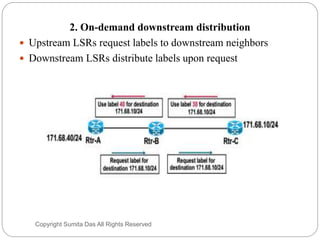
2. On-demand downstream distribution
 Upstream LSRs request labels to downstream neighbors
 Downstream LSRs distribute labels upon request
Created by Sumita Das
 In order for a downstream LSR to communicate a label/FEC
binding to an upstream LSR, the label distribution protocol
messages are sent.
 The message includes
 specific FEC values and
 label values.
Created by Sumita Das
LDP Messages
LDP offers four categories of messages:
1. Discovery messages
2. Session Management messages
3. Advertisement messages
4. Notification messages
Discovery messages
• Used to discover and maintain the presence of new peers
• Hello packets sent to all-routers multicast address
• Receiver of hello message replies with a hello message.
• Both LSRs are aware of each other’s presence.
Created by Sumita Das
Session messages
 To establish, maintain, and terminate sessions between LDP
peers.
 To exchange Initialization messages.
 An Initialization message includes receiver’s LDP identifier
and other optional parameters.
 Once two LSRs have exchanged Initialization messages, an
LDP session is established between them.
Advertisement messages
 To create, change, and delete label mappings for FECs.
Notification messages
 Used to provide advisory information and signal error
information.Created by Sumita Das
References
Created by Sumita Das
[1] Richard Swale,”Carrier Grade Voice Over IP”, Third
Edition
Thank You
Created by Sumita Das

Multiprotocol label switching

  • 1.
    Multiprotocol Label Switching(MPLS) By Sumita Das Isha Pandya
  • 2.
  • 3.
    IP routing  Datais routed from source to destination through series of routers  Each router has routing table  Disadvantages: 1. Routing protocols are used on all devices 2. Routing lookups are performed on every router 3. Each router in network makes an independent decision when forwarding packets Created by Sumita Das
  • 4.
    IP Routing 4. connectionless.Eg. No QoS 5.Larger IP header Why MPLS 1. Makes IP routing fast 2. Reduces number of routing lookups 3. Eliminates to run a particular routing protocol on all the devices Created by Sumita Das
  • 5.
  • 6.
    Architecture Components: 1. Provider router 2.Provideredge router 3.Customer edge router 1. Provider router/ Label switching routers - Service provider’s router -located in the middle of an MPLS network -uses the label included in the packet header as an index to determine the next hop Created by Sumita Das
  • 7.
    Architecture 2. Provider EdgeRouters/ Label Edge Routers -operates at the edge of an MPLS network -entry and exit points for the network -PUSH to add label on incoming packet -POP to remove label from outgoing packet 3. Customer edge router - routers on customer side Created by Sumita Das
  • 8.
  • 9.
    MPLS Header L2 HeaderMPLS Header IP Header Label Value Exp S TTL MPLS header : 32-bits (4 Bytes) 1. Label value: -20 bits - acts as index to routing table in the router 2. Exp: -3 bit field -Experimental purpose Created by Sumita Das
  • 10.
    MPLS Header 3. S: -1bit stack field - tells whether the label is last label or not if S=1, then it is the last label 4. TTL: -8 bit field -Each visited router decrement the value of this field -When it reaches “0” packet is discarded Created by Sumita Das
  • 11.
    Forwarding Equivalence Class(FEC)  To describe a set of packets with similar characteristics which may be forwarded the same way.  A packet’s FEC can be determined by one or more of the following: a. Source and/or destination IP address b. Source and/or destination port number c. Protocol ID d. Differentiated services code point e. Incoming interface Created by Sumita Das
  • 12.
    Forwarding Equivalence Class(FEC)  The FEC can implicitly indicate such information, and routing decisions in the network can automatically take that information into account.  A given FEC can force a packet to take a particular route through the network. Created by Sumita Das
  • 13.
    Label-switched path (LSP) The path through a network is determined solely by the FEC that applies at the point of ingress.  A path is established before the data transmission starts. Created by Sumita Das
  • 14.
    Label Distribution Protocol(LDP) A protocol that enables the routers to automatically share FEC/label bindings.  The primary function of LDP- Establishment and maintenance of LSPs Created by Sumita Das
  • 15.
    Upstream and DownstreamLSRs  Rtr-C is the downstream neighbor of Rtr-B for destination 171.68.10/24  Rtr-B is the downstream neighbor of Rtr-A for destination 171.68.10/24 • LSRs know their downstream neighbors through the IP routing protocol  Next-hop address is the downstream neighbor Created by Sumita Das
  • 16.
     The downstreamLSR uses a label distribution protocol to communicate the binding to the upstream LSR.  Two ways- 1. Unsolicited downstream distribution A downstream LSR can directly distribute a label/FEC binding to an upstream LSR Created by Sumita Das
  • 17.
    2. On-demand downstreamdistribution  Upstream LSRs request labels to downstream neighbors  Downstream LSRs distribute labels upon request Created by Sumita Das
  • 18.
     In orderfor a downstream LSR to communicate a label/FEC binding to an upstream LSR, the label distribution protocol messages are sent.  The message includes  specific FEC values and  label values. Created by Sumita Das
  • 19.
    LDP Messages LDP offersfour categories of messages: 1. Discovery messages 2. Session Management messages 3. Advertisement messages 4. Notification messages Discovery messages • Used to discover and maintain the presence of new peers • Hello packets sent to all-routers multicast address • Receiver of hello message replies with a hello message. • Both LSRs are aware of each other’s presence. Created by Sumita Das
  • 20.
    Session messages  Toestablish, maintain, and terminate sessions between LDP peers.  To exchange Initialization messages.  An Initialization message includes receiver’s LDP identifier and other optional parameters.  Once two LSRs have exchanged Initialization messages, an LDP session is established between them. Advertisement messages  To create, change, and delete label mappings for FECs. Notification messages  Used to provide advisory information and signal error information.Created by Sumita Das
  • 21.
    References Created by SumitaDas [1] Richard Swale,”Carrier Grade Voice Over IP”, Third Edition
  • 22.