Motivation
• The high demand for a large volume of
  multimedia services in wireless
  communication systems require high
  transmission rates. But high Transmission
  rates may result in severe fading and ISI.
  These channel impairments can be combated
  by OFDM.
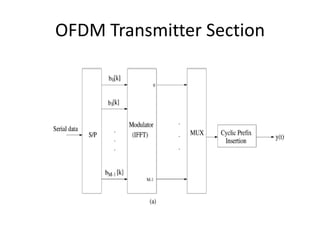
OFDM Transmitter Section
OFDM Symbol generation
• Symbol Mapping:        The high rate data streams
  are first converted into parallel data of M
  subchannels. The data is modulated using BPSK
  before S/P conversion.

      OFDM symbol is given by-
           bm[k]            (mapped data)
•     Where m= mth data stream
•      k= kth data symbol
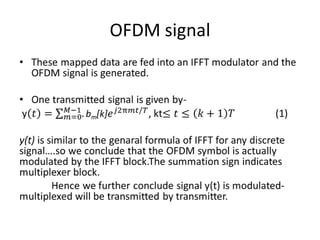
OFDM signal
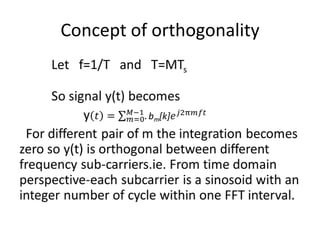
Concept of orthogonality
ISI
• If a sinusoid has no longer an integer number
  of cycles within an FFT interval than
  orthogonality is lost and Inter Symbol
  Interference (ISI) occurs.
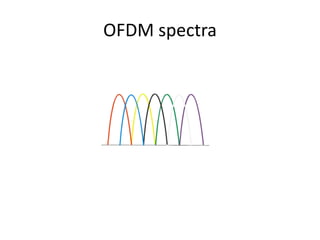
OFDM spectra
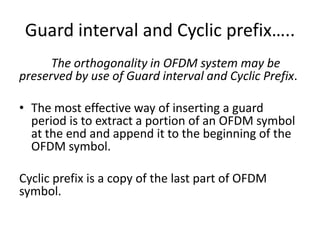
Guard interval and Cyclic prefix…..
      The orthogonality in OFDM system may be
preserved by use of Guard interval and Cyclic Prefix.

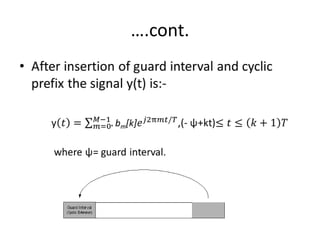
• The most effective way of inserting a guard
  period is to extract a portion of an OFDM symbol
  at the end and append it to the beginning of the
  OFDM symbol.

Cyclic prefix is a copy of the last part of OFDM
symbol.
….cont.
Channel Model
  The channel used for the project is a Rayleigh-
Jakes-WSSUS process model
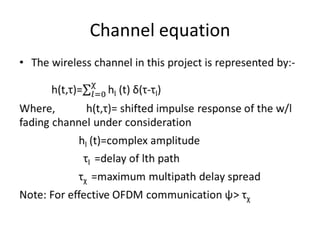
Channel equation
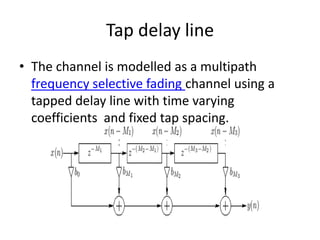
Tap delay line
• The channel is modelled as a multipath
  frequency selective fading channel using a
  tapped delay line with time varying
  coefficients and fixed tap spacing.
Frequency selective and Flat fading
• In many cases the reciever recieves more than
  one copy of the transmitted signal due to
  multipath between the transmitter and the
  reciever ie., a multipath channel. In such cases
  the channel is said to be frequency selective
  ie; the channel varies in frequency.
  – The other case is when reciever only recieves one
    copy of the transmitted signal which esults in a
    Flat Frequency Fading spectrum.
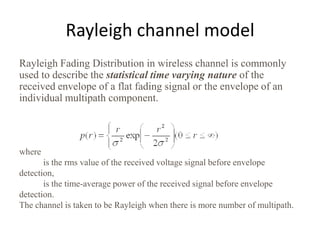
Rayleigh channel model
Rayleigh Fading Distribution in wireless channel is commonly
used to describe the statistical time varying nature of the
received envelope of a flat fading signal or the envelope of an
individual multipath component.


where
       is the rms value of the received voltage signal before envelope
detection,
       is the time-average power of the received signal before envelope
detection.
The channel is taken to be Rayleigh when there is more number of multipath.
Jakes Model
• A real time channel is both time and
  frequency variant. The Jakes channel model
  with an exponential PDP is used to generate
  time-frequency-variant channel.
            Jakes model is closely related to
Doppler shift and Doppler shift is obtaind when
iether or both the transmitter and reciever is in
motion.
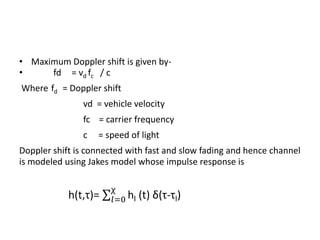
• Maximum Doppler shift is given by-
•     fd = vd fc / c
Where fd = Doppler shift
               vd = vehicle velocity
               fc = carrier frequency
               c   = speed of light
Doppler shift is connected with fast and slow fading and hence channel
is modeled using Jakes model whose impulse response is
• The autocorrelation of different transmission
paths is a zero order Bessel function that depends
on the time difference T and Doppler shift ,fd.
Autocorreletion in time domain is given by:
             Φt[m]= Jo( 2πfdT)
fdT is the factor that controls how much the
channel varies betwwen two successive symbols.
Not:the above equation also indicates that the
power spectral density of the channel satisfies Jakes
model.
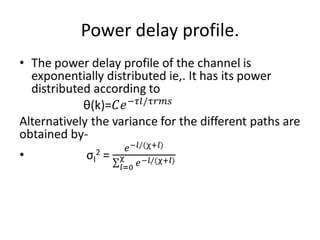
Power delay profile.
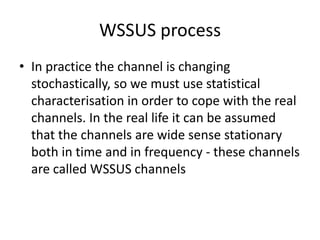
WSSUS process
• In practice the channel is changing
  stochastically, so we must use statistical
  characterisation in order to cope with the real
  channels. In the real life it can be assumed
  that the channels are wide sense stationary
  both in time and in frequency - these channels
  are called WSSUS channels
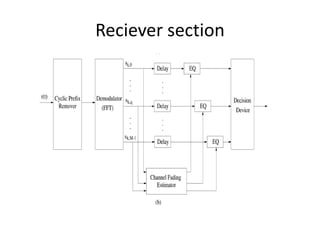
Reciever section
At the reciever end….
• The received signal r(t) at kth symbol duration
  by the OFDM reciever is given by:-


• from the received signal first the CP is
  removed
• After CP removal the signal is demodulated
  using FFT, which converts the time domain
  signal to frequency domain signal.
….cont.
• The output of the demodulator block is called the
measured signal, ‘Sk,q ‘.
    • Where k= kth symbol interval, k=1.2.3….
    • q = number of sub-carriers generated by IFFT.

• This signal is actually the input to the estimator block.
• The delay blocks are inserted to synchronise the output
of the demodulator and the estimator block.
• The estimator block esrimates the channel states of
each sub-carrier.
Channel Estimation
• There are mainly two problems with the
  design of channel estimators
• ------how the pilot information should be
  transmitted
• -------design of an interpolater with low
  complexity and good performance.
Pilot Arrangement
• Channel estimates are often achieved by
  multiplexing pilot symbols into data sequence
  and this technic is called Pilot Symbol Assisted
  Modulation(PSAM)
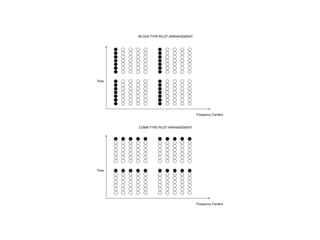
• Block Type
  – All sub-carriers    reserved for pilots wit a specific
    period

• Comb Type
  – Some sub-carriers are
    reserved for pilots for each symbol
Progress seminar

Progress seminar

  • 1.
    Motivation • The highdemand for a large volume of multimedia services in wireless communication systems require high transmission rates. But high Transmission rates may result in severe fading and ISI. These channel impairments can be combated by OFDM.
  • 2.
  • 3.
    OFDM Symbol generation •Symbol Mapping: The high rate data streams are first converted into parallel data of M subchannels. The data is modulated using BPSK before S/P conversion. OFDM symbol is given by- bm[k] (mapped data) • Where m= mth data stream • k= kth data symbol
  • 4.
  • 5.
  • 6.
    ISI • If asinusoid has no longer an integer number of cycles within an FFT interval than orthogonality is lost and Inter Symbol Interference (ISI) occurs.
  • 7.
  • 8.
    Guard interval andCyclic prefix….. The orthogonality in OFDM system may be preserved by use of Guard interval and Cyclic Prefix. • The most effective way of inserting a guard period is to extract a portion of an OFDM symbol at the end and append it to the beginning of the OFDM symbol. Cyclic prefix is a copy of the last part of OFDM symbol.
  • 9.
  • 10.
    Channel Model The channel used for the project is a Rayleigh- Jakes-WSSUS process model
  • 11.
  • 12.
    Tap delay line •The channel is modelled as a multipath frequency selective fading channel using a tapped delay line with time varying coefficients and fixed tap spacing.
  • 13.
    Frequency selective andFlat fading • In many cases the reciever recieves more than one copy of the transmitted signal due to multipath between the transmitter and the reciever ie., a multipath channel. In such cases the channel is said to be frequency selective ie; the channel varies in frequency. – The other case is when reciever only recieves one copy of the transmitted signal which esults in a Flat Frequency Fading spectrum.
  • 14.
    Rayleigh channel model RayleighFading Distribution in wireless channel is commonly used to describe the statistical time varying nature of the received envelope of a flat fading signal or the envelope of an individual multipath component. where is the rms value of the received voltage signal before envelope detection, is the time-average power of the received signal before envelope detection. The channel is taken to be Rayleigh when there is more number of multipath.
  • 15.
    Jakes Model • Areal time channel is both time and frequency variant. The Jakes channel model with an exponential PDP is used to generate time-frequency-variant channel. Jakes model is closely related to Doppler shift and Doppler shift is obtaind when iether or both the transmitter and reciever is in motion.
  • 16.
    • Maximum Dopplershift is given by- • fd = vd fc / c Where fd = Doppler shift vd = vehicle velocity fc = carrier frequency c = speed of light Doppler shift is connected with fast and slow fading and hence channel is modeled using Jakes model whose impulse response is
  • 17.
    • The autocorrelationof different transmission paths is a zero order Bessel function that depends on the time difference T and Doppler shift ,fd. Autocorreletion in time domain is given by: Φt[m]= Jo( 2πfdT) fdT is the factor that controls how much the channel varies betwwen two successive symbols. Not:the above equation also indicates that the power spectral density of the channel satisfies Jakes model.
  • 18.
  • 19.
    WSSUS process • Inpractice the channel is changing stochastically, so we must use statistical characterisation in order to cope with the real channels. In the real life it can be assumed that the channels are wide sense stationary both in time and in frequency - these channels are called WSSUS channels
  • 20.
  • 21.
    At the recieverend…. • The received signal r(t) at kth symbol duration by the OFDM reciever is given by:- • from the received signal first the CP is removed • After CP removal the signal is demodulated using FFT, which converts the time domain signal to frequency domain signal.
  • 22.
    ….cont. • The outputof the demodulator block is called the measured signal, ‘Sk,q ‘. • Where k= kth symbol interval, k=1.2.3…. • q = number of sub-carriers generated by IFFT. • This signal is actually the input to the estimator block. • The delay blocks are inserted to synchronise the output of the demodulator and the estimator block. • The estimator block esrimates the channel states of each sub-carrier.
  • 23.
    Channel Estimation • Thereare mainly two problems with the design of channel estimators • ------how the pilot information should be transmitted • -------design of an interpolater with low complexity and good performance.
  • 24.
    Pilot Arrangement • Channelestimates are often achieved by multiplexing pilot symbols into data sequence and this technic is called Pilot Symbol Assisted Modulation(PSAM) • Block Type – All sub-carriers reserved for pilots wit a specific period • Comb Type – Some sub-carriers are reserved for pilots for each symbol