Presentation for Purchase Management Presented By : group 8, PGPRM(PRIL)/07-09
Introduction Purchasing is a service function . Like all other service function , the fundamental  objective of purchase department is to provide the efficient services with  minimum costs. Moreover, it should also  endeavor to improve and maintain high employee morale resulting into initiative and extra efforts. Types of Evaluation: General. Through Audit.
Purchasing Evaluation in General Creation of any organizational set-up  basically consider the  benefit analysis. To justify, the existence of any department or section, the benefit must outweigh the costs. Over and establishment costs of the purchase department , the following costs should also be considered – Over expenditure on items  purchased or services obtained. Costs of stock- outs Cost of failure of  efficient negotiations and obtaining favorable terms and conditions.
Additional cost of expediting the procurements. Cost of not providing satisfaction to outside customers. Cost of  failure in excessive stock pilling. Cost of failure  to dispose of surplus or obsolete plant, equipments, materials or scrape at maximum price. Cost of measuring efficiency of the purchasing department.
Need for the evaluation Evaluation is a control function, which tends to be continuous one. However, the specific need of  the evaluation arises  due to following reasons: Management fails to identify any problem, but is dissatisfied with the current affairs. Numerous complaints are received from  various departments.  Numerous complaints are received from the vendors and outsiders.
Cont…. 4. The cost of  purchasing operations seems high. 5. It  seems that the purchasing department is overstaffed. 6. The integrity of the purchasing staff has become questionable. 7. Failure to achieve planned progress. 8. The need of the management to have performance records for subsequent reviews.
EVALUATON THROUGH MANAGEMENT AUDIT A recently developed concept controlled by value of M.B.O (Management by objective) is tested. Examines the functions to see whether they contribute to objective. Ensures optimum utilization of human resources and physical facilities  Anticipates problems and helps them solve in time. Statutory audit is basically concerned with the truth and fairness of the balance sheet and P/L account.
Characteristic of Management Audit Management audit is the audit of the whole process of management. Management standards are used to evaluate the performance. It is essentially an integrated approach. It is concerned with the effectiveness of management as whole. It is a continuous process. It emphasizes opportunity cost, rather than historical cost. It is constructive It is essentially a management service and it concerns itself with the intensive analysis of information needs any availability of relevant information to management, for decision making purposes.
Purchase Audit: An Area of Management Audit Purchase Audit is a part of management Audit. Management Audit = ( Purchase Audit  + Marketing Audit + Production Audit + Personnel audit). It is a tool to check efficiency and effectiveness of purchase department. Audit is mainly carried out by a ‘detached’ auditor to ensure objectivity. It focuses attention not only on the strength but also on the weakness in the operation.
AUDIT OBJECTIVES To determine the adequacy of internal controls over purchases, both in terms of existence and use. To verify whether all purchases have been updated in inventory records, all payments on account of purchases represent values of items purchased and taken into inventory.   To verify whether the items, and quantities of the items, purchased are reasonable and within the justifiable requirements of the Auditee.
Cont…(Objective) To ascertain whether descriptions, classifications, and, related disclosures are adequate and not misleading.   To determine whether the purchase management function is directed towards the accomplishment of organizational objectives, targets and goals. To establish the adequacy of MIS relating to purchases, to facilitate analysis of information, management control and decision support.
DETAILED TESTS Examine the time lag between date of Purchase Requisition and date of issue of Purchase Orders Review Purchase Requisitions for proper documentation and authorization. Review adequacy of Purchase Orders in terms of lowest quotation, approvals etc.,. Review instances of cancellation and amendments of Purchase Orders. Are the Purchase Orders complete in all respects- specifications, terms of delivery, unit price, quantity, insurance,  terms of payment etc.? Does the Purchase Order refer to vendor’s quotation?
Cont… (Detailed Test) Review vendor identification and selection criteria. Ensure fairness in selection.  Also ensure that if there is only one vendor, the internal control is working and adequate. Review import purchase orders for completeness and adequate authorization. Are instances of urgent buying justified? Are petty cash purchases in accordance with the laid down policy? Are purchases handled by departments directly, when they are to be handled by the Purchase Department?.  Are decentralized purchases handled strictly in accordance with laid down procedures?.
Test check purchase vouchers with vendor invoices, purchase orders, purchase requisitions, and  goods received note to ensure that all purchases are properly authorized properly documented. Review accounts payables for old unpaid items. Relate the listing to unpaid Goods Received Notes. Where goods received note are not supported by vendor invoices, prepare a listing of missing invoices and ensure follow-up. Review instances of fresh purchase orders being raised when existing purchase orders are not fully executed. Confirm justification for the same. Cont… (Detailed Test)
Process of Evaluation in General Qualitative and Quantitative Evaluation. Agency of Evaluation. Methods of Evaluation.
How are Quantitative and Qualitative Data Different? Data are considered  quantitative if they are numbers  and  qualitative if they are words. Quantitative data  are  hard, rigorous, credible and scientific. Quantitative data best explain the  why  and  how  of your program, while qualitative data best explain the  what ,  who  and  when .
Important Quantitative aspects to be considered while evaluating the purchasing performance Price advantage Value analysis Standardization Reduced inventory holding Better classification of scrap & salvage, higher price and faster disposal Reduced rejects Advantage from shortest routing and economical packaging.
Qualitative aspects of purchasing Development of purchase policies and procedures. Centralization of purchasing function. Selection of better staff and provision of training. Development of good condition of functions and their optimum distribution within the department. Good working relations with other departments. Good relations with the suppliers. Active participation in company, professional and community affairs. Purchasing of better quality products Improved deliveries. Awareness of make-or–buy possibilities.
Agencies for Evaluation The performance of the purchase department is evaluated by the following agencies: Internal Agencies External Agencies Evaluation by Internal Agencies can be done in tow ways- Internal check system-  wherein the work of one person or one section is checked by the other person or section of the purchase department.  The other method is the use of internal auditor  for measuring the performance of the purchase department.
The  external agencies  refer to the use of the  professional agencies  or  consultants  for the evaluation work.  These are experts in those areas . Though, it is a bit  costlier  as compared to the internal agencies, it proves more  valuable and unbiased evaluation . Generally the following aspects are studied by the external agents: Does the purchasing department have responsibility of making all purchase for the company? Does it have the adequate authority to go with this responsibility? Is the company using manual of purchasing policies and procedures? External Agencies
Is the purchasing department buying at right quantity, price and obtaining good service? Does the purchasing department co-operate with other departments of the company and vice versa? Are the relations with the vendors and outsiders good? Are operating cost of the purchasing department in line with the comparable companies in the industry? Continued
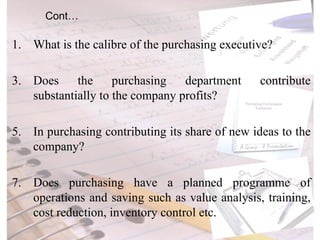
Cont… What is the calibre of the purchasing executive? Does the purchasing department contribute substantially to the company profits? In purchasing contributing its share of new ideas to the company? Does purchasing have a planned programme of operations and saving such as value analysis, training, cost reduction, inventory control etc.
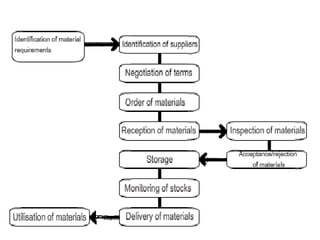
Methods of Evaluation Forms and reports : Standard formats are designed to evaluate the performance on regular basis. The actuals are compared with the budgeted figures. The variances and discrepancies are ascertained and analyzed Flow diagram : The flow diagram is an ideal method of depicting the normal procedure for performing the specific function. The flow diagram indicates purchase process, e.g., the initiation of purchase function, order-placing, follow-up, expediting, order progress, order closing etc.
 
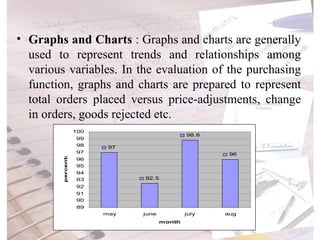
Graphs and Charts  :  Graphs and charts are generally used to represent trends and relationships among various variables. In the evaluation of the purchasing function, graphs and charts are prepared to represent total orders placed versus  price-adjustments, change in orders, goods rejected etc.
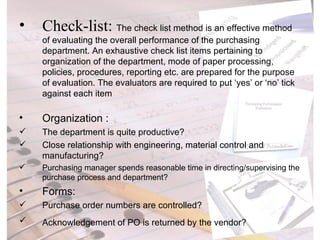
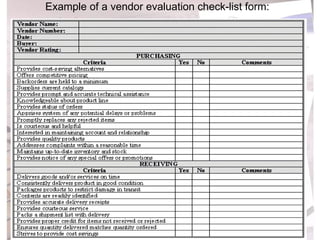
Check-list:  The check list method is an effective method of evaluating the overall performance of the purchasing department. An exhaustive check list items pertaining to organization of the department, mode of paper processing, policies, procedures, reporting etc. are prepared for the purpose of evaluation. The evaluators are required to put ‘yes’ or ‘no’ tick against each item  Organization : The department is quite productive? Close relationship with engineering, material control and manufacturing? Purchasing manager spends reasonable time in directing/supervising the purchase process and department? Forms: Purchase order numbers are controlled? Acknowledgement of PO is returned by the vendor?
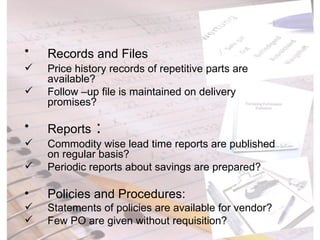
Records and Files   Price history records of repetitive parts are available? Follow –up file is maintained on delivery promises?  Reports  : Commodity wise lead time reports are published on regular basis? Periodic reports about savings are prepared? Policies and Procedures: Statements of policies are available for vendor?  Few PO are given without requisition?
Example of a vendor evaluation check-list form:
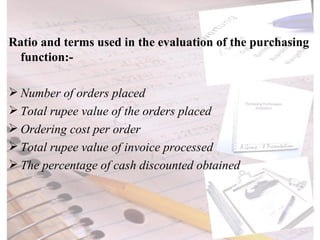
Ratio and terms used in the evaluation of the purchasing function:- Number of orders placed Total rupee value of the orders placed Ordering cost per order Total rupee value of invoice processed The percentage of cash discounted obtained
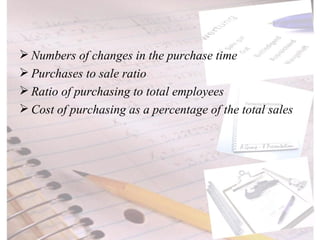
Numbers of changes in the purchase time Purchases to sale ratio Ratio of purchasing to total employees Cost of purchasing as a percentage of the total sales
Purchased materials price index Storing or inventory carrying cost as a percentage of value of materials stored Loss due to stock-outs Inventory turnover Raw materials turnover Work-in-progress turnover  Finished goods turnover  Inventory to current assets Inventory to total asset
Areas included in Purchase Audit Purchase organization. Purchase policies. Purchase procedures. Purchase evaluation and reporting.
1. ORGANIZATIONAL A good organization presents a well- defined authority-responsibility relationships.  Intra-Departmental  organization  (internal structure) Inter-Departmental organization  (in relation to other departments of  business )
Intra-Departmental  Vertical line of authority should pervade from the top to bottom. Typical sensitive areas that merit enquiry are :  Demarcation of line and staff functions. Adequate authority at the supervisory level Indication of unitary accountability of or the subordinates Clear definition of interplant purchasing responsibilities
Inter-Departmental  Functions of business are all interrelated. The areas that merit investigation at the hands of the auditor are : Is departmental authority regarding purchases to be made clearly understood ? Is authority in respect of quantum of goods to be purchased clearly understood ? Which other departments assume purchase responsibilities ? What “say” does the purchase department has with regard to procedures or changes that affect vendors, order quantum's, or specifications ?
2. POLICIES Policies in the manual reflect the purchase philosophy of the management.  Policies should be approved by the Board and they are binding on all employees. Policies should be precise, expressive, practicable and enforceable.
Policies that merit enquiry are :  Policies regarding…. Revision of specifications or requisitions Source selection The getting of a bid Contractual obligations Conflict of interest, gifts, and entertainment.
3. Procedures Procedures are required : To translate policies into action. To provide and standardize routines. To offer standards of performance. To make the Purchase Audit successful in-depth analysis is required.
Items of Enquiry Requisitions P.O. (Purchase Order) Control Vendor Analysis Transportation and Price Discounts Adjustments Make or Buy Surplus Sale Off-Plant Inventory Petty Cash Purchases Employee Purchases Receipt Procedure Vendor Payment Ethics
Evaluation and Reporting REASONS: Control mechanism engages the attention of the auditor. Objective standards of purchasing performance are examined. Reporting against standards is also examined. Continuous Performance measures are taken.
Cont… Audit specially attends to: Objective basis of performance appraisal. Whether department as a whole objectively assessed in terms of clearly established goals. Feedback system. In years to come, purchase audit would become a key word owing to the increased importance of purchase department and its functions.
ŢĦДИҜ  ҰØŪ

Purchase Presentation 1

  • 1.
    Presentation for PurchaseManagement Presented By : group 8, PGPRM(PRIL)/07-09
  • 2.
    Introduction Purchasing isa service function . Like all other service function , the fundamental objective of purchase department is to provide the efficient services with minimum costs. Moreover, it should also endeavor to improve and maintain high employee morale resulting into initiative and extra efforts. Types of Evaluation: General. Through Audit.
  • 3.
    Purchasing Evaluation inGeneral Creation of any organizational set-up basically consider the benefit analysis. To justify, the existence of any department or section, the benefit must outweigh the costs. Over and establishment costs of the purchase department , the following costs should also be considered – Over expenditure on items purchased or services obtained. Costs of stock- outs Cost of failure of efficient negotiations and obtaining favorable terms and conditions.
  • 4.
    Additional cost ofexpediting the procurements. Cost of not providing satisfaction to outside customers. Cost of failure in excessive stock pilling. Cost of failure to dispose of surplus or obsolete plant, equipments, materials or scrape at maximum price. Cost of measuring efficiency of the purchasing department.
  • 5.
    Need for theevaluation Evaluation is a control function, which tends to be continuous one. However, the specific need of the evaluation arises due to following reasons: Management fails to identify any problem, but is dissatisfied with the current affairs. Numerous complaints are received from various departments. Numerous complaints are received from the vendors and outsiders.
  • 6.
    Cont…. 4. Thecost of purchasing operations seems high. 5. It seems that the purchasing department is overstaffed. 6. The integrity of the purchasing staff has become questionable. 7. Failure to achieve planned progress. 8. The need of the management to have performance records for subsequent reviews.
  • 7.
    EVALUATON THROUGH MANAGEMENTAUDIT A recently developed concept controlled by value of M.B.O (Management by objective) is tested. Examines the functions to see whether they contribute to objective. Ensures optimum utilization of human resources and physical facilities Anticipates problems and helps them solve in time. Statutory audit is basically concerned with the truth and fairness of the balance sheet and P/L account.
  • 8.
    Characteristic of ManagementAudit Management audit is the audit of the whole process of management. Management standards are used to evaluate the performance. It is essentially an integrated approach. It is concerned with the effectiveness of management as whole. It is a continuous process. It emphasizes opportunity cost, rather than historical cost. It is constructive It is essentially a management service and it concerns itself with the intensive analysis of information needs any availability of relevant information to management, for decision making purposes.
  • 9.
    Purchase Audit: AnArea of Management Audit Purchase Audit is a part of management Audit. Management Audit = ( Purchase Audit + Marketing Audit + Production Audit + Personnel audit). It is a tool to check efficiency and effectiveness of purchase department. Audit is mainly carried out by a ‘detached’ auditor to ensure objectivity. It focuses attention not only on the strength but also on the weakness in the operation.
  • 10.
    AUDIT OBJECTIVES Todetermine the adequacy of internal controls over purchases, both in terms of existence and use. To verify whether all purchases have been updated in inventory records, all payments on account of purchases represent values of items purchased and taken into inventory.   To verify whether the items, and quantities of the items, purchased are reasonable and within the justifiable requirements of the Auditee.
  • 11.
    Cont…(Objective) To ascertainwhether descriptions, classifications, and, related disclosures are adequate and not misleading.   To determine whether the purchase management function is directed towards the accomplishment of organizational objectives, targets and goals. To establish the adequacy of MIS relating to purchases, to facilitate analysis of information, management control and decision support.
  • 12.
    DETAILED TESTS Examinethe time lag between date of Purchase Requisition and date of issue of Purchase Orders Review Purchase Requisitions for proper documentation and authorization. Review adequacy of Purchase Orders in terms of lowest quotation, approvals etc.,. Review instances of cancellation and amendments of Purchase Orders. Are the Purchase Orders complete in all respects- specifications, terms of delivery, unit price, quantity, insurance, terms of payment etc.? Does the Purchase Order refer to vendor’s quotation?
  • 13.
    Cont… (Detailed Test)Review vendor identification and selection criteria. Ensure fairness in selection. Also ensure that if there is only one vendor, the internal control is working and adequate. Review import purchase orders for completeness and adequate authorization. Are instances of urgent buying justified? Are petty cash purchases in accordance with the laid down policy? Are purchases handled by departments directly, when they are to be handled by the Purchase Department?. Are decentralized purchases handled strictly in accordance with laid down procedures?.
  • 14.
    Test check purchasevouchers with vendor invoices, purchase orders, purchase requisitions, and goods received note to ensure that all purchases are properly authorized properly documented. Review accounts payables for old unpaid items. Relate the listing to unpaid Goods Received Notes. Where goods received note are not supported by vendor invoices, prepare a listing of missing invoices and ensure follow-up. Review instances of fresh purchase orders being raised when existing purchase orders are not fully executed. Confirm justification for the same. Cont… (Detailed Test)
  • 15.
    Process of Evaluationin General Qualitative and Quantitative Evaluation. Agency of Evaluation. Methods of Evaluation.
  • 16.
    How are Quantitativeand Qualitative Data Different? Data are considered quantitative if they are numbers and qualitative if they are words. Quantitative data are hard, rigorous, credible and scientific. Quantitative data best explain the why and how of your program, while qualitative data best explain the what , who and when .
  • 17.
    Important Quantitative aspectsto be considered while evaluating the purchasing performance Price advantage Value analysis Standardization Reduced inventory holding Better classification of scrap & salvage, higher price and faster disposal Reduced rejects Advantage from shortest routing and economical packaging.
  • 18.
    Qualitative aspects ofpurchasing Development of purchase policies and procedures. Centralization of purchasing function. Selection of better staff and provision of training. Development of good condition of functions and their optimum distribution within the department. Good working relations with other departments. Good relations with the suppliers. Active participation in company, professional and community affairs. Purchasing of better quality products Improved deliveries. Awareness of make-or–buy possibilities.
  • 19.
    Agencies for EvaluationThe performance of the purchase department is evaluated by the following agencies: Internal Agencies External Agencies Evaluation by Internal Agencies can be done in tow ways- Internal check system- wherein the work of one person or one section is checked by the other person or section of the purchase department. The other method is the use of internal auditor for measuring the performance of the purchase department.
  • 20.
    The externalagencies refer to the use of the professional agencies or consultants for the evaluation work. These are experts in those areas . Though, it is a bit costlier as compared to the internal agencies, it proves more valuable and unbiased evaluation . Generally the following aspects are studied by the external agents: Does the purchasing department have responsibility of making all purchase for the company? Does it have the adequate authority to go with this responsibility? Is the company using manual of purchasing policies and procedures? External Agencies
  • 21.
    Is the purchasingdepartment buying at right quantity, price and obtaining good service? Does the purchasing department co-operate with other departments of the company and vice versa? Are the relations with the vendors and outsiders good? Are operating cost of the purchasing department in line with the comparable companies in the industry? Continued
  • 22.
    Cont… What isthe calibre of the purchasing executive? Does the purchasing department contribute substantially to the company profits? In purchasing contributing its share of new ideas to the company? Does purchasing have a planned programme of operations and saving such as value analysis, training, cost reduction, inventory control etc.
  • 23.
    Methods of EvaluationForms and reports : Standard formats are designed to evaluate the performance on regular basis. The actuals are compared with the budgeted figures. The variances and discrepancies are ascertained and analyzed Flow diagram : The flow diagram is an ideal method of depicting the normal procedure for performing the specific function. The flow diagram indicates purchase process, e.g., the initiation of purchase function, order-placing, follow-up, expediting, order progress, order closing etc.
  • 24.
  • 25.
    Graphs and Charts : Graphs and charts are generally used to represent trends and relationships among various variables. In the evaluation of the purchasing function, graphs and charts are prepared to represent total orders placed versus price-adjustments, change in orders, goods rejected etc.
  • 26.
    Check-list: Thecheck list method is an effective method of evaluating the overall performance of the purchasing department. An exhaustive check list items pertaining to organization of the department, mode of paper processing, policies, procedures, reporting etc. are prepared for the purpose of evaluation. The evaluators are required to put ‘yes’ or ‘no’ tick against each item Organization : The department is quite productive? Close relationship with engineering, material control and manufacturing? Purchasing manager spends reasonable time in directing/supervising the purchase process and department? Forms: Purchase order numbers are controlled? Acknowledgement of PO is returned by the vendor?
  • 27.
    Records and Files Price history records of repetitive parts are available? Follow –up file is maintained on delivery promises? Reports : Commodity wise lead time reports are published on regular basis? Periodic reports about savings are prepared? Policies and Procedures: Statements of policies are available for vendor? Few PO are given without requisition?
  • 28.
    Example of avendor evaluation check-list form:
  • 29.
    Ratio and termsused in the evaluation of the purchasing function:- Number of orders placed Total rupee value of the orders placed Ordering cost per order Total rupee value of invoice processed The percentage of cash discounted obtained
  • 30.
    Numbers of changesin the purchase time Purchases to sale ratio Ratio of purchasing to total employees Cost of purchasing as a percentage of the total sales
  • 31.
    Purchased materials priceindex Storing or inventory carrying cost as a percentage of value of materials stored Loss due to stock-outs Inventory turnover Raw materials turnover Work-in-progress turnover Finished goods turnover Inventory to current assets Inventory to total asset
  • 32.
    Areas included inPurchase Audit Purchase organization. Purchase policies. Purchase procedures. Purchase evaluation and reporting.
  • 33.
    1. ORGANIZATIONAL Agood organization presents a well- defined authority-responsibility relationships. Intra-Departmental organization (internal structure) Inter-Departmental organization (in relation to other departments of business )
  • 34.
    Intra-Departmental Verticalline of authority should pervade from the top to bottom. Typical sensitive areas that merit enquiry are : Demarcation of line and staff functions. Adequate authority at the supervisory level Indication of unitary accountability of or the subordinates Clear definition of interplant purchasing responsibilities
  • 35.
    Inter-Departmental Functionsof business are all interrelated. The areas that merit investigation at the hands of the auditor are : Is departmental authority regarding purchases to be made clearly understood ? Is authority in respect of quantum of goods to be purchased clearly understood ? Which other departments assume purchase responsibilities ? What “say” does the purchase department has with regard to procedures or changes that affect vendors, order quantum's, or specifications ?
  • 36.
    2. POLICIES Policiesin the manual reflect the purchase philosophy of the management. Policies should be approved by the Board and they are binding on all employees. Policies should be precise, expressive, practicable and enforceable.
  • 37.
    Policies that meritenquiry are : Policies regarding…. Revision of specifications or requisitions Source selection The getting of a bid Contractual obligations Conflict of interest, gifts, and entertainment.
  • 38.
    3. Procedures Proceduresare required : To translate policies into action. To provide and standardize routines. To offer standards of performance. To make the Purchase Audit successful in-depth analysis is required.
  • 39.
    Items of EnquiryRequisitions P.O. (Purchase Order) Control Vendor Analysis Transportation and Price Discounts Adjustments Make or Buy Surplus Sale Off-Plant Inventory Petty Cash Purchases Employee Purchases Receipt Procedure Vendor Payment Ethics
  • 40.
    Evaluation and ReportingREASONS: Control mechanism engages the attention of the auditor. Objective standards of purchasing performance are examined. Reporting against standards is also examined. Continuous Performance measures are taken.
  • 41.
    Cont… Audit speciallyattends to: Objective basis of performance appraisal. Whether department as a whole objectively assessed in terms of clearly established goals. Feedback system. In years to come, purchase audit would become a key word owing to the increased importance of purchase department and its functions.
  • 42.