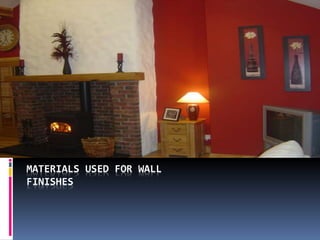
MATERIALS USED FOR WALL
FINISHES
INTRODUCTION
 As the name “Wall Finishes” itself suggests that it is finish given to the
wall to enhance the interior or exterior look of the structure.Wall
finishes used for the interiors are quite delicate and need maintenance.
 Interior finish consists mainly of the coverings of the rough walls,
ceilings, and floors, and installing doors and windows with trim and
hardware
 Wall finishes provide a decorative skin to conceal building components
including structural members, insulation, ductwork, pipes, and wires.
 Good wall finishes are plumb and straight. Surfaces may be smooth or
textured and better wall finishes are durable. Some wall finishes are
versatile, taking decorative finishes such as stain, paint or wallpaper
readily.
 Walls may make a decorating statement, or may be simply background.
In some cases, the combustibility of wall finishes may be an issue. In
kitchens and bathrooms, resistance to water damage is an asset.
Internal finishes
It is important that finishing operations are carried out in the right
sequence.
It is important that care is taken to prevent damage once a
particular finish is applied, also a good standard of workmanship is
required.
Background for finishes must be allowed to dry properly before a
particular finish is applied.
Before selecting a finish thought must be given to many factors
such as:- use of building
abuse / wear etc.
maintenance
Internal finishes
Finishes fall into two categories:-
self finish or applied finish
wet finish or dry finish
Types of finishes commonly found in domestic buildings:-
Applied finish - is a finish which is actually applied on site.
Self finish - is a finish which is inherent in the material
and does not have to be specially applied on
site.
Internal finishes
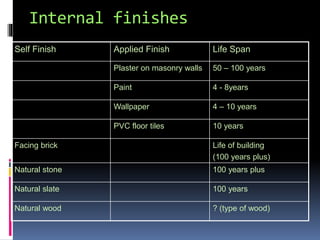
Self Finish Applied Finish Life Span
Plaster on masonry walls 50 – 100 years
Paint 4 - 8years
Wallpaper 4 – 10 years
PVC floor tiles 10 years
Facing brick Life of building
(100 years plus)
Natural stone 100 years plus
Natural slate 100 years
Natural wood ? (type of wood)
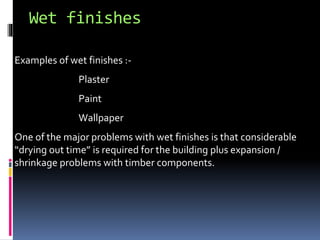
Wet finishes
Examples of wet finishes :-
Plaster
Paint
Wallpaper
One of the major problems with wet finishes is that considerable
“drying out time” is required for the building plus expansion /
shrinkage problems with timber components.
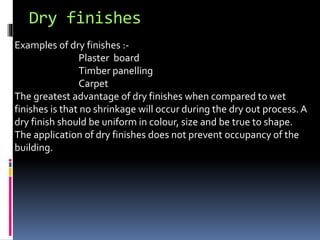
Dry finishes
Examples of dry finishes :-
Plaster board
Timber panelling
Carpet
The greatest advantage of dry finishes when compared to wet
finishes is that no shrinkage will occur during the dry out process. A
dry finish should be uniform in colour, size and be true to shape.
The application of dry finishes does not prevent occupancy of the
building.
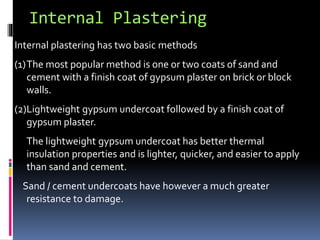
Internal Plastering
Internal plastering has two basic methods
(1)The most popular method is one or two coats of sand and
cement with a finish coat of gypsum plaster on brick or block
walls.
(2)Lightweight gypsum undercoat followed by a finish coat of
gypsum plaster.
The lightweight gypsum undercoat has better thermal
insulation properties and is lighter, quicker, and easier to apply
than sand and cement.
Sand / cement undercoats have however a much greater
resistance to damage.
Paint
Principal objectives of painting are:-
preservation
appearance
hygiene
A painting system for a given material usually consists of:-
primer
undercoat
finish coat
Paint
Primer
Adheres well to the background and evens out the surface
porosity.With ferrous metals, controls rust. Care must be taken to
choose suitable primer for the material to be covered.
Undercoat
Adheres to the primer, builds up the paint thickness and
obliterates surface irregularities.The undercoat should bring the
surface to a suitable colour for receiving the finishing coat.Two
coats of undercoat are usually required.
Finish
Adheres to the undercoat and provides a protective layer, colour
and surface texture.
TYPES OF WALL FINISHES
(MATERIALS USED FOR WALL
FINISHES)
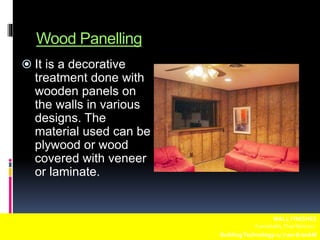
Wood Panelling
 It is a decorative
treatment done with
wooden panels on
the walls in various
designs. The
material used can be
plywood or wood
covered with veneer
or laminate.
WALL FINISHES
Fuentebella,Thea Bettina L.
BuildingTechnology-1/ 7:00-8:00AM
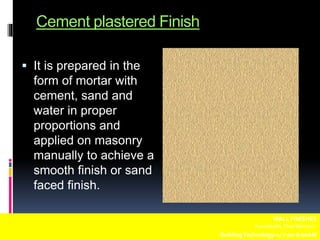
Cement plastered Finish
 It is prepared in the
form of mortar with
cement, sand and
water in proper
proportions and
applied on masonry
manually to achieve a
smooth finish or sand
faced finish.
WALL FINISHES
Fuentebella,Thea Bettina L.
BuildingTechnology-1/ 7:00-8:00AM
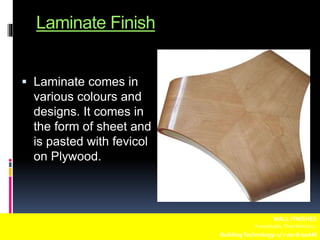
Laminate Finish
 Laminate comes in
various colours and
designs. It comes in
the form of sheet and
is pasted with fevicol
on Plywood.
WALL FINISHES
Fuentebella,Thea Bettina L.
BuildingTechnology-1/ 7:00-8:00AM
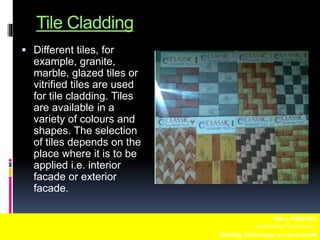
Tile Cladding
 Different tiles, for
example, granite,
marble, glazed tiles or
vitrified tiles are used
for tile cladding. Tiles
are available in a
variety of colours and
shapes. The selection
of tiles depends on the
place where it is to be
applied i.e. interior
facade or exterior
facade.
WALL FINISHES
Fuentebella,Thea Bettina L.
BuildingTechnology-1/ 7:00-8:00AM
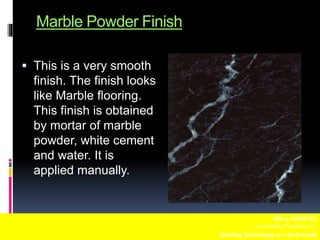
Marble Powder Finish
 This is a very smooth
finish. The finish looks
like Marble flooring.
This finish is obtained
by mortar of marble
powder, white cement
and water. It is
applied manually.
WALL FINISHES
Fuentebella,Thea Bettina L.
BuildingTechnology-1/ 7:00-8:00AM
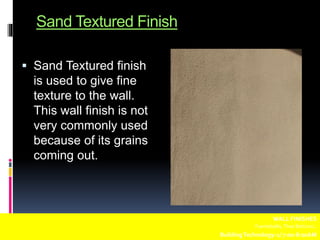
Sand Textured Finish
 Sand Textured finish
is used to give fine
texture to the wall.
This wall finish is not
very commonly used
because of its grains
coming out.
WALL FINISHES
Fuentebella,Thea Bettina L.
BuildingTechnology-1/ 7:00-8:00AM
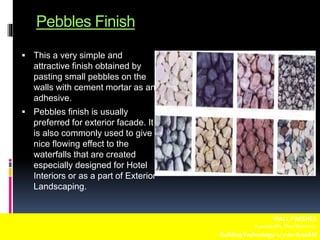
Pebbles Finish
 This a very simple and
attractive finish obtained by
pasting small pebbles on the
walls with cement mortar as an
adhesive.
 Pebbles finish is usually
preferred for exterior facade. It
is also commonly used to give
nice flowing effect to the
waterfalls that are created
especially designed for Hotel
Interiors or as a part of Exterior
Landscaping.
WALL FINISHES
Fuentebella,Thea Bettina L.
BuildingTechnology-1/ 7:00-8:00AM
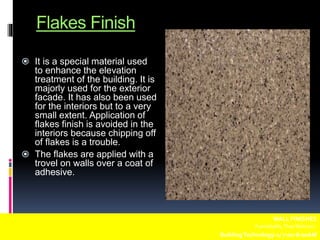
Flakes Finish
 It is a special material used
to enhance the elevation
treatment of the building. It is
majorly used for the exterior
facade. It has also been used
for the interiors but to a very
small extent. Application of
flakes finish is avoided in the
interiors because chipping off
of flakes is a trouble.
 The flakes are applied with a
trovel on walls over a coat of
adhesive.
WALL FINISHES
Fuentebella,Thea Bettina L.
BuildingTechnology-1/ 7:00-8:00AM
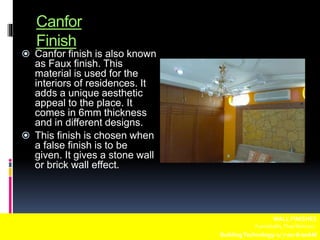
Canfor
Finish
 Canfor finish is also known
as Faux finish. This
material is used for the
interiors of residences. It
adds a unique aesthetic
appeal to the place. It
comes in 6mm thickness
and in different designs.
 This finish is chosen when
a false finish is to be
given. It gives a stone wall
or brick wall effect.
WALL FINISHES
Fuentebella,Thea Bettina L.
BuildingTechnology-1/ 7:00-8:00AM
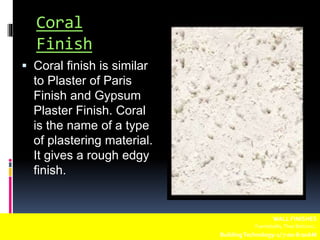
Coral
Finish
 Coral finish is similar
to Plaster of Paris
Finish and Gypsum
Plaster Finish. Coral
is the name of a type
of plastering material.
It gives a rough edgy
finish.
WALL FINISHES
Fuentebella,Thea Bettina L.
BuildingTechnology-1/ 7:00-8:00AM
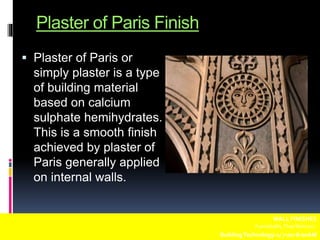
Plaster of Paris Finish
 Plaster of Paris or
simply plaster is a type
of building material
based on calcium
sulphate hemihydrates.
This is a smooth finish
achieved by plaster of
Paris generally applied
on internal walls.
WALL FINISHES
Fuentebella,Thea Bettina L.
BuildingTechnology-1/ 7:00-8:00AM
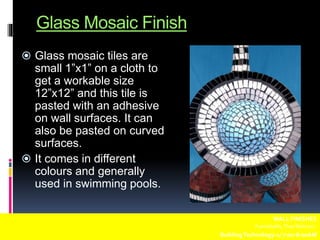
Glass Mosaic Finish
 Glass mosaic tiles are
small 1”x1” on a cloth to
get a workable size
12”x12” and this tile is
pasted with an adhesive
on wall surfaces. It can
also be pasted on curved
surfaces.
 It comes in different
colours and generally
used in swimming pools.
WALL FINISHES
Fuentebella,Thea Bettina L.
BuildingTechnology-1/ 7:00-8:00AM
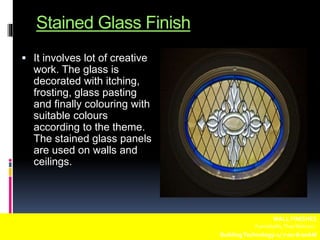
Stained Glass Finish
 It involves lot of creative
work. The glass is
decorated with itching,
frosting, glass pasting
and finally colouring with
suitable colours
according to the theme.
The stained glass panels
are used on walls and
ceilings.
WALL FINISHES
Fuentebella,Thea Bettina L.
BuildingTechnology-1/ 7:00-8:00AM
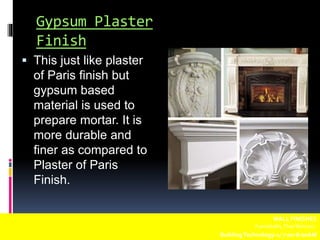
Gypsum Plaster
Finish
 This just like plaster
of Paris finish but
gypsum based
material is used to
prepare mortar. It is
more durable and
finer as compared to
Plaster of Paris
Finish.
WALL FINISHES
Fuentebella,Thea Bettina L.
BuildingTechnology-1/ 7:00-8:00AM
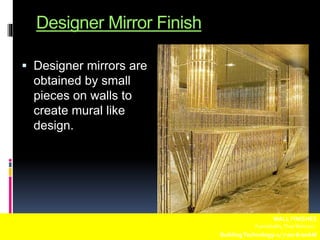
Designer Mirror Finish
 Designer mirrors are
obtained by small
pieces on walls to
create mural like
design.
WALL FINISHES
Fuentebella,Thea Bettina L.
BuildingTechnology-1/ 7:00-8:00AM
THANK U

Wall finishes

  • 1.
    MATERIALS USED FORWALL FINISHES
  • 2.
    INTRODUCTION  As thename “Wall Finishes” itself suggests that it is finish given to the wall to enhance the interior or exterior look of the structure.Wall finishes used for the interiors are quite delicate and need maintenance.  Interior finish consists mainly of the coverings of the rough walls, ceilings, and floors, and installing doors and windows with trim and hardware  Wall finishes provide a decorative skin to conceal building components including structural members, insulation, ductwork, pipes, and wires.  Good wall finishes are plumb and straight. Surfaces may be smooth or textured and better wall finishes are durable. Some wall finishes are versatile, taking decorative finishes such as stain, paint or wallpaper readily.  Walls may make a decorating statement, or may be simply background. In some cases, the combustibility of wall finishes may be an issue. In kitchens and bathrooms, resistance to water damage is an asset.
  • 3.
    Internal finishes It isimportant that finishing operations are carried out in the right sequence. It is important that care is taken to prevent damage once a particular finish is applied, also a good standard of workmanship is required. Background for finishes must be allowed to dry properly before a particular finish is applied. Before selecting a finish thought must be given to many factors such as:- use of building abuse / wear etc. maintenance
  • 4.
    Internal finishes Finishes fallinto two categories:- self finish or applied finish wet finish or dry finish Types of finishes commonly found in domestic buildings:- Applied finish - is a finish which is actually applied on site. Self finish - is a finish which is inherent in the material and does not have to be specially applied on site.
  • 5.
    Internal finishes Self FinishApplied Finish Life Span Plaster on masonry walls 50 – 100 years Paint 4 - 8years Wallpaper 4 – 10 years PVC floor tiles 10 years Facing brick Life of building (100 years plus) Natural stone 100 years plus Natural slate 100 years Natural wood ? (type of wood)
  • 6.
    Wet finishes Examples ofwet finishes :- Plaster Paint Wallpaper One of the major problems with wet finishes is that considerable “drying out time” is required for the building plus expansion / shrinkage problems with timber components.
  • 7.
    Dry finishes Examples ofdry finishes :- Plaster board Timber panelling Carpet The greatest advantage of dry finishes when compared to wet finishes is that no shrinkage will occur during the dry out process. A dry finish should be uniform in colour, size and be true to shape. The application of dry finishes does not prevent occupancy of the building.
  • 8.
    Internal Plastering Internal plasteringhas two basic methods (1)The most popular method is one or two coats of sand and cement with a finish coat of gypsum plaster on brick or block walls. (2)Lightweight gypsum undercoat followed by a finish coat of gypsum plaster. The lightweight gypsum undercoat has better thermal insulation properties and is lighter, quicker, and easier to apply than sand and cement. Sand / cement undercoats have however a much greater resistance to damage.
  • 9.
    Paint Principal objectives ofpainting are:- preservation appearance hygiene A painting system for a given material usually consists of:- primer undercoat finish coat
  • 10.
    Paint Primer Adheres well tothe background and evens out the surface porosity.With ferrous metals, controls rust. Care must be taken to choose suitable primer for the material to be covered. Undercoat Adheres to the primer, builds up the paint thickness and obliterates surface irregularities.The undercoat should bring the surface to a suitable colour for receiving the finishing coat.Two coats of undercoat are usually required. Finish Adheres to the undercoat and provides a protective layer, colour and surface texture.
  • 11.
    TYPES OF WALLFINISHES (MATERIALS USED FOR WALL FINISHES)
  • 12.
    Wood Panelling  Itis a decorative treatment done with wooden panels on the walls in various designs. The material used can be plywood or wood covered with veneer or laminate. WALL FINISHES Fuentebella,Thea Bettina L. BuildingTechnology-1/ 7:00-8:00AM
  • 13.
    Cement plastered Finish It is prepared in the form of mortar with cement, sand and water in proper proportions and applied on masonry manually to achieve a smooth finish or sand faced finish. WALL FINISHES Fuentebella,Thea Bettina L. BuildingTechnology-1/ 7:00-8:00AM
  • 14.
    Laminate Finish  Laminatecomes in various colours and designs. It comes in the form of sheet and is pasted with fevicol on Plywood. WALL FINISHES Fuentebella,Thea Bettina L. BuildingTechnology-1/ 7:00-8:00AM
  • 15.
    Tile Cladding  Differenttiles, for example, granite, marble, glazed tiles or vitrified tiles are used for tile cladding. Tiles are available in a variety of colours and shapes. The selection of tiles depends on the place where it is to be applied i.e. interior facade or exterior facade. WALL FINISHES Fuentebella,Thea Bettina L. BuildingTechnology-1/ 7:00-8:00AM
  • 16.
    Marble Powder Finish This is a very smooth finish. The finish looks like Marble flooring. This finish is obtained by mortar of marble powder, white cement and water. It is applied manually. WALL FINISHES Fuentebella,Thea Bettina L. BuildingTechnology-1/ 7:00-8:00AM
  • 17.
    Sand Textured Finish Sand Textured finish is used to give fine texture to the wall. This wall finish is not very commonly used because of its grains coming out. WALL FINISHES Fuentebella,Thea Bettina L. BuildingTechnology-1/ 7:00-8:00AM
  • 18.
    Pebbles Finish  Thisa very simple and attractive finish obtained by pasting small pebbles on the walls with cement mortar as an adhesive.  Pebbles finish is usually preferred for exterior facade. It is also commonly used to give nice flowing effect to the waterfalls that are created especially designed for Hotel Interiors or as a part of Exterior Landscaping. WALL FINISHES Fuentebella,Thea Bettina L. BuildingTechnology-1/ 7:00-8:00AM
  • 19.
    Flakes Finish  Itis a special material used to enhance the elevation treatment of the building. It is majorly used for the exterior facade. It has also been used for the interiors but to a very small extent. Application of flakes finish is avoided in the interiors because chipping off of flakes is a trouble.  The flakes are applied with a trovel on walls over a coat of adhesive. WALL FINISHES Fuentebella,Thea Bettina L. BuildingTechnology-1/ 7:00-8:00AM
  • 20.
    Canfor Finish  Canfor finishis also known as Faux finish. This material is used for the interiors of residences. It adds a unique aesthetic appeal to the place. It comes in 6mm thickness and in different designs.  This finish is chosen when a false finish is to be given. It gives a stone wall or brick wall effect. WALL FINISHES Fuentebella,Thea Bettina L. BuildingTechnology-1/ 7:00-8:00AM
  • 21.
    Coral Finish  Coral finishis similar to Plaster of Paris Finish and Gypsum Plaster Finish. Coral is the name of a type of plastering material. It gives a rough edgy finish. WALL FINISHES Fuentebella,Thea Bettina L. BuildingTechnology-1/ 7:00-8:00AM
  • 22.
    Plaster of ParisFinish  Plaster of Paris or simply plaster is a type of building material based on calcium sulphate hemihydrates. This is a smooth finish achieved by plaster of Paris generally applied on internal walls. WALL FINISHES Fuentebella,Thea Bettina L. BuildingTechnology-1/ 7:00-8:00AM
  • 23.
    Glass Mosaic Finish Glass mosaic tiles are small 1”x1” on a cloth to get a workable size 12”x12” and this tile is pasted with an adhesive on wall surfaces. It can also be pasted on curved surfaces.  It comes in different colours and generally used in swimming pools. WALL FINISHES Fuentebella,Thea Bettina L. BuildingTechnology-1/ 7:00-8:00AM
  • 24.
    Stained Glass Finish It involves lot of creative work. The glass is decorated with itching, frosting, glass pasting and finally colouring with suitable colours according to the theme. The stained glass panels are used on walls and ceilings. WALL FINISHES Fuentebella,Thea Bettina L. BuildingTechnology-1/ 7:00-8:00AM
  • 25.
    Gypsum Plaster Finish  Thisjust like plaster of Paris finish but gypsum based material is used to prepare mortar. It is more durable and finer as compared to Plaster of Paris Finish. WALL FINISHES Fuentebella,Thea Bettina L. BuildingTechnology-1/ 7:00-8:00AM
  • 26.
    Designer Mirror Finish Designer mirrors are obtained by small pieces on walls to create mural like design. WALL FINISHES Fuentebella,Thea Bettina L. BuildingTechnology-1/ 7:00-8:00AM
  • 27.