Partitions and finishes

Making the interior usable
Partitions


• Internal walls which subdivide
  rooms
• Can be load bearing or non load
  bearing
• Load bearing partitions can be
  treated like external walls, but
  without the need for rain
  resistance
• Non load bearing partitions are
  different
Finishes


• Finishes can be internal or external
• Finishes can be thick, property
  changing, or thin, cosmetic.
• Some finishes are integral to the
  nature of partitions, so will be
  considered first.
External finishes


• Dry finishes – claddings
  – Timber boarding
  – Tile hanging
  – Corrugated metal or plastic sheeting
• Wet finishes-renders
  – Renders, either cement or lime
    plaster based
  – Paints, either cosmetic or protective
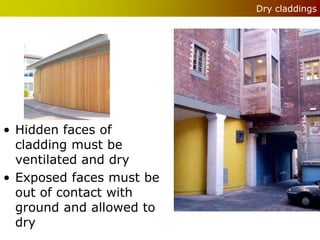
Dry claddings


• Hidden faces of
  cladding must be
  ventilated and dry
• Exposed faces must be
  out of contact with
  ground and allowed to
  dry
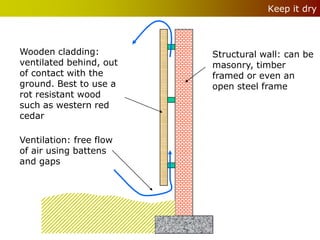
Keep it dry


Wooden cladding:         Structural wall: can be
ventilated behind, out   masonry, timber
of contact with the      framed or even an
ground. Best to use a    open steel frame
rot resistant wood
such as western red
cedar

Ventilation: free flow
of air using battens
and gaps
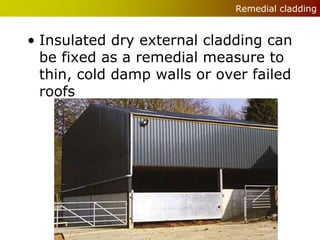
Remedial cladding


• Insulated dry external cladding can
  be fixed as a remedial measure to
  thin, cold damp walls or over failed
  roofs
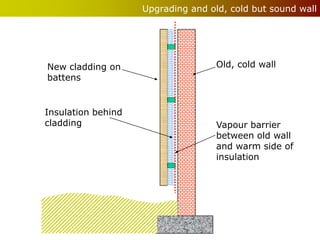
Upgrading and old, cold but sound wall


                                        Old, cold wall
Old, cold wall
  New cladding on                     Old, cold wall
  battens


  Insulation behind
  cladding                            Vapour barrier
                                      between old wall
                                      and warm side of
                                      insulation
Wet claddings: rendering


• Rendering refers to covering an
  external wall surface with a plaster
• Renders change the appearance of
  a wall and can improve the
  performance
• Traditional renders were lime
  plaster based, but modern ones
  are largely portland cement based.
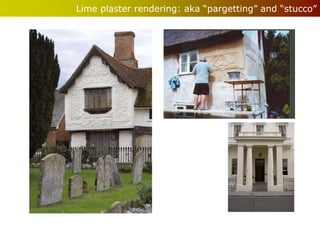
Lime plaster rendering: aka “pargetting” and “stucco”
Working with stucco


• Stucco needs to be strongly keyed
  to the sub surface
  – Keying can be grooves in the
    brickwork, heads of partly driven
    nails, or in modern work, stainless
    steel meshes fixed to the sub surface
• Any lime based finish must be
  protected form the rain
  – Good roof overhangs
  – Painted finish
Cement based rendering


• Modern cement based renders are
  basically thin layers of concrete
• Basic rule is the render must be
  weaker than the supporting wall so
  that the render fails first
• Render should also be slightly
  flexible
• Both achieved by concrete
  admixtures, often incorporating
  some lime.
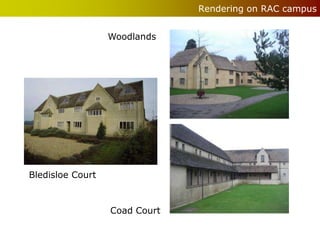
Rendering on RAC campus


                  Woodlands


Bledisloe Court


                  Coad Court
Why render a building?


• For appearance, as on the RAC
  campus
  – Cheaper than natural stone
  – More sympathetic than artificial stone
• Improved performance of old walls
  – Rendering can cover cracks
  – Extra layer can help rain resistance
  – Render can cover a new layer of
    external insulation
Internal finishes


• Thick finishes
  – Wet linings
    • Lime plaster
    • Gypsum plaster
  – Dry lining
    • Plaster board
    • Timber lining
• Thin finishes
  – Paints
  – Varnishes (timber only)
  – Stains (timber only)
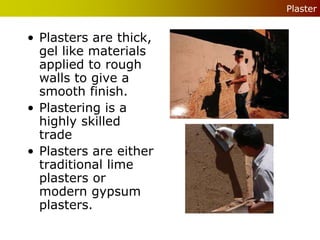
Plaster


• Plasters are thick,
  gel like materials
  applied to rough
  walls to give a
  smooth finish.
• Plastering is a
  highly skilled
  trade
• Plasters are either
  traditional lime
  plasters or
  modern gypsum
  plasters.
Lime plaster


• Lime plaster
  – Traditional, mixture of lime (calcium
    carbonate CaCO3, derived from
    limestone or chalk) with sand, water
    and possibly a binder like horse hair
  – Highly alkaline, never sets truly hard,
    very flexible and self healing
  – Lime is a dangerous, irritant chemical
  – Lime plasters generally used for
    conservation work on historic
    buildings
Gypsum plaster


• Gypsum is calcium sulphate (CaSO4)
  and a naturally occurring mineral in a
  hydrated form
• Plaster of Paris is pure gypsum
• Gypsum building plasters usually
  contains sand to bulk them out
• Gypsum plasters are non-irritant, set
  hard and expand slightly on setting,
  taking up any shrinkage cracks
• Vast bulk of modern building plasters
  are gypsum based
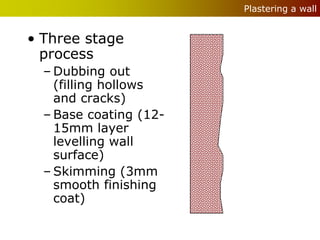
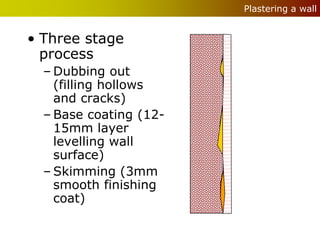
Plastering a wall


• Three stage
  process
  – Dubbing out
    (filling hollows
    and cracks)
  – Base coating (12-
    15mm layer
    levelling wall
    surface)
  – Skimming (3mm
    smooth finishing
    coat)
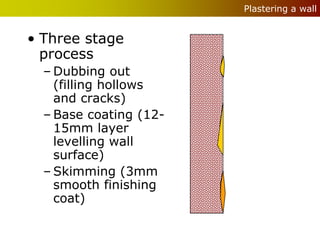
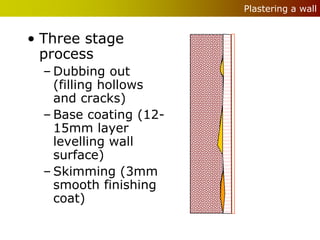
Plastering a wall


• Three stage
  process
  – Dubbing out
    (filling hollows
    and cracks)
  – Base coating (12-
    15mm layer
    levelling wall
    surface)
  – Skimming (3mm
    smooth finishing
    coat)
Plastering a wall


• Three stage
  process
  – Dubbing out
    (filling hollows
    and cracks)
  – Base coating (12-
    15mm layer
    levelling wall
    surface)
  – Skimming (3mm
    smooth finishing
    coat)
Plastering a wall


• Three stage
  process
  – Dubbing out
    (filling hollows
    and cracks)
  – Base coating (12-
    15mm layer
    levelling wall
    surface)
  – Skimming (3mm
    smooth finishing
    coat)
Dry lining


• Walls can be dry lined with wooden
  boarding, but most common finish is
  plasterboard.
• Plasterboard is one of the cheapest but
  most versatile building materials.
• Basic plaster board is a set layer of
  gypsum plaster covered with strong
  paper
• Plasterboard can also be foil backed as
  a vapour check or foam insulation
  backed as a complete internal insulation
  and finishing system
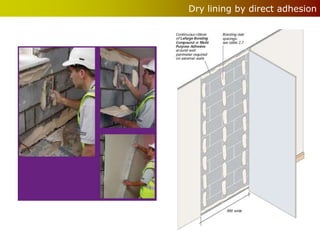
Dry lining by direct adhesion
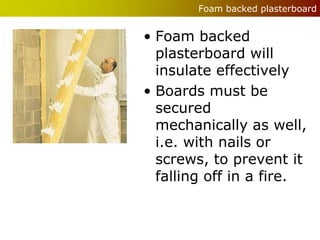
Foam backed plasterboard


• Foam backed
  plasterboard will
  insulate effectively
• Boards must be
  secured
  mechanically as well,
  i.e. with nails or
  screws, to prevent it
  falling off in a fire.
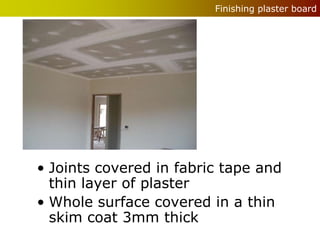
Finishing plaster board


• Joints covered in fabric tape and
  thin layer of plaster
• Whole surface covered in a thin
  skim coat 3mm thick
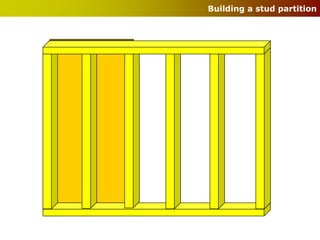
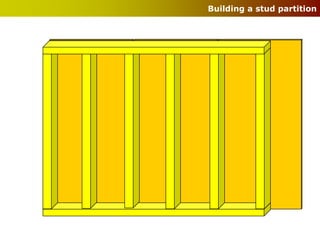
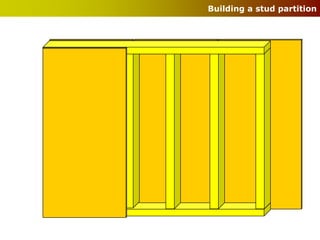
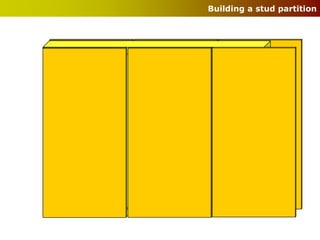
Partitions


• Load bearing partitions generally
  built in blockwork with a
  plaster/plasterboard finish
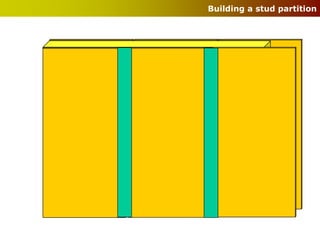
• Non load bearing partitions
  – Timber framed with plasterboard
    finish both sides
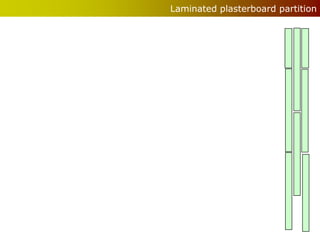
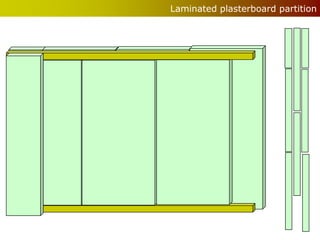
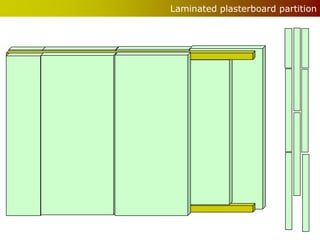
  – Laminated plaster board
  – Steel studwork with plasterboard
    finish
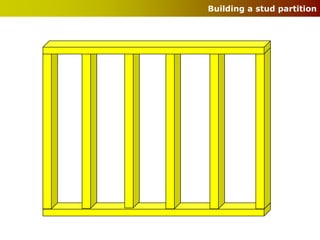
Building a stud partition
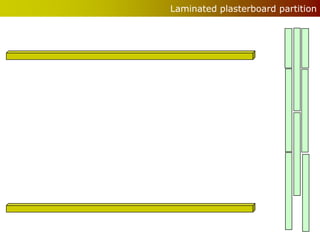
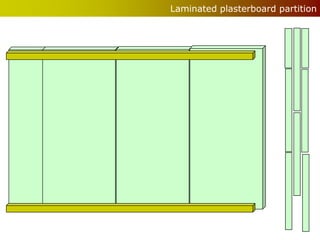
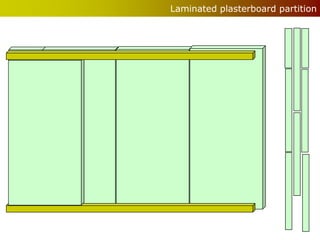
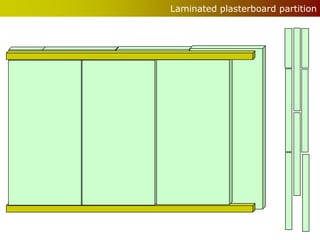
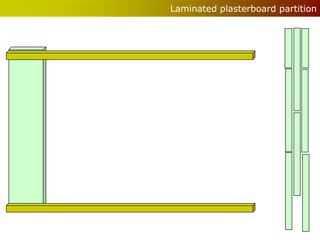
Laminated plasterboard partition
Thin finishes


• Thin finishes can be classed into
  opaque (paints) or transparent
  (varnishes).
• Staines are not a true finish, but
  change the appearance of timbers
  and have water repellent and anti-
  fungal components.
Paints


• All materials can be painted to
  – Improve appearance
  – Change colour
  – Protect base material
• Paints always applied as a system
  – Primer: acts as a glue between base
    surface and paint system
  – Undercoat: highly pigmented, forms
    body of the system
  – Top coat, usually impermeable, may
    be glossy, gives final colour and seal
Varnish


• Transparent finish
• Only used on wood
• Primers and undercoats can’t be
  used because of transparency
• Multiple layers needed
• Usually requires refinishing a
  regular intervals particularly if
  exposed to sunlight
Stains


• Pigmented, largely transparent
  chemicals with water repellent and
  fungicidal qualities
• Designed to soak into timber and give it
  a weather resistant, coloured surface
• Works well for exposed structural
  timber, such as fences
• Much used for window frames in the
  1970-80s with poor results. Water still
  gets into the joints
• Easy to restain, hard to refinish with
  paint
References


• Lafarge are the largest plaster and
  plasterboard manufacturers and
  produce very good technical
  literature:
• www.lafarge.co.uk
• Lafarge dry lining manual
  – http://www.lafargeplasterboard.co.uk
    /drywall_manual/default.html
• Any building textbook will give
  details of internal plastering and
  partitioning systems

Partitions and finishes-slideshare

  • 1.
    Partitions and finishes Makingthe interior usable
  • 2.
    Partitions • Internal wallswhich subdivide rooms • Can be load bearing or non load bearing • Load bearing partitions can be treated like external walls, but without the need for rain resistance • Non load bearing partitions are different
  • 3.
    Finishes • Finishes canbe internal or external • Finishes can be thick, property changing, or thin, cosmetic. • Some finishes are integral to the nature of partitions, so will be considered first.
  • 4.
    External finishes • Dryfinishes – claddings – Timber boarding – Tile hanging – Corrugated metal or plastic sheeting • Wet finishes-renders – Renders, either cement or lime plaster based – Paints, either cosmetic or protective
  • 5.
    Dry claddings • Hiddenfaces of cladding must be ventilated and dry • Exposed faces must be out of contact with ground and allowed to dry
  • 6.
    Keep it dry Woodencladding: Structural wall: can be ventilated behind, out masonry, timber of contact with the framed or even an ground. Best to use a open steel frame rot resistant wood such as western red cedar Ventilation: free flow of air using battens and gaps
  • 7.
    Remedial cladding • Insulateddry external cladding can be fixed as a remedial measure to thin, cold damp walls or over failed roofs
  • 8.
    Upgrading and old,cold but sound wall Old, cold wall Old, cold wall New cladding on Old, cold wall battens Insulation behind cladding Vapour barrier between old wall and warm side of insulation
  • 9.
    Wet claddings: rendering •Rendering refers to covering an external wall surface with a plaster • Renders change the appearance of a wall and can improve the performance • Traditional renders were lime plaster based, but modern ones are largely portland cement based.
  • 10.
    Lime plaster rendering:aka “pargetting” and “stucco”
  • 11.
    Working with stucco •Stucco needs to be strongly keyed to the sub surface – Keying can be grooves in the brickwork, heads of partly driven nails, or in modern work, stainless steel meshes fixed to the sub surface • Any lime based finish must be protected form the rain – Good roof overhangs – Painted finish
  • 12.
    Cement based rendering •Modern cement based renders are basically thin layers of concrete • Basic rule is the render must be weaker than the supporting wall so that the render fails first • Render should also be slightly flexible • Both achieved by concrete admixtures, often incorporating some lime.
  • 13.
    Rendering on RACcampus Woodlands Bledisloe Court Coad Court
  • 14.
    Why render abuilding? • For appearance, as on the RAC campus – Cheaper than natural stone – More sympathetic than artificial stone • Improved performance of old walls – Rendering can cover cracks – Extra layer can help rain resistance – Render can cover a new layer of external insulation
  • 15.
    Internal finishes • Thickfinishes – Wet linings • Lime plaster • Gypsum plaster – Dry lining • Plaster board • Timber lining • Thin finishes – Paints – Varnishes (timber only) – Stains (timber only)
  • 16.
    Plaster • Plasters arethick, gel like materials applied to rough walls to give a smooth finish. • Plastering is a highly skilled trade • Plasters are either traditional lime plasters or modern gypsum plasters.
  • 17.
    Lime plaster • Limeplaster – Traditional, mixture of lime (calcium carbonate CaCO3, derived from limestone or chalk) with sand, water and possibly a binder like horse hair – Highly alkaline, never sets truly hard, very flexible and self healing – Lime is a dangerous, irritant chemical – Lime plasters generally used for conservation work on historic buildings
  • 18.
    Gypsum plaster • Gypsumis calcium sulphate (CaSO4) and a naturally occurring mineral in a hydrated form • Plaster of Paris is pure gypsum • Gypsum building plasters usually contains sand to bulk them out • Gypsum plasters are non-irritant, set hard and expand slightly on setting, taking up any shrinkage cracks • Vast bulk of modern building plasters are gypsum based
  • 19.
    Plastering a wall •Three stage process – Dubbing out (filling hollows and cracks) – Base coating (12- 15mm layer levelling wall surface) – Skimming (3mm smooth finishing coat)
  • 20.
    Plastering a wall •Three stage process – Dubbing out (filling hollows and cracks) – Base coating (12- 15mm layer levelling wall surface) – Skimming (3mm smooth finishing coat)
  • 21.
    Plastering a wall •Three stage process – Dubbing out (filling hollows and cracks) – Base coating (12- 15mm layer levelling wall surface) – Skimming (3mm smooth finishing coat)
  • 22.
    Plastering a wall •Three stage process – Dubbing out (filling hollows and cracks) – Base coating (12- 15mm layer levelling wall surface) – Skimming (3mm smooth finishing coat)
  • 23.
    Dry lining • Wallscan be dry lined with wooden boarding, but most common finish is plasterboard. • Plasterboard is one of the cheapest but most versatile building materials. • Basic plaster board is a set layer of gypsum plaster covered with strong paper • Plasterboard can also be foil backed as a vapour check or foam insulation backed as a complete internal insulation and finishing system
  • 24.
    Dry lining bydirect adhesion
  • 25.
    Foam backed plasterboard •Foam backed plasterboard will insulate effectively • Boards must be secured mechanically as well, i.e. with nails or screws, to prevent it falling off in a fire.
  • 26.
    Finishing plaster board •Joints covered in fabric tape and thin layer of plaster • Whole surface covered in a thin skim coat 3mm thick
  • 27.
    Partitions • Load bearingpartitions generally built in blockwork with a plaster/plasterboard finish • Non load bearing partitions – Timber framed with plasterboard finish both sides – Laminated plaster board – Steel studwork with plasterboard finish
  • 28.
    Building a studpartition
  • 29.
    Building a studpartition
  • 30.
    Building a studpartition
  • 31.
    Building a studpartition
  • 32.
    Building a studpartition
  • 33.
    Building a studpartition
  • 34.
    Building a studpartition
  • 35.
    Building a studpartition
  • 36.
  • 37.
  • 38.
  • 39.
  • 40.
  • 41.
  • 42.
  • 43.
  • 44.
    Thin finishes • Thinfinishes can be classed into opaque (paints) or transparent (varnishes). • Staines are not a true finish, but change the appearance of timbers and have water repellent and anti- fungal components.
  • 45.
    Paints • All materialscan be painted to – Improve appearance – Change colour – Protect base material • Paints always applied as a system – Primer: acts as a glue between base surface and paint system – Undercoat: highly pigmented, forms body of the system – Top coat, usually impermeable, may be glossy, gives final colour and seal
  • 46.
    Varnish • Transparent finish •Only used on wood • Primers and undercoats can’t be used because of transparency • Multiple layers needed • Usually requires refinishing a regular intervals particularly if exposed to sunlight
  • 47.
    Stains • Pigmented, largelytransparent chemicals with water repellent and fungicidal qualities • Designed to soak into timber and give it a weather resistant, coloured surface • Works well for exposed structural timber, such as fences • Much used for window frames in the 1970-80s with poor results. Water still gets into the joints • Easy to restain, hard to refinish with paint
  • 48.
    References • Lafarge arethe largest plaster and plasterboard manufacturers and produce very good technical literature: • www.lafarge.co.uk • Lafarge dry lining manual – http://www.lafargeplasterboard.co.uk /drywall_manual/default.html • Any building textbook will give details of internal plastering and partitioning systems