SUBMITTED BY:
SAMRIDHI GUPTA
JAGMIT SINGH
HARSIMRANJEET KAUR
SUBMITTED TO:
AR. AAKRITI DHIMAN
Lamination is the technique of manufacturing a material
in multiple layers, so that the composite material
achieves improved strength, stability, sound insulation,
appearance or other properties from the use of differing
materials. A laminate is a permanently assembled object
by heat, pressure, welding, or adhesives
There are different lamination processes, depending
on the type of materials to be laminated. The
materials used in laminates can be the same or
different, depending on the processes and the object
to be laminated. An example of the type of laminate
using different materials would be the application of
a layer of plastic film—the "laminate"—on either
side of a sheet of glass—the laminated subject.
MATERIALS
Vehicle windshields are commonly made by laminating
a tough plastic film between two layers of glass. This is
to prevent shards of glass detaching from the
windshield in case it breaks. Plywood is a common
example of a laminate using the same material in each
layer. Glued and laminated dimensioned timber is used
in the construction industry to make wooden beams,
Glulam, with sizes larger and stronger than can be
obtained from single pieces of wood. Another reason
to laminate wooden strips into beams is quality control,
as with this method each and every strip can be
inspected before it becomes part of a highly stressed
component
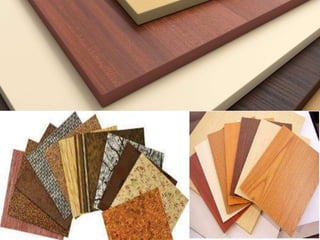
Decorative laminates are laminated products primarily
used as furniture surface materials or wall paneling. It
can be manufactured as either high- or low-pressure
laminate, with the two processes not much different
from each other except for the pressure applied in the
pressing process.
It is said that the first decorative High Pressure
Laminate was produced by Marc-Anton André, who is
the sixth generation of Johann Ludwig André, in 1959.
According to McGraw-Hill Dictionary of Architecture
& Construction, high-pressure laminates consists of
laminates "molded and cured at pressures not lower than
1,000 lb per sq in. (70 kg per sq cm) and more
commonly in the range of 1,200 to 2,000 lb per sq in.
(84 to 140 kg per sq cm).
HIGH PRESSURE LAMINATES
LOW PRESSURE LAMINATES
Low Pressure laminate is defined as "a plastic laminate
molded and cured at pressures in general of 400 pounds
per square inch (approximately 27 atmospheres or 2.8 x
106 pascals).
QUALITY STANDARDS
There are various industrial standards specifically applied
for high-pressure decorative laminates:
European Standard EN438
The European Standard EN438 is one of the standards
that most decorative laminates manufacturers selling to
worldwide market (such as Abet Laminati, Dekodur
Laminating Technologie, Violam, Formica, Maica,
Wilsonart, Greenlam) adhere to. The specific code is
EN438, entitled: Decorative high-pressure laminates
(HPL) sheets based on thermosetting resins,
specifications. It replaces the BS3794 standard.
The specific part of EN438 which applies to high-
pressure laminates is Part 3. The full title to this standard
is: High-pressure decorative laminates (HPL) Sheets
based on thermosetting resins (Usually called laminates)
Part 3: Classification and specifications for laminates less
than 2 mm thick intended for bonding to supporting
substrates. In total there are 9 parts to the EN438.
ANTIBACTERIAL
Antibacterial properties are important for decorative
laminates because these laminates are used as kitchen
tops and counter tops, cabinets and table tops that may
be in constant contact with food materials and younger
children. Antibacterial properties are there to ensure that
bacterial growth is minimal.
One of the standards for Anti-Bacterial is the ISO
22196:2007, which is based on the Japanese Industrial
Standards (JIS), code Z2801. This is one of the
standards most often referred to in the industry with
regards to tests on microbial activities (specifically
bacteria) and in the JIS Z2801, two bacteria species are
used as a standard, namely E. Coli and Staphylococcus
aureus. However, some companies may have the
initiative to test more than just these two bacteria and
may also replace Staphylococcus aureus with MRSA, the
methicillin-resistant version of the same bacteria.
Again, different countries may choose to specify
different types of microbes for testing especially if they
identified some bacteria groups which are more
intimidating in their countries due to specific reasons.
A common anti-fungi standard is the ASTM G21-09.
Not all manufacturers will take the initiatives for product
R&D for anti-Fungi attributes. Manufacturers like Maica
Laminates send their products for laboratory tests for
certification following the ASTM G21-09 standard,[6]
while Formica (South America) partners with Microban
Protection,which is a company manufacturing additives,
including the anti-bacterial additives.
ANTI FUNGI
There are many different standards with regards to fire-
resistant and flame-retardant properties of high-
pressure decorative laminates. While different countries
may have different standards for the building industry to
adhere to, most countries may agree on some of the
more common standards being used in the industry.
Very often, just like other standards applicable to the
industry, the tests may be European Standards with their
equivalent in the US Standards.
Fire-resistant and flame-retardant
For example, many Commonwealth countries may be
comfortable with the British Standards 476 especially
Parts 6 and 7, while there will still be US Standard
equivalence in the ASTM.
The list of tests applicable to decorative laminates will
never be exhaustive. As the technology improves, there
will be many more tests to ensure the safety of the
products upon use by the end consumer, for example
perhaps the tests on transfer of surface substance to
food materials if prepared on the decorative laminates as
a kitchen surface. The core tests will then also branch
out based on the specific requirements and standards
adopted by different countries.
OTHERS
Two of the internationally acknowledged "Green"
certificates for decorative laminates are MAS Certified
Green and GREENGUARD. The MAS Certified Green
and GREENGUARD marks are to certify that the
products have low chemical emissions. Chemicals tested
include VOCs, formaldehyde and other harmful
particles. The tests are based on single occupancy room
with outdoor ventilation following the ANSI/ASHRAE
Standard 62.1-2007, Ventilation for Acceptable Indoor
Air Quality. GREENGUARD especially, has two
GREEN CERTIFICATES
There are also many other "Green" certifications, some
which are requirements by the authorities before the
product can be used as building materials. These include
the Singapore Green Label which is recognised by the
Global Ecolabelling Network (GEN) and all its
member countries.
main consideration, GREENGUARD and
GREENGUARD GOLD. The GREENGUARD n
GOLD was previously known as the GREENGUARD
Children and Schools Certified, signifying its relevance
of very low allowable chemical emissions levels to
ensure the safety of young children and school
environment.
Decorative high-pressure laminates are usually used for
furniture tops especially on flat surfaces, including
cabinets and tables. Decorative compact laminates are
sometimes constructed as toilet cubicle systems,
laboratory tables and kitchen tops. Some new usage
models include wall panels with conceptual designs and
custom prints.
The popularity of large format printing using inkjet
printers have given a cheaper alternative to decorative
laminates, minus the quality. For most uninformed
consumers, the large format printing are similar to
laminates, and seem to offer more variety of designs and
applications. For example, large format prints can be
printed on wall stickers, and then installed on walls.
Unlike decorative laminates, there are no special
adhesive to be used, and the price may sometimes seem
so much cheaper comparatively.
However, there are health considerations for large
format prints because of the solvent inks used,
especially with their relatively high concentrations of
VOCs
Here are a few unconventional decorating ideas you can
try at home with laminate sheets:
Choose a pattern that looks like stone for a “natural”
table runner. It looks great underneath potted plants and
other earthen displays.
Line the inside back of a bookcase to make an
interesting backdrop for books and collectibles.
Apply laminate to a sheet of particleboard to create a
custom headboard.
Resurface a coffee or side table for enhanced eye appeal.
Use as a photo backdrop for objects, pets or children.
Resurface the wooden base of a bar. For an industrial
chic look, try decorative metals.
Resurface a kid’s desk or art table For a place where
water spills and crayon smudges are inevitable, laminate
is the perfect, easy-to-maintain option.
Apply it to stair risers to add an unexpected pop of
color or pattern.
Frame various-sized pieces, treating them as art; mix and
match similar or varied patterns. Stone looks, such as
3474 Petrified Wood in the laminate line 180fx® by
Formica Group, or graphic patterns, such as the Geo
and Dogbone Collections and 6942 Charcoal
Boomerang (pictured below) show well.
Resurface a worn wood breakfast tray to give it a new
look. Try a woodgrain so that it still looks like wood
(such as 204 Butcherblock Maple), or go for a bolder
graphic or solid color laminate.
Raw Materials
Decorative plastic laminate sheeting is made of resins
that react with aldehydes during the thermosetting
process. The resins are laminated onto layers of kraft
paper topped with a decorative sheet. Kraft paper is the
same brown paper used in grocery bags. The first plastic
laminates were made with phenolic resin, a polymer of
formaldehyde and phenol. Phenolic resins produce only
dark colors. In the 1930s, a urea-based resin called
melamine was developed that produced a clear surface.
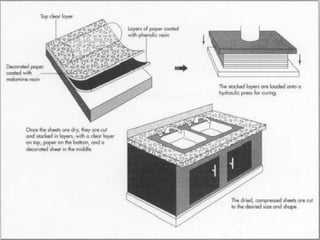
In the modern manufacturing process, the top two layers
of paper are impregnated with melamine resin, and the
lower layers use phenolic.
Impregnating the paper
1 The process begins by soaking strips of paper in resin.
Decorative plastic laminates can be made in different
grades or thicknesses, depending on its intended use.
There may be from 7-18 layers of paper combined into
the final sheet. The bottom layers are kraft paper. The
paper comes in ribbons of different widths, commonly
of three, four, or five feet. The kraft paper is run
through a "bath tub" or vat containing phenolic resins.
The paper for the top layer of the sheet is translucent.
This is run through a vat of melamine resin.
The layer just beneath the top is the decorative layer.
This is a sheet of paper printed with the color or design
that will show through the clear top layer for the desired
surface pattern. This sheet is also run through a
melamine vat.
Drying
2 The resin-impregnated sheets are then put into a
drying chamber. Next, they are cut and stacked in layers.
The clear layer and the decorative layer are on top of the
kraft paper.
Thermosetting
3 The layers of paper are then loaded onto a flat-bed
hydraulic press for final curing. The press compresses
the sandwich of resin-soaked paper at 1,400 psi, while
heating it to a high temperature. The heat catalyzes a
reaction in the resins.
The phenol (or melamine) and formaldehyde molecules
Decorative Plastic Laminate attach to each other in an
alternating chain fashion, releasing water molecules in
the process. The resins flow together and then set.
Thermosetting converts the paper sheets into one single,
rigid laminated sheet. This sheet is dry and insoluble,
and it cannot be shaped or molded, even at high
temperatures.
Finishing
4 The dry sheet is cut into the desired size and shape. It
may also be bonded to a building material such as
plywood, flakeboard, fiberboard, or metal.
The plastic laminate manufacturing process produces
several by products, some of which are considered
hazardous. Toxic emissions emanate from phenolic
resins during the laminating process, and acrylic resins
and hardeners used in applying plastic laminates to
surfaces are also considered hazardous. Decorative
plastic laminate itself is not considered a "recyclable"
plastic. However, at least one major manufacturer has
taken steps to reduce harmful waste and emissions.
BY PRODUCTS/WASTE
By switching from solvent based to water-based
phenolic resins, the amount of toxins released during
lamination can be reduced. Recent changes in the
composition of melamine have also virtually eliminated
alcohol emissions from this type of resin as well.
Control devices such as so-called packed column
scrubbers also reduce particulate emissions into the air.
Paper and laminate residue generated during the
manufacturing process are burned in power boilers. This
reduces the amount of waste sent to landfills. Metal-
based pigments used in decorative papers also create a
waste problem, as these can be hazardous. The leading
manufacturer of plastic laminate has for this reason
reduced the use of such pigments, and plans to totally
eliminate the use of metal-based pigments in the future.
Although used laminate is not recyclable, some
companies have collated old laminates into new sample
sets suitable for distribution.
Sunmica and other brands of Laminates in India usually
have a thickness that ranges from 0.6 mm to 1.5 mm.
The thicker self-supporting Compact laminates on the
other hand have a thickness ranging from 3 mm to 30
mm
THICKNESS
The most standard size of laminate sheets produced by
most of the laminate companies in India is 8'x 4'(8 feet
by 4 feet). Some laminate manufacturers also make some
laminate sheets in special sizes such as 3 feet x 7 feet, or
5 feet by 12 feet, but the standard and common size is
8'x 4'.
The prices of the laminates are specified by the plywood
and laminate retailers in India in terms of cost (in Rs.)
per sheet of laminate. On the contrary plywood rates are
usually specified in terms of cost (Rs.) per square foot.
PRICES
.laminates -BUILDING MATERIAL-LAMINATE

.laminates -BUILDING MATERIAL-LAMINATE

  • 1.
    SUBMITTED BY: SAMRIDHI GUPTA JAGMITSINGH HARSIMRANJEET KAUR SUBMITTED TO: AR. AAKRITI DHIMAN
  • 2.
    Lamination is thetechnique of manufacturing a material in multiple layers, so that the composite material achieves improved strength, stability, sound insulation, appearance or other properties from the use of differing materials. A laminate is a permanently assembled object by heat, pressure, welding, or adhesives
  • 3.
    There are differentlamination processes, depending on the type of materials to be laminated. The materials used in laminates can be the same or different, depending on the processes and the object to be laminated. An example of the type of laminate using different materials would be the application of a layer of plastic film—the "laminate"—on either side of a sheet of glass—the laminated subject. MATERIALS
  • 4.
    Vehicle windshields arecommonly made by laminating a tough plastic film between two layers of glass. This is to prevent shards of glass detaching from the windshield in case it breaks. Plywood is a common example of a laminate using the same material in each layer. Glued and laminated dimensioned timber is used in the construction industry to make wooden beams, Glulam, with sizes larger and stronger than can be obtained from single pieces of wood. Another reason to laminate wooden strips into beams is quality control, as with this method each and every strip can be inspected before it becomes part of a highly stressed component
  • 7.
    Decorative laminates arelaminated products primarily used as furniture surface materials or wall paneling. It can be manufactured as either high- or low-pressure laminate, with the two processes not much different from each other except for the pressure applied in the pressing process. It is said that the first decorative High Pressure Laminate was produced by Marc-Anton André, who is the sixth generation of Johann Ludwig André, in 1959.
  • 8.
    According to McGraw-HillDictionary of Architecture & Construction, high-pressure laminates consists of laminates "molded and cured at pressures not lower than 1,000 lb per sq in. (70 kg per sq cm) and more commonly in the range of 1,200 to 2,000 lb per sq in. (84 to 140 kg per sq cm). HIGH PRESSURE LAMINATES
  • 9.
    LOW PRESSURE LAMINATES LowPressure laminate is defined as "a plastic laminate molded and cured at pressures in general of 400 pounds per square inch (approximately 27 atmospheres or 2.8 x 10⁶ pascals).
  • 10.
    QUALITY STANDARDS There arevarious industrial standards specifically applied for high-pressure decorative laminates: European Standard EN438 The European Standard EN438 is one of the standards that most decorative laminates manufacturers selling to worldwide market (such as Abet Laminati, Dekodur Laminating Technologie, Violam, Formica, Maica, Wilsonart, Greenlam) adhere to. The specific code is EN438, entitled: Decorative high-pressure laminates (HPL) sheets based on thermosetting resins, specifications. It replaces the BS3794 standard.
  • 11.
    The specific partof EN438 which applies to high- pressure laminates is Part 3. The full title to this standard is: High-pressure decorative laminates (HPL) Sheets based on thermosetting resins (Usually called laminates) Part 3: Classification and specifications for laminates less than 2 mm thick intended for bonding to supporting substrates. In total there are 9 parts to the EN438.
  • 12.
    ANTIBACTERIAL Antibacterial properties areimportant for decorative laminates because these laminates are used as kitchen tops and counter tops, cabinets and table tops that may be in constant contact with food materials and younger children. Antibacterial properties are there to ensure that bacterial growth is minimal.
  • 13.
    One of thestandards for Anti-Bacterial is the ISO 22196:2007, which is based on the Japanese Industrial Standards (JIS), code Z2801. This is one of the standards most often referred to in the industry with regards to tests on microbial activities (specifically bacteria) and in the JIS Z2801, two bacteria species are used as a standard, namely E. Coli and Staphylococcus aureus. However, some companies may have the initiative to test more than just these two bacteria and may also replace Staphylococcus aureus with MRSA, the methicillin-resistant version of the same bacteria.
  • 14.
    Again, different countriesmay choose to specify different types of microbes for testing especially if they identified some bacteria groups which are more intimidating in their countries due to specific reasons.
  • 15.
    A common anti-fungistandard is the ASTM G21-09. Not all manufacturers will take the initiatives for product R&D for anti-Fungi attributes. Manufacturers like Maica Laminates send their products for laboratory tests for certification following the ASTM G21-09 standard,[6] while Formica (South America) partners with Microban Protection,which is a company manufacturing additives, including the anti-bacterial additives. ANTI FUNGI
  • 16.
    There are manydifferent standards with regards to fire- resistant and flame-retardant properties of high- pressure decorative laminates. While different countries may have different standards for the building industry to adhere to, most countries may agree on some of the more common standards being used in the industry. Very often, just like other standards applicable to the industry, the tests may be European Standards with their equivalent in the US Standards. Fire-resistant and flame-retardant
  • 17.
    For example, manyCommonwealth countries may be comfortable with the British Standards 476 especially Parts 6 and 7, while there will still be US Standard equivalence in the ASTM.
  • 18.
    The list oftests applicable to decorative laminates will never be exhaustive. As the technology improves, there will be many more tests to ensure the safety of the products upon use by the end consumer, for example perhaps the tests on transfer of surface substance to food materials if prepared on the decorative laminates as a kitchen surface. The core tests will then also branch out based on the specific requirements and standards adopted by different countries. OTHERS
  • 19.
    Two of theinternationally acknowledged "Green" certificates for decorative laminates are MAS Certified Green and GREENGUARD. The MAS Certified Green and GREENGUARD marks are to certify that the products have low chemical emissions. Chemicals tested include VOCs, formaldehyde and other harmful particles. The tests are based on single occupancy room with outdoor ventilation following the ANSI/ASHRAE Standard 62.1-2007, Ventilation for Acceptable Indoor Air Quality. GREENGUARD especially, has two GREEN CERTIFICATES
  • 20.
    There are alsomany other "Green" certifications, some which are requirements by the authorities before the product can be used as building materials. These include the Singapore Green Label which is recognised by the Global Ecolabelling Network (GEN) and all its member countries. main consideration, GREENGUARD and GREENGUARD GOLD. The GREENGUARD n GOLD was previously known as the GREENGUARD Children and Schools Certified, signifying its relevance of very low allowable chemical emissions levels to ensure the safety of young children and school environment.
  • 22.
    Decorative high-pressure laminatesare usually used for furniture tops especially on flat surfaces, including cabinets and tables. Decorative compact laminates are sometimes constructed as toilet cubicle systems, laboratory tables and kitchen tops. Some new usage models include wall panels with conceptual designs and custom prints.
  • 25.
    The popularity oflarge format printing using inkjet printers have given a cheaper alternative to decorative laminates, minus the quality. For most uninformed consumers, the large format printing are similar to laminates, and seem to offer more variety of designs and applications. For example, large format prints can be printed on wall stickers, and then installed on walls. Unlike decorative laminates, there are no special adhesive to be used, and the price may sometimes seem so much cheaper comparatively. However, there are health considerations for large format prints because of the solvent inks used, especially with their relatively high concentrations of VOCs
  • 26.
    Here are afew unconventional decorating ideas you can try at home with laminate sheets: Choose a pattern that looks like stone for a “natural” table runner. It looks great underneath potted plants and other earthen displays. Line the inside back of a bookcase to make an interesting backdrop for books and collectibles. Apply laminate to a sheet of particleboard to create a custom headboard. Resurface a coffee or side table for enhanced eye appeal. Use as a photo backdrop for objects, pets or children. Resurface the wooden base of a bar. For an industrial chic look, try decorative metals.
  • 27.
    Resurface a kid’sdesk or art table For a place where water spills and crayon smudges are inevitable, laminate is the perfect, easy-to-maintain option. Apply it to stair risers to add an unexpected pop of color or pattern. Frame various-sized pieces, treating them as art; mix and match similar or varied patterns. Stone looks, such as 3474 Petrified Wood in the laminate line 180fx® by Formica Group, or graphic patterns, such as the Geo and Dogbone Collections and 6942 Charcoal Boomerang (pictured below) show well.
  • 28.
    Resurface a wornwood breakfast tray to give it a new look. Try a woodgrain so that it still looks like wood (such as 204 Butcherblock Maple), or go for a bolder graphic or solid color laminate.
  • 30.
    Raw Materials Decorative plasticlaminate sheeting is made of resins that react with aldehydes during the thermosetting process. The resins are laminated onto layers of kraft paper topped with a decorative sheet. Kraft paper is the same brown paper used in grocery bags. The first plastic laminates were made with phenolic resin, a polymer of formaldehyde and phenol. Phenolic resins produce only dark colors. In the 1930s, a urea-based resin called melamine was developed that produced a clear surface. In the modern manufacturing process, the top two layers of paper are impregnated with melamine resin, and the lower layers use phenolic.
  • 33.
    Impregnating the paper 1The process begins by soaking strips of paper in resin. Decorative plastic laminates can be made in different grades or thicknesses, depending on its intended use. There may be from 7-18 layers of paper combined into the final sheet. The bottom layers are kraft paper. The paper comes in ribbons of different widths, commonly of three, four, or five feet. The kraft paper is run through a "bath tub" or vat containing phenolic resins. The paper for the top layer of the sheet is translucent. This is run through a vat of melamine resin.
  • 34.
    The layer justbeneath the top is the decorative layer. This is a sheet of paper printed with the color or design that will show through the clear top layer for the desired surface pattern. This sheet is also run through a melamine vat.
  • 35.
    Drying 2 The resin-impregnatedsheets are then put into a drying chamber. Next, they are cut and stacked in layers. The clear layer and the decorative layer are on top of the kraft paper. Thermosetting 3 The layers of paper are then loaded onto a flat-bed hydraulic press for final curing. The press compresses the sandwich of resin-soaked paper at 1,400 psi, while heating it to a high temperature. The heat catalyzes a reaction in the resins.
  • 36.
    The phenol (ormelamine) and formaldehyde molecules Decorative Plastic Laminate attach to each other in an alternating chain fashion, releasing water molecules in the process. The resins flow together and then set. Thermosetting converts the paper sheets into one single, rigid laminated sheet. This sheet is dry and insoluble, and it cannot be shaped or molded, even at high temperatures.
  • 37.
    Finishing 4 The drysheet is cut into the desired size and shape. It may also be bonded to a building material such as plywood, flakeboard, fiberboard, or metal.
  • 38.
    The plastic laminatemanufacturing process produces several by products, some of which are considered hazardous. Toxic emissions emanate from phenolic resins during the laminating process, and acrylic resins and hardeners used in applying plastic laminates to surfaces are also considered hazardous. Decorative plastic laminate itself is not considered a "recyclable" plastic. However, at least one major manufacturer has taken steps to reduce harmful waste and emissions. BY PRODUCTS/WASTE
  • 39.
    By switching fromsolvent based to water-based phenolic resins, the amount of toxins released during lamination can be reduced. Recent changes in the composition of melamine have also virtually eliminated alcohol emissions from this type of resin as well. Control devices such as so-called packed column scrubbers also reduce particulate emissions into the air.
  • 40.
    Paper and laminateresidue generated during the manufacturing process are burned in power boilers. This reduces the amount of waste sent to landfills. Metal- based pigments used in decorative papers also create a waste problem, as these can be hazardous. The leading manufacturer of plastic laminate has for this reason reduced the use of such pigments, and plans to totally eliminate the use of metal-based pigments in the future. Although used laminate is not recyclable, some companies have collated old laminates into new sample sets suitable for distribution.
  • 41.
    Sunmica and otherbrands of Laminates in India usually have a thickness that ranges from 0.6 mm to 1.5 mm. The thicker self-supporting Compact laminates on the other hand have a thickness ranging from 3 mm to 30 mm THICKNESS
  • 42.
    The most standardsize of laminate sheets produced by most of the laminate companies in India is 8'x 4'(8 feet by 4 feet). Some laminate manufacturers also make some laminate sheets in special sizes such as 3 feet x 7 feet, or 5 feet by 12 feet, but the standard and common size is 8'x 4'.
  • 43.
    The prices ofthe laminates are specified by the plywood and laminate retailers in India in terms of cost (in Rs.) per sheet of laminate. On the contrary plywood rates are usually specified in terms of cost (Rs.) per square foot. PRICES