Welcome To Our
Presentation
Department of Civil Engineering
Details of Construction
2nd Year; 2nd Semester
Sec : A
Presentation on
Brick masonry, Paint and
Plastering
Presented by
Group – 5
Group Members :
 Abontee Barua
 Sanchari Halder
 Mahfijur Rahman
 Tusher Kanti Munshi
 Asif Hasan
 Yeasin Ali Talukder
 Md. Ashraful Alam
 Sarwar Murshed
What’s Masonry?
The construction of stone or brick which in hardened by heat is termed
as masonry. It’s also defined as construction of building units bonded
together with mortar.
Types: Masonry is basically a wall material. Masonry walls can be divided
into three categories, as follows:
Load bearing walls.
Non-load bearing walls
Retaining walls.
Now from the point of view of using in construction, masonry can be divided
into 4 categories, as follows:
1)Stone masonry
2)Brick masonry
3)Reinforced masonry &
4)Composite masonry
BRICK MASONRY
BRICK MASONRY
What is Brick Masonry::
What is Brick Masonry
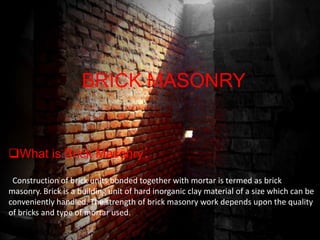
Construction of brick units bonded together with mortar is termed as brick
masonry. Brick is a building unit of hard inorganic clay material of a size which can be
conveniently handled. The strength of brick masonry work depends upon the quality
of bricks and type of mortar used.
Types Of Bricks
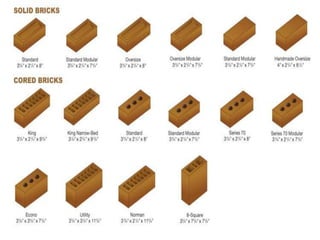
 Generally two types,
=>Traditional bricks;
Size: 23cm*10cm*10cm (with mortar),
=>Modular bricks;
Size: 20cm*10cm*10cm (with mortar).
For beautification other types of ceramic bricks are also be used
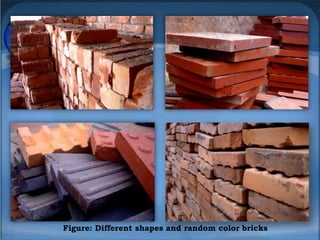
Figure: Different shapes and random color bricks
GENERAL PRINCIPLES TO BE OBSERVED IN BRICK
MASONARY CONSTRUCTION
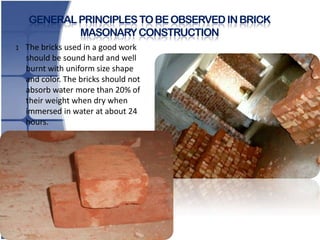
1.

The bricks used in a good work
should be sound hard and well
burnt with uniform size shape
and color. The bricks should not
absorb water more than 20% of
their weight when dry when
immersed in water at about 24
hours.
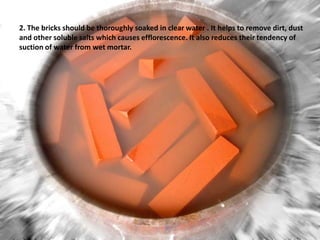
2. The bricks should be thoroughly soaked in clear water . It helps to remove dirt, dust
and other soluble salts which causes efflorescence. It also reduces their tendency of
suction of water from wet mortar.
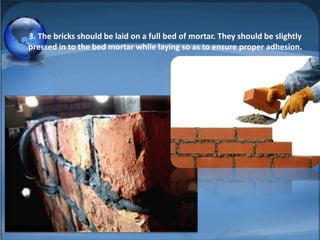
3. The bricks should be laid on a full bed of mortar. They should be slightly
pressed in to the bed mortar while laying so as to ensure proper adhesion.
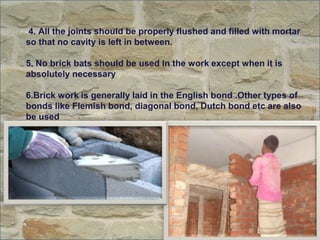
4. All the joints should be properly flushed and filled with mortar
so that no cavity is left in between.
5. No brick bats should be used in the work except when it is
absolutely necessary
6.Brick work is generally laid in the English bond .Other types of
bonds like Flemish bond, diagonal bond, Dutch bond etc are also
be used
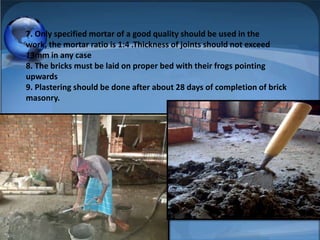
7. Only specified mortar of a good quality should be used in the
work, the mortar ratio is 1:4 .Thickness of joints should not exceed
13mm in any case
8. The bricks must be laid on proper bed with their frogs pointing
upwards
9. Plastering should be done after about 28 days of completion of brick
masonry.
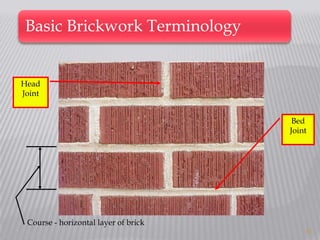
Basic Brickwork Terminology

Head
Joint
Bed
Joint

Course - horizontal layer of brick
15
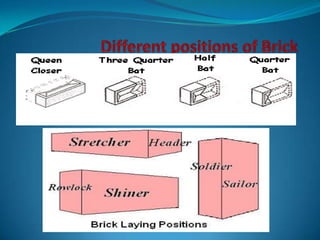
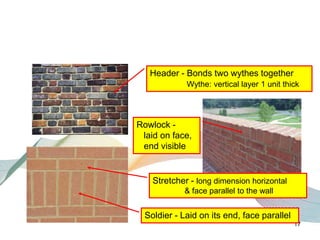
Header - Bonds two wythes together
Wythe: vertical layer 1 unit thick

Rowlock laid on face,
end visible

Stretcher - long dimension horizontal
& face parallel to the wall

Soldier - Laid on its end, face parallel
17
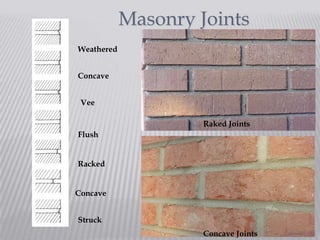
Masonry Joints
Weathered
Concave
Vee
Raked Joints

Flush
Racked

Concave
Struck
Concave Joints
Why bond is necessary ???
• Eliminates continuous vertical joints
• Imparts strength to the masonry
• Defective arrangement reduces strength &
durability
• A wall having continuous vertical joints does
not act as homogeneous mass
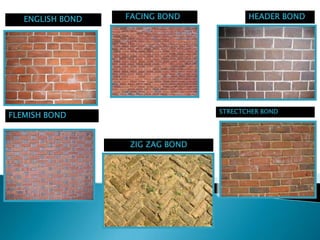
Types of Bond
 English Bond
 Flemish Bond
 Stretching Bond
Heading Bond
Garden Wall Bond
Facing Bond
Raking Bond
Dutch Bond
English Cross-Bond
Zig-Zag Bond
Silverlock’s bond
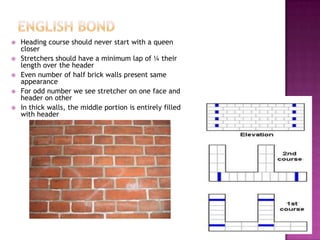
ENGLISH BOND

FACING BOND

HEADER BOND

STRECTCHER BOND

FLEMISH BOND
ZIG ZAG BOND






Heading course should never start with a queen
closer
Stretchers should have a minimum lap of ¼ their
length over the header
Even number of half brick walls present same
appearance
For odd number we see stretcher on one face and
header on other
In thick walls, the middle portion is entirely filled
with header
FLEMISH BOND





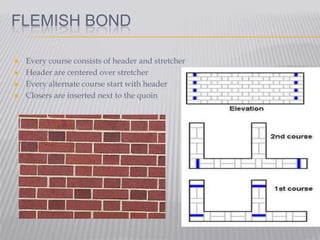
Every course consists of header and stretcher
Header are centered over stretcher
Every alternate course start with header
Closers are inserted next to the quoin









Single flemish bond:
Combination of english and flemish bond
In a course, facing is flemish and backing is
english
Cannot be adopted in walls having thickness
less than one and half brick
Provided for the attractive appearance of the
flemish bond









Double Flemish bond:
Each course presents the same appearance both in the
face and back of the wall
Every course consists of headers and stretchers
alternately
Best suited for consideration of economy and
appearance
This type of bonding is comparatively weaker than
English bond
Comparison ??
English bond is stronger
Flemish is more attractive
Flemish requires more attention
Flemish is economical
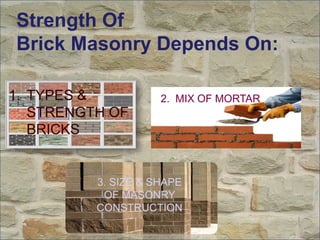
Strength Of
Brick Masonry Depends On:
1. TYPES &
STRENGTH OF
BRICKS

2. MIX OF MORTAR

3. SIZE & SHAPE
OF MASONRY
CONSTRUCTION
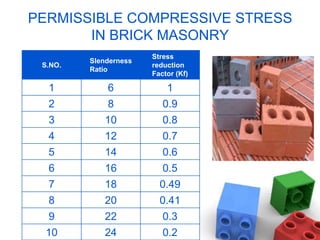
PERMISSIBLE COMPRESSIVE STRESS
IN BRICK MASONRY
S.NO.

Slenderness
Ratio

Stress
reduction
Factor (Kf)

1

6

1

2

8

0.9

3

10

0.8

4

12

0.7

5

14

0.6

6

16

0.5

7

18

0.49

8

20

0.41

9

22

0.3

10

24

0.2
Defects In Brick
Masonry
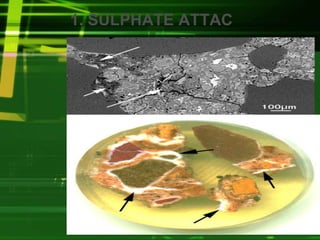
1. SULPHATE ATTAC
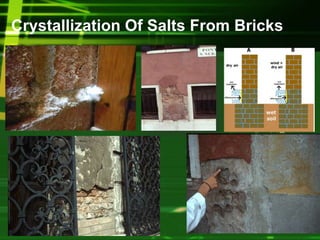
Crystallization Of Salts From Bricks
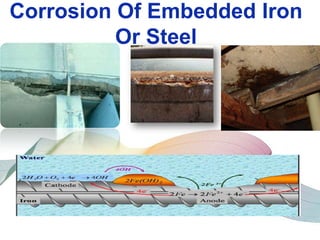
Corrosion Of Embedded Iron
Or Steel
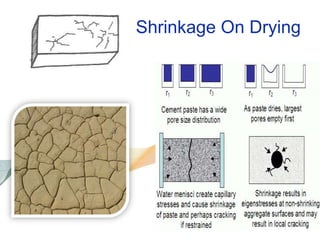
Shrinkage On Drying
NOW THE
QUESTION
MAY BE
ARRISED ........
HOW CAN WE REMOVE DEFECTS IN
BRICK MASONRY?
WE CAN REMOVE DEFECTS IN BRICK
MASONRY:

• Sulphate attack can be removed by

suitable
construction details and choosing materials.

• Efflorescence can be removed by brushing and washing
the effected surface repeatedly

• Shrinkage on drying can be prevented by using good
quality brick and by protecting masonry from moisture
penetration

• Corrosion of embedded iron or steel can be removed by
encasing the reinforcement or iron member in dense cement
mortar .
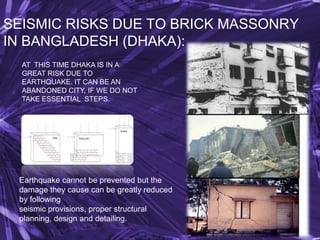
SEISMIC RISKS DUE TO BRICK MASSONRY
IN BANGLADESH (DHAKA):
AT THIS TIME DHAKA IS IN A
GREAT RISK DUE TO
EARTHQUAKE. IT CAN BE AN
ABANDONED CITY, IF WE DO NOT
TAKE ESSENTIAL STEPS.

Earthquake cannot be prevented but the
damage they cause can be greatly reduced
by following
seismic provisions, proper structural
planning, design and detailing.
Plastering
• DEFINATION OF PLASTERING:
The word “plaster” comes from the Greek language meaning
“to daub on”.
This is a process of covering rough surfaces with a plastic
material to obtain an even , smooth , regular ,clean &
durable surface.
On the other hand we say that
A mixture of lime or gypsum, sand, and water, sometimes
with fiber added, that hardens to a smooth solid and is used
for coating walls and ceilings.
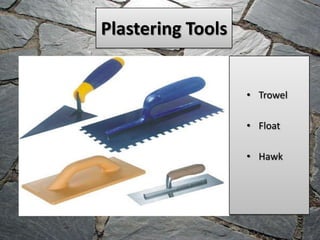
Plastering Tools

• Trowel
• Float
• Hawk
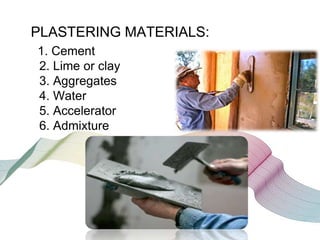
PLASTERING MATERIALS:
1. Cement
2. Lime or clay
3. Aggregates
4. Water
5. Accelerator
6. Admixture
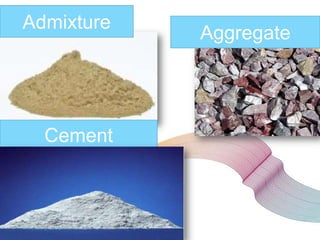
Admixture

Cement

Aggregate
SAND USED IN
PLASTERING
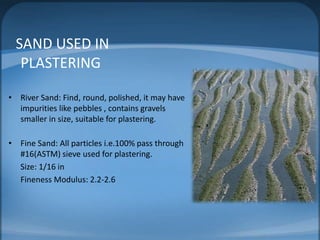
• River Sand: Find, round, polished, it may have
impurities like pebbles , contains gravels
smaller in size, suitable for plastering.
• Fine Sand: All particles i.e.100% pass through
#16(ASTM) sieve used for plastering.
Size: 1/16 in
Fineness Modulus: 2.2-2.6
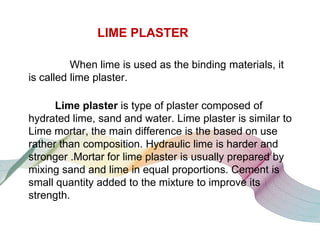
KINDS OF PLASTERING :

There are several different types of Plaster
available such as :

(a) Lime Plaster
(b) Cement Plaster
(c) Mud Plaster
(d) Stucco Plaster
(e) Plaster on lath
LIME PLASTER
When lime is used as the binding materials, it
is called lime plaster.
Lime plaster is type of plaster composed of
hydrated lime, sand and water. Lime plaster is similar to
Lime mortar, the main difference is the based on use
rather than composition. Hydraulic lime is harder and
stronger .Mortar for lime plaster is usually prepared by
mixing sand and lime in equal proportions. Cement is
small quantity added to the mixture to improve its
strength.
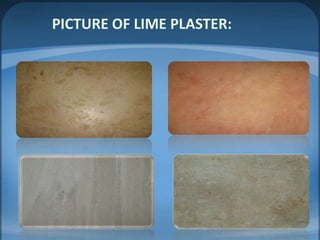
PICTURE OF LIME PLASTER:
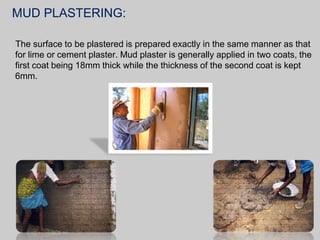
MUD PLASTERING:
The surface to be plastered is prepared exactly in the same manner as that
for lime or cement plaster. Mud plaster is generally applied in two coats, the
first coat being 18mm thick while the thickness of the second coat is kept
6mm.
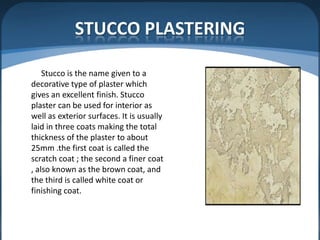
STUCCO PLASTERING
Stucco is the name given to a
decorative type of plaster which
gives an excellent finish. Stucco
plaster can be used for interior as
well as exterior surfaces. It is usually
laid in three coats making the total
thickness of the plaster to about
25mm .the first coat is called the
scratch coat ; the second a finer coat
, also known as the brown coat, and
the third is called white coat or
finishing coat.
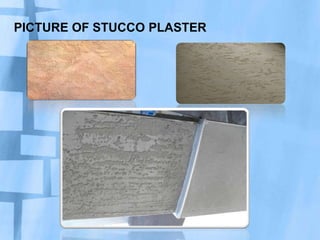
PICTURE OF STUCCO PLASTER
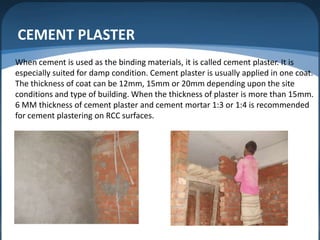
CEMENT PLASTER
When cement is used as the binding materials, it is called cement plaster. It is
especially suited for damp condition. Cement plaster is usually applied in one coat.
The thickness of coat can be 12mm, 15mm or 20mm depending upon the site
conditions and type of building. When the thickness of plaster is more than 15mm.
6 MM thickness of cement plaster and cement mortar 1:3 or 1:4 is recommended
for cement plastering on RCC surfaces.
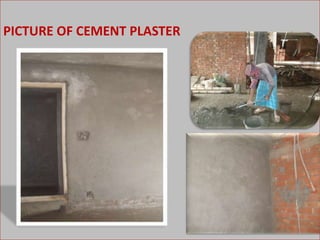
PICTURE OF CEMENT PLASTER
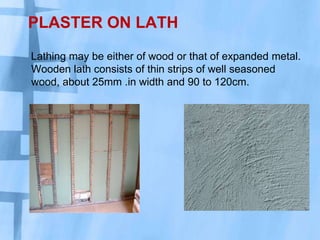
PLASTER ON LATH
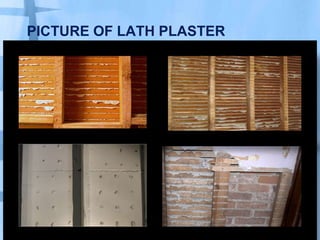
Lathing may be either of wood or that of expanded metal.
Wooden lath consists of thin strips of well seasoned
wood, about 25mm .in width and 90 to 120cm.
PICTURE OF LATH PLASTER
SPECIAL TYPES OF
FINISHING

a)
b)
c)
d)
e)

Smooth Cast
Rough Cast
Pebble Dash
Scrapped Finish
Textured Finish
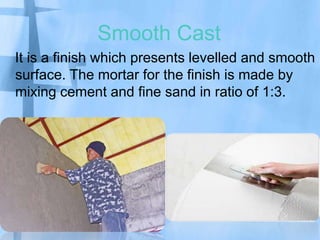
Smooth Cast
It is a finish which presents levelled and smooth
surface. The mortar for the finish is made by
mixing cement and fine sand in ratio of 1:3.
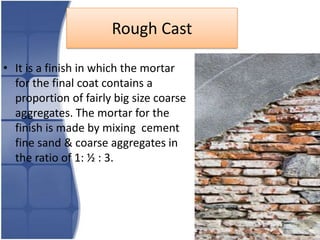
Rough Cast
• It is a finish in which the mortar
for the final coat contains a
proportion of fairly big size coarse
aggregates. The mortar for the
finish is made by mixing cement
fine sand & coarse aggregates in
the ratio of 1: ½ : 3.
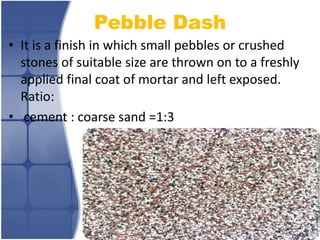
Pebble Dash
• It is a finish in which small pebbles or crushed
stones of suitable size are thrown on to a freshly
applied final coat of mortar and left exposed.
Ratio:
• cement : coarse sand =1:3
Scrapped Finish
It is a finish in which the final coat after being
leveled and allowed to stiffen for a few hours.
The final coat is usually 6 to 12mm thickness
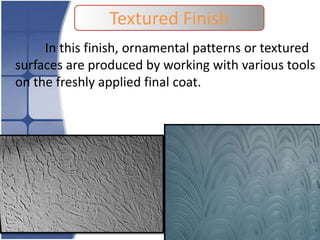
Textured Finish
In this finish, ornamental patterns or textured
surfaces are produced by working with various tools
on the freshly applied final coat.
Defects in plaster work

Cracking
Efflorescence
Falling out of plaster
Blowing of plaster
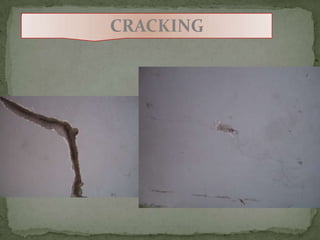
Cracking
a. Old surface not being properly prepared.
b. Movements in the backing either on account due to
shrinkage caused by the drying of the backing
material.
c. Excessive shrinkage of plaster due to the application
of mortar in thick coats.
CRACKING
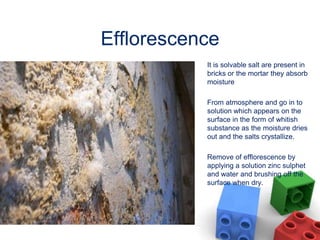
Efflorescence
It is solvable salt are present in
bricks or the mortar they absorb
moisture
From atmosphere and go in to
solution which appears on the
surface in the form of whitish
substance as the moisture dries
out and the salts crystallize.
Remove of efflorescence by
applying a solution zinc sulphet
and water and brushing off the
surface when dry.
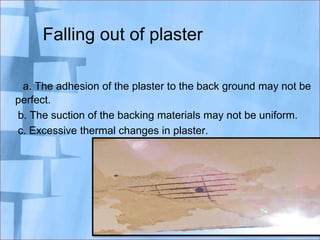
Falling out of plaster
a. The adhesion of the plaster to the back ground may not be
perfect.
b. The suction of the backing materials may not be uniform.
c. Excessive thermal changes in plaster.
Blowing of plaster

This consists of information of small patches of plaster
swelling out beyond the plastered surface and chiefly due
to improper slaking of lime particles in the plaster.
ADVANTAGES OF
PLASTERING
a) Easy in application
b) No surgery is required.
c) Plaster is the most common form of
interior wall finishing
d) If properly mixed and applied, a plaster
coating creates a stronger and more
durable.
DISADVANTAGES OF PLASTERING

a) When plaster cracks then difficult to
repair.
b) Repairing is very expensive.
c) Despite the extra labor of hanging and
finishing drywall, it tends to be less
expensive than plastering
PAI N
T
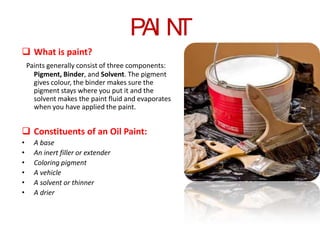
 What is paint?
Paints generally consist of three components:
Pigment, Binder, and Solvent. The pigment
gives colour, the binder makes sure the
pigment stays where you put it and the
solvent makes the paint fluid and evaporates
when you have applied the paint.

 Constituents of an Oil Paint:
•
•
•
•
•
•

A base
An inert filler or extender
Coloring pigment
A vehicle
A solvent or thinner
A drier
Characteristics of a Good
Paint
•
•
•
•
•
•
•
•

stick well to surface & able to seal porous substrata
consistency should provide easy workability
thickness should be adequate for good protection & decoration
paint film should dry easily
able to withstand adverse weather effect without losing gloss
offer resistance to failure by checking, cracking & flaking
possess good moisture resistance
color should not fade
Types of Paints












Aluminum paints
Anti-corrosive paints
Asbestos paints
Bituminous paints
Bronze paints
Cellulose paints
Casein paints
Cement based paints
Enamel paints
Oil paints
Rubber base paints
Presentation on Brick Masonry, Paint and Plastering

Presentation on Brick Masonry, Paint and Plastering

  • 1.
  • 2.
    Department of CivilEngineering Details of Construction 2nd Year; 2nd Semester Sec : A
  • 3.
    Presentation on Brick masonry,Paint and Plastering
  • 4.
    Presented by Group –5 Group Members :  Abontee Barua  Sanchari Halder  Mahfijur Rahman  Tusher Kanti Munshi  Asif Hasan  Yeasin Ali Talukder  Md. Ashraful Alam  Sarwar Murshed
  • 5.
    What’s Masonry? The constructionof stone or brick which in hardened by heat is termed as masonry. It’s also defined as construction of building units bonded together with mortar. Types: Masonry is basically a wall material. Masonry walls can be divided into three categories, as follows: Load bearing walls. Non-load bearing walls Retaining walls. Now from the point of view of using in construction, masonry can be divided into 4 categories, as follows: 1)Stone masonry 2)Brick masonry 3)Reinforced masonry & 4)Composite masonry
  • 6.
    BRICK MASONRY BRICK MASONRY Whatis Brick Masonry:: What is Brick Masonry Construction of brick units bonded together with mortar is termed as brick Construction of brick units bonded together with mortar is termed as brick masonry. Brick is a building unit of hard inorganic clay material of a size which can be masonry. Brick is a building unit of hard inorganic clay material of a size which can be conveniently handled. The strength of brick masonry work depends upon the quality conveniently handled. The strength of brick masonry work depends upon the quality of bricks and type of mortar used. of bricks and type of mortar used.
  • 7.
    Types Of Bricks Generally two types, =>Traditional bricks; Size: 23cm*10cm*10cm (with mortar), =>Modular bricks; Size: 20cm*10cm*10cm (with mortar). For beautification other types of ceramic bricks are also be used
  • 8.
    Figure: Different shapesand random color bricks
  • 10.
    GENERAL PRINCIPLES TOBE OBSERVED IN BRICK MASONARY CONSTRUCTION 1. The bricks used in a good work should be sound hard and well burnt with uniform size shape and color. The bricks should not absorb water more than 20% of their weight when dry when immersed in water at about 24 hours.
  • 11.
    2. The bricksshould be thoroughly soaked in clear water . It helps to remove dirt, dust and other soluble salts which causes efflorescence. It also reduces their tendency of suction of water from wet mortar.
  • 12.
    3. The bricksshould be laid on a full bed of mortar. They should be slightly pressed in to the bed mortar while laying so as to ensure proper adhesion.
  • 13.
    4. All thejoints should be properly flushed and filled with mortar so that no cavity is left in between. 5. No brick bats should be used in the work except when it is absolutely necessary 6.Brick work is generally laid in the English bond .Other types of bonds like Flemish bond, diagonal bond, Dutch bond etc are also be used
  • 14.
    7. Only specifiedmortar of a good quality should be used in the work, the mortar ratio is 1:4 .Thickness of joints should not exceed 13mm in any case 8. The bricks must be laid on proper bed with their frogs pointing upwards 9. Plastering should be done after about 28 days of completion of brick masonry.
  • 15.
  • 17.
    Header - Bondstwo wythes together Wythe: vertical layer 1 unit thick Rowlock laid on face, end visible Stretcher - long dimension horizontal & face parallel to the wall Soldier - Laid on its end, face parallel 17
  • 18.
  • 19.
    Why bond isnecessary ??? • Eliminates continuous vertical joints • Imparts strength to the masonry • Defective arrangement reduces strength & durability • A wall having continuous vertical joints does not act as homogeneous mass
  • 20.
    Types of Bond English Bond  Flemish Bond  Stretching Bond Heading Bond Garden Wall Bond Facing Bond Raking Bond Dutch Bond English Cross-Bond Zig-Zag Bond Silverlock’s bond
  • 21.
    ENGLISH BOND FACING BOND HEADERBOND STRECTCHER BOND FLEMISH BOND ZIG ZAG BOND
  • 22.
         Heading course shouldnever start with a queen closer Stretchers should have a minimum lap of ¼ their length over the header Even number of half brick walls present same appearance For odd number we see stretcher on one face and header on other In thick walls, the middle portion is entirely filled with header
  • 23.
    FLEMISH BOND     Every courseconsists of header and stretcher Header are centered over stretcher Every alternate course start with header Closers are inserted next to the quoin
  • 24.
         Single flemish bond: Combinationof english and flemish bond In a course, facing is flemish and backing is english Cannot be adopted in walls having thickness less than one and half brick Provided for the attractive appearance of the flemish bond
  • 25.
         Double Flemish bond: Eachcourse presents the same appearance both in the face and back of the wall Every course consists of headers and stretchers alternately Best suited for consideration of economy and appearance This type of bonding is comparatively weaker than English bond
  • 26.
    Comparison ?? English bondis stronger Flemish is more attractive Flemish requires more attention Flemish is economical
  • 27.
    Strength Of Brick MasonryDepends On: 1. TYPES & STRENGTH OF BRICKS 2. MIX OF MORTAR 3. SIZE & SHAPE OF MASONRY CONSTRUCTION
  • 28.
    PERMISSIBLE COMPRESSIVE STRESS INBRICK MASONRY S.NO. Slenderness Ratio Stress reduction Factor (Kf) 1 6 1 2 8 0.9 3 10 0.8 4 12 0.7 5 14 0.6 6 16 0.5 7 18 0.49 8 20 0.41 9 22 0.3 10 24 0.2
  • 29.
  • 30.
  • 31.
  • 32.
    Corrosion Of EmbeddedIron Or Steel
  • 33.
  • 34.
    NOW THE QUESTION MAY BE ARRISED........ HOW CAN WE REMOVE DEFECTS IN BRICK MASONRY?
  • 35.
    WE CAN REMOVEDEFECTS IN BRICK MASONRY: • Sulphate attack can be removed by suitable construction details and choosing materials. • Efflorescence can be removed by brushing and washing the effected surface repeatedly • Shrinkage on drying can be prevented by using good quality brick and by protecting masonry from moisture penetration • Corrosion of embedded iron or steel can be removed by encasing the reinforcement or iron member in dense cement mortar .
  • 36.
    SEISMIC RISKS DUETO BRICK MASSONRY IN BANGLADESH (DHAKA): AT THIS TIME DHAKA IS IN A GREAT RISK DUE TO EARTHQUAKE. IT CAN BE AN ABANDONED CITY, IF WE DO NOT TAKE ESSENTIAL STEPS. Earthquake cannot be prevented but the damage they cause can be greatly reduced by following seismic provisions, proper structural planning, design and detailing.
  • 37.
    Plastering • DEFINATION OFPLASTERING: The word “plaster” comes from the Greek language meaning “to daub on”. This is a process of covering rough surfaces with a plastic material to obtain an even , smooth , regular ,clean & durable surface. On the other hand we say that A mixture of lime or gypsum, sand, and water, sometimes with fiber added, that hardens to a smooth solid and is used for coating walls and ceilings.
  • 38.
  • 39.
    PLASTERING MATERIALS: 1. Cement 2.Lime or clay 3. Aggregates 4. Water 5. Accelerator 6. Admixture
  • 40.
  • 41.
    SAND USED IN PLASTERING •River Sand: Find, round, polished, it may have impurities like pebbles , contains gravels smaller in size, suitable for plastering. • Fine Sand: All particles i.e.100% pass through #16(ASTM) sieve used for plastering. Size: 1/16 in Fineness Modulus: 2.2-2.6
  • 42.
    KINDS OF PLASTERING: There are several different types of Plaster available such as : (a) Lime Plaster (b) Cement Plaster (c) Mud Plaster (d) Stucco Plaster (e) Plaster on lath
  • 43.
    LIME PLASTER When limeis used as the binding materials, it is called lime plaster. Lime plaster is type of plaster composed of hydrated lime, sand and water. Lime plaster is similar to Lime mortar, the main difference is the based on use rather than composition. Hydraulic lime is harder and stronger .Mortar for lime plaster is usually prepared by mixing sand and lime in equal proportions. Cement is small quantity added to the mixture to improve its strength.
  • 44.
  • 45.
    MUD PLASTERING: The surfaceto be plastered is prepared exactly in the same manner as that for lime or cement plaster. Mud plaster is generally applied in two coats, the first coat being 18mm thick while the thickness of the second coat is kept 6mm.
  • 46.
    STUCCO PLASTERING Stucco isthe name given to a decorative type of plaster which gives an excellent finish. Stucco plaster can be used for interior as well as exterior surfaces. It is usually laid in three coats making the total thickness of the plaster to about 25mm .the first coat is called the scratch coat ; the second a finer coat , also known as the brown coat, and the third is called white coat or finishing coat.
  • 47.
  • 48.
    CEMENT PLASTER When cementis used as the binding materials, it is called cement plaster. It is especially suited for damp condition. Cement plaster is usually applied in one coat. The thickness of coat can be 12mm, 15mm or 20mm depending upon the site conditions and type of building. When the thickness of plaster is more than 15mm. 6 MM thickness of cement plaster and cement mortar 1:3 or 1:4 is recommended for cement plastering on RCC surfaces.
  • 49.
  • 50.
    PLASTER ON LATH Lathingmay be either of wood or that of expanded metal. Wooden lath consists of thin strips of well seasoned wood, about 25mm .in width and 90 to 120cm.
  • 51.
  • 52.
    SPECIAL TYPES OF FINISHING a) b) c) d) e) SmoothCast Rough Cast Pebble Dash Scrapped Finish Textured Finish
  • 53.
    Smooth Cast It isa finish which presents levelled and smooth surface. The mortar for the finish is made by mixing cement and fine sand in ratio of 1:3.
  • 54.
    Rough Cast • Itis a finish in which the mortar for the final coat contains a proportion of fairly big size coarse aggregates. The mortar for the finish is made by mixing cement fine sand & coarse aggregates in the ratio of 1: ½ : 3.
  • 55.
    Pebble Dash • Itis a finish in which small pebbles or crushed stones of suitable size are thrown on to a freshly applied final coat of mortar and left exposed. Ratio: • cement : coarse sand =1:3
  • 56.
    Scrapped Finish It isa finish in which the final coat after being leveled and allowed to stiffen for a few hours. The final coat is usually 6 to 12mm thickness
  • 57.
    Textured Finish In thisfinish, ornamental patterns or textured surfaces are produced by working with various tools on the freshly applied final coat.
  • 58.
    Defects in plasterwork Cracking Efflorescence Falling out of plaster Blowing of plaster
  • 59.
    Cracking a. Old surfacenot being properly prepared. b. Movements in the backing either on account due to shrinkage caused by the drying of the backing material. c. Excessive shrinkage of plaster due to the application of mortar in thick coats.
  • 60.
  • 61.
    Efflorescence It is solvablesalt are present in bricks or the mortar they absorb moisture From atmosphere and go in to solution which appears on the surface in the form of whitish substance as the moisture dries out and the salts crystallize. Remove of efflorescence by applying a solution zinc sulphet and water and brushing off the surface when dry.
  • 62.
    Falling out ofplaster a. The adhesion of the plaster to the back ground may not be perfect. b. The suction of the backing materials may not be uniform. c. Excessive thermal changes in plaster.
  • 63.
    Blowing of plaster Thisconsists of information of small patches of plaster swelling out beyond the plastered surface and chiefly due to improper slaking of lime particles in the plaster.
  • 64.
    ADVANTAGES OF PLASTERING a) Easyin application b) No surgery is required. c) Plaster is the most common form of interior wall finishing d) If properly mixed and applied, a plaster coating creates a stronger and more durable.
  • 65.
    DISADVANTAGES OF PLASTERING a)When plaster cracks then difficult to repair. b) Repairing is very expensive. c) Despite the extra labor of hanging and finishing drywall, it tends to be less expensive than plastering
  • 66.
    PAI N T  Whatis paint? Paints generally consist of three components: Pigment, Binder, and Solvent. The pigment gives colour, the binder makes sure the pigment stays where you put it and the solvent makes the paint fluid and evaporates when you have applied the paint.  Constituents of an Oil Paint: • • • • • • A base An inert filler or extender Coloring pigment A vehicle A solvent or thinner A drier
  • 67.
    Characteristics of aGood Paint • • • • • • • • stick well to surface & able to seal porous substrata consistency should provide easy workability thickness should be adequate for good protection & decoration paint film should dry easily able to withstand adverse weather effect without losing gloss offer resistance to failure by checking, cracking & flaking possess good moisture resistance color should not fade
  • 68.
    Types of Paints            Aluminumpaints Anti-corrosive paints Asbestos paints Bituminous paints Bronze paints Cellulose paints Casein paints Cement based paints Enamel paints Oil paints Rubber base paints