

Lloyd Dean Endurance Training
Aims To explore the principle of overloading the body’s system to produce endurance adaptation. Specific endurance techniques to study are: Interval Training Fartlek Training Circuit Training
Endurance Training “ A common trend with aerobic endurance athletes is to adopt the training practices of highly successful athletes..........athletes are better served by constructing their own training regimen based on a good working knowledge of sound training principles”  (Baechle & Earle, 2008; pp. 490) What is the statement above telling us?
Factors Impacting Endurance Performance According to Baechle and Earle (2008) the following should be taken into account when planning endurance activities: VO2 Max  – The ability to utilise oxygen will impact how much the athlete can perform during the training session. Endurance training should be designed to increase maximal oxygen uptake Lactate Threshold  – Measurement of lactic acid in the muscle and blood. Is argued as a more clearer indicator of an athletes aerobic performance than VO2 Max. Training should include sessions with elevated blood lactate levels. Exercise Economy  – Technique of athlete in their respective sports has a large impact on results.
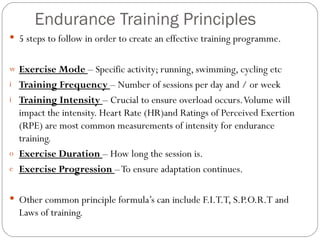
Endurance Training Principles 5 steps to follow in order to create an effective training programme. Exercise Mode  – Specific activity; running, swimming, cycling etc Training Frequency  – Number of sessions per day and / or week Training Intensity  – Crucial to ensure overload occurs. Volume will impact the intensity. Heart Rate (HR)and Ratings of Perceived Exertion (RPE) are most common measurements of intensity for endurance training. Exercise Duration  – How long the session is. Exercise Progression  – To ensure adaptation continues. Other common principle formula’s can include F.I.T.T, S.P.O.R.T and Laws of training.
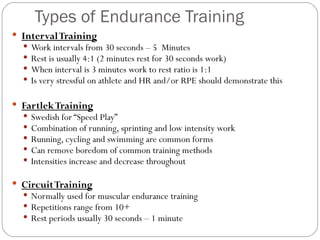
Types of Endurance Training Interval Training Work intervals from 30 seconds – 5  Minutes Rest is usually 4:1 (2 minutes rest for 30 seconds work) When interval is 3 minutes work to rest ratio is 1:1 Is very stressful on athlete and HR and/or RPE should demonstrate this Fartlek Training Swedish for “Speed Play” Combination of running, sprinting and low intensity work Running, cycling and swimming are common forms Can remove boredom of common training methods Intensities increase and decrease throughout Circuit Training Normally used for muscular endurance training Repetitions range from 10+ Rest periods usually 30 seconds – 1 minute
Resources  http://www.drmelsiff.com/ http://www.coachesinfo.com/index.php http://www.pponline.co.uk/encyc/endurance-training.htm http://www.sport-fitness-advisor.com/endurancetraining.html http://dissc.tees.ac.uk/references/Ref9.htm

W12 endurance training

  • 1.
  • 2.
    Aims To explorethe principle of overloading the body’s system to produce endurance adaptation. Specific endurance techniques to study are: Interval Training Fartlek Training Circuit Training
  • 3.
    Endurance Training “A common trend with aerobic endurance athletes is to adopt the training practices of highly successful athletes..........athletes are better served by constructing their own training regimen based on a good working knowledge of sound training principles” (Baechle & Earle, 2008; pp. 490) What is the statement above telling us?
  • 4.
    Factors Impacting EndurancePerformance According to Baechle and Earle (2008) the following should be taken into account when planning endurance activities: VO2 Max – The ability to utilise oxygen will impact how much the athlete can perform during the training session. Endurance training should be designed to increase maximal oxygen uptake Lactate Threshold – Measurement of lactic acid in the muscle and blood. Is argued as a more clearer indicator of an athletes aerobic performance than VO2 Max. Training should include sessions with elevated blood lactate levels. Exercise Economy – Technique of athlete in their respective sports has a large impact on results.
  • 5.
    Endurance Training Principles5 steps to follow in order to create an effective training programme. Exercise Mode – Specific activity; running, swimming, cycling etc Training Frequency – Number of sessions per day and / or week Training Intensity – Crucial to ensure overload occurs. Volume will impact the intensity. Heart Rate (HR)and Ratings of Perceived Exertion (RPE) are most common measurements of intensity for endurance training. Exercise Duration – How long the session is. Exercise Progression – To ensure adaptation continues. Other common principle formula’s can include F.I.T.T, S.P.O.R.T and Laws of training.
  • 6.
    Types of EnduranceTraining Interval Training Work intervals from 30 seconds – 5 Minutes Rest is usually 4:1 (2 minutes rest for 30 seconds work) When interval is 3 minutes work to rest ratio is 1:1 Is very stressful on athlete and HR and/or RPE should demonstrate this Fartlek Training Swedish for “Speed Play” Combination of running, sprinting and low intensity work Running, cycling and swimming are common forms Can remove boredom of common training methods Intensities increase and decrease throughout Circuit Training Normally used for muscular endurance training Repetitions range from 10+ Rest periods usually 30 seconds – 1 minute
  • 7.
    Resources http://www.drmelsiff.com/http://www.coachesinfo.com/index.php http://www.pponline.co.uk/encyc/endurance-training.htm http://www.sport-fitness-advisor.com/endurancetraining.html http://dissc.tees.ac.uk/references/Ref9.htm