





Will Kirousis | @willkirousis | 978*466*5151 | will@tri-hard.com
www.tri-hard.com
Long Slow Distance OR High
Intensity: What’s Better? (For you)
Getting Started
• Discuss volume and intensity
in the context of the training
process overall.
• This starts out general…
• Then we will look at issues
which lead to specific
variations/adjustments in how
YOU could apply volume and
intensity within your training
program.
• Finish up with a review of a
few “Second Level” strategies
that can help you perform
your best.
“What is a training program?”
A systematic approach to stressing
an athlete such that they
progressively adapt to specific
workout stress in a way that
allows them to perform at their
best at a specific competitive
event or series of competitive
events at a predictable time.
For best results:
Set up training to facilitate recovery,
not just to maximize work accomplished.
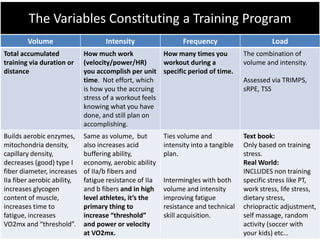
The Variables Constituting a Training Program
Volume Intensity Frequency Load
Total accumulated
training via duration or
distance
How much work
(velocity/power/HR)
you accomplish per unit
time. Not effort, which
is how you the accruing
stress of a workout feels
knowing what you have
done, and still plan on
accomplishing.
How many times you
workout during a
specific period of time.
The combination of
volume and intensity.
Assessed via TRIMPS,
sRPE, TSS
Builds aerobic enzymes,
mitochondria density,
capillary density,
decreases (good) type I
fiber diameter, increases
IIa fiber aerobic ability,
increases glycogen
content of muscle,
increases time to
fatigue, increases
VO2mx and “threshold”.
Same as volume, but
also increases acid
buffering ability,
economy, aerobic ability
of IIa/b fibers and
fatigue resistance of IIa
and b fibers and in high
level athletes, it’s the
primary thing to
increase “threshold”
and power or velocity
at VO2mx.
Ties volume and
intensity into a tangible
plan.
Intermingles with both
volume and intensity
improving fatigue
resistance and technical
skill acquisition.
Text book:
Only based on training
stress.
Real World:
INCLUDES non training
specific stress like PT,
work stress, life stress,
dietary stress,
chriopractic adjustment,
self massage, random
activity (soccer with
your kids) etc…
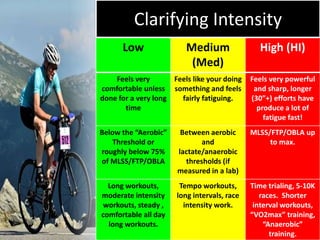
Clarifying Intensity
Low Medium
(Med)
High (HI)
Feels very
comfortable unless
done for a very long
time
Feels like your doing
something and feels
fairly fatiguing.
Feels very powerful
and sharp, longer
(30”+) efforts have
produce a lot of
fatigue fast!
Below the “Aerobic”
Threshold or
roughly below 75%
of MLSS/FTP/OBLA
Between aerobic
and
lactate/anaerobic
thresholds (if
measured in a lab)
MLSS/FTP/OBLA up
to max.
Long workouts,
moderate intensity
workouts, steady ,
comfortable all day
long workouts.
Tempo workouts,
long intervals, race
intensity work.
Time trialing, 5-10K
races. Shorter
interval workouts,
“VO2max” training,
“Anaerobic”
training.
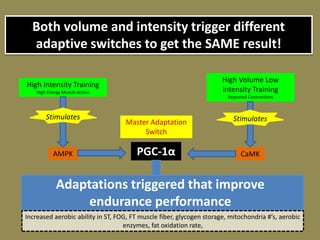
High Intensity Training
High Energy Muscle Action
High Volume Low
intensity Training
Repeated Contractions
AMPK CaMKPGC-1α
Increased aerobic ability in ST, FOG, FT muscle fiber, glycogen storage, mitochondria #’s, aerobic
enzymes, fat oxidation rate,
Master Adaptation
Switch
Adaptations triggered that improve
endurance performance
Both volume and intensity trigger different
adaptive switches to get the SAME result!
Stimulates Stimulates
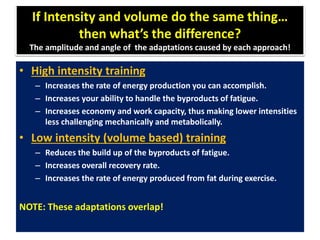
If Intensity and volume do the same thing…
then what’s the difference?
The amplitude and angle of the adaptations caused by each approach!
• High intensity training
– Increases the rate of energy production you can accomplish.
– Increases your ability to handle the byproducts of fatigue.
– Increases economy and work capacity, thus making lower intensities
less challenging mechanically and metabolically.
• Low intensity (volume based) training
– Reduces the build up of the byproducts of fatigue.
– Increases overall recovery rate.
– Increases the rate of energy produced from fat during exercise.
NOTE: These adaptations overlap!
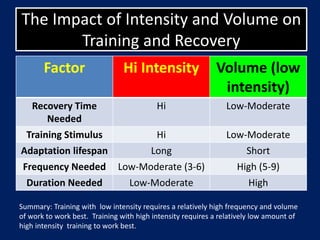
The Impact of Intensity and Volume on
Training and Recovery
Factor Hi Intensity Volume (low
intensity)
Recovery Time
Needed
Hi Low-Moderate
Training Stimulus Hi Low-Moderate
Adaptation lifespan Long Short
Frequency Needed Low-Moderate (3-6) High (5-9)
Duration Needed Low-Moderate High
Summary: Training with low intensity requires a relatively high frequency and volume
of work to work best. Training with high intensity requires a relatively low amount of
high intensity training to work best.
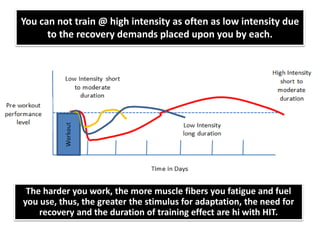
You can not train @ high intensity as often as low intensity due
to the recovery demands placed upon you by each.
The harder you work, the more muscle fibers you fatigue and fuel
you use, thus, the greater the stimulus for adaptation, the need for
recovery and the duration of training effect are hi with HIT.
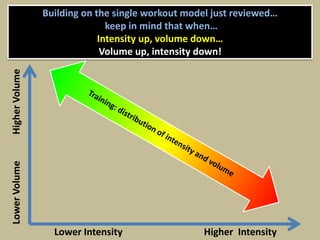
Building on the single workout model just reviewed…
keep in mind that when…
Intensity up, volume down…
Volume up, intensity down!
Lower Intensity Higher Intensity
LowerVolumeHigherVolume
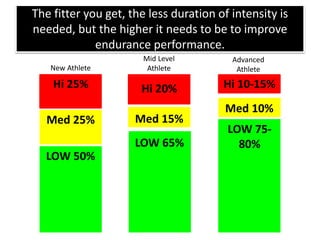
The fitter you get, the less duration of intensity is
needed, but the higher it needs to be to improve
endurance performance.
LOW 50%
Med 25%
Hi 25%
LOW 65%
Med 15%
Hi 20%
LOW 75-
80%
Med 10%
Hi 10-15%
New Athlete
Mid Level
Athlete
Advanced
Athlete
• Youtubeification of Sport (Ie,
it plays well on youtube)
• Often the middle is believed
to be high/very high
intensity
• Provides instant gratification
• Visible fatigue is glorified
Uh Oh… “We” like the
middle – it feels like “we
are doing something”.
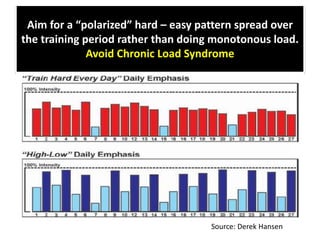
Aim for a “polarized” hard – easy pattern spread over
the training period rather than doing monotonous load.
Avoid Chronic Load Syndrome
Source: Derek Hansen
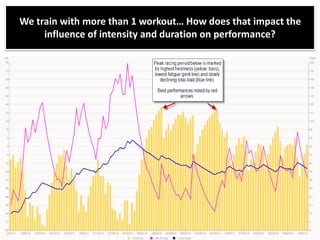
We train with more than 1 workout… How does that impact the
influence of intensity and duration on performance?
• What have you done?
(Training history)
• Do you recover fast or
slow?
• Life logistics/stress?
(how much time do you
have)
• Training/racing goals?
(what are you trying to
do)
• ST / FT???
Since they work best in conjunction with each other, the
question then becomes: volume or intensity…
What’s best for you?
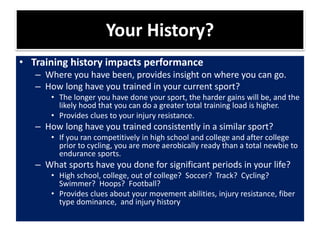
Your History?
• Training history impacts performance
– Where you have been, provides insight on where you can go.
– How long have you trained in your current sport?
• The longer you have done your sport, the harder gains will be, and the
likely hood that you can do a greater total training load is higher.
• Provides clues to your injury resistance.
– How long have you trained consistently in a similar sport?
• If you ran competitively in high school and college and after college
prior to cycling, you are more aerobically ready than a total newbie to
endurance sports.
– What sports have you done for significant periods in your life?
• High school, college, out of college? Soccer? Track? Cycling?
Swimmer? Hoops? Football?
• Provides clues about your movement abilities, injury resistance, fiber
type dominance, and injury history
How do you recover?
• Your adaptation “profile” (slow / fast responder)
– Slow recovery rate = less intensity is possible. Longer low
intensity training focus is likely best for you.
– Fast recovery rate = more frequent intensity. Even if
training for very long races, doing frequent intensity bouts
will be best for you. (not every day!)
– Based on questions on or observations of your past.
NOTE: Changes over time (fitter = faster relative to you,
increases in age and life stress slow recovery down relative
to you)
What’s your non training load?
• Your life (stress load and logistics)
– All the time in the world / low stress = higher volume and
intensity
– Some time / moderate stress = moderate volume / greater
% of total time at high intensity
– Minimal time / moderate stress = low volume / high % of
total time at high intensity.
– High stress regardless of time = low volume / a high % of
time at high intensity, but minimal total amounts of
training.
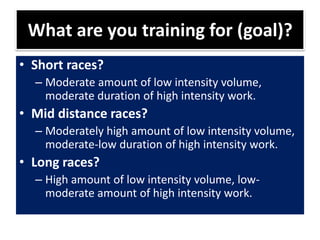
What are you training for (goal)?
• Short races?
– Moderate amount of low intensity volume,
moderate duration of high intensity work.
• Mid distance races?
– Moderately high amount of low intensity volume,
moderate-low duration of high intensity work.
• Long races?
– High amount of low intensity volume, low-
moderate amount of high intensity work.
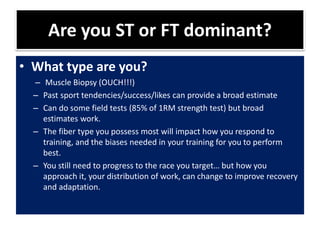
Are you ST or FT dominant?
• What type are you?
– Muscle Biopsy (OUCH!!!)
– Past sport tendencies/success/likes can provide a broad estimate
– Can do some field tests (85% of 1RM strength test) but broad
estimates work.
– The fiber type you possess most will impact how you respond to
training, and the biases needed in your training for you to perform
best.
– You still need to progress to the race you target… but how you
approach it, your distribution of work, can change to improve recovery
and adaptation.
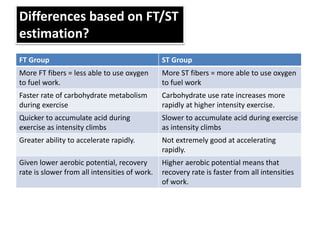
Differences based on FT/ST
estimation?
FT Group ST Group
More FT fibers = less able to use oxygen
to fuel work.
More ST fibers = more able to use oxygen
to fuel work
Faster rate of carbohydrate metabolism
during exercise
Carbohydrate use rate increases more
rapidly at higher intensity exercise.
Quicker to accumulate acid during
exercise as intensity climbs
Slower to accumulate acid during exercise
as intensity climbs
Greater ability to accelerate rapidly. Not extremely good at accelerating
rapidly.
Given lower aerobic potential, recovery
rate is slower from all intensities of work.
Higher aerobic potential means that
recovery rate is faster from all intensities
of work.
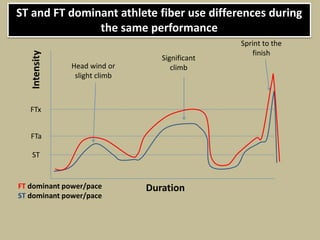
Intensity
FTx
FTa
ST
Head wind or
slight climb
Significant
climb
Sprint to the
finish
DurationFT dominant power/pace
ST dominant power/pace
ST and FT dominant athlete fiber use differences during
the same performance
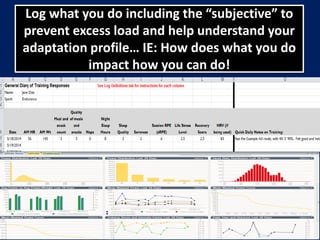
Log what you do including the “subjective” to
prevent excess load and help understand your
adaptation profile… IE: How does what you do
impact how you can do!
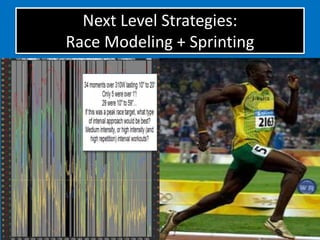
Next Level Strategies:
Race Modeling + Sprinting
Summing Things Up
• You need volume and intensity to
fully prepare for endurance sport.
• The amount of each, is dependent on
your training age, training status
(current), lifestyle, genes and goal.
• You need to respect YOUR recovery
needs as a major priority in your
training!
• You can use “tricks” to create
additional gains or be better
prepared for a specific race.
Will Kirousis
will@tri-hard.com
978.466.5151
@willkirousis

Long slow distance or high intensity

  • 1.
    Will Kirousis |@willkirousis | 978*466*5151 | will@tri-hard.com www.tri-hard.com Long Slow Distance OR High Intensity: What’s Better? (For you)
  • 2.
    Getting Started • Discussvolume and intensity in the context of the training process overall. • This starts out general… • Then we will look at issues which lead to specific variations/adjustments in how YOU could apply volume and intensity within your training program. • Finish up with a review of a few “Second Level” strategies that can help you perform your best.
  • 3.
    “What is atraining program?” A systematic approach to stressing an athlete such that they progressively adapt to specific workout stress in a way that allows them to perform at their best at a specific competitive event or series of competitive events at a predictable time.
  • 4.
    For best results: Setup training to facilitate recovery, not just to maximize work accomplished.
  • 5.
    The Variables Constitutinga Training Program Volume Intensity Frequency Load Total accumulated training via duration or distance How much work (velocity/power/HR) you accomplish per unit time. Not effort, which is how you the accruing stress of a workout feels knowing what you have done, and still plan on accomplishing. How many times you workout during a specific period of time. The combination of volume and intensity. Assessed via TRIMPS, sRPE, TSS Builds aerobic enzymes, mitochondria density, capillary density, decreases (good) type I fiber diameter, increases IIa fiber aerobic ability, increases glycogen content of muscle, increases time to fatigue, increases VO2mx and “threshold”. Same as volume, but also increases acid buffering ability, economy, aerobic ability of IIa/b fibers and fatigue resistance of IIa and b fibers and in high level athletes, it’s the primary thing to increase “threshold” and power or velocity at VO2mx. Ties volume and intensity into a tangible plan. Intermingles with both volume and intensity improving fatigue resistance and technical skill acquisition. Text book: Only based on training stress. Real World: INCLUDES non training specific stress like PT, work stress, life stress, dietary stress, chriopractic adjustment, self massage, random activity (soccer with your kids) etc…
  • 6.
    Clarifying Intensity Low Medium (Med) High(HI) Feels very comfortable unless done for a very long time Feels like your doing something and feels fairly fatiguing. Feels very powerful and sharp, longer (30”+) efforts have produce a lot of fatigue fast! Below the “Aerobic” Threshold or roughly below 75% of MLSS/FTP/OBLA Between aerobic and lactate/anaerobic thresholds (if measured in a lab) MLSS/FTP/OBLA up to max. Long workouts, moderate intensity workouts, steady , comfortable all day long workouts. Tempo workouts, long intervals, race intensity work. Time trialing, 5-10K races. Shorter interval workouts, “VO2max” training, “Anaerobic” training.
  • 7.
    High Intensity Training HighEnergy Muscle Action High Volume Low intensity Training Repeated Contractions AMPK CaMKPGC-1α Increased aerobic ability in ST, FOG, FT muscle fiber, glycogen storage, mitochondria #’s, aerobic enzymes, fat oxidation rate, Master Adaptation Switch Adaptations triggered that improve endurance performance Both volume and intensity trigger different adaptive switches to get the SAME result! Stimulates Stimulates
  • 8.
    If Intensity andvolume do the same thing… then what’s the difference? The amplitude and angle of the adaptations caused by each approach! • High intensity training – Increases the rate of energy production you can accomplish. – Increases your ability to handle the byproducts of fatigue. – Increases economy and work capacity, thus making lower intensities less challenging mechanically and metabolically. • Low intensity (volume based) training – Reduces the build up of the byproducts of fatigue. – Increases overall recovery rate. – Increases the rate of energy produced from fat during exercise. NOTE: These adaptations overlap!
  • 9.
    The Impact ofIntensity and Volume on Training and Recovery Factor Hi Intensity Volume (low intensity) Recovery Time Needed Hi Low-Moderate Training Stimulus Hi Low-Moderate Adaptation lifespan Long Short Frequency Needed Low-Moderate (3-6) High (5-9) Duration Needed Low-Moderate High Summary: Training with low intensity requires a relatively high frequency and volume of work to work best. Training with high intensity requires a relatively low amount of high intensity training to work best.
  • 10.
    You can nottrain @ high intensity as often as low intensity due to the recovery demands placed upon you by each. The harder you work, the more muscle fibers you fatigue and fuel you use, thus, the greater the stimulus for adaptation, the need for recovery and the duration of training effect are hi with HIT.
  • 11.
    Building on thesingle workout model just reviewed… keep in mind that when… Intensity up, volume down… Volume up, intensity down! Lower Intensity Higher Intensity LowerVolumeHigherVolume
  • 12.
    The fitter youget, the less duration of intensity is needed, but the higher it needs to be to improve endurance performance. LOW 50% Med 25% Hi 25% LOW 65% Med 15% Hi 20% LOW 75- 80% Med 10% Hi 10-15% New Athlete Mid Level Athlete Advanced Athlete
  • 13.
    • Youtubeification ofSport (Ie, it plays well on youtube) • Often the middle is believed to be high/very high intensity • Provides instant gratification • Visible fatigue is glorified Uh Oh… “We” like the middle – it feels like “we are doing something”.
  • 14.
    Aim for a“polarized” hard – easy pattern spread over the training period rather than doing monotonous load. Avoid Chronic Load Syndrome Source: Derek Hansen
  • 15.
    We train withmore than 1 workout… How does that impact the influence of intensity and duration on performance?
  • 16.
    • What haveyou done? (Training history) • Do you recover fast or slow? • Life logistics/stress? (how much time do you have) • Training/racing goals? (what are you trying to do) • ST / FT??? Since they work best in conjunction with each other, the question then becomes: volume or intensity… What’s best for you?
  • 17.
    Your History? • Traininghistory impacts performance – Where you have been, provides insight on where you can go. – How long have you trained in your current sport? • The longer you have done your sport, the harder gains will be, and the likely hood that you can do a greater total training load is higher. • Provides clues to your injury resistance. – How long have you trained consistently in a similar sport? • If you ran competitively in high school and college and after college prior to cycling, you are more aerobically ready than a total newbie to endurance sports. – What sports have you done for significant periods in your life? • High school, college, out of college? Soccer? Track? Cycling? Swimmer? Hoops? Football? • Provides clues about your movement abilities, injury resistance, fiber type dominance, and injury history
  • 18.
    How do yourecover? • Your adaptation “profile” (slow / fast responder) – Slow recovery rate = less intensity is possible. Longer low intensity training focus is likely best for you. – Fast recovery rate = more frequent intensity. Even if training for very long races, doing frequent intensity bouts will be best for you. (not every day!) – Based on questions on or observations of your past. NOTE: Changes over time (fitter = faster relative to you, increases in age and life stress slow recovery down relative to you)
  • 19.
    What’s your nontraining load? • Your life (stress load and logistics) – All the time in the world / low stress = higher volume and intensity – Some time / moderate stress = moderate volume / greater % of total time at high intensity – Minimal time / moderate stress = low volume / high % of total time at high intensity. – High stress regardless of time = low volume / a high % of time at high intensity, but minimal total amounts of training.
  • 20.
    What are youtraining for (goal)? • Short races? – Moderate amount of low intensity volume, moderate duration of high intensity work. • Mid distance races? – Moderately high amount of low intensity volume, moderate-low duration of high intensity work. • Long races? – High amount of low intensity volume, low- moderate amount of high intensity work.
  • 21.
    Are you STor FT dominant? • What type are you? – Muscle Biopsy (OUCH!!!) – Past sport tendencies/success/likes can provide a broad estimate – Can do some field tests (85% of 1RM strength test) but broad estimates work. – The fiber type you possess most will impact how you respond to training, and the biases needed in your training for you to perform best. – You still need to progress to the race you target… but how you approach it, your distribution of work, can change to improve recovery and adaptation.
  • 22.
    Differences based onFT/ST estimation? FT Group ST Group More FT fibers = less able to use oxygen to fuel work. More ST fibers = more able to use oxygen to fuel work Faster rate of carbohydrate metabolism during exercise Carbohydrate use rate increases more rapidly at higher intensity exercise. Quicker to accumulate acid during exercise as intensity climbs Slower to accumulate acid during exercise as intensity climbs Greater ability to accelerate rapidly. Not extremely good at accelerating rapidly. Given lower aerobic potential, recovery rate is slower from all intensities of work. Higher aerobic potential means that recovery rate is faster from all intensities of work.
  • 23.
    Intensity FTx FTa ST Head wind or slightclimb Significant climb Sprint to the finish DurationFT dominant power/pace ST dominant power/pace ST and FT dominant athlete fiber use differences during the same performance
  • 24.
    Log what youdo including the “subjective” to prevent excess load and help understand your adaptation profile… IE: How does what you do impact how you can do!
  • 25.
    Next Level Strategies: RaceModeling + Sprinting
  • 26.
    Summing Things Up •You need volume and intensity to fully prepare for endurance sport. • The amount of each, is dependent on your training age, training status (current), lifestyle, genes and goal. • You need to respect YOUR recovery needs as a major priority in your training! • You can use “tricks” to create additional gains or be better prepared for a specific race.
  • 27.

Editor's Notes

  • #2 Should I focus on doing increasing volumes of low intensity training to get faster… Should I focus on hammering interval workout after interval workout to get faster… THEY ARE BOTH RIGHT! Lets look at why each can work, and then why ultimately, the combination is the best approach.
  • #4 Intensity has to be discussed relative to volume and total training program.
  • #6 Volume is the duration of training accumulated either in time or distance per workout and training phase. --Done appropriately (at low intensity), actually helps facilitate recovery --Builds aerobic enzymes, mitochondria density, capillary density, decreases (good) type I fiber diameter, increases IIa fiber aerobic ability, increases glycogen content of muscle, increases time to fatigue, increases VO2mx and “threshold”. Intensity is how much work you are accomplishing per unit time. --Difference between intensity and effort. --Hi intensity builds all the things lower intensity volume builds, but also increases acid buffering ability, economy, builds aerobic ability of IIa/b fibers and fatigue resistance of IIa and b fibers and in athletes beyond the moderately trained level, this is the primary thing that will increase “threshold” and power or velocity at VO2mx. Frequency of training is how often you workout – which is a major factor both in accumulating volume, in your ability to create intensity and in particular, your ability to recover and adapt to training. Volume and intensity sum to yield training load: V * I = L
  • #7 Intensity, for this discussion, can be broken into 3 parts: HI: MLSS/FTP/OBLA up to max. Time trialing, 5k-10k race, 6’ and shorter intervals with short rest periods, vVO2max / wVO2max intervals Med: between aerobic and lactate threshold (if lab measured – which is lower than what “threshold” testing shows by a solid margin) Tempo workouts, long intervals, race pace work. Low: below aerobic threshold or roughly below 75% of MLSS/FTP/OBLA Long workouts, moderate intensity workouts, steady, comfortable all day pace training.
  • #8 Training with high intensity stimulates AMPK pathway to lead to PCG-α mediated improvements in endurance ability. Training with low intensity and high volume stimulates CaMK pathway to lead to PCG-α mediated in endurance ability. Yes – both volume and intensity trigger different adaptive switches to create positive changes in variables associated with endurance performance!  SAME result in endurance performance ability.
  • #10 Low intensity workouts – even with solid volume, are relatively quick to be recovered from.  This means 3 things: 1, the stimulus to adapt to that workout when doing low intensity work is low; 2, being relatively low stimulus, the recovery process is fairly fast from a low intensity workout and; 3, the adaptations from low intensity work have a shorter lifespan compared to higher intensity adaptations.  Because of those 3 things, relatively high frequency and volume of low intensity work are required to reap the best rewards of this work. Hi intensity workouts are slower to recover from.  This means 3 things: they are a very high stimulus for improvement, they take a significant period of time to recover from, the adaptations they create have a longer lifespan than low intensity adaptations.  Because of those 3 things, relatively low frequency of high intensity workouts are needed to reap the rewards of this work. Generally speaking, pending training age, fiber type dominance estimate, training history, you can likely perform and recover from 3-6 high intensity workouts in a week, and about 5-9 low intensity workouts per week. In combination, the numbers of each that are doable decrease.
  • #28 Tri-Hard | www.tri-hard.com