Learning Theories & Technology Integration
                    By
                   E.C.
Contents
                   
 What is Constructivist Theory?
 Who are the main proponents?
 What are the implications for teachers?
 What are the implications for students?
 Final thoughts about the theory.
 Sources.


                                            Continue
Constructivist Theory
               
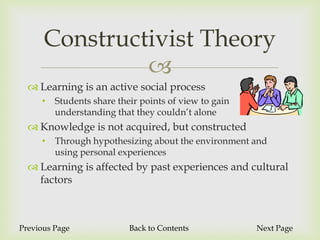
   Learning is an active social process
     •   Students share their points of view to gain
         understanding that they couldn’t alone
   Knowledge is not acquired, but constructed
     •   Through hypothesizing about the environment and
         using personal experiences
   Learning is affected by past experiences and cultural
    factors


Previous Page              Back to Contents            Next Page
Constructivist Theory
               
   Students learn by doing and discovering
     •   Inquiry encourages critical thinking and a deeper
         understanding of the material
   Teachers are Facilitators
     •   Rather than present information, teachers guide the
         student to reach their own understanding of the material


Previous Page             Back to Contents               Next Page
Important People
                                                      “The principle goal of education
                                                       should be creating men and

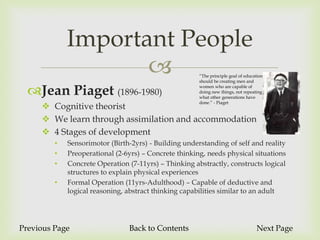
  Jean Piaget (1896-1980)                             women who are capable of
                                                       doing new things, not repeating
                                                       what other generations have
                                                       done.” - Piaget
      Cognitive theorist
      We learn through assimilation and accommodation
      4 Stages of development
         •   Sensorimotor (Birth-2yrs) - Building understanding of self and reality
         •   Preoperational (2-6yrs) – Concrete thinking, needs physical situations
         •   Concrete Operation (7-11yrs) – Thinking abstractly, constructs logical
             structures to explain physical experiences
         •   Formal Operation (11yrs-Adulthood) – Capable of deductive and
             logical reasoning, abstract thinking capabilities similar to an adult


Previous Page                   Back to Contents                                   Next Page
Important People
                    
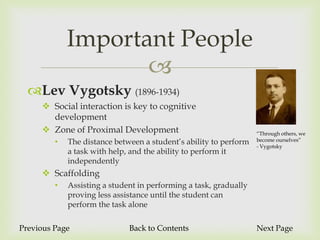
  Lev Vygotsky (1896-1934)
      Social interaction is key to cognitive
       development
      Zone of Proximal Development                                “Through others, we
         •   The distance between a student’s ability to perform   become ourselves”
                                                                   - Vygotsky
             a task with help, and the ability to perform it
             independently
      Scaffolding
         •   Assisting a student in performing a task, gradually
             proving less assistance until the student can
             perform the task alone

Previous Page                 Back to Contents                     Next Page
Important People
                    
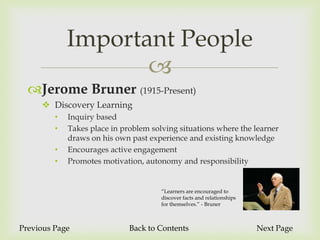
  Jerome Bruner (1915-Present)
      Discovery Learning
         •   Inquiry based
         •   Takes place in problem solving situations where the learner
             draws on his own past experience and existing knowledge
         •   Encourages active engagement
         •   Promotes motivation, autonomy and responsibility


                                       “Learners are encouraged to
                                       discover facts and relationships
                                       for themselves.” - Bruner


Previous Page                 Back to Contents                            Next Page
Constructivism and
               Teachers
                                  
   Teachers must play the role of learning facilitator
     •   Provide enough guidance to reach an objective, but give the
         students the independence to get there on their own
     •   Give students instructions and online resources and then have
         them research and organize the information on their own
   Incorporate collaborative activities
     •   Use projects where the students teach the rest of class using
         PowerPoint
     •   Have students explain their point of view or how they understood
         the material


Previous Page                Back to Contents                   Next Page
Constructivism and
                Students
                                    
   Students must discover knowledge
     •   Student can use the internet to find information from various
         sources and in various formats
   Take initiative and experiment
     •   Students should form hypothesis and then test to see if they were
         correct
   Collaborate with their peers
     •   Use software such as Elluminate to share ideas with their peers in
         classes in another district or around the world
   Think critically
     •   Use inquiry to find a solution


Previous Page                 Back to Contents                    Next Page
Final Thoughts
                       
   I found the theory of constructivism very interesting. As a
    math major I know how much knowledge builds on itself,
    how every concept can be related to another in some way.
    I will definitely try to incorporate it into my teaching, the
    collaborative and inquiry aspects especially. Some people
    understand things differently and perhaps a student can
    explain a concept to their peer in a way that is easier for
    them to understand. I want my students to think critically
    of information they receive instead of just accepting it; by
    using the Socratic Method of inquiry in which students
    ask each other questions to better understand the logic of
    their reasoning, I can accomplish this in my classes.

Previous Page             Back to Contents              Next Page
Sources
                      
   Images: Piaget, Vygotsky, Bruner.

   Information: Bruner B2, Constructivism C2 C3 C4,
    Piaget P2, Vygotsky V2.


Previous Page         Back to Contents      End Slide Show

Constructivism

  • 1.
    Learning Theories &Technology Integration By E.C.
  • 2.
    Contents   What is Constructivist Theory?  Who are the main proponents?  What are the implications for teachers?  What are the implications for students?  Final thoughts about the theory.  Sources. Continue
  • 3.
    Constructivist Theory   Learning is an active social process • Students share their points of view to gain understanding that they couldn’t alone  Knowledge is not acquired, but constructed • Through hypothesizing about the environment and using personal experiences  Learning is affected by past experiences and cultural factors Previous Page Back to Contents Next Page
  • 4.
    Constructivist Theory   Students learn by doing and discovering • Inquiry encourages critical thinking and a deeper understanding of the material  Teachers are Facilitators • Rather than present information, teachers guide the student to reach their own understanding of the material Previous Page Back to Contents Next Page
  • 5.
    Important People  “The principle goal of education should be creating men and Jean Piaget (1896-1980) women who are capable of doing new things, not repeating what other generations have done.” - Piaget  Cognitive theorist  We learn through assimilation and accommodation  4 Stages of development • Sensorimotor (Birth-2yrs) - Building understanding of self and reality • Preoperational (2-6yrs) – Concrete thinking, needs physical situations • Concrete Operation (7-11yrs) – Thinking abstractly, constructs logical structures to explain physical experiences • Formal Operation (11yrs-Adulthood) – Capable of deductive and logical reasoning, abstract thinking capabilities similar to an adult Previous Page Back to Contents Next Page
  • 6.
    Important People  Lev Vygotsky (1896-1934)  Social interaction is key to cognitive development  Zone of Proximal Development “Through others, we • The distance between a student’s ability to perform become ourselves” - Vygotsky a task with help, and the ability to perform it independently  Scaffolding • Assisting a student in performing a task, gradually proving less assistance until the student can perform the task alone Previous Page Back to Contents Next Page
  • 7.
    Important People  Jerome Bruner (1915-Present)  Discovery Learning • Inquiry based • Takes place in problem solving situations where the learner draws on his own past experience and existing knowledge • Encourages active engagement • Promotes motivation, autonomy and responsibility “Learners are encouraged to discover facts and relationships for themselves.” - Bruner Previous Page Back to Contents Next Page
  • 8.
    Constructivism and Teachers   Teachers must play the role of learning facilitator • Provide enough guidance to reach an objective, but give the students the independence to get there on their own • Give students instructions and online resources and then have them research and organize the information on their own  Incorporate collaborative activities • Use projects where the students teach the rest of class using PowerPoint • Have students explain their point of view or how they understood the material Previous Page Back to Contents Next Page
  • 9.
    Constructivism and Students   Students must discover knowledge • Student can use the internet to find information from various sources and in various formats  Take initiative and experiment • Students should form hypothesis and then test to see if they were correct  Collaborate with their peers • Use software such as Elluminate to share ideas with their peers in classes in another district or around the world  Think critically • Use inquiry to find a solution Previous Page Back to Contents Next Page
  • 10.
    Final Thoughts   I found the theory of constructivism very interesting. As a math major I know how much knowledge builds on itself, how every concept can be related to another in some way. I will definitely try to incorporate it into my teaching, the collaborative and inquiry aspects especially. Some people understand things differently and perhaps a student can explain a concept to their peer in a way that is easier for them to understand. I want my students to think critically of information they receive instead of just accepting it; by using the Socratic Method of inquiry in which students ask each other questions to better understand the logic of their reasoning, I can accomplish this in my classes. Previous Page Back to Contents Next Page
  • 11.
    Sources   Images: Piaget, Vygotsky, Bruner.  Information: Bruner B2, Constructivism C2 C3 C4, Piaget P2, Vygotsky V2. Previous Page Back to Contents End Slide Show