Constructivism
             ZZ
CONSTRUCTIVISM


 How people learn?


 People construct their own understanding and
  knowledge of the world, through experiencing things
  and reflecting on those experiences.
CONSTRUCTIVISM
IMPORTANT FIGURES
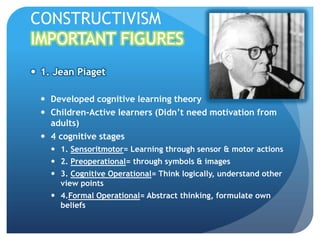
 1. Jean Piaget

   Developed cognitive learning theory
   Children-Active learners (Didn’t need motivation from
    adults)
   4 cognitive stages
     1. Sensoritmotor= Learning through sensor & motor actions
     2. Preoperational= through symbols & images
     3. Cognitive Operational= Think logically, understand other
      view points
     4.Formal Operational= Abstract thinking, formulate own
      beliefs
CONSTRUCTIVISM
IMPORTANT FIGURES
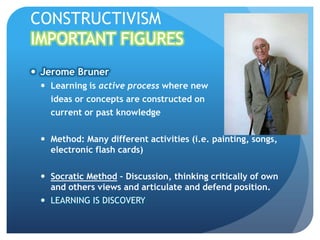
 Jerome Bruner
  Learning is active process where new
   ideas or concepts are constructed on
   current or past knowledge

  Method: Many different activities (i.e. painting, songs,
   electronic flash cards)

  Socratic Method – Discussion, thinking critically of own
   and others views and articulate and defend position.
  LEARNING IS DISCOVERY
CONSTRUCTIVISM
IMPORTANT FIGURES
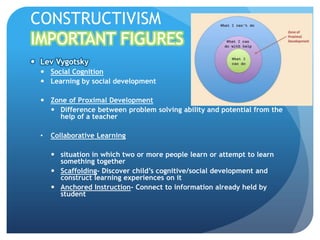
 Lev Vygotsky
   Social Cognition
   Learning by social development

   Zone of Proximal Development
     Difference between problem solving ability and potential from the
      help of a teacher

  •   Collaborative Learning

       situation in which two or more people learn or attempt to learn
        something together
       Scaffolding- Discover child’s cognitive/social development and
        construct learning experiences on it
       Anchored Instruction- Connect to information already held by
        student
CONSTRUCTIVISM
IMPORTANT FIGURES
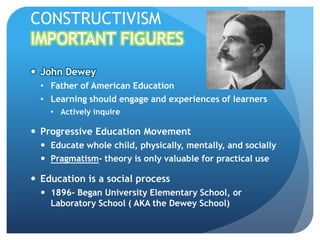
 John Dewey
  • Father of American Education
  • Learning should engage and experiences of learners
    • Actively inquire

 Progressive Education Movement
   Educate whole child, physically, mentally, and socially
   Pragmatism- theory is only valuable for practical use

 Education is a social process
   1896- Began University Elementary School, or
    Laboratory School ( AKA the Dewey School)
Classroom Implications
TEACHERS
• Facilitate learning

• Encourage Students To Ask Questions

• Encourage Reflection

• Active Participation

• Variety Of Learning Methods

• Propose Contrary Beliefs
Classroom Implications
STUDENTS
 Building On Previous Knowledge

 Work In Groups

 Ask Questions

 Thinking

 Reflecting

 Establishing Views
Final Thoughts
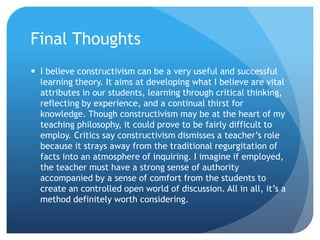
 I believe constructivism can be a very useful and successful
  learning theory. It aims at developing what I believe are vital
  attributes in our students, learning through critical thinking,
  reflecting by experience, and a continual thirst for
  knowledge. Though constructivism may be at the heart of my
  teaching philosophy, it could prove to be fairly difficult to
  employ. Critics say constructivism dismisses a teacher’s role
  because it strays away from the traditional regurgitation of
  facts into an atmosphere of inquiring. I imagine if employed,
  the teacher must have a strong sense of authority
  accompanied by a sense of comfort from the students to
  create an controlled open world of discussion. All in all, it’s a
  method definitely worth considering.
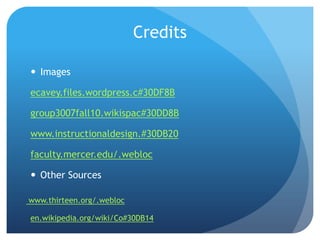
Credits

 Images

ecavey.files.wordpress.c#30DF8B

group3007fall10.wikispac#30DD8B

www.instructionaldesign.#30DB20

faculty.mercer.edu/.webloc

 Other Sources

www.thirteen.org/.webloc

en.wikipedia.org/wiki/Co#30DB14

Zack constructivismlearningtheory

  • 1.
  • 2.
    CONSTRUCTIVISM  How peoplelearn?  People construct their own understanding and knowledge of the world, through experiencing things and reflecting on those experiences.
  • 3.
    CONSTRUCTIVISM IMPORTANT FIGURES  1.Jean Piaget  Developed cognitive learning theory  Children-Active learners (Didn’t need motivation from adults)  4 cognitive stages  1. Sensoritmotor= Learning through sensor & motor actions  2. Preoperational= through symbols & images  3. Cognitive Operational= Think logically, understand other view points  4.Formal Operational= Abstract thinking, formulate own beliefs
  • 4.
    CONSTRUCTIVISM IMPORTANT FIGURES  JeromeBruner  Learning is active process where new ideas or concepts are constructed on current or past knowledge  Method: Many different activities (i.e. painting, songs, electronic flash cards)  Socratic Method – Discussion, thinking critically of own and others views and articulate and defend position.  LEARNING IS DISCOVERY
  • 5.
    CONSTRUCTIVISM IMPORTANT FIGURES  LevVygotsky  Social Cognition  Learning by social development  Zone of Proximal Development  Difference between problem solving ability and potential from the help of a teacher • Collaborative Learning  situation in which two or more people learn or attempt to learn something together  Scaffolding- Discover child’s cognitive/social development and construct learning experiences on it  Anchored Instruction- Connect to information already held by student
  • 6.
    CONSTRUCTIVISM IMPORTANT FIGURES  JohnDewey • Father of American Education • Learning should engage and experiences of learners • Actively inquire  Progressive Education Movement  Educate whole child, physically, mentally, and socially  Pragmatism- theory is only valuable for practical use  Education is a social process  1896- Began University Elementary School, or Laboratory School ( AKA the Dewey School)
  • 7.
    Classroom Implications TEACHERS • Facilitatelearning • Encourage Students To Ask Questions • Encourage Reflection • Active Participation • Variety Of Learning Methods • Propose Contrary Beliefs
  • 8.
    Classroom Implications STUDENTS  BuildingOn Previous Knowledge  Work In Groups  Ask Questions  Thinking  Reflecting  Establishing Views
  • 9.
    Final Thoughts  Ibelieve constructivism can be a very useful and successful learning theory. It aims at developing what I believe are vital attributes in our students, learning through critical thinking, reflecting by experience, and a continual thirst for knowledge. Though constructivism may be at the heart of my teaching philosophy, it could prove to be fairly difficult to employ. Critics say constructivism dismisses a teacher’s role because it strays away from the traditional regurgitation of facts into an atmosphere of inquiring. I imagine if employed, the teacher must have a strong sense of authority accompanied by a sense of comfort from the students to create an controlled open world of discussion. All in all, it’s a method definitely worth considering.
  • 10.