VOLVOX
OCCURRENCE, STRUCTURE AND REPRODUCTION
DR.M.JEEVITHA
Assistant Professor of Botany,
Pope’s College (Autonomous)
Thoothukudi
SYSTEMATIC POSITION OF VOLVOX
Systematic Position of Volvox:
OCCURRENCE OF VOLVOX
• Volvox is free floating fresh water green algae.
• Volvox grows as planktons on surface of water bodies like temporary
and permanent ponds, lakes and water tanks.
• During rainy season due to its fast growth the surface of water bodies
become green.
• The Volvox colonies appear as green rolling balls on surface of water.
Volvox is represented by about 20 species:
Some common Indian species are— Volvox globator, V aureus, V. prolificus, V. africanus and V.
rousseletii.
Volvox globator V aureus
Volvox rousseletii.
STRUCTURE OF VOLVOX
SINGLE CELLED VOLVOX
REPRODUCTION IN VOLVOX
• Volvox reproduces both asexually and sexually.
• The asexual reproduction takes place under favourable conditions during spring and
early summer.
• In Volvox mostly the cells of posterior part of colony take part in reproduction.
• These reproductive cells can be recognized by their larger size, prominent nuclei,
dense granular cytoplasm, more pyrenoids and absence of flagella.
ASEXUAL REPRODUCTION
SEXUAL REPRODUCTION
• The sexual reproduction in Volvox is oogamous type.
• Some species of Volvox e.g., V. globator are monoecious or homothallic i.e., the
antheridia and oogonia develop on same colony. Other Volvox species e.g., V.
rousseletii are dioecious or heterothallic i.e., antheridia and oogonia develop on
different colonies.
• Monoecious species are usually protandrous i.e., antheridia mature before oogonia
but some species are protogynous i.e., oogonia develop before antheridia. V aureus is
mostly dioecious but sometimes can be monoecious.
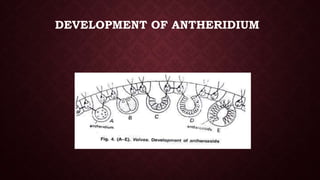
• Reproductive cells mostly differentiate in the posterior part of colony. These cells
enlarge, lose flagella and are called gametangia. The male reproductive cells are
called antheridia or androgonidia and female reproductive cells are called
oogonia or gynogonidia
DEVELOPMENT OF ANTHERIDIUM
DEVELOPMENT OF OOGONIUM
FERTILIZATION OF VOLVOX
• After liberation from antheridium, the antherozoids swim freely on surface of water.
Due to chemotactic response the antherozoids reach the oogonia.
• Some antherozoids enter each oogonium. Only one antherozoid enters inside the
oogonium through receptive spot. After this plasmogainy i.e., fusion of male and
female cytoplasm and karyogamy i.e., fusion of male and female nuclei take place.
This results in formation of diploid zygote (Fig. 5 D).
• The diploid zygote secretes a three layered thick wall. The layers of the wall are
exospore, mesospore and endospore (Fig. 6 A, B). The outer exospore is thick. It may
be smooth e.g., V. aureus (Fig. 6 A) or spiny e.g., V. globator (Fig. 6 B).
• The mesospores and endospores are thin and smooth. The walls contain nucleus
pigment haematochrome which imparts red colour to the zygote. The zygotes are
released by the disintegration of parent colony. Then zygotes undergo a period of
dormancy.
GERMINATION OF ZYGOTE
LIFE CYCLE OF VOLVOX
THANK YOU

Volvox.pptx

  • 1.
    VOLVOX OCCURRENCE, STRUCTURE ANDREPRODUCTION DR.M.JEEVITHA Assistant Professor of Botany, Pope’s College (Autonomous) Thoothukudi
  • 2.
    SYSTEMATIC POSITION OFVOLVOX Systematic Position of Volvox:
  • 3.
    OCCURRENCE OF VOLVOX •Volvox is free floating fresh water green algae. • Volvox grows as planktons on surface of water bodies like temporary and permanent ponds, lakes and water tanks. • During rainy season due to its fast growth the surface of water bodies become green. • The Volvox colonies appear as green rolling balls on surface of water. Volvox is represented by about 20 species: Some common Indian species are— Volvox globator, V aureus, V. prolificus, V. africanus and V. rousseletii.
  • 4.
    Volvox globator Vaureus Volvox rousseletii.
  • 5.
  • 6.
  • 7.
    REPRODUCTION IN VOLVOX •Volvox reproduces both asexually and sexually. • The asexual reproduction takes place under favourable conditions during spring and early summer. • In Volvox mostly the cells of posterior part of colony take part in reproduction. • These reproductive cells can be recognized by their larger size, prominent nuclei, dense granular cytoplasm, more pyrenoids and absence of flagella.
  • 8.
  • 9.
    SEXUAL REPRODUCTION • Thesexual reproduction in Volvox is oogamous type. • Some species of Volvox e.g., V. globator are monoecious or homothallic i.e., the antheridia and oogonia develop on same colony. Other Volvox species e.g., V. rousseletii are dioecious or heterothallic i.e., antheridia and oogonia develop on different colonies. • Monoecious species are usually protandrous i.e., antheridia mature before oogonia but some species are protogynous i.e., oogonia develop before antheridia. V aureus is mostly dioecious but sometimes can be monoecious. • Reproductive cells mostly differentiate in the posterior part of colony. These cells enlarge, lose flagella and are called gametangia. The male reproductive cells are called antheridia or androgonidia and female reproductive cells are called oogonia or gynogonidia
  • 10.
  • 11.
  • 12.
    FERTILIZATION OF VOLVOX •After liberation from antheridium, the antherozoids swim freely on surface of water. Due to chemotactic response the antherozoids reach the oogonia. • Some antherozoids enter each oogonium. Only one antherozoid enters inside the oogonium through receptive spot. After this plasmogainy i.e., fusion of male and female cytoplasm and karyogamy i.e., fusion of male and female nuclei take place. This results in formation of diploid zygote (Fig. 5 D). • The diploid zygote secretes a three layered thick wall. The layers of the wall are exospore, mesospore and endospore (Fig. 6 A, B). The outer exospore is thick. It may be smooth e.g., V. aureus (Fig. 6 A) or spiny e.g., V. globator (Fig. 6 B). • The mesospores and endospores are thin and smooth. The walls contain nucleus pigment haematochrome which imparts red colour to the zygote. The zygotes are released by the disintegration of parent colony. Then zygotes undergo a period of dormancy.
  • 13.
  • 14.
  • 15.