• opposite sides are equal
• each angle is of 900
• Diagonals are equal &bisect each other
SQUARE
• All sides are equal
• each angle is of 900
• Diagonals are equal & bisect each other at 900
CICRLE
Cube

Requirement
Edge/side
Cube

L
L
L

•Diagonal of cube=√3×L unit
•Lateral surface area=perimeter of base ×height
=4×L3 unit3

• Total surface area = 2LxL + 2LxL + 2LxL
= 6L2

• Volume = Base area x height
=LxLxL
= L3
Cuboid
Top
Side 2

Back
Front
Bottom
Length (L)

Side 1

Height (H)

Breadth (B)
Total surface Area
L

L
H

L

B

B
H

H
B

B
H

L

L

H

L

H

L

Total surface Area = L x H + B x H + L x H + B x H + L x B + L x B
= 2 LxB + 2BxH + 2LxH
= 2 ( LB + BH + LH )
Lateral surface area=2(L+B)H unit2

Volume=area of base×height
=L×B×H unit3
Diagonal of cuboid=√L2+B2+H2
Example:
7 cm

4 cm
8 cm
Here:
l=8cm
B=4cm
H=7cm
SA=2(lb+bh+lh)=2(8X4+4x7+8x7)
=2(64+56+112)
=232cm²

V = lwh
V = 8(4)(7)
V = 224 cm³
Curved surface area of
cylinder

Curved surface area of an object is the area of outer covering of
it. If a rectangular paper is folded ,the length becomes the
circumference and the breadth becomes the height. So csa of a
cylinder is 2πr x height.

Curved surface area of
cylinder=2πrh
Outer Curved Surface area of cylinder

r

Circumference of
circle = 2 π r

r

h

Formation of Cylinder by
bangles

It is the area covered by the outer surface of a cylinder.
Circumference of circle = 2 π r
Area covered by cylinder = Surface area of of cylinder = (2 π r) x( h)
Total Surface area of a solid cylinder

circular
surfaces

=

Area of curved surface +

=(2 π r) x( h) + 2 π r2
= 2 π r( h+ r)

Curved
surface

area of two circular surfaces
Other method of Finding Surface area of cylinder with the help of paper

r

h

h

2πr

Surface area of cylinder = Area of rectangle= 2 πrh
Here:
r=3.1
H=12
SA = 2πrh + 2πr²
SA = 2π(3.1)(12) + 2π(3.1)²
SA = 2π (37.2) + 2π(9.61)
SA = π(74.4) + π(19.2)
SA = 233.7 + 60.4
SA = 294.1 in²
Right Circular Cone
Requirement
Radius(r)
Height(h)
Slant height(l)
At least 2 must be given

(l)2= (h)2 + (r)2
l =√ h2 + r2
Surface area of cone
l

l

Area of a circle having sector (circumference) 2π l = π l 2
Area of circle having circumference 1 = π l 2/ 2 π l
So area of sector having sector 2 π r = (π l 2/ 2 π l )x 2 π r = π rl

2πr
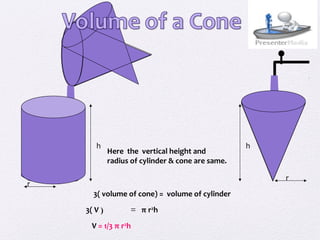
h

Here the vertical height and
radius of cylinder & cone are same.

h

r

r
3( volume of cone) = volume of cylinder
3( V )

= π r2h

V = 1/3 π r2h
if both cylinder and cone have same height and radius then volume of a cylinder is
three times the volume of a cone ,

Volume = 3V

Volume =V
Mr. Mohan has only a little jar of juice he wants to distribute it to
his three friends. This time he choose the cone shaped glass so
that quantity of juice seem to appreciable.
Sphere
Requirement
Radius(r)
Height = diameter
If we make a cone having radius and height equal to the radius of sphere. Then a
water filled cone can fill the sphere in 4 times.

r
r

r

V=1/3 πr2h
V1

If h = r then
V=1/3 πr3
V1 = 4V = 4(1/3 πr3)
= 4/3 πr3
Click to See the
experiment

Volume of a Sphere

h=r
r
Here the vertical height and
radius of cone are same as radius
of sphere.
r

4( volume of cone) = volume of Sphere
4( 1/3πr2h ) = 4( 1/3πr3 ) = V
V = 4/3 π r3
Hemisphere
Requirement
Radius/ diameter

Height=radius
Frustum of Cone
Volume

V = π/12 h (D2 + D d + d2) (9a)
m = ( ( (D - d) / 2 )2 + h2)1/2 (9c)
Bottle

Cone
shape

Cylindrical
shape
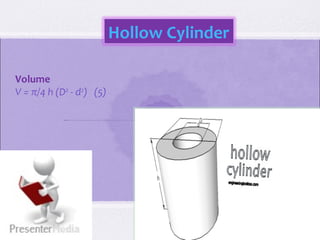
Hollow Cylinder
Volume
V = π/4 h (D2 - d2) (5)
TRIANGULAR
PRISM
To find the surface
area of a triangular
prism you need to be
able to imagine that
you can take the
prism apart like so:
Notice there are TWO congruent triangles
and THREE rectangles. The rectangles may
or may not all be the same.
Find each area, then add.
Example:

Find the AREA of each SURFACE
1. Top or bottom triangle:

8mm

A = ½ bh
A = ½ (6)(6)
9mm

A = 18
2. The two dark sides are the same.
A = lw
A = 6(9)

6 mm

6mm

3. The back rectangle is
different

A = 54

ADD THEM ALL UP!
18 + 18 + 54 + 54 + 72

A = lw
A = 8(9)
A = 72

SA = 216 mm²
PYRAMID
Volume
V = 1/3 h A

1

(6)

where
A1 = area of base (m2, ft2)
h = perpendicular height of pyramid (m,
ft)

Surface
A = ∑ sum of areas of triangles forming sides
+A

b

(6b)

where
the surface areas of the triangular faces will
have different formulas for different shaped
FRUSTUM OF PYRAMID
VOLUME
V = h/3 ( A1 + A2 + (A1 A2)1/2) (7)
Zone of SPHERE

V = π/6 h (3a2 + 3b2 + h) (11a)
Am = 2 π r h (11b)
A0 = π (2 r h + a2 + b2) (11c)
V = π/6 h (3/4 s2 + h2)

= π h2 (r - h/3) (12a)

Am = 2 π r h
= π/4 (s2 + 4 h2) (12b)
V = 2/3 π r2 h (13a)
A0 = π/2 r (4 h + s) (13b)
V = π/6 h (14a)
A0 = 4 π ((R + r) (R - r))
3

3

= 2 π h (R + r) (14b)
h = 2 (R2 - r2)1/2 (14c)

1/2
V = 2/3 π R

2

h (15a)

A0 = 2 π R (h + (R2 - h2/4)1/2)
h = 2 (R2 - r2)1/2 (15c)

(15b)
V = π2/4 D d2 (16a)
A0 = π2 D d (16b)
V = 2/3 r2 h (18a)
Am = 2 r h (18b)
A0 = Am + π/2 r2 + π/2 r (r2 +
2 1/2
V = π/4 d2 h

(17a)
Am = π d h (17b)

A0 = π r (h1 + h2 + r + (r2 + (h1 2

1/2
V ≈ π/12 h (2 D2 + d2)

(19a)
Volume

V = A1 h (3a)
where
A1 = side area (m2, ft2)
Surface area and volume

Surface area and volume

  • 5.
    • opposite sidesare equal • each angle is of 900 • Diagonals are equal &bisect each other
  • 7.
    SQUARE • All sidesare equal • each angle is of 900 • Diagonals are equal & bisect each other at 900
  • 9.
  • 12.
  • 13.
    Cube L L L •Diagonal of cube=√3×Lunit •Lateral surface area=perimeter of base ×height =4×L3 unit3 • Total surface area = 2LxL + 2LxL + 2LxL = 6L2 • Volume = Base area x height =LxLxL = L3
  • 14.
  • 15.
    Total surface Area L L H L B B H H B B H L L H L H L Totalsurface Area = L x H + B x H + L x H + B x H + L x B + L x B = 2 LxB + 2BxH + 2LxH = 2 ( LB + BH + LH )
  • 16.
    Lateral surface area=2(L+B)Hunit2 Volume=area of base×height =L×B×H unit3 Diagonal of cuboid=√L2+B2+H2
  • 17.
    Example: 7 cm 4 cm 8cm Here: l=8cm B=4cm H=7cm SA=2(lb+bh+lh)=2(8X4+4x7+8x7) =2(64+56+112) =232cm² V = lwh V = 8(4)(7) V = 224 cm³
  • 18.
    Curved surface areaof cylinder Curved surface area of an object is the area of outer covering of it. If a rectangular paper is folded ,the length becomes the circumference and the breadth becomes the height. So csa of a cylinder is 2πr x height. Curved surface area of cylinder=2πrh
  • 19.
    Outer Curved Surfacearea of cylinder r Circumference of circle = 2 π r r h Formation of Cylinder by bangles It is the area covered by the outer surface of a cylinder. Circumference of circle = 2 π r Area covered by cylinder = Surface area of of cylinder = (2 π r) x( h)
  • 20.
    Total Surface areaof a solid cylinder circular surfaces = Area of curved surface + =(2 π r) x( h) + 2 π r2 = 2 π r( h+ r) Curved surface area of two circular surfaces
  • 21.
    Other method ofFinding Surface area of cylinder with the help of paper r h h 2πr Surface area of cylinder = Area of rectangle= 2 πrh
  • 22.
    Here: r=3.1 H=12 SA = 2πrh+ 2πr² SA = 2π(3.1)(12) + 2π(3.1)² SA = 2π (37.2) + 2π(9.61) SA = π(74.4) + π(19.2) SA = 233.7 + 60.4 SA = 294.1 in²
  • 24.
    Right Circular Cone Requirement Radius(r) Height(h) Slantheight(l) At least 2 must be given (l)2= (h)2 + (r)2 l =√ h2 + r2
  • 25.
    Surface area ofcone l l Area of a circle having sector (circumference) 2π l = π l 2 Area of circle having circumference 1 = π l 2/ 2 π l So area of sector having sector 2 π r = (π l 2/ 2 π l )x 2 π r = π rl 2πr
  • 26.
    h Here the verticalheight and radius of cylinder & cone are same. h r r 3( volume of cone) = volume of cylinder 3( V ) = π r2h V = 1/3 π r2h
  • 27.
    if both cylinderand cone have same height and radius then volume of a cylinder is three times the volume of a cone , Volume = 3V Volume =V
  • 29.
    Mr. Mohan hasonly a little jar of juice he wants to distribute it to his three friends. This time he choose the cone shaped glass so that quantity of juice seem to appreciable.
  • 34.
  • 35.
    If we makea cone having radius and height equal to the radius of sphere. Then a water filled cone can fill the sphere in 4 times. r r r V=1/3 πr2h V1 If h = r then V=1/3 πr3 V1 = 4V = 4(1/3 πr3) = 4/3 πr3
  • 36.
    Click to Seethe experiment Volume of a Sphere h=r r Here the vertical height and radius of cone are same as radius of sphere. r 4( volume of cone) = volume of Sphere 4( 1/3πr2h ) = 4( 1/3πr3 ) = V V = 4/3 π r3
  • 39.
  • 41.
    Frustum of Cone Volume V= π/12 h (D2 + D d + d2) (9a) m = ( ( (D - d) / 2 )2 + h2)1/2 (9c)
  • 46.
  • 52.
    Hollow Cylinder Volume V =π/4 h (D2 - d2) (5)
  • 53.
    TRIANGULAR PRISM To find thesurface area of a triangular prism you need to be able to imagine that you can take the prism apart like so: Notice there are TWO congruent triangles and THREE rectangles. The rectangles may or may not all be the same. Find each area, then add.
  • 54.
    Example: Find the AREAof each SURFACE 1. Top or bottom triangle: 8mm A = ½ bh A = ½ (6)(6) 9mm A = 18 2. The two dark sides are the same. A = lw A = 6(9) 6 mm 6mm 3. The back rectangle is different A = 54 ADD THEM ALL UP! 18 + 18 + 54 + 54 + 72 A = lw A = 8(9) A = 72 SA = 216 mm²
  • 55.
    PYRAMID Volume V = 1/3h A 1 (6) where A1 = area of base (m2, ft2) h = perpendicular height of pyramid (m, ft) Surface A = ∑ sum of areas of triangles forming sides +A b (6b) where the surface areas of the triangular faces will have different formulas for different shaped
  • 56.
    FRUSTUM OF PYRAMID VOLUME V= h/3 ( A1 + A2 + (A1 A2)1/2) (7)
  • 57.
    Zone of SPHERE V= π/6 h (3a2 + 3b2 + h) (11a) Am = 2 π r h (11b) A0 = π (2 r h + a2 + b2) (11c)
  • 58.
    V = π/6h (3/4 s2 + h2) = π h2 (r - h/3) (12a) Am = 2 π r h = π/4 (s2 + 4 h2) (12b)
  • 59.
    V = 2/3π r2 h (13a) A0 = π/2 r (4 h + s) (13b)
  • 60.
    V = π/6h (14a) A0 = 4 π ((R + r) (R - r)) 3 3 = 2 π h (R + r) (14b) h = 2 (R2 - r2)1/2 (14c) 1/2
  • 61.
    V = 2/3π R 2 h (15a) A0 = 2 π R (h + (R2 - h2/4)1/2) h = 2 (R2 - r2)1/2 (15c) (15b)
  • 62.
    V = π2/4D d2 (16a) A0 = π2 D d (16b)
  • 63.
    V = 2/3r2 h (18a) Am = 2 r h (18b) A0 = Am + π/2 r2 + π/2 r (r2 + 2 1/2
  • 64.
    V = π/4d2 h (17a) Am = π d h (17b) A0 = π r (h1 + h2 + r + (r2 + (h1 2 1/2
  • 65.
    V ≈ π/12h (2 D2 + d2) (19a)
  • 66.
    Volume V = A1h (3a) where A1 = side area (m2, ft2)