NAME ; ZOHA SAJJAD HUSSAIN
CLASS ; VIII-I
SCHOOL ;KENDRIYA VIDYALAYA GOLE MARKAT
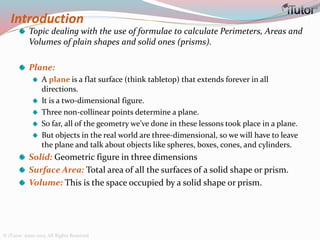
Introduction
Topic dealing with the use of formulae to calculate Perimeters, Areas and
Volumes of plain shapes and solid ones (prisms).
Plane:
A plane is a flat surface (think tabletop) that extends forever in all
directions.
It is a two-dimensional figure.
Three non-collinear points determine a plane.
So far, all of the geometry we’ve done in these lessons took place in a plane.
But objects in the real world are three-dimensional, so we will have to leave
the plane and talk about objects like spheres, boxes, cones, and cylinders.
Solid: Geometric figure in three dimensions
Surface Area: Total area of all the surfaces of a solid shape or prism.
Volume: This is the space occupied by a solid shape or prism.
© iTutor. 2000-2013. All Rights Reserved
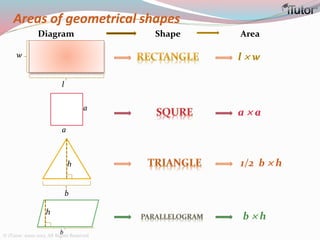
Areas of geometrical shapes
l
w l  w
a
a
a  a
b
h 1/2 b  h
h
b
b  h
ShapeDiagram Area
© iTutor. 2000-2013. All Rights Reserved
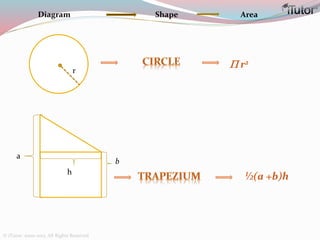
ShapeDiagram Area
 r2
r
½(a +b)h
a
h
b
© iTutor. 2000-2013. All Rights Reserved
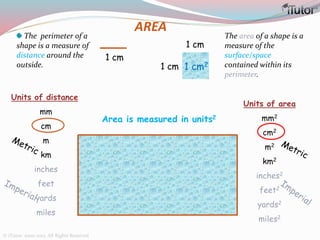
AREA
The perimeter of a
shape is a measure of
distance around the
outside.
The area of a shape is a
measure of the
surface/space
contained within its
perimeter.
Area is measured in units2
Units of distance
mm
cm
m
km
inches
feet
yards
miles
1 cm
1 cm2
1 cm
1 cm
Units of area
mm2
cm2
m2
km2
inches2
feet2
yards2
miles2
© iTutor. 2000-2013. All Rights Reserved
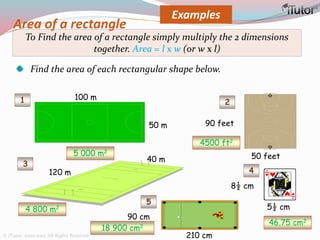
Area of a rectangle
Examples
To Find the area of a rectangle simply multiply the 2 dimensions
together. Area = l x w (or w x l)
Find the area of each rectangular shape below.
100 m
50 m
120 m
40 m
1 2
3
4
5
8½ cm
5½ cm
90 feet
50 feet
210 cm
90 cm
5 000 m2
4500 ft2
4 800 m2
46.75 cm2
18 900 cm2
© iTutor. 2000-2013. All Rights Reserved
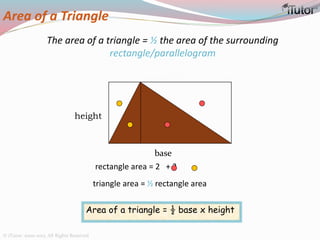
Area of a Triangle
rectangle area = 2 + 2
triangle area = ½ rectangle area
base
height
Area of a triangle = ½ base x height
The area of a triangle = ½ the area of the surrounding
rectangle/parallelogram
© iTutor. 2000-2013. All Rights Reserved
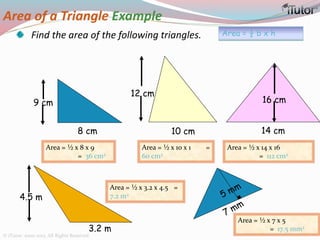
Area of a Triangle Example
Find the area of the following triangles.
8 cm 10 cm 14 cm
12 cm
9 cm 16 cm
Area = ½ b x h
3.2 m
4.5 m
Area = ½ x 8 x 9
= 36 cm2
Area = ½ x 10 x 1 =
60 cm2
Area = ½ x 14 x 16
= 112 cm2
Area = ½ x 3.2 x 4.5 =
7.2 m2
Area = ½ x 7 x 5
= 17.5 mm2
© iTutor. 2000-2013. All Rights Reserved
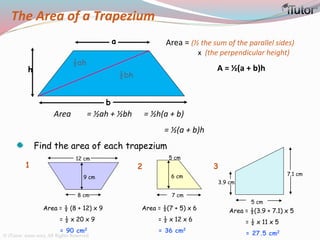
The Area of a Trapezium
Area = (½ the sum of the parallel sides)
x (the perpendicular height)
A = ½(a + b)h
a
b
h
½ah
½bh
Area = ½ah + ½bh = ½h(a + b)
= ½(a + b)h
Find the area of each trapezium
1
8 cm
12 cm
9 cm
2
5 cm
7 cm
6 cm
3
5 cm
3.9 cm
7.1 cm
Area = ½ (8 + 12) x 9
= ½ x 20 x 9
= 90 cm2
Area = ½(7 + 5) x 6
= ½ x 12 x 6
= 36 cm2
Area = ½(3.9 + 7.1) x 5
= ½ x 11 x 5
= 27.5 cm2
© iTutor. 2000-2013. All Rights Reserved
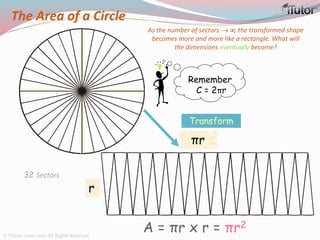
32 Sectors
Transform
Remember
C = 2πr
?
?
As the number of sectors  , the transformed shape
becomes more and more like a rectangle. What will
the dimensions eventually become?
½C
r
πr
A = πr x r = πr2
The Area of a Circle
© iTutor. 2000-2013. All Rights Reserved
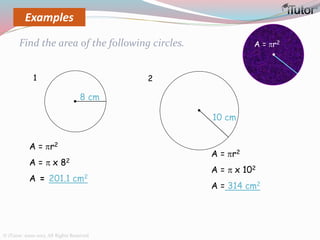
A = r2
A =  x 82
A = 201.1 cm2
A = r2
A =  x 102
A = 314 cm2
Find the area of the following circles. A = r2
8 cm
1
10 cm
2
Examples
© iTutor. 2000-2013. All Rights Reserved
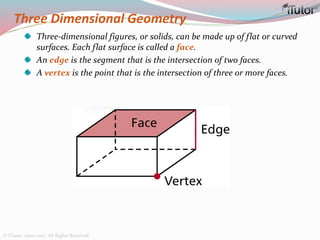
Three Dimensional Geometry
Three-dimensional figures, or solids, can be made up of flat or curved
surfaces. Each flat surface is called a face.
An edge is the segment that is the intersection of two faces.
A vertex is the point that is the intersection of three or more faces.
© iTutor. 2000-2013. All Rights Reserved
Boxes
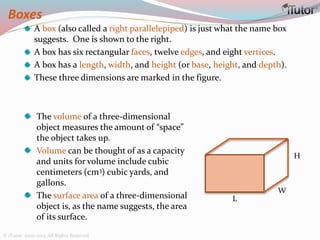
A box (also called a right parallelepiped) is just what the name box
suggests. One is shown to the right.
A box has six rectangular faces, twelve edges, and eight vertices.
A box has a length, width, and height (or base, height, and depth).
These three dimensions are marked in the figure.
L
W
H
The volume of a three-dimensional
object measures the amount of “space”
the object takes up.
Volume can be thought of as a capacity
and units for volume include cubic
centimeters (cm3) cubic yards, and
gallons.
The surface area of a three-dimensional
object is, as the name suggests, the area
of its surface.
© iTutor. 2000-2013. All Rights Reserved
Volume and Surface Area of a Box
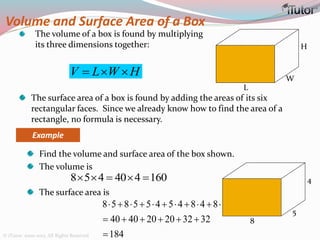
The volume of a box is found by multiplying
its three dimensions together:
L
W
H
V L W H  
Example
Find the volume and surface area of the box shown.
The volume is
The surface area is
The surface area of a box is found by adding the areas of its six
rectangular faces. Since we already know how to find the area of a
rectangle, no formula is necessary.
8 5 4 40 4 160    
8 5 8 5 5 4 5 4 8 4 8 4
40 40 20 20 32 32
184
          
     

8
5
4
© iTutor. 2000-2013. All Rights Reserved
Cube
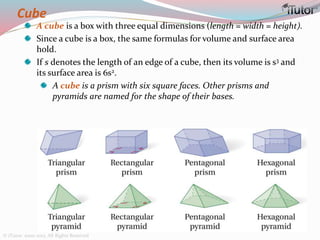
A cube is a box with three equal dimensions (length = width = height).
Since a cube is a box, the same formulas for volume and surface area
hold.
If s denotes the length of an edge of a cube, then its volume is s3 and
its surface area is 6s2.
A cube is a prism with six square faces. Other prisms and
pyramids are named for the shape of their bases.
© iTutor. 2000-2013. All Rights Reserved
Prisms
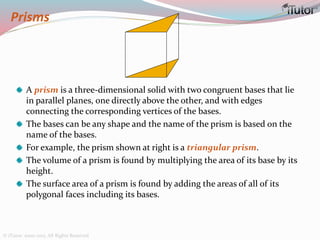
A prism is a three-dimensional solid with two congruent bases that lie
in parallel planes, one directly above the other, and with edges
connecting the corresponding vertices of the bases.
The bases can be any shape and the name of the prism is based on the
name of the bases.
For example, the prism shown at right is a triangular prism.
The volume of a prism is found by multiplying the area of its base by its
height.
The surface area of a prism is found by adding the areas of all of its
polygonal faces including its bases.
© iTutor. 2000-2013. All Rights Reserved
Solution
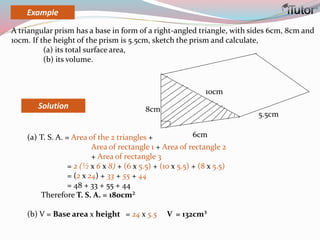
(a) T. S. A. = Area of the 2 triangles +
Area of rectangle 1 + Area of rectangle 2
+ Area of rectangle 3
= 2 (½ x 6 x 8) + (6 x 5.5) + (10 x 5.5) + (8 x 5.5)
= (2 x 24) + 33 + 55 + 44
= 48 + 33 + 55 + 44
Therefore T. S. A. = 180cm²
(b) V = Base area x height = 24 x 5.5 V = 132cm³
6cm
8cm
5.5cm
10cm
A triangular prism has a base in form of a right-angled triangle, with sides 6cm, 8cm and
10cm. If the height of the prism is 5.5cm, sketch the prism and calculate,
(a) its total surface area,
(b) its volume.
Example
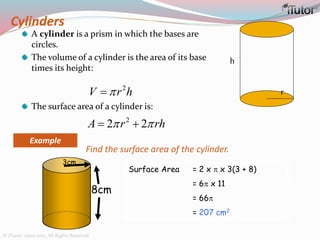
Cylinders
A cylinder is a prism in which the bases are
circles.
The volume of a cylinder is the area of its base
times its height:
The surface area of a cylinder is:
h
r
2
V r h
2
2 2A r rh  
8cm
3cm
Find the surface area of the cylinder.
Surface Area = 2 x  x 3(3 + 8)
= 6 x 11
= 66
= 207 cm2
Example
© iTutor. 2000-2013. All Rights Reserved
Pyramids
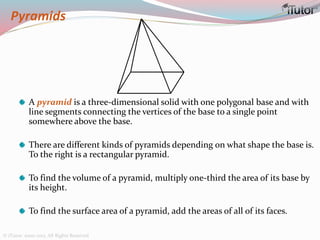
A pyramid is a three-dimensional solid with one polygonal base and with
line segments connecting the vertices of the base to a single point
somewhere above the base.
There are different kinds of pyramids depending on what shape the base is.
To the right is a rectangular pyramid.
To find the volume of a pyramid, multiply one-third the area of its base by
its height.
To find the surface area of a pyramid, add the areas of all of its faces.
© iTutor. 2000-2013. All Rights Reserved
Cones
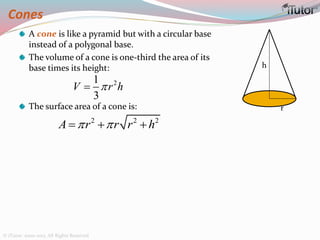
A cone is like a pyramid but with a circular base
instead of a polygonal base.
The volume of a cone is one-third the area of its
base times its height:
The surface area of a cone is:
h
r
21
3
V r h
2 2 2
A r r r h   
© iTutor. 2000-2013. All Rights Reserved
MENSURATION
MENSURATION

MENSURATION

  • 1.
    NAME ; ZOHASAJJAD HUSSAIN CLASS ; VIII-I SCHOOL ;KENDRIYA VIDYALAYA GOLE MARKAT
  • 2.
    Introduction Topic dealing withthe use of formulae to calculate Perimeters, Areas and Volumes of plain shapes and solid ones (prisms). Plane: A plane is a flat surface (think tabletop) that extends forever in all directions. It is a two-dimensional figure. Three non-collinear points determine a plane. So far, all of the geometry we’ve done in these lessons took place in a plane. But objects in the real world are three-dimensional, so we will have to leave the plane and talk about objects like spheres, boxes, cones, and cylinders. Solid: Geometric figure in three dimensions Surface Area: Total area of all the surfaces of a solid shape or prism. Volume: This is the space occupied by a solid shape or prism. © iTutor. 2000-2013. All Rights Reserved
  • 3.
    Areas of geometricalshapes l w l  w a a a  a b h 1/2 b  h h b b  h ShapeDiagram Area © iTutor. 2000-2013. All Rights Reserved
  • 4.
    ShapeDiagram Area  r2 r ½(a+b)h a h b © iTutor. 2000-2013. All Rights Reserved
  • 5.
    AREA The perimeter ofa shape is a measure of distance around the outside. The area of a shape is a measure of the surface/space contained within its perimeter. Area is measured in units2 Units of distance mm cm m km inches feet yards miles 1 cm 1 cm2 1 cm 1 cm Units of area mm2 cm2 m2 km2 inches2 feet2 yards2 miles2 © iTutor. 2000-2013. All Rights Reserved
  • 6.
    Area of arectangle Examples To Find the area of a rectangle simply multiply the 2 dimensions together. Area = l x w (or w x l) Find the area of each rectangular shape below. 100 m 50 m 120 m 40 m 1 2 3 4 5 8½ cm 5½ cm 90 feet 50 feet 210 cm 90 cm 5 000 m2 4500 ft2 4 800 m2 46.75 cm2 18 900 cm2 © iTutor. 2000-2013. All Rights Reserved
  • 7.
    Area of aTriangle rectangle area = 2 + 2 triangle area = ½ rectangle area base height Area of a triangle = ½ base x height The area of a triangle = ½ the area of the surrounding rectangle/parallelogram © iTutor. 2000-2013. All Rights Reserved
  • 8.
    Area of aTriangle Example Find the area of the following triangles. 8 cm 10 cm 14 cm 12 cm 9 cm 16 cm Area = ½ b x h 3.2 m 4.5 m Area = ½ x 8 x 9 = 36 cm2 Area = ½ x 10 x 1 = 60 cm2 Area = ½ x 14 x 16 = 112 cm2 Area = ½ x 3.2 x 4.5 = 7.2 m2 Area = ½ x 7 x 5 = 17.5 mm2 © iTutor. 2000-2013. All Rights Reserved
  • 9.
    The Area ofa Trapezium Area = (½ the sum of the parallel sides) x (the perpendicular height) A = ½(a + b)h a b h ½ah ½bh Area = ½ah + ½bh = ½h(a + b) = ½(a + b)h Find the area of each trapezium 1 8 cm 12 cm 9 cm 2 5 cm 7 cm 6 cm 3 5 cm 3.9 cm 7.1 cm Area = ½ (8 + 12) x 9 = ½ x 20 x 9 = 90 cm2 Area = ½(7 + 5) x 6 = ½ x 12 x 6 = 36 cm2 Area = ½(3.9 + 7.1) x 5 = ½ x 11 x 5 = 27.5 cm2 © iTutor. 2000-2013. All Rights Reserved
  • 10.
    32 Sectors Transform Remember C =2πr ? ? As the number of sectors  , the transformed shape becomes more and more like a rectangle. What will the dimensions eventually become? ½C r πr A = πr x r = πr2 The Area of a Circle © iTutor. 2000-2013. All Rights Reserved
  • 11.
    A = r2 A=  x 82 A = 201.1 cm2 A = r2 A =  x 102 A = 314 cm2 Find the area of the following circles. A = r2 8 cm 1 10 cm 2 Examples © iTutor. 2000-2013. All Rights Reserved
  • 12.
    Three Dimensional Geometry Three-dimensionalfigures, or solids, can be made up of flat or curved surfaces. Each flat surface is called a face. An edge is the segment that is the intersection of two faces. A vertex is the point that is the intersection of three or more faces. © iTutor. 2000-2013. All Rights Reserved
  • 13.
    Boxes A box (alsocalled a right parallelepiped) is just what the name box suggests. One is shown to the right. A box has six rectangular faces, twelve edges, and eight vertices. A box has a length, width, and height (or base, height, and depth). These three dimensions are marked in the figure. L W H The volume of a three-dimensional object measures the amount of “space” the object takes up. Volume can be thought of as a capacity and units for volume include cubic centimeters (cm3) cubic yards, and gallons. The surface area of a three-dimensional object is, as the name suggests, the area of its surface. © iTutor. 2000-2013. All Rights Reserved
  • 14.
    Volume and SurfaceArea of a Box The volume of a box is found by multiplying its three dimensions together: L W H V L W H   Example Find the volume and surface area of the box shown. The volume is The surface area is The surface area of a box is found by adding the areas of its six rectangular faces. Since we already know how to find the area of a rectangle, no formula is necessary. 8 5 4 40 4 160     8 5 8 5 5 4 5 4 8 4 8 4 40 40 20 20 32 32 184                   8 5 4 © iTutor. 2000-2013. All Rights Reserved
  • 15.
    Cube A cube isa box with three equal dimensions (length = width = height). Since a cube is a box, the same formulas for volume and surface area hold. If s denotes the length of an edge of a cube, then its volume is s3 and its surface area is 6s2. A cube is a prism with six square faces. Other prisms and pyramids are named for the shape of their bases. © iTutor. 2000-2013. All Rights Reserved
  • 16.
    Prisms A prism isa three-dimensional solid with two congruent bases that lie in parallel planes, one directly above the other, and with edges connecting the corresponding vertices of the bases. The bases can be any shape and the name of the prism is based on the name of the bases. For example, the prism shown at right is a triangular prism. The volume of a prism is found by multiplying the area of its base by its height. The surface area of a prism is found by adding the areas of all of its polygonal faces including its bases. © iTutor. 2000-2013. All Rights Reserved
  • 17.
    Solution (a) T. S.A. = Area of the 2 triangles + Area of rectangle 1 + Area of rectangle 2 + Area of rectangle 3 = 2 (½ x 6 x 8) + (6 x 5.5) + (10 x 5.5) + (8 x 5.5) = (2 x 24) + 33 + 55 + 44 = 48 + 33 + 55 + 44 Therefore T. S. A. = 180cm² (b) V = Base area x height = 24 x 5.5 V = 132cm³ 6cm 8cm 5.5cm 10cm A triangular prism has a base in form of a right-angled triangle, with sides 6cm, 8cm and 10cm. If the height of the prism is 5.5cm, sketch the prism and calculate, (a) its total surface area, (b) its volume. Example
  • 18.
    Cylinders A cylinder isa prism in which the bases are circles. The volume of a cylinder is the area of its base times its height: The surface area of a cylinder is: h r 2 V r h 2 2 2A r rh   8cm 3cm Find the surface area of the cylinder. Surface Area = 2 x  x 3(3 + 8) = 6 x 11 = 66 = 207 cm2 Example © iTutor. 2000-2013. All Rights Reserved
  • 19.
    Pyramids A pyramid isa three-dimensional solid with one polygonal base and with line segments connecting the vertices of the base to a single point somewhere above the base. There are different kinds of pyramids depending on what shape the base is. To the right is a rectangular pyramid. To find the volume of a pyramid, multiply one-third the area of its base by its height. To find the surface area of a pyramid, add the areas of all of its faces. © iTutor. 2000-2013. All Rights Reserved
  • 20.
    Cones A cone islike a pyramid but with a circular base instead of a polygonal base. The volume of a cone is one-third the area of its base times its height: The surface area of a cone is: h r 21 3 V r h 2 2 2 A r r r h    © iTutor. 2000-2013. All Rights Reserved