Surface area of a rectangular prism
Looking at the rectangular prism template, it is easy to see that the solid has six sides and each side
is a rectangle
The bottom side and the top side are equal and have l and w as dimensions
The area for the top and bottom side is l× w + l × w = 2 × l × w
The front side (shown in sky blue) and the back side (not shown) are equal and have h and l as
dimensions
The area for the front and the back side is l× h + l × h = 2 × l × h
Then, the last two sides have h and w as its dimensions. One side is shown in purple
The area for the front and the back side is w× h + w × h = 2 × w × h
The total surface area, call it SA is:
SA = 2 × l × w + 2 × l × h + 2 × w × h
Example #1:
Find the surface area of a rectangular prism with a length of 6 cm, a width of 4 cm, and a height of 2
cm
SA = 2 × l × w + 2 × l × h + 2 × w × h
SA = 2 × 6 × 4 + 2 × 6 × 2 + 2 × 4 × 2
SA = 48 + 24 + 16
SA = 88 cm2
Surface area of a cube
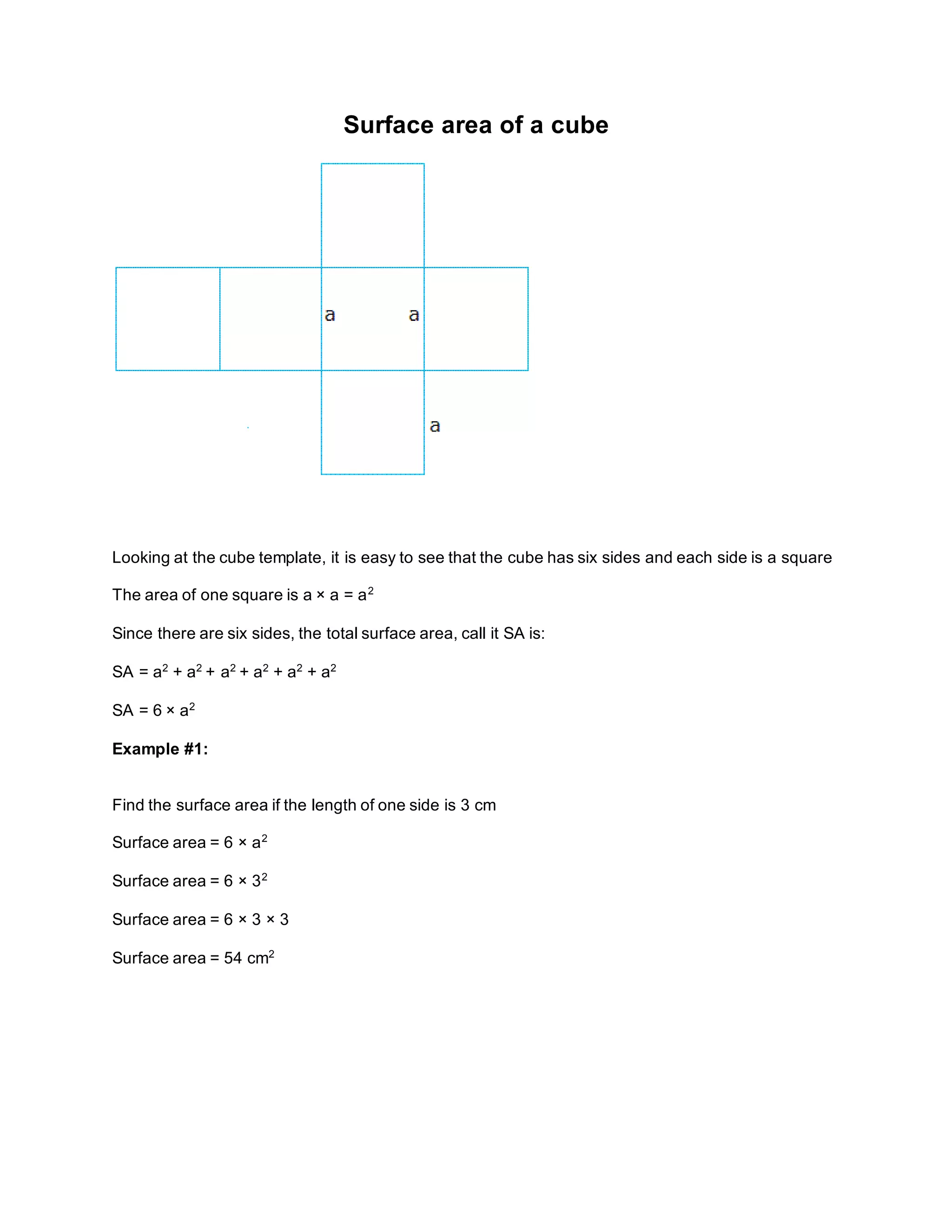
Looking at the cube template, it is easy to see that the cube has six sides and each side is a square
The area of one square is a × a = a2
Since there are six sides, the total surface area, call it SA is:
SA = a2
+ a2
+ a2
+ a2
+ a2
+ a2
SA = 6 × a2
Example #1:
Find the surface area if the length of one side is 3 cm
Surface area = 6 × a2
Surface area = 6 × 32
Surface area = 6 × 3 × 3
Surface area = 54 cm2
Surface area of a cylinder
Thus, the longest side or folded side of the rectangle must be equal to 2 × pi × r, which is the
circumference of the circle
To get the area of the rectangle, multiply h by 2 × pi × r and that is equal to 2 × pi × r × h
Therefore, the total surface area of the cylinder, call it SA is:
SA = 2 × pi × r2
+ 2 × pi × r × h
Example #1:
Find the surface area of a cylinder with a radius of 2 cm, and a height of 1 cm
SA = 2 × pi × r2
+ 2 × pi × r × h
SA = 2 × 3.14 × 22
+ 2 × 3.14 × 2 × 1
SA = 6.28 × 4 + 6.28 × 2
SA = 25.12 + 12.56
Surface area = 37.68 cm2
Surface area of a square pyramid
l is the slant height. It is not for no reason this height is called slant height!
The word slant refers also to something that is oblique or bent, or something that is not vertical or
straight up. Basically, anything that is not horizontal or vertical!
The area of the square is s2
The area of one triangle is (s × l)/2
Since there are 4 triangles, the area is 4 × (s × l)/2 = 2 × s × l
Therefore, the surface area, call it SA is:
SA = s2
+ 2 × s × l :
Example #1:
Find the surface area of a square pyramid with a base length of 5 cm, and a slant height of 10 cm
SA = s2
+ 2 × s × l
SA = 52
+ 2 × 5 × 10
SA = 25 + 100
SA = 125 cm2
Surface area of a sphere
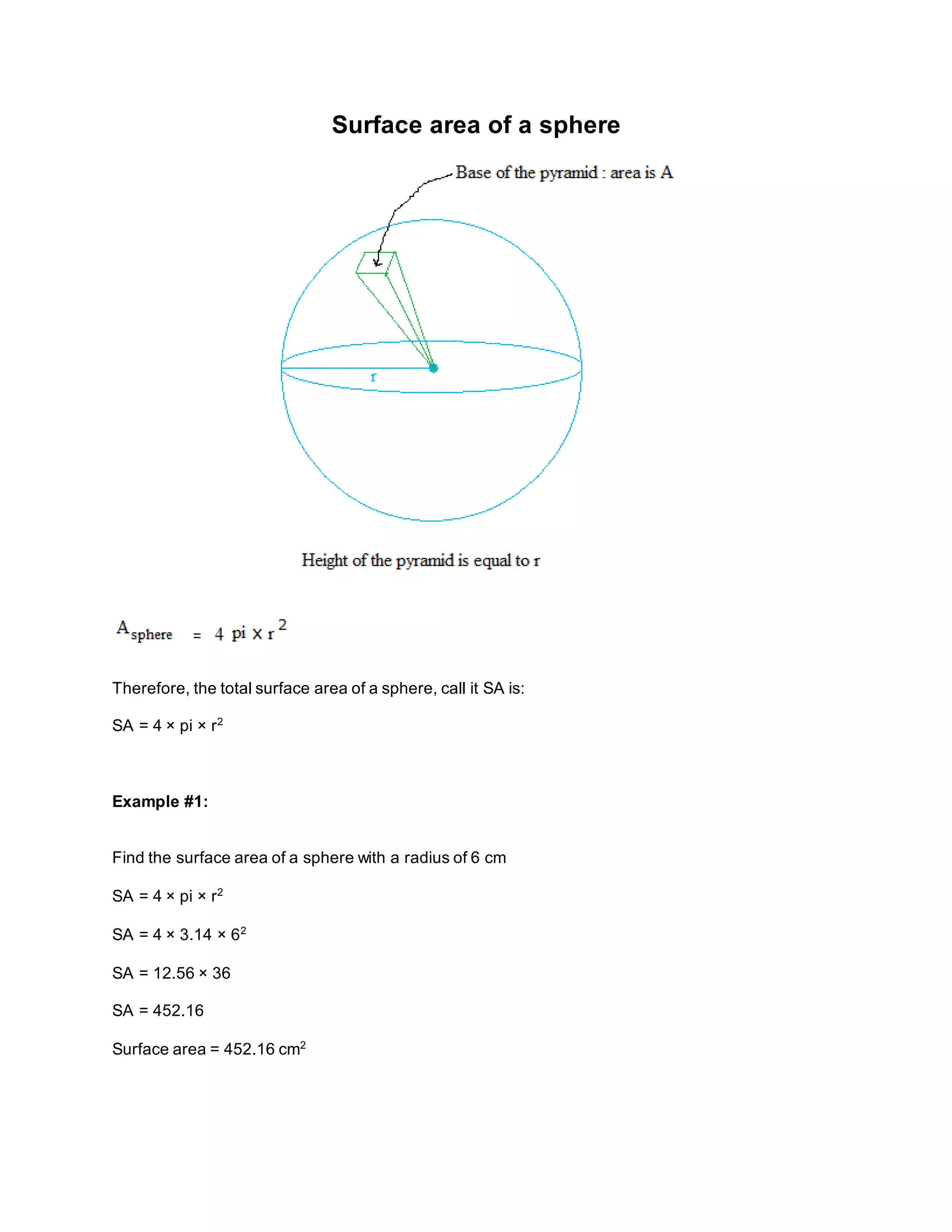
Therefore, the total surface area of a sphere, call it SA is:
SA = 4 × pi × r2
Example #1:
Find the surface area of a sphere with a radius of 6 cm
SA = 4 × pi × r2
SA = 4 × 3.14 × 62
SA = 12.56 × 36
SA = 452.16
Surface area = 452.16 cm2
Surface area of a cone
For a cone, the base is a circle, A = π × r2
P = 2 × π × r
To find the slant height, l, just use the Pythagorean Theorem
l = r2
+ h2
l = √ (r2
+ h2
)
Putting it all together, we get:
S = A + 1/2 (P × l)
S = π × r2
+ 1/2 ( 2 × π × r × √ (r2
+ h2
)
S = π × r2
+ π × r × √ (r2
+ h2
)
Example #1:
Find the surface area of a cone with a radius of 4 cm, and a height of 8 cm
S = π × r2
+ π × r × √ (r2
+ h2
)
S = 3.14 × 42
+ 3.14 × 4 × √ (42
+ 82
)
S = 3.14 × 16 + 12.56 × √ (16 + 64)
S = 50.24 + 12.56 × √ (80)
S = 50.24 + 12.56 × 8.94
S = 50.24 + 112.28
S = 162.52 cm2
Volume of a sphere
V = (4/3) × pi × r3
Use pi = 3.14
Example #1
Find Vsphere if r = 2 inches
Vsphere = 4/3 × pi × r3
Vsphere = 4/3 × 3.14 × 23
Vsphere = 4/3 × 3.14 × 8
Vsphere = 4/3 × 25.12
Vsphere = 4/3 × 25.12/1
Vsphere = (4 × 25.12)/(3 × 1)
Vsphere = (100.48)/3
Vsphere = 33.49 inches3
Volume of an ellipsoid
V =
43
× π × a × b × c
The formulas can also be written as V =
4 × π × a × b × c3
Use pi = 3.14
Example #1
Find V if a = 2 inches, b = 4 inches, and c = 3 inches
Vellipsoid =
4 × 3.14 × 2 × 4 × 33
Vellipsoid =
4 × 3.14 × 2 × 123
Vellipsoid =
4 × 3.14 × 243
Vellipsoid =
4 × 75.363
Vellipsoid =
301.443
Vellipsoid = 100.48 inches3
Volume of cylinders
Volumecy linder = Area of base × height = pi × r2
× h
Use 3.14 for pi.
Notice that the base of the cylinder is a circle and the formula to get the are is pi × r2
Example #1:
Calculate Volumecy linder if r = 2 cm and h = 5 cm
Volumecy linder = pi × r2
× h
Volumecy linder = 3.14 × 22
× 5
Volumecy linder = 3.14 × 4 × 5
Volumecy linder = 3.14 × 20
Volumecy linder = 62.8 cm3
Volume of a cone
Formula: Vcone = 1/3 × b × h
b is the area of the base of the cone. Since the base is a circle, area of the base = pi × r2
Thus, the formula is Vcone = 1/3 × pi × r2
× h
Use pi = 3.14
Example #1:
Calculate the volume if r = 2 cm and h = 3 cm
Vcone = 1/3 × 3.14 × 22
× 3
Vcone = 1/3 × 3.14 × 4 × 3
Vcone = 1/3 × 3.14 × 12
Vcone = 1/3 × 37.68
Vcone = 1/3 × 37.68/1
Vcone = (1 × 37.68)/(3 × 1)
Vcone = 37.68/3
Vcone = 12.56 cm3
Volume of a pyramid
Volume = (B × h)/3
B is the area of the base
h is the height
The base of the pyramid can be a rectangle, a triangle, or a square. Compute the area of the base
accordingly
Volume of a square pyramid
Example #1:
A square pyramid has a height of 9 meters. If a side of the base measures 4 meters, what is the
volume of the pyramid?
Since the base is a square, area of the base = 4 × 4 = 16 m2
Volume of the pyramid = (B × h)/3 = (16 × 9)/3 = 144/3 = 48 m3
Volume of irregular shapes
A house
The house above is made of two 3-d shapes: A triangular prism and a rectangular prism
The roof of the house is the one shaped like a triangular prism
Volume of house = volume of triangular prism + volume of rectangular prism
volume of triangular prism = area of triangle × length of house
volume of triangular prism =
base of triangle × height of triangle2
× length of house
length of house = 50 feet, base of triangle = 15 feet, and height of triangle = 10 feet
volume of triangular prism =
15 × 102
× 50
volume of triangular prism = 75 × 50 = 3750 feet3
volume of rectangular prism = 15 × 15 × 50 = 11250 feet3
Volume of house = 3750 + 11250 = 15000 feet3
Ice ceam cone:
When you order ice cream, you may have never realized that it could be a combination of half a
sphere and a cone
Of course, we have to assume that the shape made by the ice cream scoop is half a sphere.
The shape of my ice cream shown below is half a sphere and then we put it on a cone. What is the
volume?
It may be easier to see how to compute the volume if we remove the ice cream
Pretend that the radius of the cone or r is 1.5 inches and the height of the cone or h is 6.5 inches
here is how to compute the volume
Volume = volume of half the sphere + volume of the cone
volume of a sphere =
4 × π × r3
3
volume of a sphere =
42.393
volume = 14.13 inches3
Since it is half a sphere, we get 7.065 inches3
volume of a cone =
π × r2
× h3
volume of a cone =
3.14 × 1.52
× 6.53
volume of a cone =
45.92253
volume of cone = 15.3075 inches3
volume of the whole thing is 7.065 + 15.3075 = 22.3725 inches3

Basic formula for Shapes - Area and Volume and Surfae

  • 1.
    Surface area ofa rectangular prism Looking at the rectangular prism template, it is easy to see that the solid has six sides and each side is a rectangle The bottom side and the top side are equal and have l and w as dimensions The area for the top and bottom side is l× w + l × w = 2 × l × w The front side (shown in sky blue) and the back side (not shown) are equal and have h and l as dimensions The area for the front and the back side is l× h + l × h = 2 × l × h Then, the last two sides have h and w as its dimensions. One side is shown in purple The area for the front and the back side is w× h + w × h = 2 × w × h The total surface area, call it SA is: SA = 2 × l × w + 2 × l × h + 2 × w × h Example #1: Find the surface area of a rectangular prism with a length of 6 cm, a width of 4 cm, and a height of 2 cm SA = 2 × l × w + 2 × l × h + 2 × w × h SA = 2 × 6 × 4 + 2 × 6 × 2 + 2 × 4 × 2 SA = 48 + 24 + 16 SA = 88 cm2
  • 2.
    Surface area ofa cube Looking at the cube template, it is easy to see that the cube has six sides and each side is a square The area of one square is a × a = a2 Since there are six sides, the total surface area, call it SA is: SA = a2 + a2 + a2 + a2 + a2 + a2 SA = 6 × a2 Example #1: Find the surface area if the length of one side is 3 cm Surface area = 6 × a2 Surface area = 6 × 32 Surface area = 6 × 3 × 3 Surface area = 54 cm2
  • 3.
    Surface area ofa cylinder Thus, the longest side or folded side of the rectangle must be equal to 2 × pi × r, which is the circumference of the circle To get the area of the rectangle, multiply h by 2 × pi × r and that is equal to 2 × pi × r × h
  • 4.
    Therefore, the totalsurface area of the cylinder, call it SA is: SA = 2 × pi × r2 + 2 × pi × r × h Example #1: Find the surface area of a cylinder with a radius of 2 cm, and a height of 1 cm SA = 2 × pi × r2 + 2 × pi × r × h SA = 2 × 3.14 × 22 + 2 × 3.14 × 2 × 1 SA = 6.28 × 4 + 6.28 × 2 SA = 25.12 + 12.56 Surface area = 37.68 cm2
  • 5.
    Surface area ofa square pyramid l is the slant height. It is not for no reason this height is called slant height! The word slant refers also to something that is oblique or bent, or something that is not vertical or straight up. Basically, anything that is not horizontal or vertical! The area of the square is s2 The area of one triangle is (s × l)/2 Since there are 4 triangles, the area is 4 × (s × l)/2 = 2 × s × l Therefore, the surface area, call it SA is: SA = s2 + 2 × s × l : Example #1: Find the surface area of a square pyramid with a base length of 5 cm, and a slant height of 10 cm SA = s2 + 2 × s × l SA = 52 + 2 × 5 × 10 SA = 25 + 100 SA = 125 cm2
  • 6.
    Surface area ofa sphere Therefore, the total surface area of a sphere, call it SA is: SA = 4 × pi × r2 Example #1: Find the surface area of a sphere with a radius of 6 cm SA = 4 × pi × r2 SA = 4 × 3.14 × 62 SA = 12.56 × 36 SA = 452.16 Surface area = 452.16 cm2
  • 7.
    Surface area ofa cone For a cone, the base is a circle, A = π × r2 P = 2 × π × r To find the slant height, l, just use the Pythagorean Theorem l = r2 + h2 l = √ (r2 + h2 ) Putting it all together, we get: S = A + 1/2 (P × l) S = π × r2 + 1/2 ( 2 × π × r × √ (r2 + h2 ) S = π × r2 + π × r × √ (r2 + h2 ) Example #1: Find the surface area of a cone with a radius of 4 cm, and a height of 8 cm S = π × r2 + π × r × √ (r2 + h2 ) S = 3.14 × 42 + 3.14 × 4 × √ (42 + 82 ) S = 3.14 × 16 + 12.56 × √ (16 + 64) S = 50.24 + 12.56 × √ (80) S = 50.24 + 12.56 × 8.94 S = 50.24 + 112.28 S = 162.52 cm2
  • 8.
    Volume of asphere V = (4/3) × pi × r3 Use pi = 3.14 Example #1 Find Vsphere if r = 2 inches Vsphere = 4/3 × pi × r3 Vsphere = 4/3 × 3.14 × 23 Vsphere = 4/3 × 3.14 × 8 Vsphere = 4/3 × 25.12 Vsphere = 4/3 × 25.12/1 Vsphere = (4 × 25.12)/(3 × 1) Vsphere = (100.48)/3 Vsphere = 33.49 inches3
  • 9.
    Volume of anellipsoid V = 43 × π × a × b × c The formulas can also be written as V = 4 × π × a × b × c3 Use pi = 3.14 Example #1 Find V if a = 2 inches, b = 4 inches, and c = 3 inches Vellipsoid = 4 × 3.14 × 2 × 4 × 33 Vellipsoid = 4 × 3.14 × 2 × 123 Vellipsoid = 4 × 3.14 × 243 Vellipsoid = 4 × 75.363 Vellipsoid = 301.443 Vellipsoid = 100.48 inches3
  • 10.
    Volume of cylinders Volumecylinder = Area of base × height = pi × r2 × h Use 3.14 for pi. Notice that the base of the cylinder is a circle and the formula to get the are is pi × r2 Example #1: Calculate Volumecy linder if r = 2 cm and h = 5 cm Volumecy linder = pi × r2 × h Volumecy linder = 3.14 × 22 × 5 Volumecy linder = 3.14 × 4 × 5 Volumecy linder = 3.14 × 20 Volumecy linder = 62.8 cm3
  • 11.
    Volume of acone Formula: Vcone = 1/3 × b × h b is the area of the base of the cone. Since the base is a circle, area of the base = pi × r2 Thus, the formula is Vcone = 1/3 × pi × r2 × h Use pi = 3.14 Example #1: Calculate the volume if r = 2 cm and h = 3 cm Vcone = 1/3 × 3.14 × 22 × 3 Vcone = 1/3 × 3.14 × 4 × 3 Vcone = 1/3 × 3.14 × 12 Vcone = 1/3 × 37.68 Vcone = 1/3 × 37.68/1 Vcone = (1 × 37.68)/(3 × 1) Vcone = 37.68/3 Vcone = 12.56 cm3
  • 12.
    Volume of apyramid Volume = (B × h)/3 B is the area of the base h is the height The base of the pyramid can be a rectangle, a triangle, or a square. Compute the area of the base accordingly Volume of a square pyramid Example #1: A square pyramid has a height of 9 meters. If a side of the base measures 4 meters, what is the volume of the pyramid? Since the base is a square, area of the base = 4 × 4 = 16 m2 Volume of the pyramid = (B × h)/3 = (16 × 9)/3 = 144/3 = 48 m3
  • 13.
    Volume of irregularshapes A house The house above is made of two 3-d shapes: A triangular prism and a rectangular prism The roof of the house is the one shaped like a triangular prism Volume of house = volume of triangular prism + volume of rectangular prism volume of triangular prism = area of triangle × length of house volume of triangular prism = base of triangle × height of triangle2 × length of house length of house = 50 feet, base of triangle = 15 feet, and height of triangle = 10 feet volume of triangular prism = 15 × 102 × 50 volume of triangular prism = 75 × 50 = 3750 feet3 volume of rectangular prism = 15 × 15 × 50 = 11250 feet3 Volume of house = 3750 + 11250 = 15000 feet3
  • 14.
    Ice ceam cone: Whenyou order ice cream, you may have never realized that it could be a combination of half a sphere and a cone Of course, we have to assume that the shape made by the ice cream scoop is half a sphere. The shape of my ice cream shown below is half a sphere and then we put it on a cone. What is the volume? It may be easier to see how to compute the volume if we remove the ice cream Pretend that the radius of the cone or r is 1.5 inches and the height of the cone or h is 6.5 inches here is how to compute the volume Volume = volume of half the sphere + volume of the cone
  • 15.
    volume of asphere = 4 × π × r3 3 volume of a sphere = 42.393 volume = 14.13 inches3 Since it is half a sphere, we get 7.065 inches3 volume of a cone = π × r2 × h3 volume of a cone = 3.14 × 1.52 × 6.53 volume of a cone = 45.92253 volume of cone = 15.3075 inches3 volume of the whole thing is 7.065 + 15.3075 = 22.3725 inches3