Surface Area and
Surface Area and
Volume
Volume
Surface Area
Surface Area
Surface Area
Surface Area = The total area of the surface of a
= The total area of the surface of a
three-dimensional object
(Or think of it as the amount of paper you’ll need
to wrap the shape.)
to wrap the shape.)
Rectangular
Prism
Triangular
Prism
Surface Area (SA) of a Rectangular
Prism
Prism
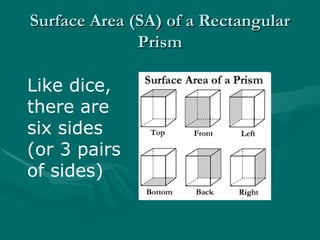
Like dice,
there are
six sides
(or 3 pairs
of sides)
Prism net - unfolded
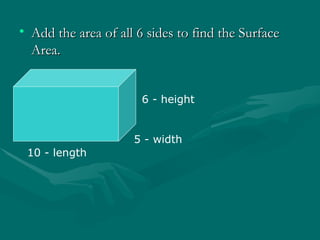
• Add the area of all 6 sides to find the Surface
Add the area of all 6 sides to find the Surface
Area.
Area.
10 - length
5 - width
6 - height
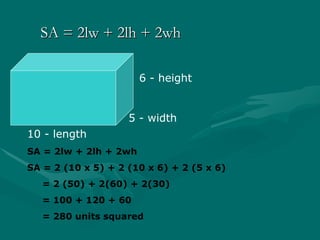
SA = 2lw + 2lh + 2wh
10 - length
5 - width
6 - height
SA = 2lw + 2lh + 2wh
SA = 2 (10 x 5) + 2 (10 x 6) + 2 (5 x 6)
= 2 (50) + 2(60) + 2(30)
= 100 + 120 + 60
= 280 units squared
Practice
Practice
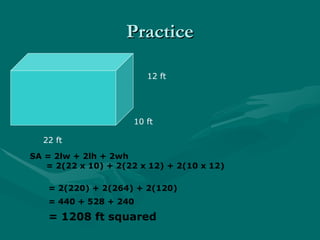
10 ft
12 ft
22 ft
SA = 2lw + 2lh + 2wh
= 2(22 x 10) + 2(22 x 12) + 2(10 x 12)
= 2(220) + 2(264) + 2(120)
= 440 + 528 + 240
= 1208 ft squared
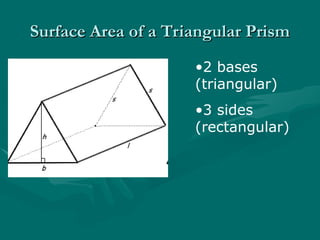
Surface Area of a Triangular Prism
•2 bases
(triangular)
•3 sides
(rectangular)
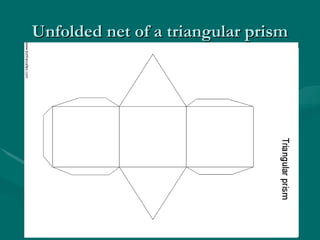
Unfolded net of a triangular prism
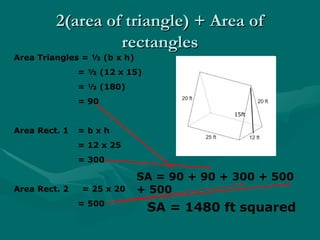
2(area of triangle) + Area of
rectangles
rectangles
15ft
Area Triangles = ½ (b x h)
= ½ (12 x 15)
= ½ (180)
= 90
Area Rect. 1 = b x h
= 12 x 25
= 300
Area Rect. 2 = 25 x 20
= 500
SA = 90 + 90 + 300 + 500
+ 500
SA = 1480 ft squared
Practice
Practice
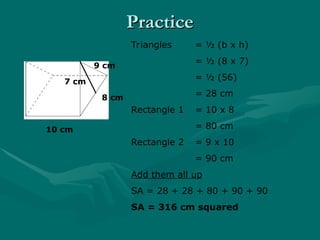
10 cm
8 cm
9 cm
7 cm
Triangles = ½ (b x h)
= ½ (8 x 7)
= ½ (56)
= 28 cm
Rectangle 1 = 10 x 8
= 80 cm
Rectangle 2 = 9 x 10
= 90 cm
Add them all up
SA = 28 + 28 + 80 + 90 + 90
SA = 316 cm squared
Surface Area of a Cylinder
Review
Review
•Surface area is like the amount of
paper you’ll need to wrap the shape.
•You have to “take apart” the shape
and figure the area of the parts.
•Then add them together for the
Surface Area (SA)
Parts of a cylinder
Parts of a cylinder
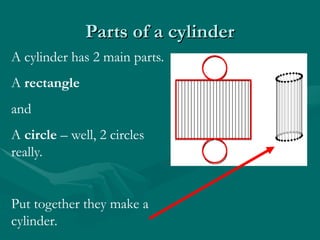
A cylinder has 2 main parts.
A rectangle
and
A circle – well, 2 circles
really.
Put together they make a
cylinder.
The Soup Can
The Soup Can
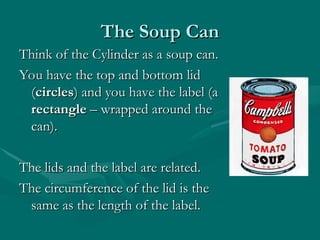
Think of the Cylinder as a soup can.
You have the top and bottom lid
(
(circles
circles) and you have the label (a
) and you have the label (a
rectangle
rectangle – wrapped around the
– wrapped around the
can).
can).
The lids and the label are related.
The circumference of the lid is the
same as the length of the label.
Area of the Circles
Area of the Circles
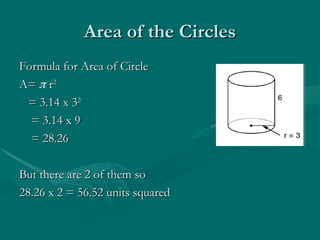
Formula for Area of Circle
A=
A=  r
r2
2
= 3.14 x 3
= 3.14 x 32
2
= 3.14 x 9
= 3.14 x 9
= 28.26
= 28.26
But there are 2 of them so
28.26 x 2 = 56.52 units squared
The Rectangle
The Rectangle
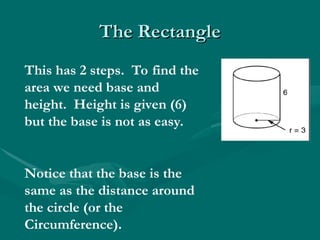
This has 2 steps. To find the
area we need base and
height. Height is given (6)
but the base is not as easy.
Notice that the base is the
same as the distance around
the circle (or the
Circumference).
Find Circumference
Find Circumference
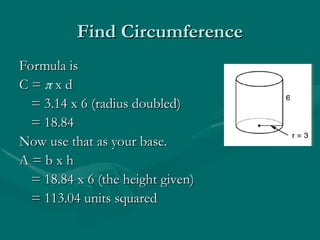
Formula is
Formula is
C =
C =  x d
x d
= 3.14 x 6 (radius doubled)
= 18.84
= 18.84
Now use that as your base.
A = b x h
A = b x h
= 18.84 x 6 (the height given)
= 113.04 units squared
Add them together
Add them together
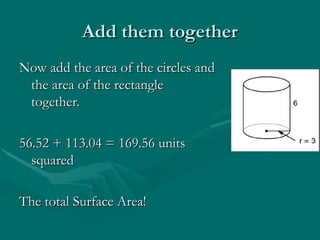
Now add the area of the circles and
the area of the rectangle
together.
together.
56.52 + 113.04 = 169.56 units
squared
squared
The total Surface Area!
Formula
Formula
SA = (
SA = ( d x h) + 2 (
d x h) + 2 ( r
r2
2
)
)
Label
Label Lids (2)
Lids (2)
Area of Rectangle Area of Circles
Practice
Practice
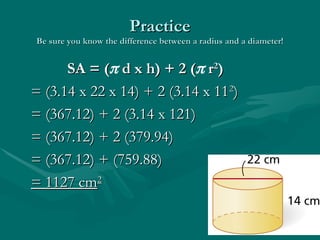
Be sure you know the difference between a radius and a diameter!
SA = (
SA = ( d x h) + 2 (
d x h) + 2 ( r
r2
2
)
)
= (3.14 x 22 x 14) + 2 (3.14 x 11
= (3.14 x 22 x 14) + 2 (3.14 x 112
2
)
)
= (367.12) + 2 (3.14 x 121)
= (367.12) + 2 (379.94)
= (367.12) + 2 (379.94)
= (367.12) + (759.88)
= (367.12) + (759.88)
= 1127 cm
= 1127 cm2
2
More Practice!
More Practice!
SA
SA = (
= ( d x h) + 2 (
d x h) + 2 ( r
r2
2
)
)
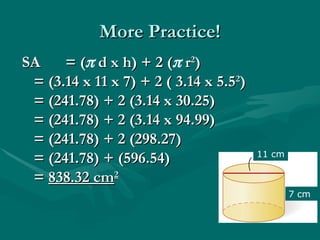
= (3.14 x 11 x 7) + 2 ( 3.14 x 5.5
= (3.14 x 11 x 7) + 2 ( 3.14 x 5.52
2
)
)
= (241.78) + 2 (3.14 x 30.25)
= (241.78) + 2 (3.14 x 94.99)
= (241.78) + 2 (298.27)
= (241.78) + 2 (298.27)
= (241.78) + (596.54)
= (241.78) + (596.54)
=
= 838.32 cm
838.32 cm2
2
11 cm
7 cm
Surface Area of a
Surface Area of a
Pyramid
Pyramid
Pyramid Nets
Pyramid Nets
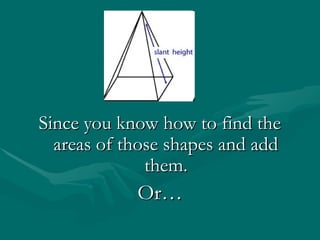
A pyramid has 2
A pyramid has 2
shapes:
shapes:
One (1) square
One (1) square
&
&
Four (4) triangles
Four (4) triangles
Since you know how to find the
areas of those shapes and add
them.
them.
Or…
Or…
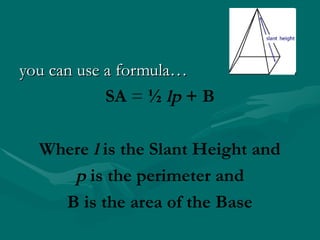
you can use a formula…
SA = ½ lp + B
Where l is the Slant Height and
p is the perimeter and
B is the area of the Base
SA = ½ lp + B
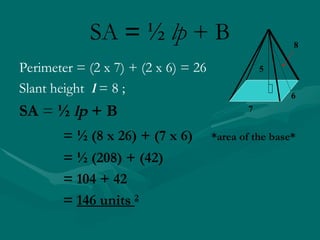
6
7
8
5
Perimeter = (2 x 7) + (2 x 6) = 26
Slant height l = 8 ;
SA = ½ lp + B
= ½ (8 x 26) + (7 x 6) *area of the base*
= ½ (208) + (42)
= 104 + 42
= 146 units 2
Practice
Practice
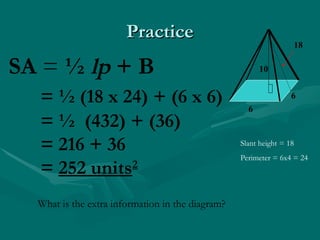
6
6
18
10
SA = ½ lp + B
= ½ (18 x 24) + (6 x 6)
= ½ (432) + (36)
= 216 + 36
= 252 units2
Slant height = 18
Perimeter = 6x4 = 24
What is the extra information in the diagram?
Volume of Prisms and Cylinders
Volume
Volume
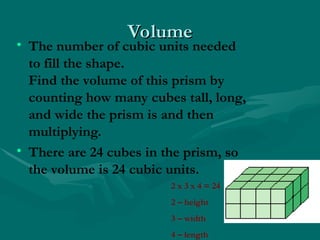
• The number of cubic units needed
to fill the shape.
Find the volume of this prism by
counting how many cubes tall, long,
and wide the prism is and then
multiplying.
• There are 24 cubes in the prism, so
the volume is 24 cubic units.
2 x 3 x 4 = 24
2 – height
3 – width
4 – length
Formula for Prisms
Formula for Prisms
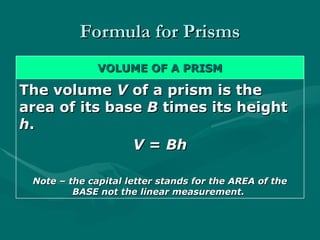
VOLUME OF A PRISM
VOLUME OF A PRISM
The volume
The volume V
V of a prism is the
of a prism is the
area of its base
area of its base B
B times its height
times its height
h
h.
.
V
V =
= Bh
Bh
Note – the capital letter stands for the AREA of the
BASE not the linear measurement.
Try It
Try It
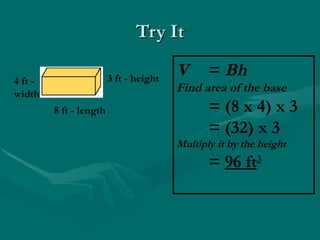
4 ft -
width
3 ft - height
8 ft - length
V = Bh
Find area of the base
= (8 x 4) x 3
= (32) x 3
Multiply it by the height
= 96 ft3
Practice
Practice
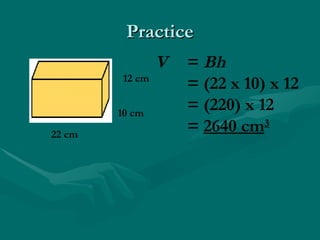
12 cm
10 cm
22 cm
V = Bh
= (22 x 10) x 12
= (220) x 12
= 2640 cm3
Cylinders
Cylinders
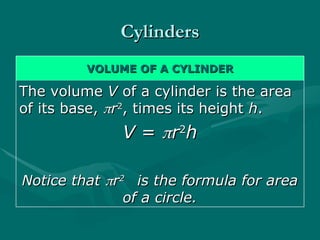
VOLUME OF A CYLINDER
The volume
The volume V
V of a cylinder is the area
of a cylinder is the area
of its base,
of its base, 
r
r2
2
, times its height
, times its height h
h.
.
V
V =
= 
r
r2
2
h
h
Notice that
Notice that 
r
r2
2
is the formula for area
of a circle.
of a circle.
Try It
Try It
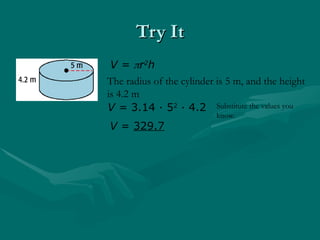
V = r2
h
The radius of the cylinder is 5 m, and the height
is 4.2 m
V = 3.14 · 52
· 4.2
V = 329.7
Substitute the values you
know.
Practice
Practice
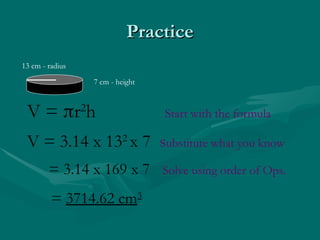
7 cm - height
13 cm - radius
V = r2
h Start with the formula
V = 3.14 x 132
x 7 substitute what you know
= 3.14 x 169 x 7 Solve using order of Ops.
= 3714.62 cm3
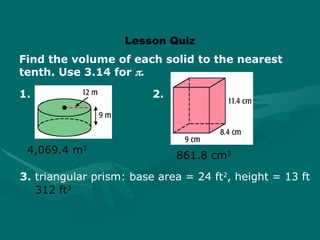
Lesson Quiz
Find the volume of each solid to the nearest
tenth. Use 3.14 for .
861.8 cm3
4,069.4 m3
312 ft3
3. triangular prism: base area = 24 ft2
, height = 13 ft
1. 2.
Volume of Pyramids
Volume of Pyramids
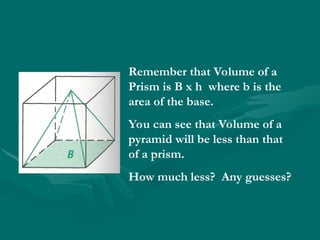
Remember that Volume of a
Prism is B x h where b is the
area of the base.
You can see that Volume of a
pyramid will be less than that
of a prism.
How much less? Any guesses?
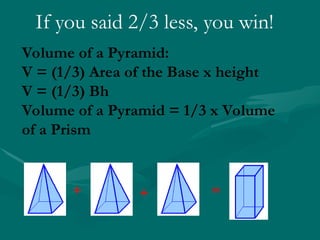
Volume of a Pyramid:
V = (1/3) Area of the Base x height
V = (1/3) Bh
Volume of a Pyramid = 1/3 x Volume
of a Prism
If you said 2/3 less, you win!
+ + =
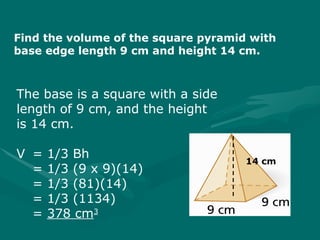
Find the volume of the square pyramid with
base edge length 9 cm and height 14 cm.
The base is a square with a side
length of 9 cm, and the height
is 14 cm.
V = 1/3 Bh
= 1/3 (9 x 9)(14)
= 1/3 (81)(14)
= 1/3 (1134)
= 378 cm3
14 cm
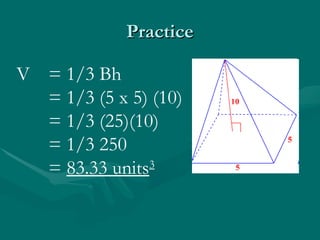
Practice
Practice
V = 1/3 Bh
= 1/3 (5 x 5) (10)
= 1/3 (25)(10)
= 1/3 250
= 83.33 units3
Quiz
Quiz
Find the volume of each figure.
1. a rectangular pyramid with length 25 cm,
width 17 cm, and height 21 cm
2975 cm3
2. a triangular pyramid with base edge length
12 in. a base altitude of 9 in. and height
10 in.
360 in3
End
End

Surface Area and Volume of Solid Figure PowerPoint.ppt

  • 1.
    Surface Area and SurfaceArea and Volume Volume
  • 2.
    Surface Area Surface Area SurfaceArea Surface Area = The total area of the surface of a = The total area of the surface of a three-dimensional object three-dimensional object (Or think of it as the amount of paper you’ll need (Or think of it as the amount of paper you’ll need to wrap the shape.) to wrap the shape.)
  • 3.
  • 4.
    Surface Area (SA)of a Rectangular Surface Area (SA) of a Rectangular Prism Prism Like dice, there are six sides (or 3 pairs of sides)
  • 5.
    Prism net -unfolded Prism net - unfolded
  • 6.
    • Add thearea of all 6 sides to find the Surface Add the area of all 6 sides to find the Surface Area. Area. 10 - length 5 - width 6 - height
  • 7.
    SA = 2lw+ 2lh + 2wh SA = 2lw + 2lh + 2wh 10 - length 5 - width 6 - height SA = 2lw + 2lh + 2wh SA = 2 (10 x 5) + 2 (10 x 6) + 2 (5 x 6) = 2 (50) + 2(60) + 2(30) = 100 + 120 + 60 = 280 units squared
  • 8.
    Practice Practice 10 ft 12 ft 22ft SA = 2lw + 2lh + 2wh = 2(22 x 10) + 2(22 x 12) + 2(10 x 12) = 2(220) + 2(264) + 2(120) = 440 + 528 + 240 = 1208 ft squared
  • 9.
    Surface Area ofa Triangular Prism Surface Area of a Triangular Prism •2 bases (triangular) •3 sides (rectangular)
  • 10.
    Unfolded net ofa triangular prism Unfolded net of a triangular prism
  • 11.
    2(area of triangle)+ Area of 2(area of triangle) + Area of rectangles rectangles 15ft Area Triangles = ½ (b x h) = ½ (12 x 15) = ½ (180) = 90 Area Rect. 1 = b x h = 12 x 25 = 300 Area Rect. 2 = 25 x 20 = 500 SA = 90 + 90 + 300 + 500 + 500 SA = 1480 ft squared
  • 12.
    Practice Practice 10 cm 8 cm 9cm 7 cm Triangles = ½ (b x h) = ½ (8 x 7) = ½ (56) = 28 cm Rectangle 1 = 10 x 8 = 80 cm Rectangle 2 = 9 x 10 = 90 cm Add them all up SA = 28 + 28 + 80 + 90 + 90 SA = 316 cm squared
  • 13.
    Surface Area ofa Cylinder Surface Area of a Cylinder
  • 14.
    Review Review •Surface area islike the amount of paper you’ll need to wrap the shape. •You have to “take apart” the shape and figure the area of the parts. •Then add them together for the Surface Area (SA)
  • 15.
    Parts of acylinder Parts of a cylinder A cylinder has 2 main parts. A rectangle and A circle – well, 2 circles really. Put together they make a cylinder.
  • 16.
    The Soup Can TheSoup Can Think of the Cylinder as a soup can. Think of the Cylinder as a soup can. You have the top and bottom lid You have the top and bottom lid ( (circles circles) and you have the label (a ) and you have the label (a rectangle rectangle – wrapped around the – wrapped around the can). can). The lids and the label are related. The lids and the label are related. The circumference of the lid is the The circumference of the lid is the same as the length of the label. same as the length of the label.
  • 17.
    Area of theCircles Area of the Circles Formula for Area of Circle Formula for Area of Circle A= A=  r r2 2 = 3.14 x 3 = 3.14 x 32 2 = 3.14 x 9 = 3.14 x 9 = 28.26 = 28.26 But there are 2 of them so But there are 2 of them so 28.26 x 2 = 56.52 units squared 28.26 x 2 = 56.52 units squared
  • 18.
    The Rectangle The Rectangle Thishas 2 steps. To find the area we need base and height. Height is given (6) but the base is not as easy. Notice that the base is the same as the distance around the circle (or the Circumference).
  • 19.
    Find Circumference Find Circumference Formulais Formula is C = C =  x d x d = 3.14 x 6 (radius doubled) = 3.14 x 6 (radius doubled) = 18.84 = 18.84 Now use that as your base. Now use that as your base. A = b x h A = b x h = 18.84 x 6 (the height given) = 18.84 x 6 (the height given) = 113.04 units squared = 113.04 units squared
  • 20.
    Add them together Addthem together Now add the area of the circles and Now add the area of the circles and the area of the rectangle the area of the rectangle together. together. 56.52 + 113.04 = 169.56 units 56.52 + 113.04 = 169.56 units squared squared The total Surface Area! The total Surface Area!
  • 21.
    Formula Formula SA = ( SA= ( d x h) + 2 ( d x h) + 2 ( r r2 2 ) ) Label Label Lids (2) Lids (2) Area of Rectangle Area of Circles Area of Rectangle Area of Circles
  • 22.
    Practice Practice Be sure youknow the difference between a radius and a diameter! Be sure you know the difference between a radius and a diameter! SA = ( SA = ( d x h) + 2 ( d x h) + 2 ( r r2 2 ) ) = (3.14 x 22 x 14) + 2 (3.14 x 11 = (3.14 x 22 x 14) + 2 (3.14 x 112 2 ) ) = (367.12) + 2 (3.14 x 121) = (367.12) + 2 (3.14 x 121) = (367.12) + 2 (379.94) = (367.12) + 2 (379.94) = (367.12) + (759.88) = (367.12) + (759.88) = 1127 cm = 1127 cm2 2
  • 23.
    More Practice! More Practice! SA SA= ( = ( d x h) + 2 ( d x h) + 2 ( r r2 2 ) ) = (3.14 x 11 x 7) + 2 ( 3.14 x 5.5 = (3.14 x 11 x 7) + 2 ( 3.14 x 5.52 2 ) ) = (241.78) + 2 (3.14 x 30.25) = (241.78) + 2 (3.14 x 30.25) = (241.78) + 2 (3.14 x 94.99) = (241.78) + 2 (3.14 x 94.99) = (241.78) + 2 (298.27) = (241.78) + 2 (298.27) = (241.78) + (596.54) = (241.78) + (596.54) = = 838.32 cm 838.32 cm2 2 11 cm 7 cm
  • 24.
    Surface Area ofa Surface Area of a Pyramid Pyramid
  • 25.
    Pyramid Nets Pyramid Nets Apyramid has 2 A pyramid has 2 shapes: shapes: One (1) square One (1) square & & Four (4) triangles Four (4) triangles
  • 26.
    Since you knowhow to find the Since you know how to find the areas of those shapes and add areas of those shapes and add them. them. Or… Or…
  • 27.
    you can usea formula… you can use a formula… SA = ½ lp + B Where l is the Slant Height and p is the perimeter and B is the area of the Base
  • 28.
    SA = ½lp + B 6 7 8 5 Perimeter = (2 x 7) + (2 x 6) = 26 Slant height l = 8 ; SA = ½ lp + B = ½ (8 x 26) + (7 x 6) *area of the base* = ½ (208) + (42) = 104 + 42 = 146 units 2
  • 29.
    Practice Practice 6 6 18 10 SA = ½lp + B = ½ (18 x 24) + (6 x 6) = ½ (432) + (36) = 216 + 36 = 252 units2 Slant height = 18 Perimeter = 6x4 = 24 What is the extra information in the diagram?
  • 31.
    Volume of Prismsand Cylinders Volume of Prisms and Cylinders
  • 32.
    Volume Volume • The numberof cubic units needed to fill the shape. Find the volume of this prism by counting how many cubes tall, long, and wide the prism is and then multiplying. • There are 24 cubes in the prism, so the volume is 24 cubic units. 2 x 3 x 4 = 24 2 – height 3 – width 4 – length
  • 33.
    Formula for Prisms Formulafor Prisms VOLUME OF A PRISM VOLUME OF A PRISM The volume The volume V V of a prism is the of a prism is the area of its base area of its base B B times its height times its height h h. . V V = = Bh Bh Note – the capital letter stands for the AREA of the Note – the capital letter stands for the AREA of the BASE not the linear measurement. BASE not the linear measurement.
  • 34.
    Try It Try It 4ft - width 3 ft - height 8 ft - length V = Bh Find area of the base = (8 x 4) x 3 = (32) x 3 Multiply it by the height = 96 ft3
  • 35.
    Practice Practice 12 cm 10 cm 22cm V = Bh = (22 x 10) x 12 = (220) x 12 = 2640 cm3
  • 36.
    Cylinders Cylinders VOLUME OF ACYLINDER VOLUME OF A CYLINDER The volume The volume V V of a cylinder is the area of a cylinder is the area of its base, of its base,  r r2 2 , times its height , times its height h h. . V V = =  r r2 2 h h Notice that Notice that  r r2 2 is the formula for area is the formula for area of a circle. of a circle.
  • 37.
    Try It Try It V= r2 h The radius of the cylinder is 5 m, and the height is 4.2 m V = 3.14 · 52 · 4.2 V = 329.7 Substitute the values you know.
  • 38.
    Practice Practice 7 cm -height 13 cm - radius V = r2 h Start with the formula V = 3.14 x 132 x 7 substitute what you know = 3.14 x 169 x 7 Solve using order of Ops. = 3714.62 cm3
  • 39.
    Lesson Quiz Find thevolume of each solid to the nearest tenth. Use 3.14 for . 861.8 cm3 4,069.4 m3 312 ft3 3. triangular prism: base area = 24 ft2 , height = 13 ft 1. 2.
  • 40.
  • 41.
    Remember that Volumeof a Prism is B x h where b is the area of the base. You can see that Volume of a pyramid will be less than that of a prism. How much less? Any guesses?
  • 42.
    Volume of aPyramid: V = (1/3) Area of the Base x height V = (1/3) Bh Volume of a Pyramid = 1/3 x Volume of a Prism If you said 2/3 less, you win! + + =
  • 43.
    Find the volumeof the square pyramid with base edge length 9 cm and height 14 cm. The base is a square with a side length of 9 cm, and the height is 14 cm. V = 1/3 Bh = 1/3 (9 x 9)(14) = 1/3 (81)(14) = 1/3 (1134) = 378 cm3 14 cm
  • 44.
    Practice Practice V = 1/3Bh = 1/3 (5 x 5) (10) = 1/3 (25)(10) = 1/3 250 = 83.33 units3
  • 45.
    Quiz Quiz Find the volumeof each figure. 1. a rectangular pyramid with length 25 cm, width 17 cm, and height 21 cm 2975 cm3 2. a triangular pyramid with base edge length 12 in. a base altitude of 9 in. and height 10 in. 360 in3
  • 46.