Group Members
arc length
sphere
parametric surfaces
calculus
partial derivatives double integration
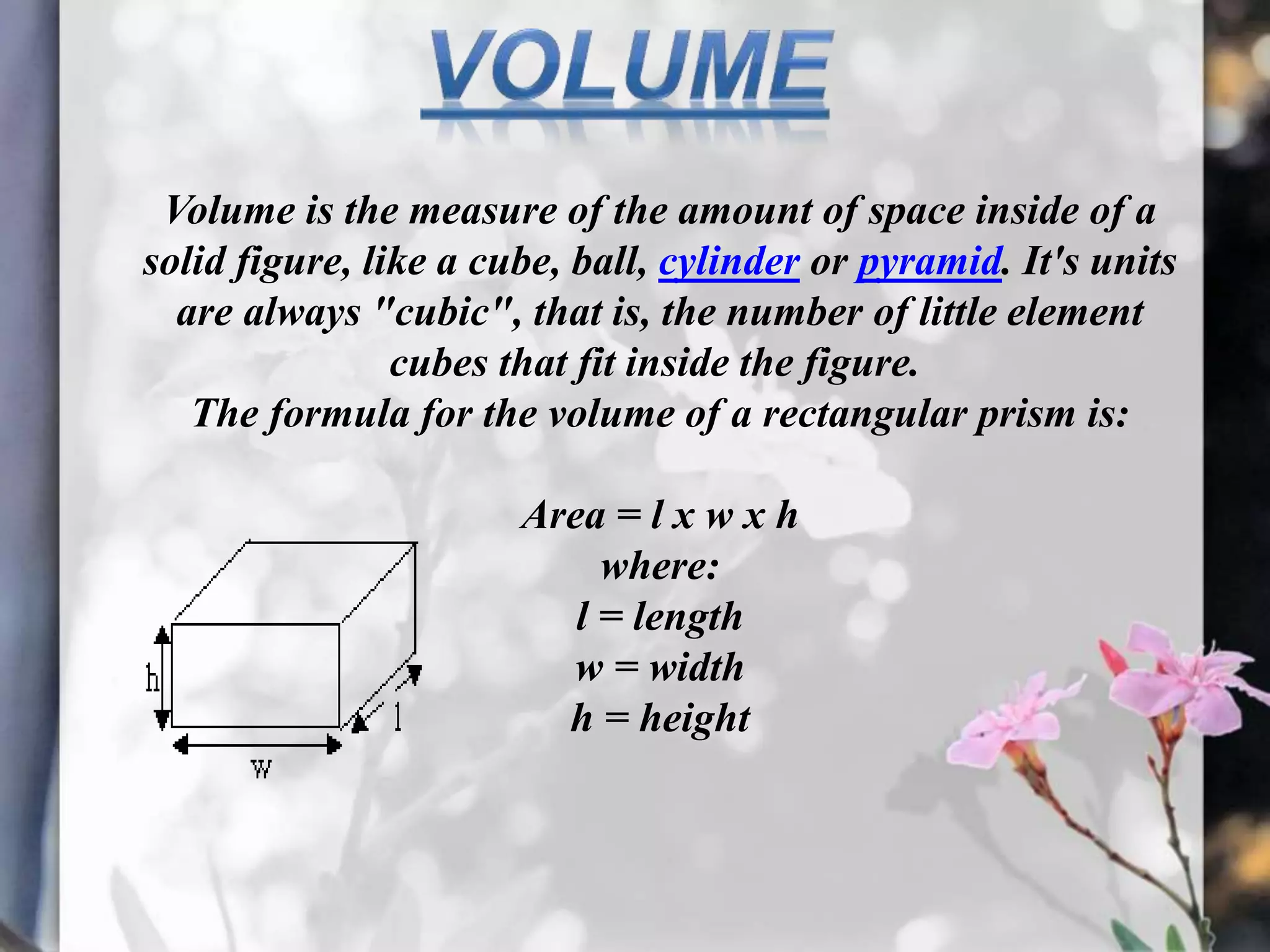
Volume is the measure of the amount of space inside of a
solid figure, like a cube, ball, cylinder or pyramid. It's units
are always "cubic", that is, the number of little element
cubes that fit inside the figure.
The formula for the volume of a rectangular prism is:
Area = l x w x h
where:
l = length
w = width
h = height
Rectangular Pyramid
• Has rectangular base & 4
slanted faces.
• If the base is a square, &
if the apex lies directly
above a point at the
center of the base, then it
is a symmetrical
square pyramid.
S.A. = t2 + 2t √(s2 – t2/4)
V = Ah/3
s = slant height
t = edge of the base
The Cube
• It is a regular
hexahedron
• Has 12 edges & 6
faces
S.A. = 6s2
V = s3
CUBOID
• A hexahedron that
has 6 rectangular
faces.
• Has 12 edges but not
necessarily of the
same length.
Surface Area = 2lb + 2bh + 2hl
Volume = lbh
l
b
h
Cones and Cylinders
• A cone has a circular or
elliptical base and an
apex point.
• A cylinder has a circular
or elliptical base, & a
circular or elliptical top
that is congruent to the
base & that lies in a
plane parallel to the
base.
Right circular cone
Frustum of Right circular
cone
Slant circular cone
Right circular cylinder
Slant circular cylinder
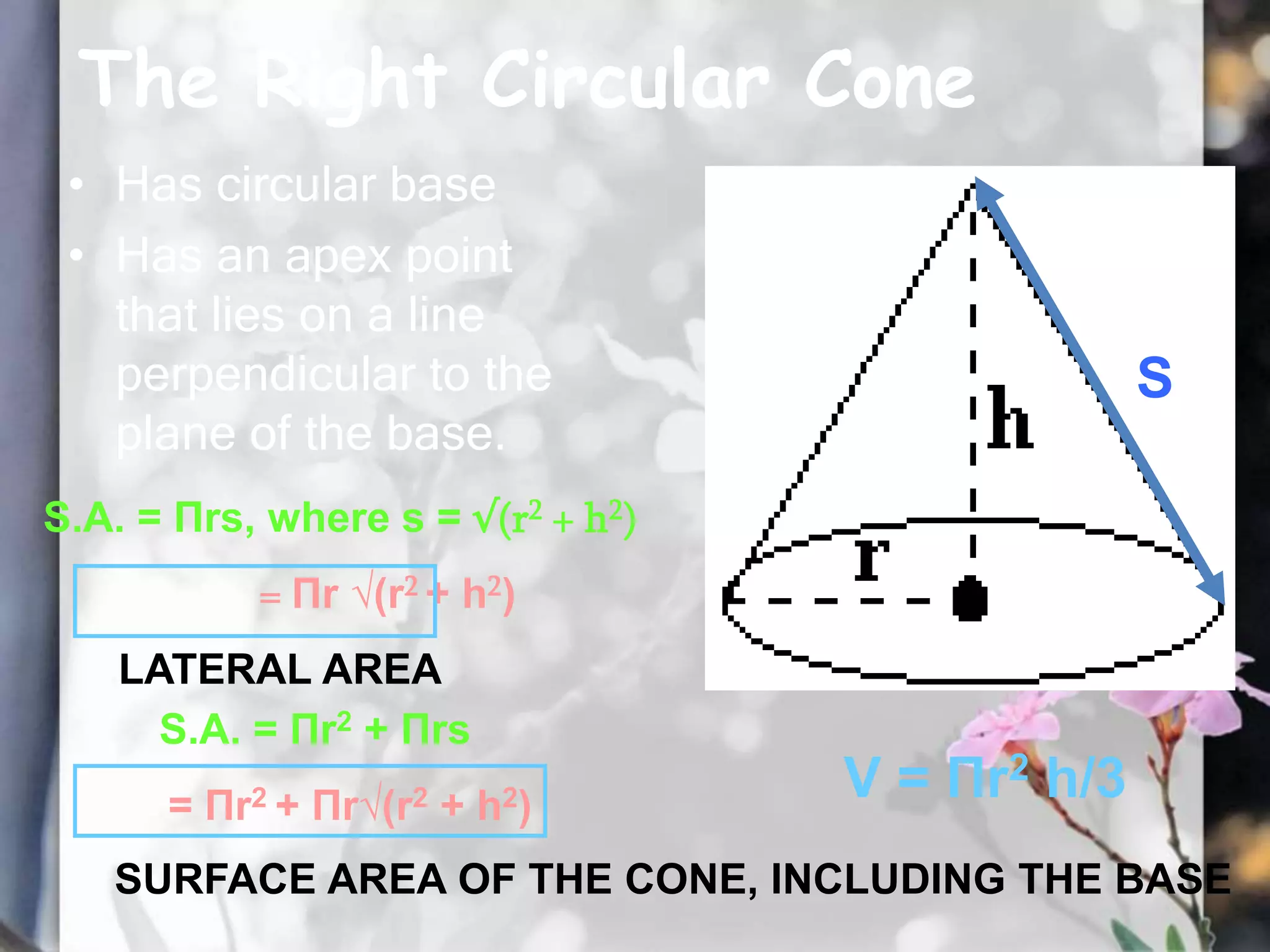
The Right Circular Cone
• Has circular base
• Has an apex point
that lies on a line
perpendicular to the
plane of the base.
S.A. = Πrs, where s = √(r2 + h2)
= Πr √(r2 + h2)
S.A. = Πr2 + Πrs
= Πr2 + Πr√(r2 + h2)
V = Πr2 h/3
S
LATERAL AREA
SURFACE AREA OF THE CONE, INCLUDING THE BASE
Frustum of Right Circular Cone
• It is when a right
circular cone was
truncated by a plane
parallel to the base.
S.A. = Π(r2 + r2) √[h2 + (r2 – r1)2] + Π(r1
2 + r2
2),
where s = √[h2 + (r2 – r1)2], then
= Πs(r2 + r2) + Π (r1
2 + r2
2)
S.A. = Π(r1 + r2) √[h2 + (r2 – r1)2]
where s = √[h2 + (r2 – r1)2], then
= Πs(r1 + r2)
V = Πh( r1
2 +r1r2 + r2
2)/3
S.A. INCLUDING THE
TOP & THE BASE
S.A. EXCLUDING THE
TOP & THE BASE
The Slant Circular Cone
• Has circular base
• Has an apex point
that does not pass
through the center of
the base
V = Πr2 h/3
r
h
The Right Circular Cylinder
• Has circular base &
circular top.
• The base & the top lie
in a parallel planes
S.A. = 2Πrh + 2Πr2 or
= 2Πr (h + r)
S.A. = 2Πrh
V = Πr2 h
S.A. INCLUDING THE BASE
S.A. EXCLUDING THE BASE
The Slant Circular Cylinder
• It has circular base
and circular top
• The base & the top lie
in parallel planes
V = Πr2 h
r
h
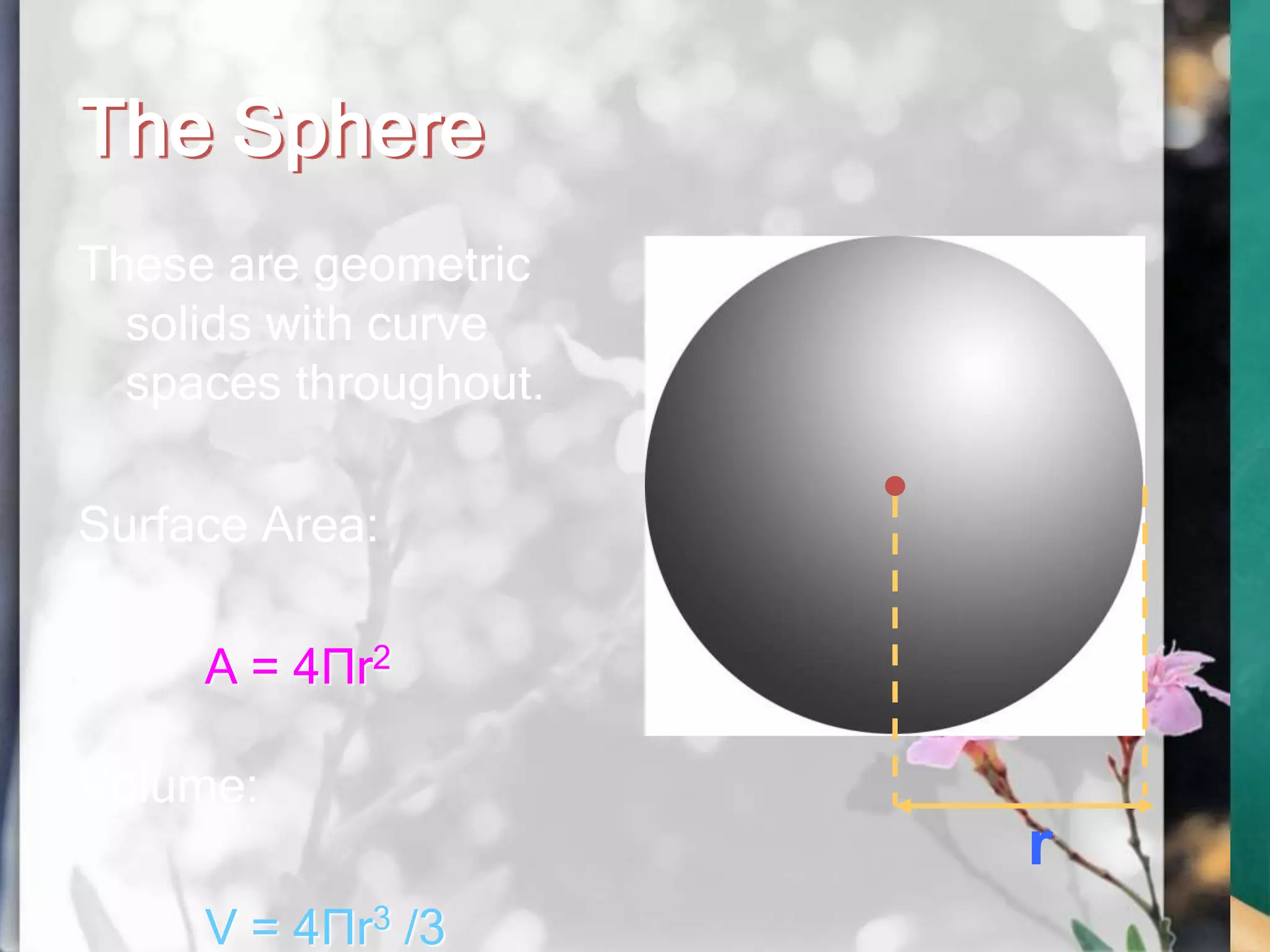
The Sphere
These are geometric
solids with curve
spaces throughout.
Surface Area:
A = 4Πr2
Volume:
V = 4Πr3 /3
r
Surface area and volumes for class 10th

Surface area and volumes for class 10th

  • 2.
  • 3.
  • 4.
    Volume is themeasure of the amount of space inside of a solid figure, like a cube, ball, cylinder or pyramid. It's units are always "cubic", that is, the number of little element cubes that fit inside the figure. The formula for the volume of a rectangular prism is: Area = l x w x h where: l = length w = width h = height
  • 5.
    Rectangular Pyramid • Hasrectangular base & 4 slanted faces. • If the base is a square, & if the apex lies directly above a point at the center of the base, then it is a symmetrical square pyramid. S.A. = t2 + 2t √(s2 – t2/4) V = Ah/3 s = slant height t = edge of the base
  • 6.
    The Cube • Itis a regular hexahedron • Has 12 edges & 6 faces S.A. = 6s2 V = s3
  • 7.
    CUBOID • A hexahedronthat has 6 rectangular faces. • Has 12 edges but not necessarily of the same length. Surface Area = 2lb + 2bh + 2hl Volume = lbh l b h
  • 8.
    Cones and Cylinders •A cone has a circular or elliptical base and an apex point. • A cylinder has a circular or elliptical base, & a circular or elliptical top that is congruent to the base & that lies in a plane parallel to the base. Right circular cone Frustum of Right circular cone Slant circular cone Right circular cylinder Slant circular cylinder
  • 9.
    The Right CircularCone • Has circular base • Has an apex point that lies on a line perpendicular to the plane of the base. S.A. = Πrs, where s = √(r2 + h2) = Πr √(r2 + h2) S.A. = Πr2 + Πrs = Πr2 + Πr√(r2 + h2) V = Πr2 h/3 S LATERAL AREA SURFACE AREA OF THE CONE, INCLUDING THE BASE
  • 10.
    Frustum of RightCircular Cone • It is when a right circular cone was truncated by a plane parallel to the base. S.A. = Π(r2 + r2) √[h2 + (r2 – r1)2] + Π(r1 2 + r2 2), where s = √[h2 + (r2 – r1)2], then = Πs(r2 + r2) + Π (r1 2 + r2 2) S.A. = Π(r1 + r2) √[h2 + (r2 – r1)2] where s = √[h2 + (r2 – r1)2], then = Πs(r1 + r2) V = Πh( r1 2 +r1r2 + r2 2)/3 S.A. INCLUDING THE TOP & THE BASE S.A. EXCLUDING THE TOP & THE BASE
  • 11.
    The Slant CircularCone • Has circular base • Has an apex point that does not pass through the center of the base V = Πr2 h/3 r h
  • 12.
    The Right CircularCylinder • Has circular base & circular top. • The base & the top lie in a parallel planes S.A. = 2Πrh + 2Πr2 or = 2Πr (h + r) S.A. = 2Πrh V = Πr2 h S.A. INCLUDING THE BASE S.A. EXCLUDING THE BASE
  • 13.
    The Slant CircularCylinder • It has circular base and circular top • The base & the top lie in parallel planes V = Πr2 h r h
  • 14.
    The Sphere These aregeometric solids with curve spaces throughout. Surface Area: A = 4Πr2 Volume: V = 4Πr3 /3 r