(VOIP)
ANAND NADAR
ROLL NO:26
 •Voice Over Internet Protocol is the assembling of
voice into IP data. This data can then be
transmitted over an IP network to an addressable (
IP address) destination
 •Voice calls look like data calls
 •Packet switched is data that is can be routed
through different routes on a network to reach a
destination
 •Circuit switched is a connection where a physical
path is dedicated between two end points
 •Analog voice is received by a CODEC (coder /
de-coder)
 •Once sampled and matched with the codebook
the voice is now presented as data
 •Some codebooks are of different sizes and have a
different fidelity
 •These codebooks are “recommended standards”
that copies voice samples into different sizes
 •Once voice is sampled and replaced by code the voice
can then be formed into data and transported.
 •The usual transport method uses the IP (Internet
Protocol) standard.
 •IP uses many layers associated with the OSI model to
form, control, administer, and transport data.
 •Most VoIP calls use a recommended standard that
covers voice, video and data over IP networks. This
standard is called H.323
 •H.323 encompasses many sub-standards that control
setup, signaling, transport and terminations

 Voice
CODEC
Compress
Create Packet
Add Headers
Network
ANALOG
DIGITAL
Digital
Analog Voice
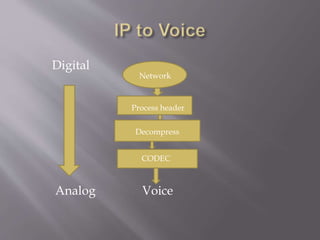
Network
Process header
Decompress
CODEC
 Is there a difference between making a local
call and a long distance call?
 Some VOIP providers offer their services for
free, normally only calls to other subscribers to
the service. Your VOIP provider may permit
you to select an area code different from the
area which you live. It also means that people
who call you may incur long distance charges
depending on their area code and service.
 Depending upon your service, you might be
limited only to other subscribers to the service,
or you may be able to call anyone who has a
telephone number-including local, long
distance, mobile , and international numbers. If
you are calling someone who has a regular
analog phone, that person does not need any
special equipment to talk to you.
 Some VOIP services may allow you to speak
with more than one person at a time.
 Cost savings- The most attractive feature of
VOIP is its cost-saving potential.
 When we move away from pubic switched
telephone networks, long distance phone calls
become inexpensive.
 Instead of being processed across conventional
commercial telecommunication line
configurations, voice traffic travels on the
Internet or over private data network lines.
 The legacy phone system mainly provides
voice and fax service even though limited
video service is possible. However, the demand
of users is much higher than that, as shown in
today’s rich media communications through
the Internet.
 People check out friend’s presence, send
instant messages, make voice or video calls,
transfer images, and so on.
 Most VOIP service providers provide a user
control interface, typically a web GUI, to their
customers so that they can change features,
options, and services dynamically.
 The users log in to the web GUI and change
call forwarding number, speed dial, presence
information, black/white list, music-on-hold
option, anonymous call block, and so on.
 The legacy phone system assigns a phone
number with a dedicated line, so you generally
cannot move your home phone to another
place if you want to use the same number.
 It is a common hassle to call the phone
company and ask for a phone number update
when moving to a new house.
 Many businesspeople today bring their IP
phones or soft phones when travelling, and use
the same numbers everywhere.
 The context of mobility here includes service
mobility as well.
 Whenever we change the phone, the same
services could be available, such as call
features, voicemail access, call logs, security
features, service features, service policy and so
on.
 Complicated service and network architecture-
 Integrated rich media services(such as voice,
video, and fax)make it difficult to design the
service and network architecture because many
different types of devices for each service are
involved, as well as different protocols and
characteristics of each media.
 It also causes various errors and makes it
harder to troubleshoot and isolate them.
 Voice and video streams flow over an IP
network as real-time packets, passing through
multiple networks and devices(such as
switches, routers, firewalls, and media
gateways).
 Therefore, ensuring QoS is very difficult and
costs lots of time and resources to meet the
users expectations.
 Legacy home phones continue to work even
during a power outage because the phone line
supplies 48 volts constantly.
 However, VOIP phones use regular data
network lines that do not provide power in
most cases, which means you cannot use VOIP
phones during power outages.
Voip

Voip

  • 1.
  • 2.
     •Voice OverInternet Protocol is the assembling of voice into IP data. This data can then be transmitted over an IP network to an addressable ( IP address) destination  •Voice calls look like data calls  •Packet switched is data that is can be routed through different routes on a network to reach a destination  •Circuit switched is a connection where a physical path is dedicated between two end points
  • 3.
     •Analog voiceis received by a CODEC (coder / de-coder)  •Once sampled and matched with the codebook the voice is now presented as data  •Some codebooks are of different sizes and have a different fidelity  •These codebooks are “recommended standards” that copies voice samples into different sizes
  • 4.
     •Once voiceis sampled and replaced by code the voice can then be formed into data and transported.  •The usual transport method uses the IP (Internet Protocol) standard.  •IP uses many layers associated with the OSI model to form, control, administer, and transport data.  •Most VoIP calls use a recommended standard that covers voice, video and data over IP networks. This standard is called H.323  •H.323 encompasses many sub-standards that control setup, signaling, transport and terminations
  • 5.
      Voice CODEC Compress Create Packet AddHeaders Network ANALOG DIGITAL
  • 6.
  • 7.
     Is therea difference between making a local call and a long distance call?  Some VOIP providers offer their services for free, normally only calls to other subscribers to the service. Your VOIP provider may permit you to select an area code different from the area which you live. It also means that people who call you may incur long distance charges depending on their area code and service.
  • 8.
     Depending uponyour service, you might be limited only to other subscribers to the service, or you may be able to call anyone who has a telephone number-including local, long distance, mobile , and international numbers. If you are calling someone who has a regular analog phone, that person does not need any special equipment to talk to you.  Some VOIP services may allow you to speak with more than one person at a time.
  • 9.
     Cost savings-The most attractive feature of VOIP is its cost-saving potential.  When we move away from pubic switched telephone networks, long distance phone calls become inexpensive.  Instead of being processed across conventional commercial telecommunication line configurations, voice traffic travels on the Internet or over private data network lines.
  • 10.
     The legacyphone system mainly provides voice and fax service even though limited video service is possible. However, the demand of users is much higher than that, as shown in today’s rich media communications through the Internet.  People check out friend’s presence, send instant messages, make voice or video calls, transfer images, and so on.
  • 11.
     Most VOIPservice providers provide a user control interface, typically a web GUI, to their customers so that they can change features, options, and services dynamically.  The users log in to the web GUI and change call forwarding number, speed dial, presence information, black/white list, music-on-hold option, anonymous call block, and so on.
  • 12.
     The legacyphone system assigns a phone number with a dedicated line, so you generally cannot move your home phone to another place if you want to use the same number.  It is a common hassle to call the phone company and ask for a phone number update when moving to a new house.  Many businesspeople today bring their IP phones or soft phones when travelling, and use the same numbers everywhere.
  • 13.
     The contextof mobility here includes service mobility as well.  Whenever we change the phone, the same services could be available, such as call features, voicemail access, call logs, security features, service features, service policy and so on.
  • 14.
     Complicated serviceand network architecture-  Integrated rich media services(such as voice, video, and fax)make it difficult to design the service and network architecture because many different types of devices for each service are involved, as well as different protocols and characteristics of each media.  It also causes various errors and makes it harder to troubleshoot and isolate them.
  • 15.
     Voice andvideo streams flow over an IP network as real-time packets, passing through multiple networks and devices(such as switches, routers, firewalls, and media gateways).  Therefore, ensuring QoS is very difficult and costs lots of time and resources to meet the users expectations.
  • 16.
     Legacy homephones continue to work even during a power outage because the phone line supplies 48 volts constantly.  However, VOIP phones use regular data network lines that do not provide power in most cases, which means you cannot use VOIP phones during power outages.