VoIP
Mostafa Hussien
W will talk about:
 e
• Telephone.
• Internet Protocol.
• Voice over Internet Protocol.
 1. Its uses.
 2. Its benefits.
 3. Challenges.
Agenda
Telephone
• Telephone is a telecommunications device
  that transmits and receives sound.

• It converts the sound waves to electrical signals, which
  are sent through the transferring medium to the other
  phone, where they are converted back to sound waves.

• Telephones are a duplex communications medium,
  meaning they allow the people on both ends to talk
  simultaneously.
Internet Protocol
• Protocol is how some thing is done in given steps.
• Internet Protocol is how data is transmitted through the
  internet.
• Each computer has it’s own IP address so data is sent
  directly to it’s address.
• Packets is how data is transferred through the internet.
• Each part is sent through the internet as one packet.
• Packet is a data with some other headers like source IP
  address , destination IP address & packet size.
VoIP
• Is one of a family of internet technologies and
  transmission technologies for delivery of voice
  communications and multimedia sessions over Internet
  Protocol (IP) networks.

• Is a technology that allows you to make voice calls
  using an Internet connection instead of a regular
  phone line.

• VoIP is the technology in which the analogue voice
  signal is digitized and becomes binary numbers in order
  to be transferred by the IP protocol.
VoIP can be
implemented in several
       ways:
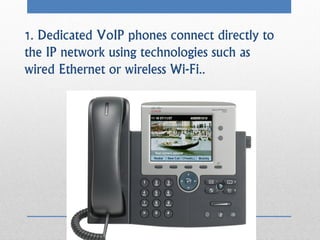
1. Dedicated VoIP phones connect directly to
the IP network using technologies such as
wired Ethernet or wireless Wi-Fi..
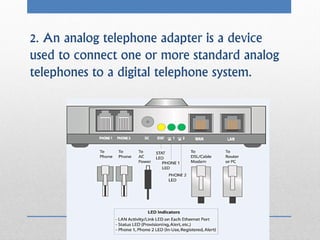
2. An analog telephone adapter is a device
used to connect one or more standard analog
telephones to a digital telephone system.
• A softphone (Skype) is application software
  installed on a networked computer that is
  equipped with a microphone and speaker.
Why we use
  VoIP?!
• Because of the bandwidth efficiency and low costs
  that VoIP technology can provide.

• VoIP allows both voice and data communications to
  be run over a single network, which can significantly
  reduce infrastructure costs.

• VoIP devices have simple user interfaces, so users
  can often make simple system configuration changes.
Benefits of VoIP
1. Operational Cost
• VoIP can be a benefit for reducing
  communication and infrastructure costs.
  Examples include:
• Routing phone calls over existing data networks to avoid the
  need for separate voice and data networks.

• Conference calling, IVR, call forwarding, automatic redial,
  and caller ID features that traditional telecommunication
  companies normally charge extra for, are available free of
  charge in VoIP.
2. Flexibility
• The ability to transmit more than one telephone call over
  a single broadband connection.

• Location independence. Only a sufficiently fast and stable
  Internet connection is needed to get a connection from
  anywhere to a VoIP provider.

• Integration with other services available over the Internet,
  including video conversation, message or data file
  exchange during the conversation.
Challenges of
   V  oIP
1.Quality of service
• It does not provide a network-based
  mechanism to ensure that data packets are not
  lost, or delivered in sequential order.

• A VoIP packet usually has to wait for the
  current packet to finish transmission, although
  it is possible to abort a less important packet in
  mid-transmission.
2. Power Failure
• Telephones for traditional analog service are usually
  connected directly to telephone company which
  provide direct current to power independently of
  locally available power.

• IP Phones and VoIP telephone adapters connect
  to routers or cable modems which typically depend
  on the availability of mains electricity or locally
  generated power.
3. Emergency calls
• The nature of IP makes it difficult to locate network
  users geographically.

• Emergency calls, therefore, cannot easily be routed to
  a nearby call center.

• Sometimes, VoIP systems may route emergency calls
  to a non-emergency phone line at the intended
  department.
4. Security
• VoIP telephone systems are susceptible to attacks as are any
  internet-connected devices. This means that hackers who
  know about these vulnerabilities can institute attacks, harvest
  customer data, record conversations.

• To prevent the above security concerns government and
  military organizations are using Voice over Secure IP
  (VoSIP), Secure Voice over IP (SVoIP), and Secure Voice
  over Secure IP (SVoSIP) to protect confidential and
  classified VoIP communications.
Voice over Internet Protocol

Voice over Internet Protocol

  • 1.
  • 2.
    W will talkabout: e • Telephone. • Internet Protocol. • Voice over Internet Protocol. 1. Its uses. 2. Its benefits. 3. Challenges.
  • 3.
  • 4.
  • 5.
    • Telephone isa telecommunications device that transmits and receives sound. • It converts the sound waves to electrical signals, which are sent through the transferring medium to the other phone, where they are converted back to sound waves. • Telephones are a duplex communications medium, meaning they allow the people on both ends to talk simultaneously.
  • 6.
  • 7.
    • Protocol ishow some thing is done in given steps. • Internet Protocol is how data is transmitted through the internet. • Each computer has it’s own IP address so data is sent directly to it’s address. • Packets is how data is transferred through the internet. • Each part is sent through the internet as one packet. • Packet is a data with some other headers like source IP address , destination IP address & packet size.
  • 8.
  • 9.
    • Is oneof a family of internet technologies and transmission technologies for delivery of voice communications and multimedia sessions over Internet Protocol (IP) networks. • Is a technology that allows you to make voice calls using an Internet connection instead of a regular phone line. • VoIP is the technology in which the analogue voice signal is digitized and becomes binary numbers in order to be transferred by the IP protocol.
  • 10.
    VoIP can be implementedin several ways:
  • 11.
    1. Dedicated VoIPphones connect directly to the IP network using technologies such as wired Ethernet or wireless Wi-Fi..
  • 12.
    2. An analogtelephone adapter is a device used to connect one or more standard analog telephones to a digital telephone system.
  • 13.
    • A softphone(Skype) is application software installed on a networked computer that is equipped with a microphone and speaker.
  • 14.
  • 15.
    • Because ofthe bandwidth efficiency and low costs that VoIP technology can provide. • VoIP allows both voice and data communications to be run over a single network, which can significantly reduce infrastructure costs. • VoIP devices have simple user interfaces, so users can often make simple system configuration changes.
  • 16.
  • 17.
    1. Operational Cost •VoIP can be a benefit for reducing communication and infrastructure costs. Examples include: • Routing phone calls over existing data networks to avoid the need for separate voice and data networks. • Conference calling, IVR, call forwarding, automatic redial, and caller ID features that traditional telecommunication companies normally charge extra for, are available free of charge in VoIP.
  • 18.
    2. Flexibility • Theability to transmit more than one telephone call over a single broadband connection. • Location independence. Only a sufficiently fast and stable Internet connection is needed to get a connection from anywhere to a VoIP provider. • Integration with other services available over the Internet, including video conversation, message or data file exchange during the conversation.
  • 19.
  • 20.
    1.Quality of service •It does not provide a network-based mechanism to ensure that data packets are not lost, or delivered in sequential order. • A VoIP packet usually has to wait for the current packet to finish transmission, although it is possible to abort a less important packet in mid-transmission.
  • 21.
    2. Power Failure •Telephones for traditional analog service are usually connected directly to telephone company which provide direct current to power independently of locally available power. • IP Phones and VoIP telephone adapters connect to routers or cable modems which typically depend on the availability of mains electricity or locally generated power.
  • 22.
    3. Emergency calls •The nature of IP makes it difficult to locate network users geographically. • Emergency calls, therefore, cannot easily be routed to a nearby call center. • Sometimes, VoIP systems may route emergency calls to a non-emergency phone line at the intended department.
  • 23.
    4. Security • VoIPtelephone systems are susceptible to attacks as are any internet-connected devices. This means that hackers who know about these vulnerabilities can institute attacks, harvest customer data, record conversations. • To prevent the above security concerns government and military organizations are using Voice over Secure IP (VoSIP), Secure Voice over IP (SVoIP), and Secure Voice over Secure IP (SVoSIP) to protect confidential and classified VoIP communications.