Voice Over IP (VoIP): Internet 
Telephony 
PPT BY AADARSH 
SRIVASTAVA
VoIP Definition 
The use of IP networks, namely the LAN and WAN, 
to carry voice
Internet Telephony 
The use of the Internet that was originally designed 
to carry computer data to carry voice 
 A packet switched network 
Voice was originally carried over circuit switched 
networks 
 PSTN
Related Issues 
Voice over Frame Relay 
Voice over ATM
Further Evolution 
Media transmission over IP 
 Audio 
 Image 
 Video
VoIP Basic Functions 
Signaling 
Database services 
 Mapping addresses (IP to Phone numbers) etc. 
Call connect and disconnect (bearer control) 
CODEC operations 
 For encapsulating voice into data packets
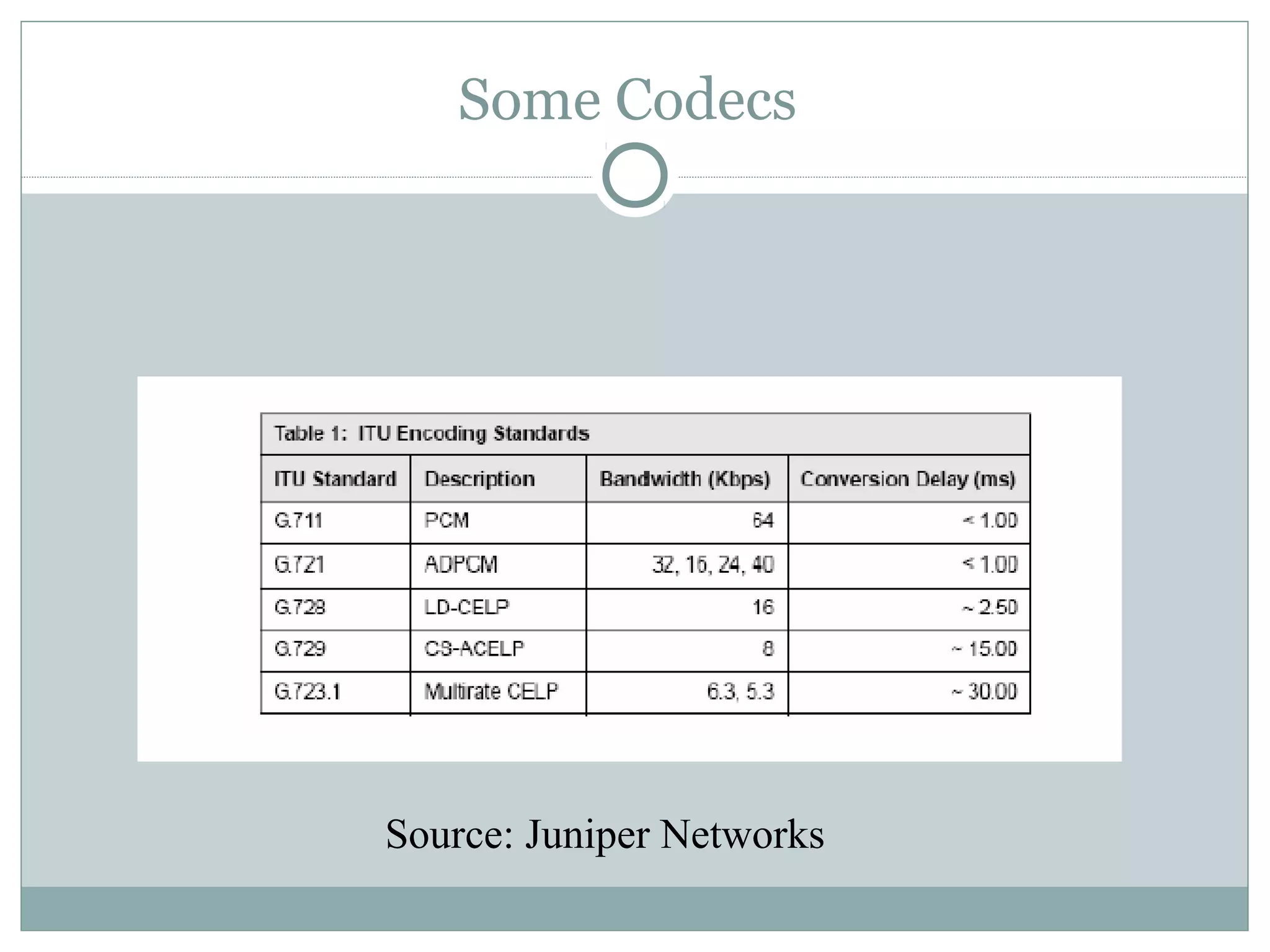
Some Codecs 
Source: Juniper Networks
VoIP Components 
Servers 
 For processing IP calls and manage interaction with PBX etc. 
End-point devices such as phones 
Media and VoIP gateways 
IP network 
Source: Juniper Networks
Overcoming the Challenges 
Latency 
Jitter 
Bandwidth 
Packet loss 
Reliability 
Scalability 
Security 
Features 
Interoperability 
Switch over cost
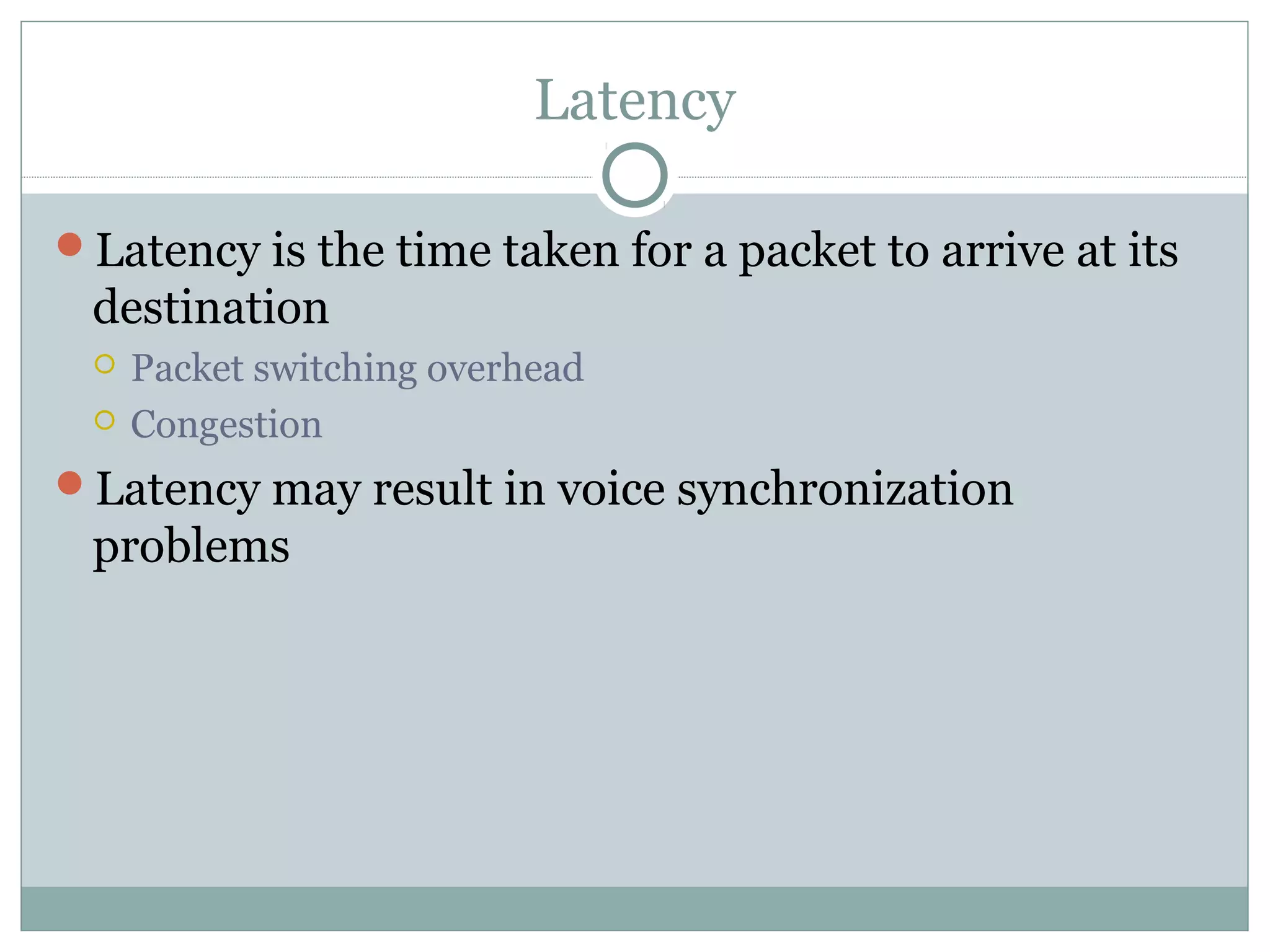
Latency 
Latency is the time taken for a packet to arrive at its 
destination 
 Packet switching overhead 
 Congestion 
Latency may result in voice synchronization 
problems
Jitter 
Jitter is the delay experienced in receiving a packet 
when a packet is expected to arrive at the end point 
at a certain time
Bandwidth 
When bandwidth is shared between voice and 
computer data, certain bandwidth may have to be 
allocated for voice communication on a network
Packet Loss 
Packet loss in unavoidable 
It can be minimally tolerated in voice transmission 
 It should not, in the first place, distort the audio
Reliability 
Because the computer network is used, the reliability 
of the network will have an impact on the telephony 
service 
 In the analog telephone industry, reliability of 99.999 percent 
uptime is required 
 The above is known as five nines 
VoIP networks can achieve over 98 percent 
reliability ?
Scalability 
Ability to add more telephony equipment as the 
company grows 
 Network bandwidth and other issues may have an effect on 
scalability
Security 
As VoIP uses the Internet, for example, it is 
vulnerable to the same type as security risks 
 Hacking 
 Denial of service 
 Eavesdropping
Features 
IP telephony need to match and, in the long run, 
exceed the features provided by the PSTN 
 Call waiting 
 Three way calling etc.
Interoperability 
IP telephony equipment manufactured by different 
vendors must be able to talk to each other 
 Standardized protocols are needed
Migration Cost 
The cost of migrating from legacy PBX to IP PBX
Facing the Challenges 
Many of the challenges listed have now been 
addressed by effective network performance 
management and standardized protocols
Network Performance Management 
Addresses the following issues: 
 Latency 
 Reliability 
 Security
Standardized Protocols 
Interoperability
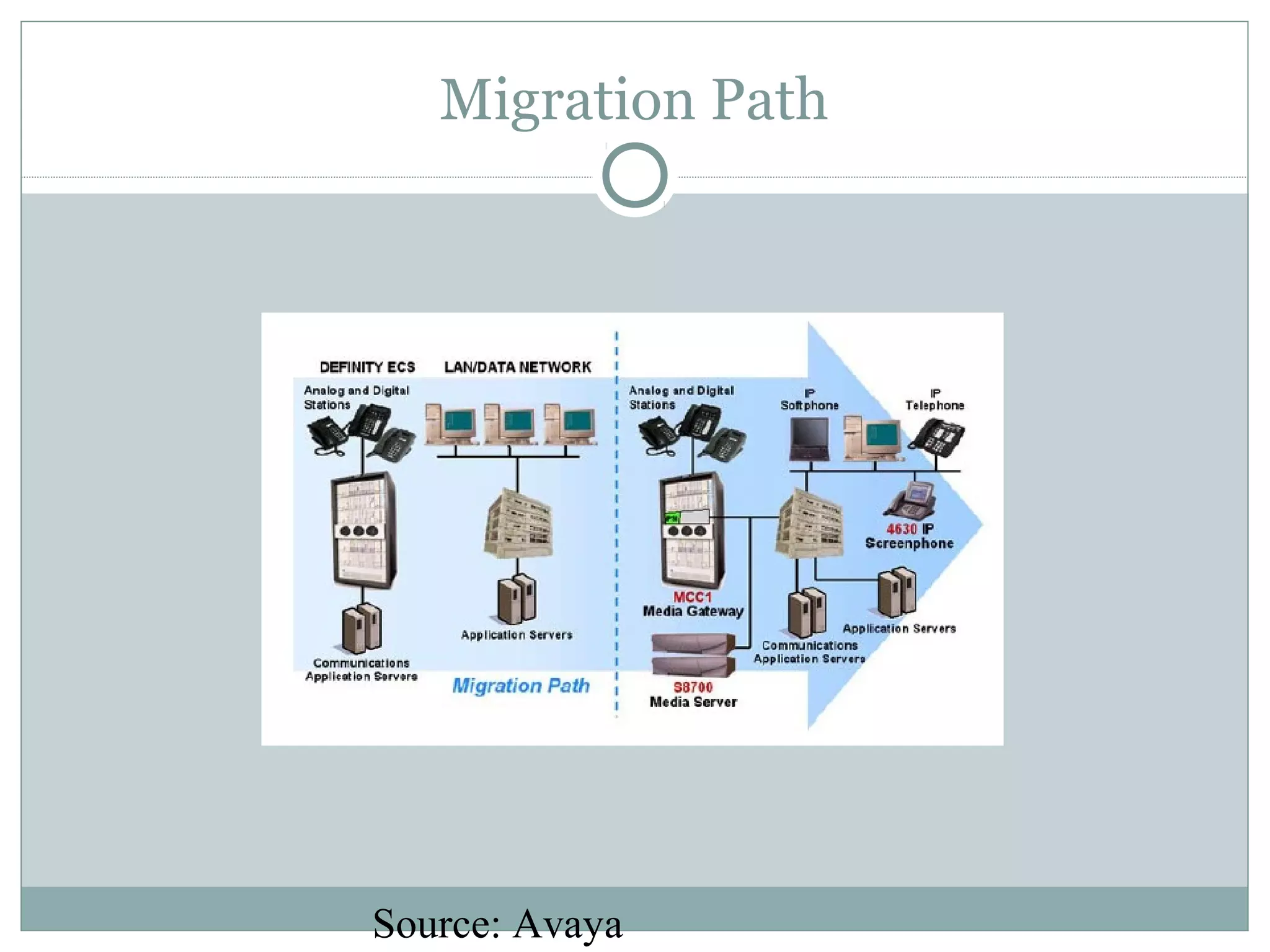
Migration Path 
Source: Avaya
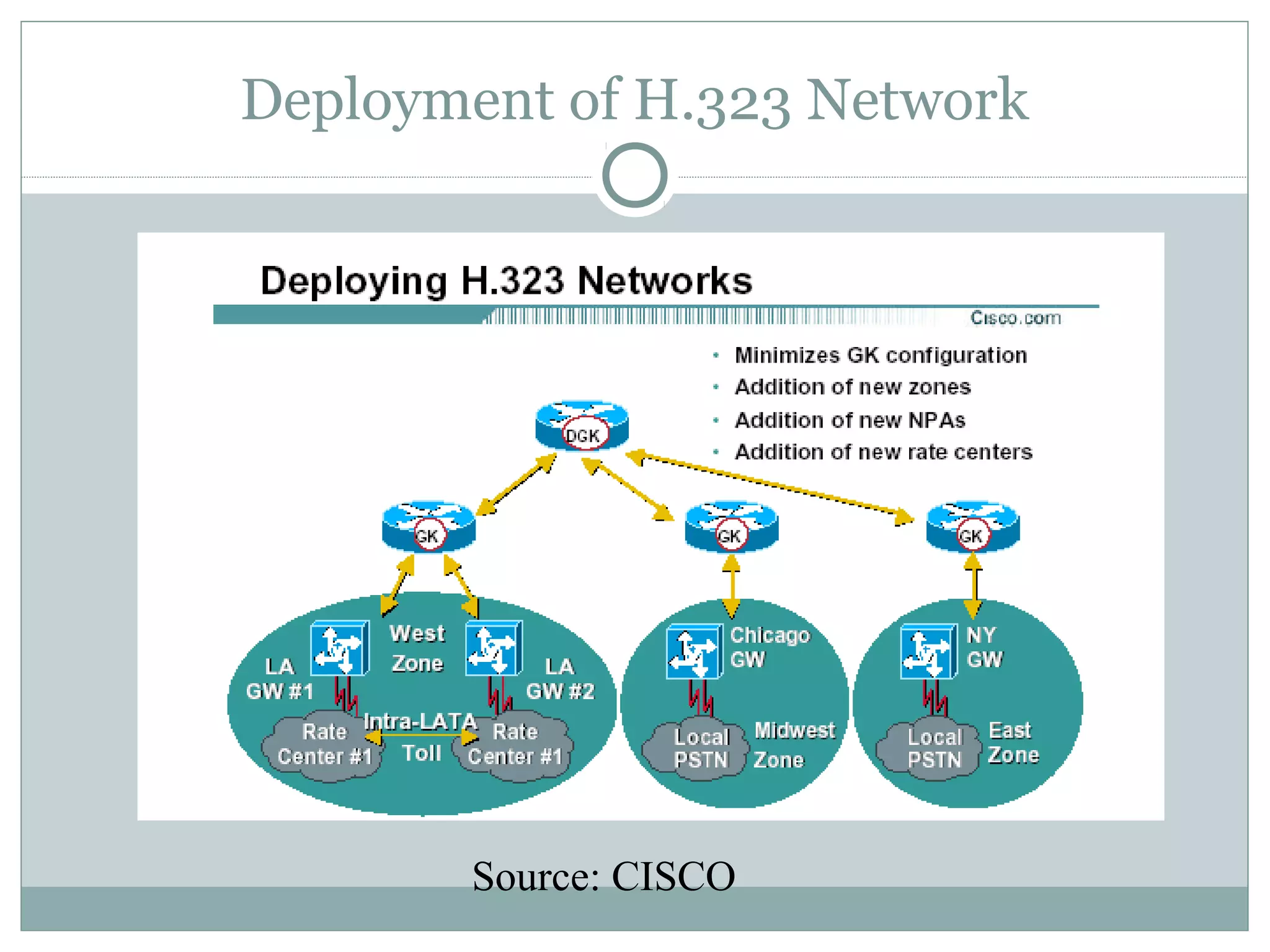
Gateways and Gatekeepers 
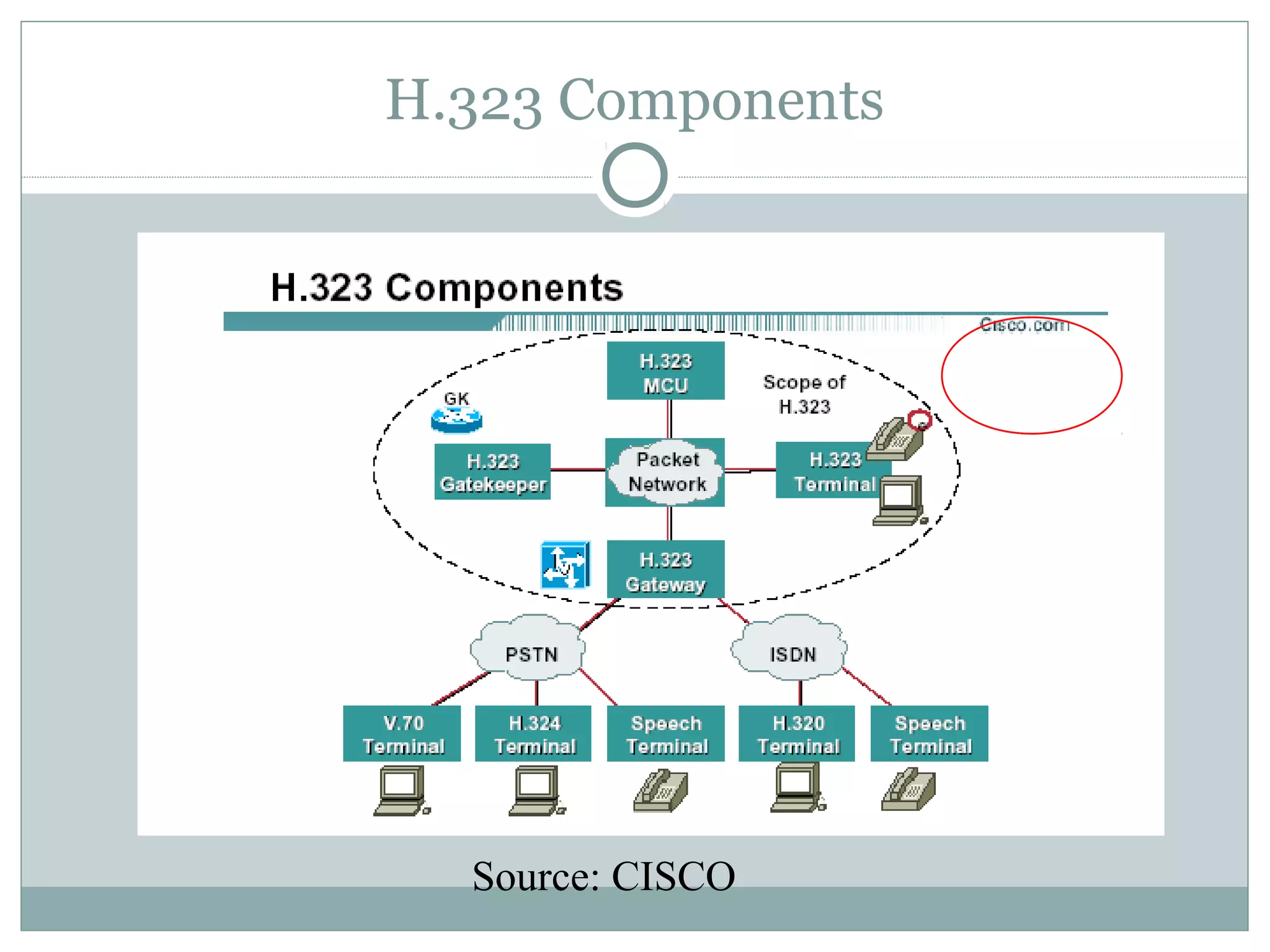
Gateway equipment performs the task of allowing 
non-IP equipment to talk to IP equipment 
Gatekeepers manage the calls within a particular 
zone 
Both items will be present in a H.323 network
Other Terminology 
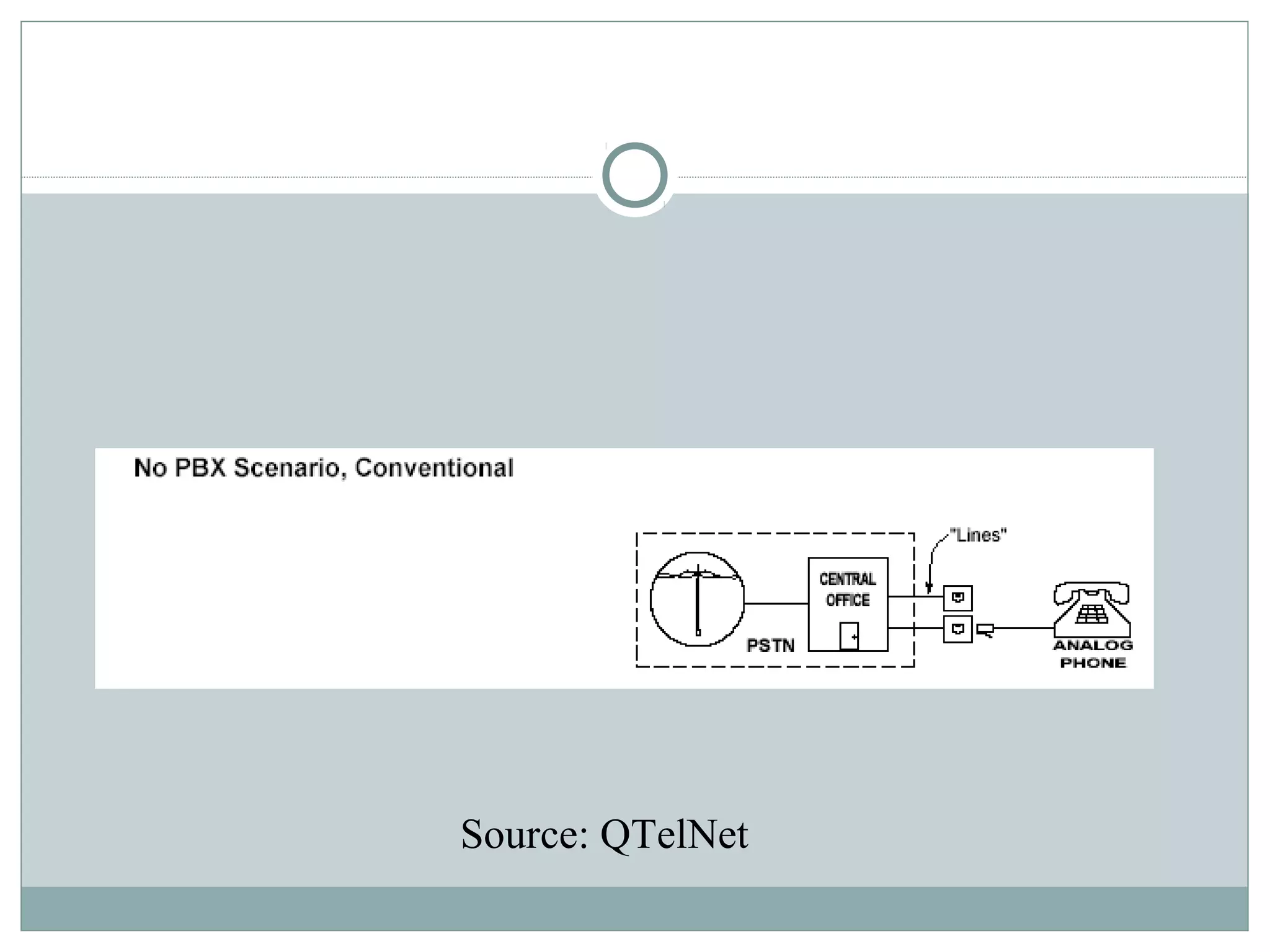
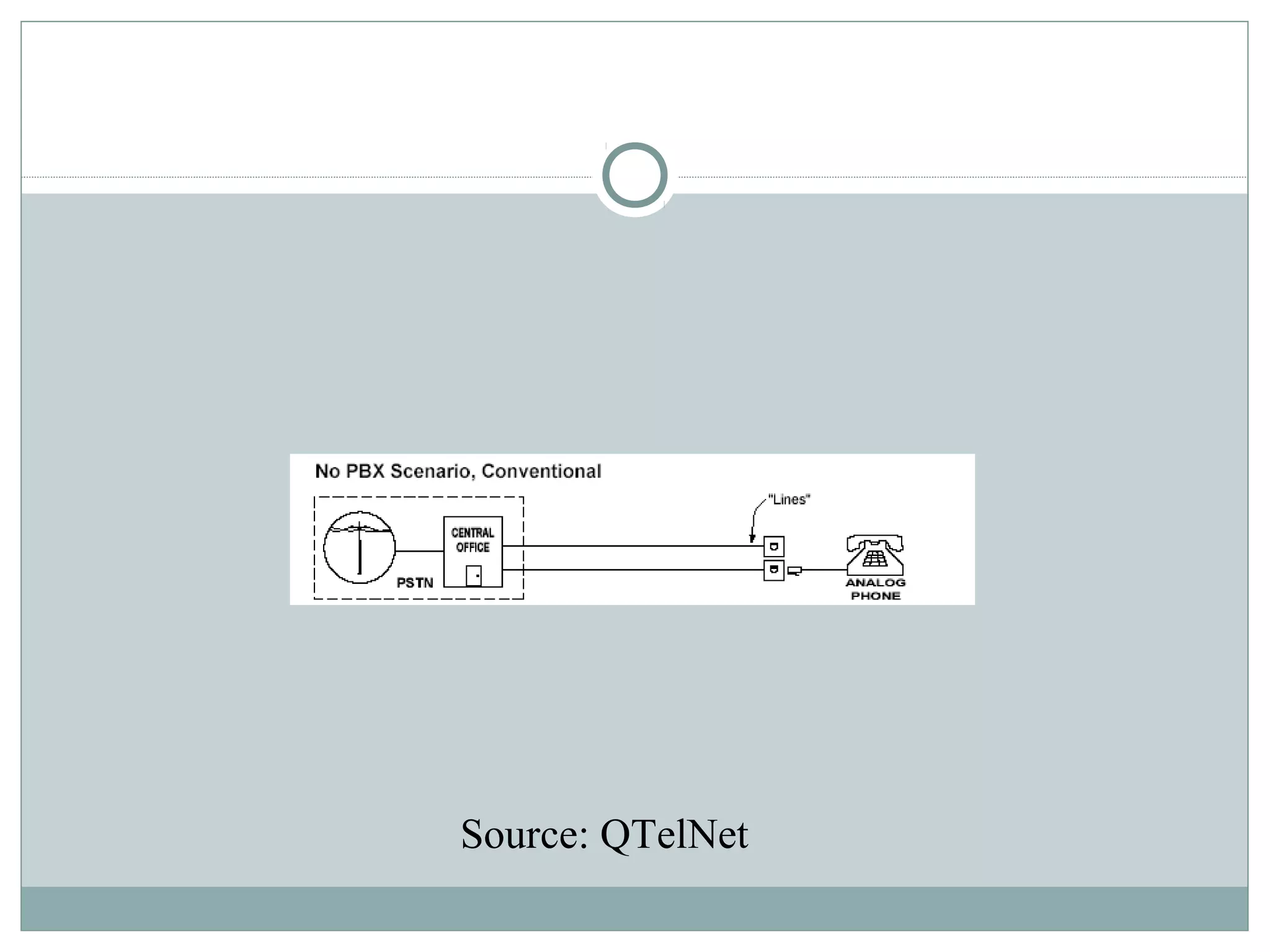
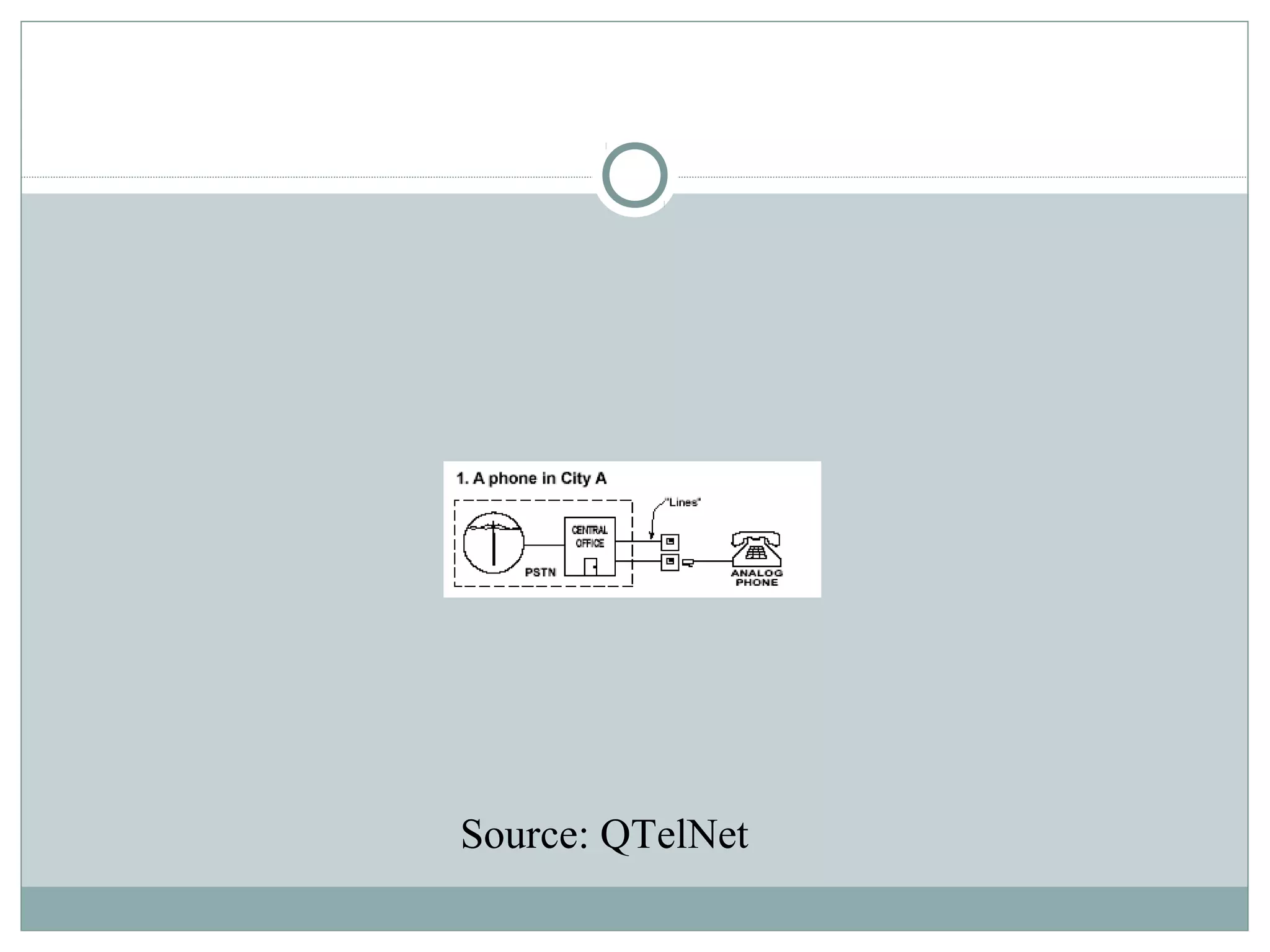
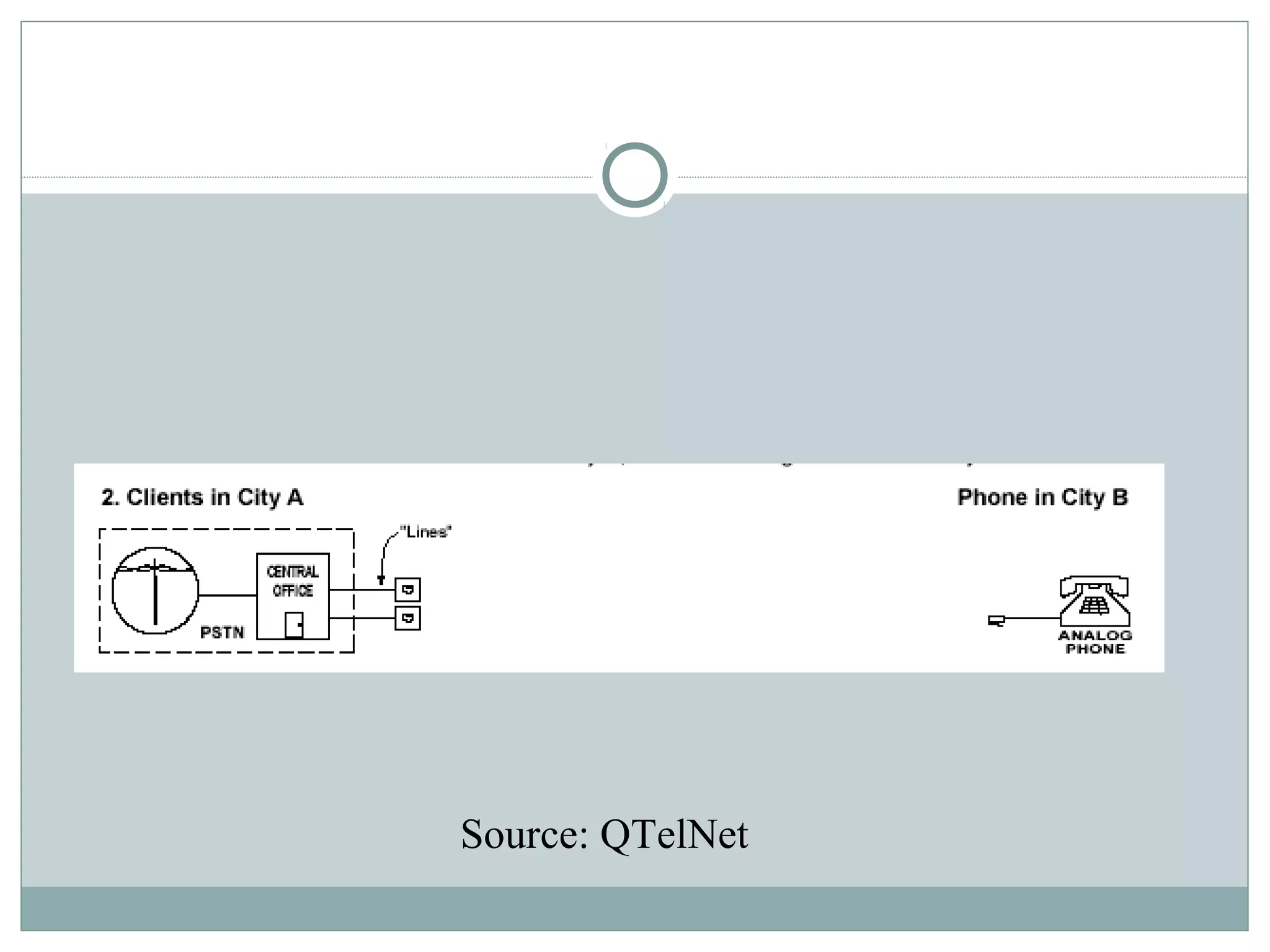
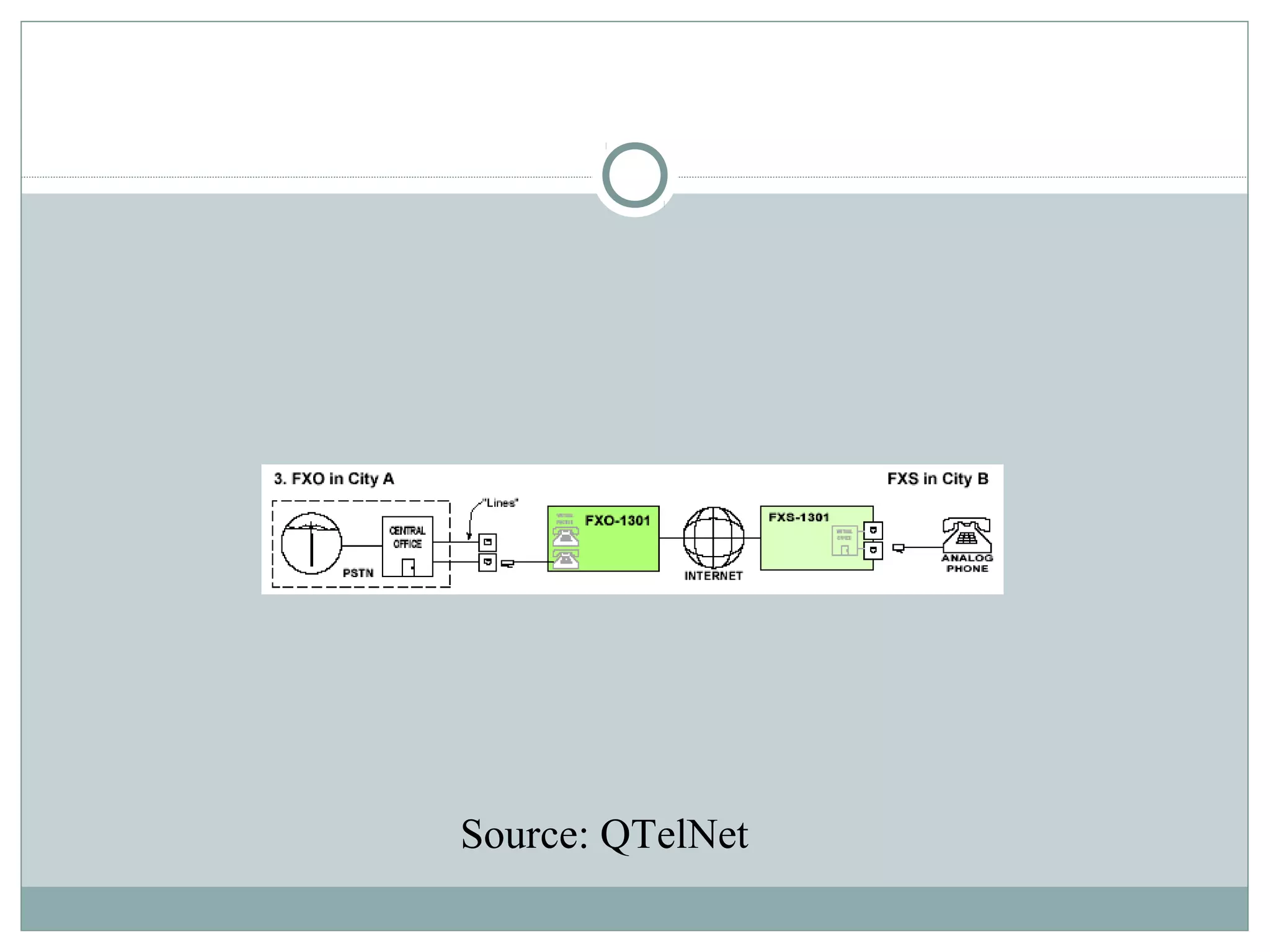
FXS 
 Foreign Exchange Station) 
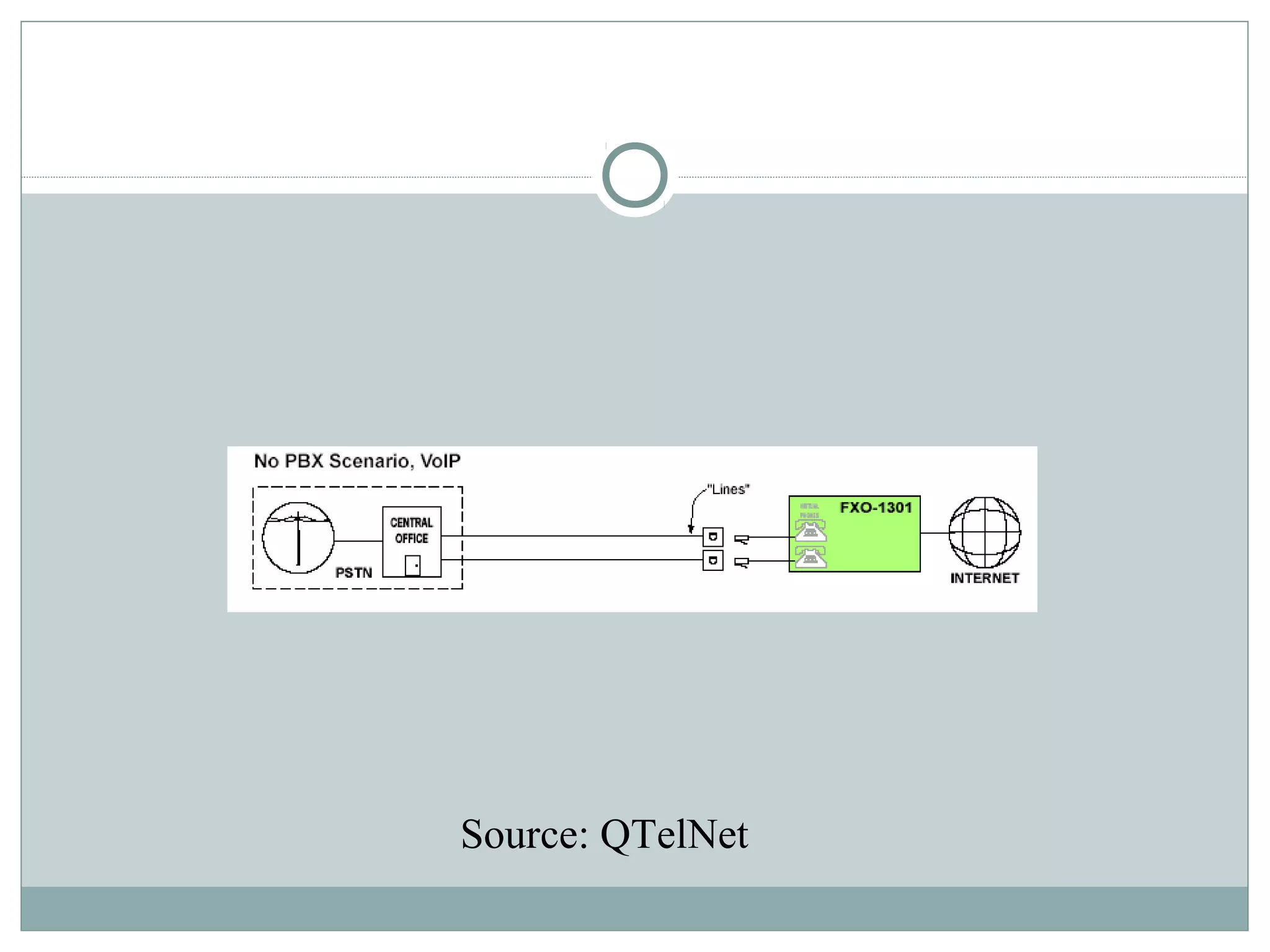
FXO 
 Foreign Exchange Office
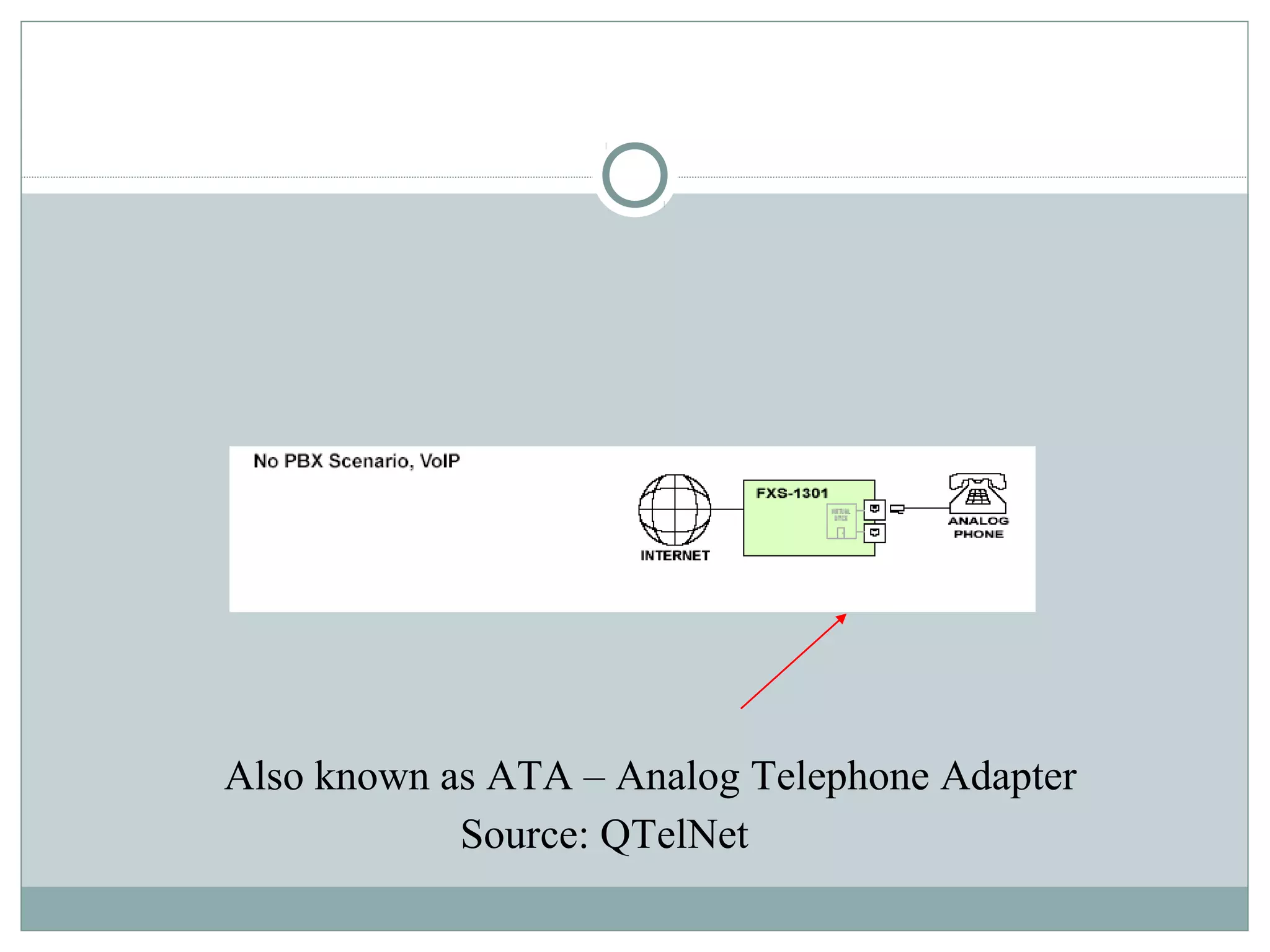
FXS 
A device that connects on one side to an analog 
equipment and other side to the Internet 
A simple example is the ATA (Analog Telephone 
Adapter) that connects an analog phone to the 
Interent
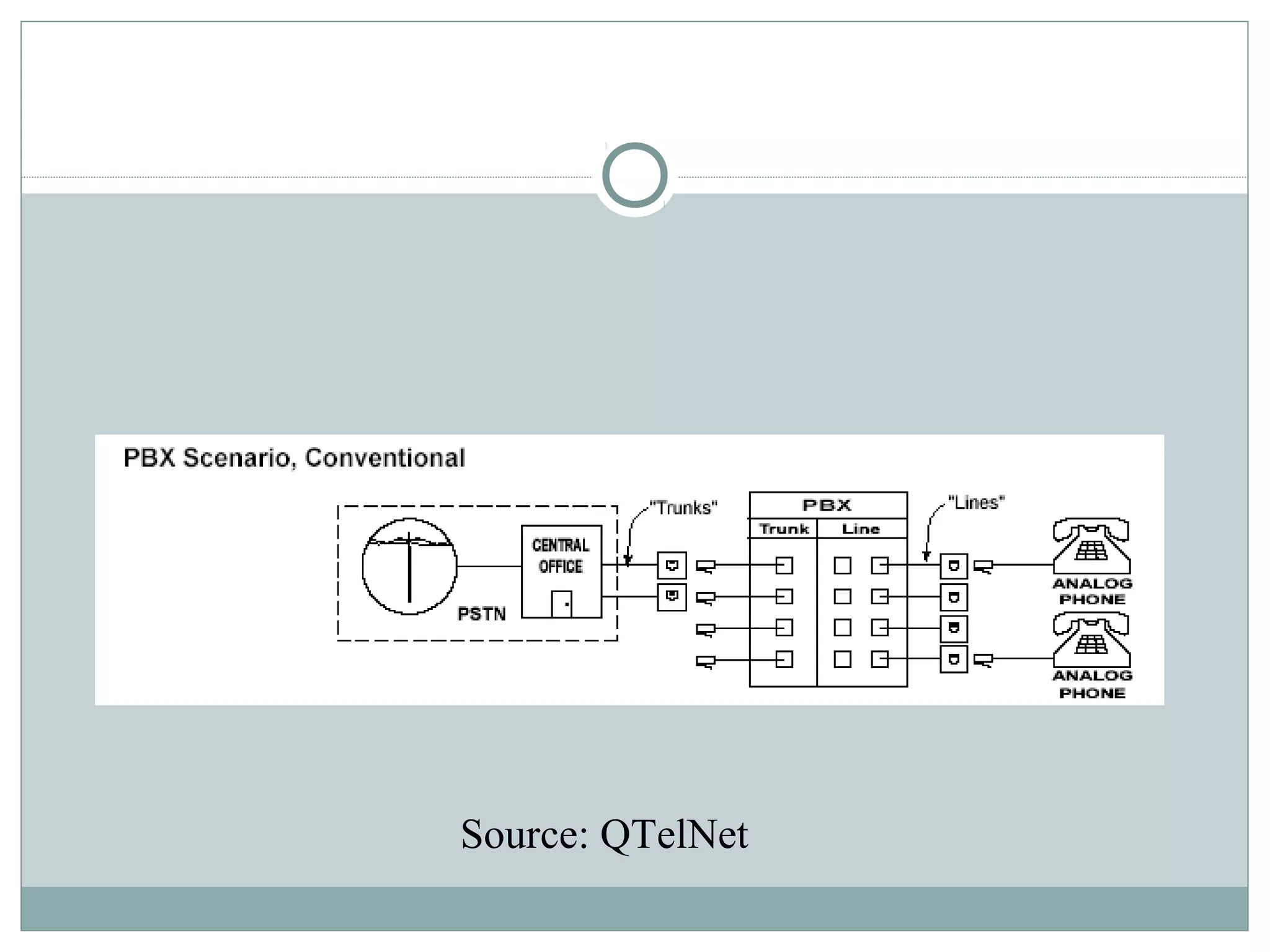
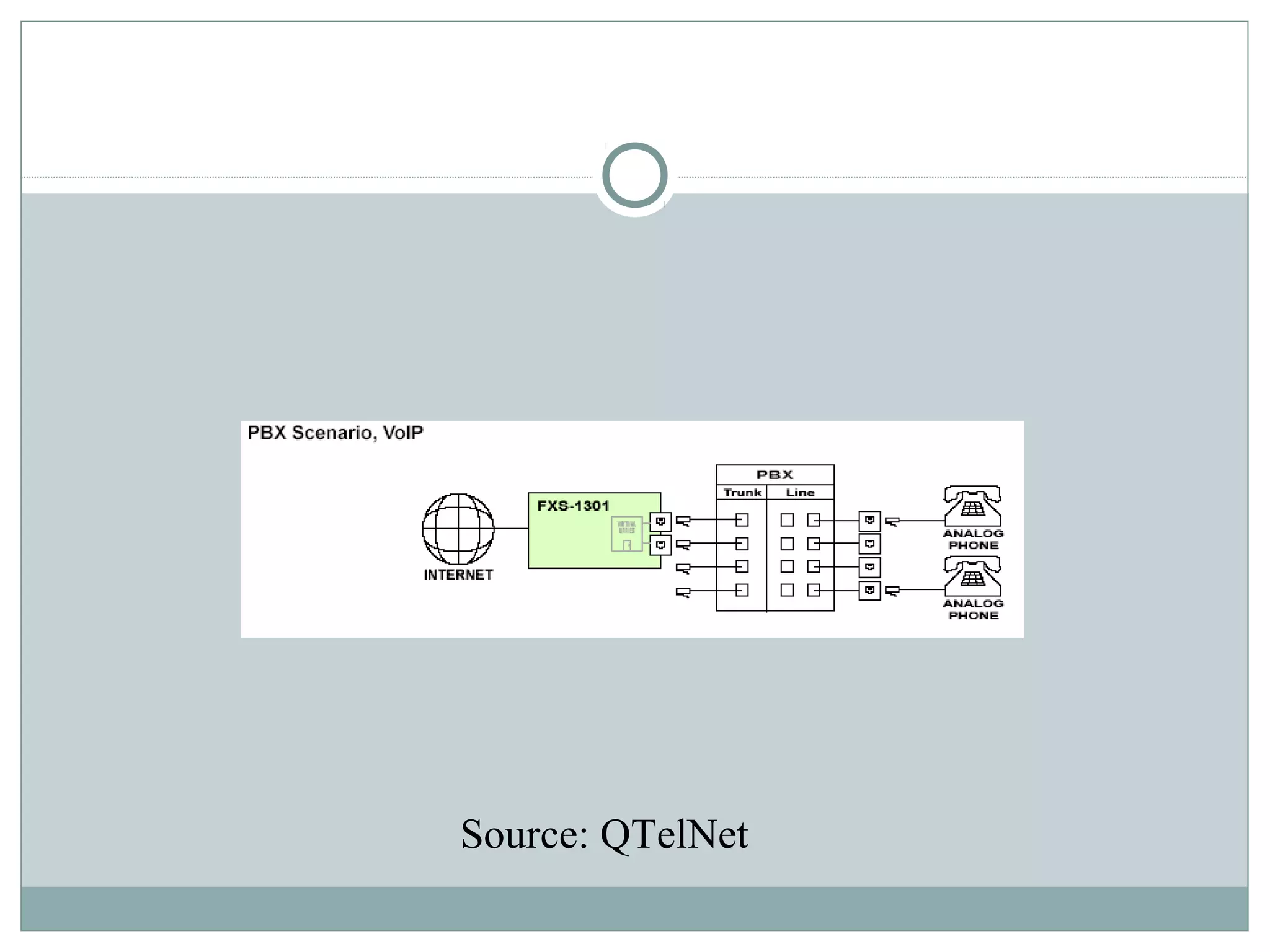
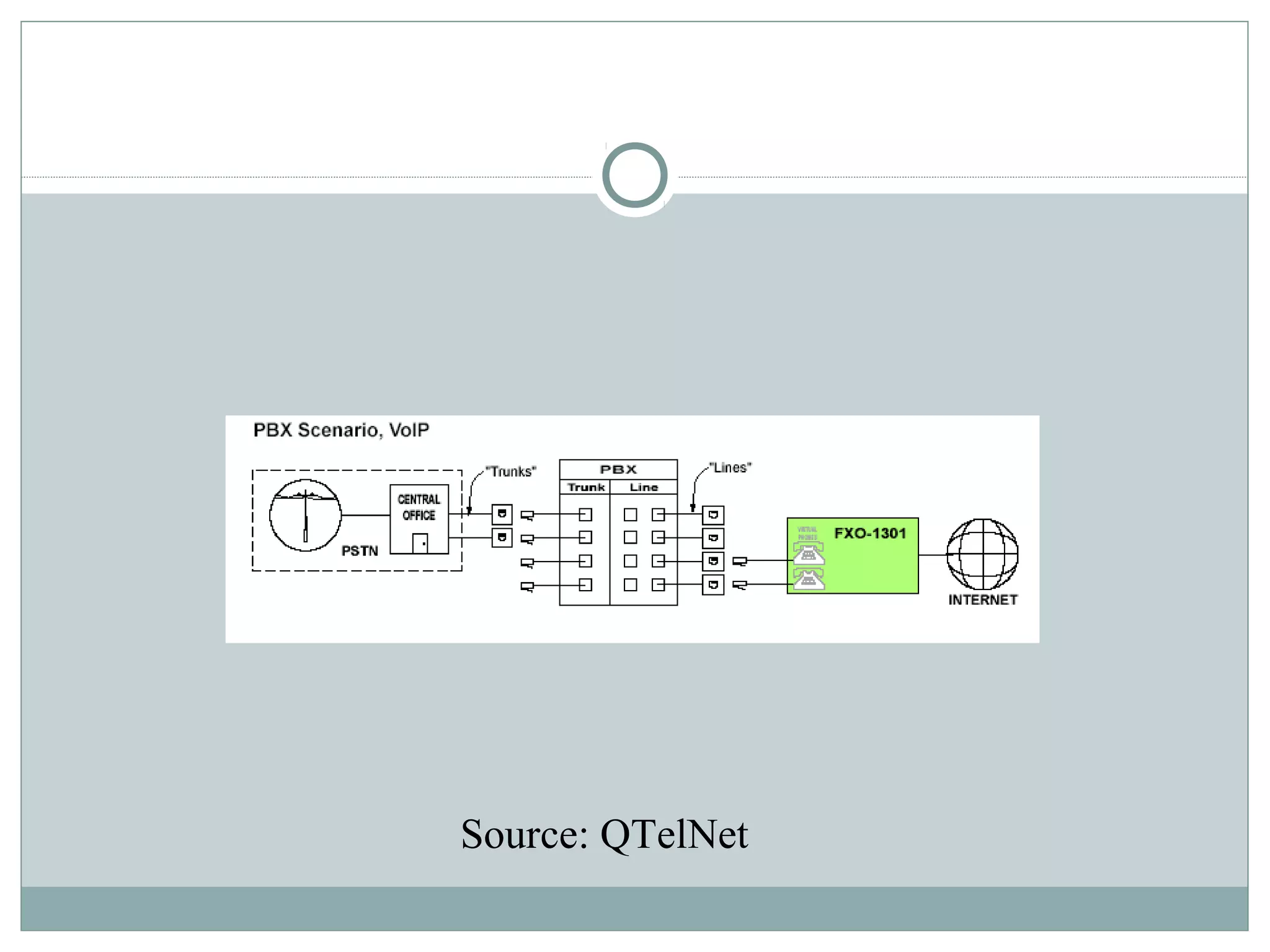
FXO 
An interface between the PSTN and the local 
equipment that would also connect to the Internet 
An example use would be to have a telephone that 
connects to the Internet and, at the same time, has 
a connection to the PSTN as well 
 There are equipment that will automatically switch to the 
PSTN if for some reason the VoIP connection does not 
function
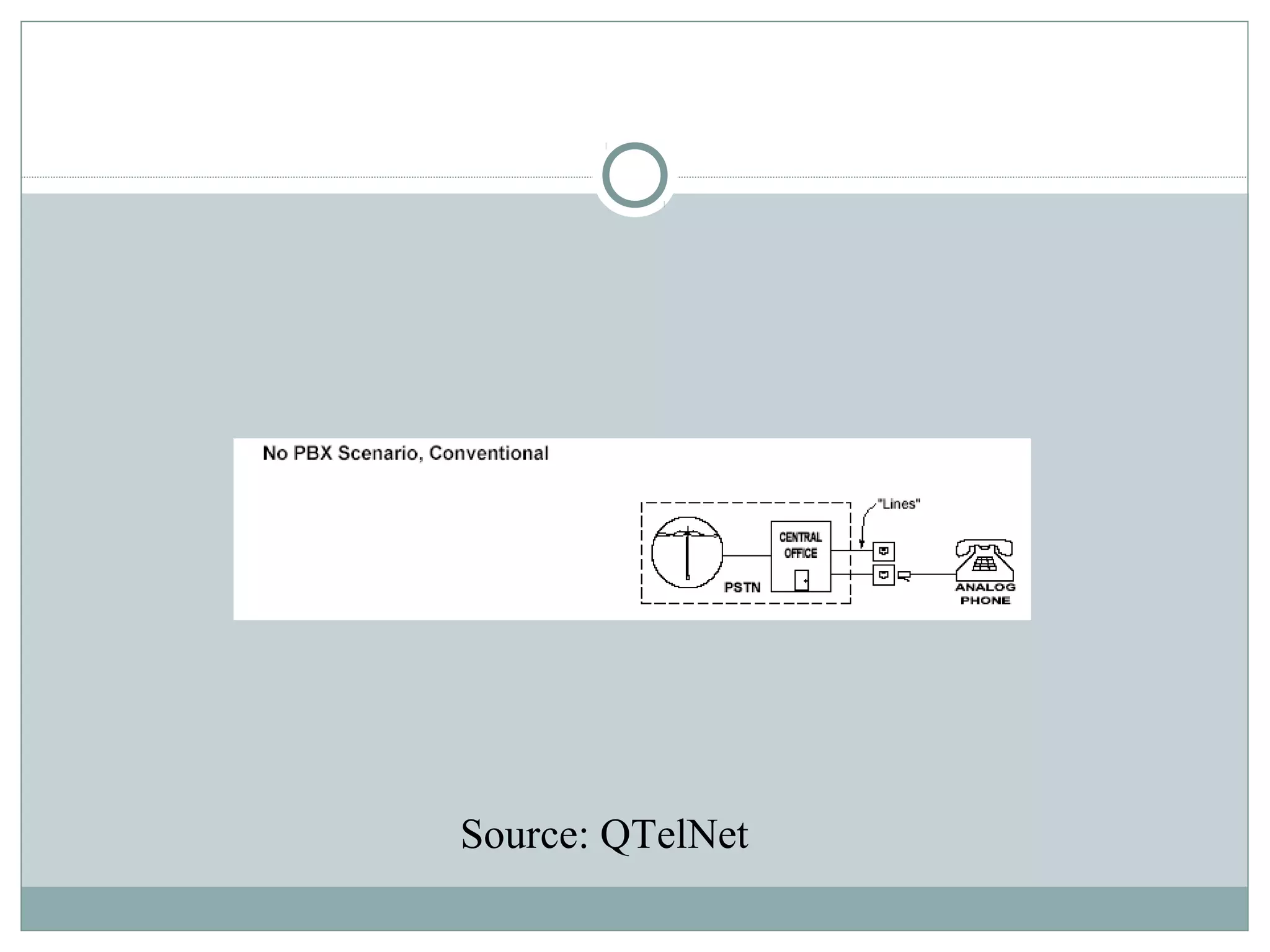
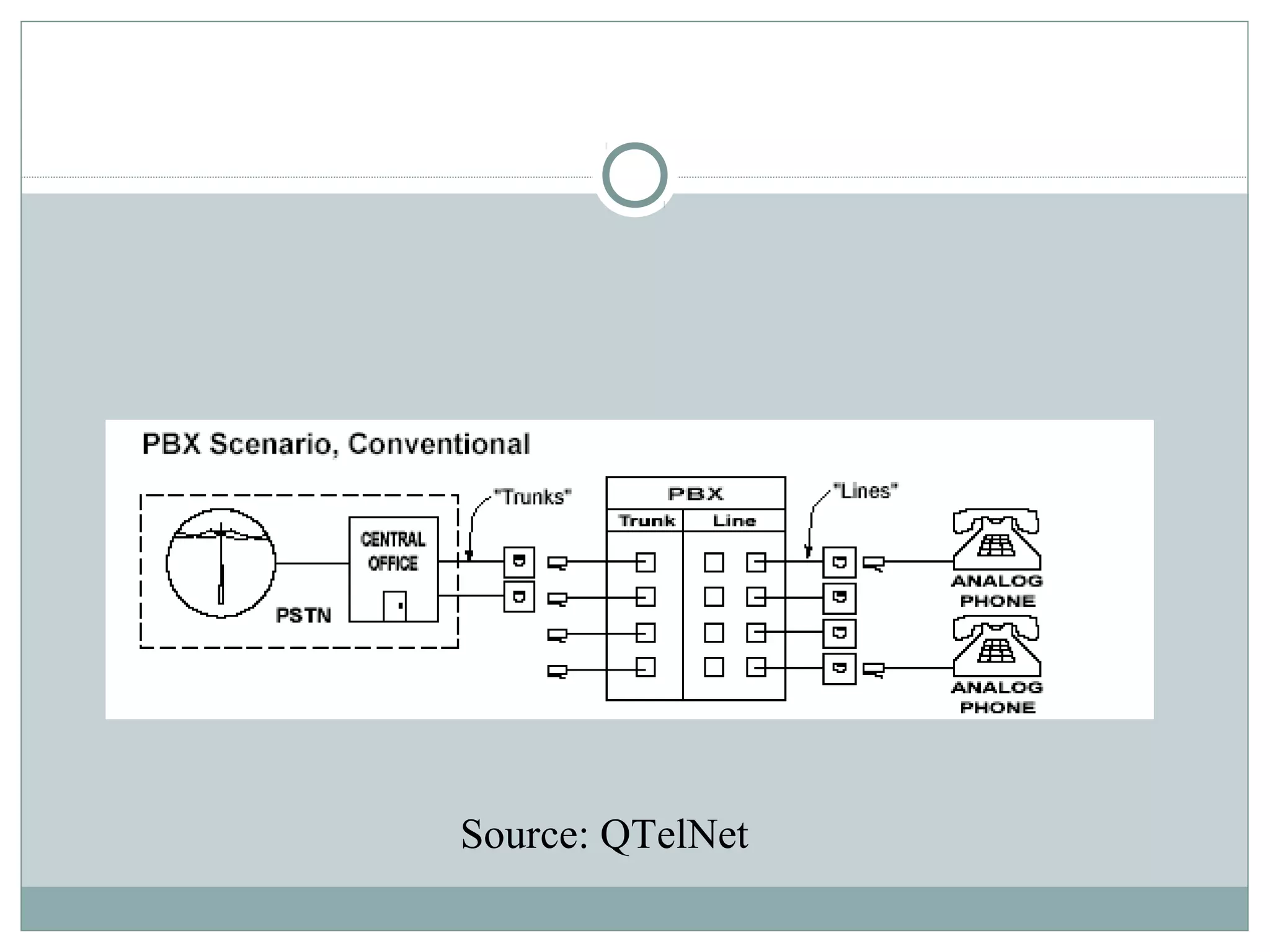
Source: QTelNet
Source: QTelNet
Also known as ATA – Analog Telephone Adapter 
Source: QTelNet
Source: QTelNet
Source: QTelNet
Source: QTelNet
Source: QTelNet
Source: QTelNet
Source: QTelNet
Source: QTelNet
Source: QTelNet
Source: QTelNet
Modes of Internet Telephony 
PC-to-PC 
PC-to-Phone 
Phone-to-Phone 
Note: In the above listing phones can be either 
analog or digital phones
Case 1: PC to PC Connection 
Made over the internet for voice connection 
Sample product: 
 Net2Phone 
 NetMeeting 
Calls are free
Vendors 
Skype 
Earthlink
Case 2: PC to Phone Connection 
Made over the Internet for connecting PC to phones 
Sample Product: 
 Net2Phone 
Need to pay for the calls but they are relatively 
inexpensive 
 Cheaper compared to phone to phone calls made over the 
Internet
Procedure 
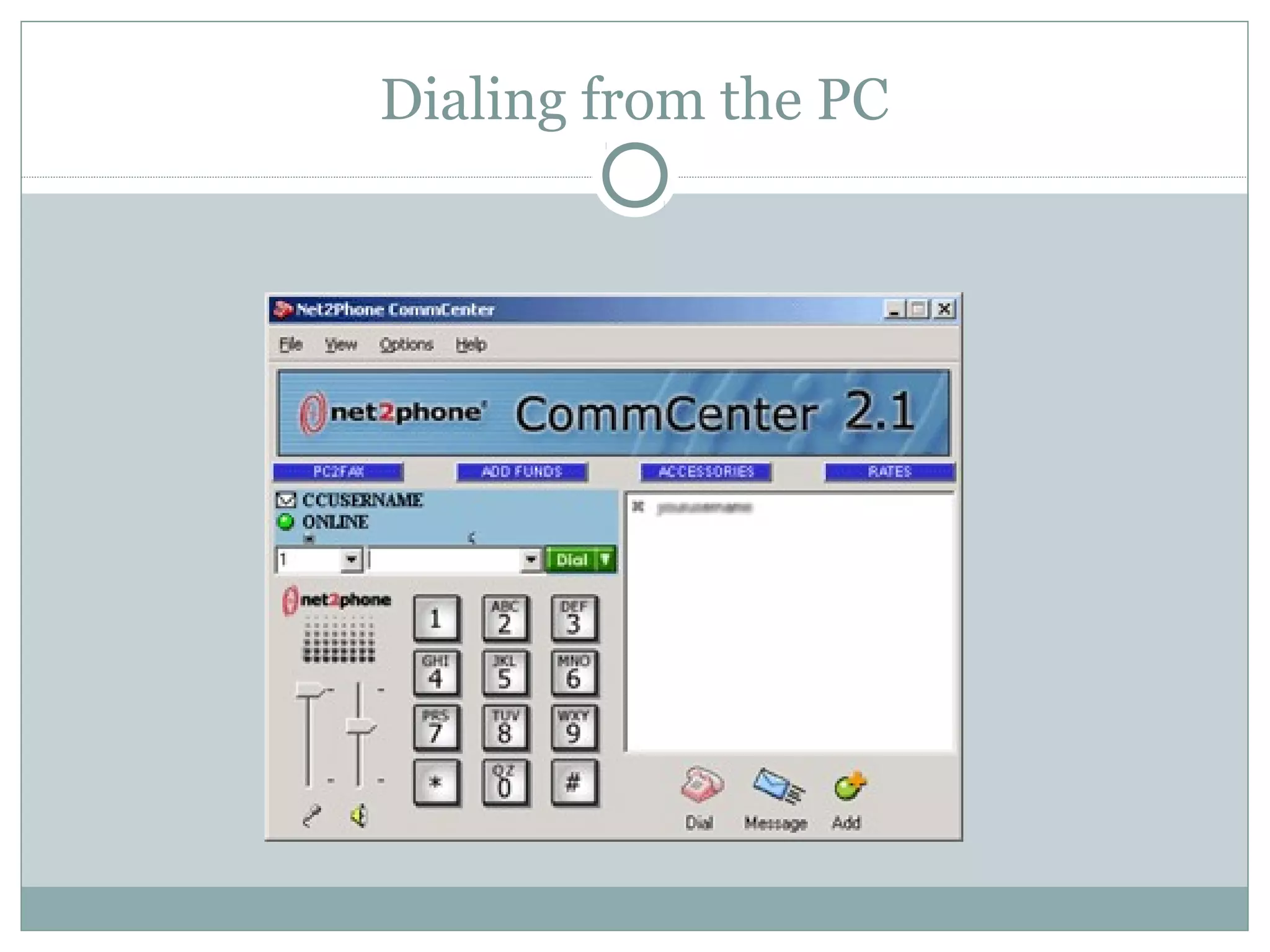
1. Download our FREE software 
2. Create a Username and Password 
3. Select the amount of money you want to add to 
your account 
4. Login to the software 
5. Make PC2Phone calls and send faxes 
- Net2Phone
Dialing from the PC
Features 
PC2PC 
PC2Phone 
PC2Fax 
Instant messaging
Vendors 
Net2Phone
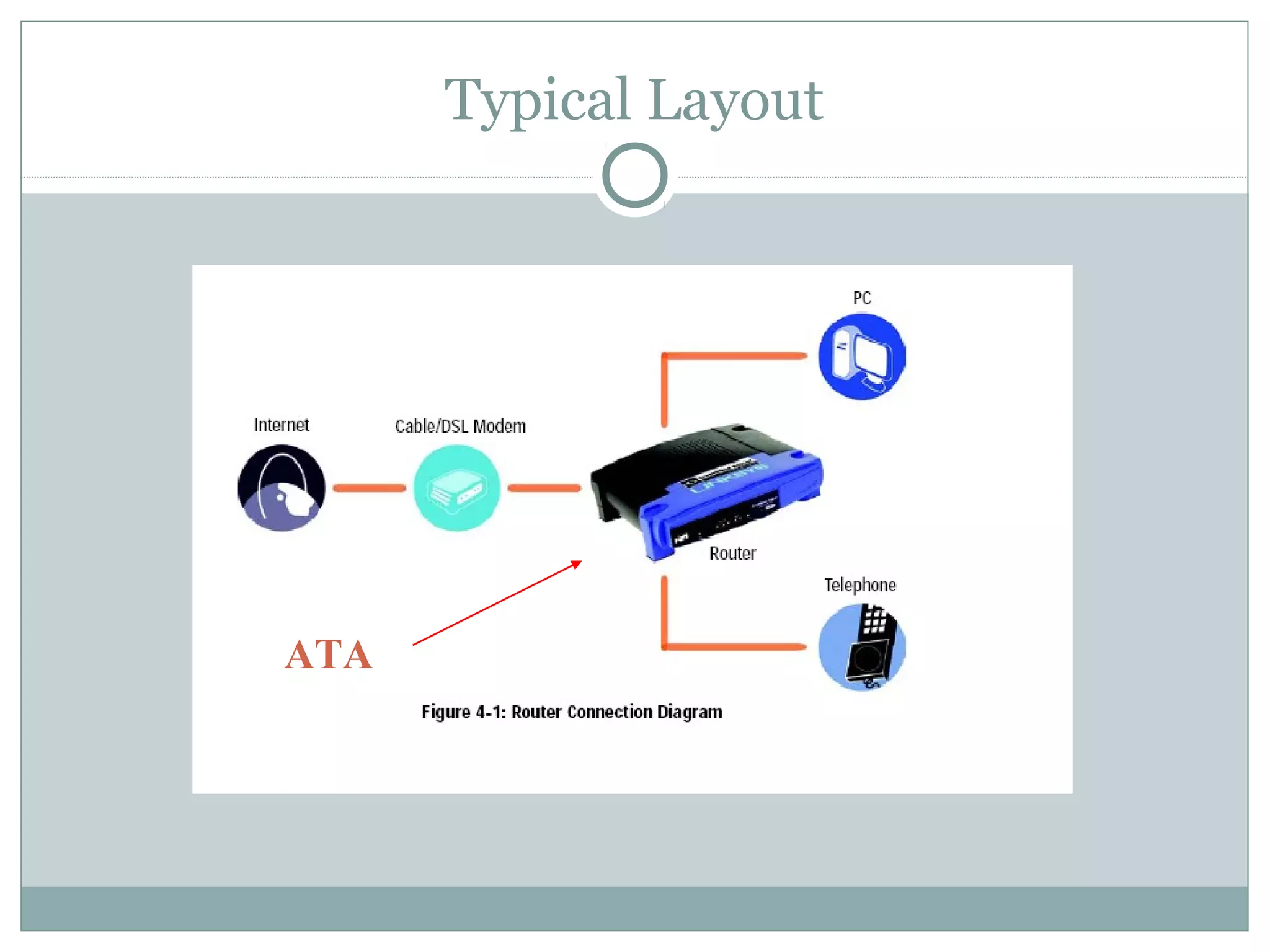
Case 3: Phone to Phone Connection 
Phone to phone calls are made over the Internet 
A special phone will connect to a hub or switch on 
the network
Typical Layout 
ATA
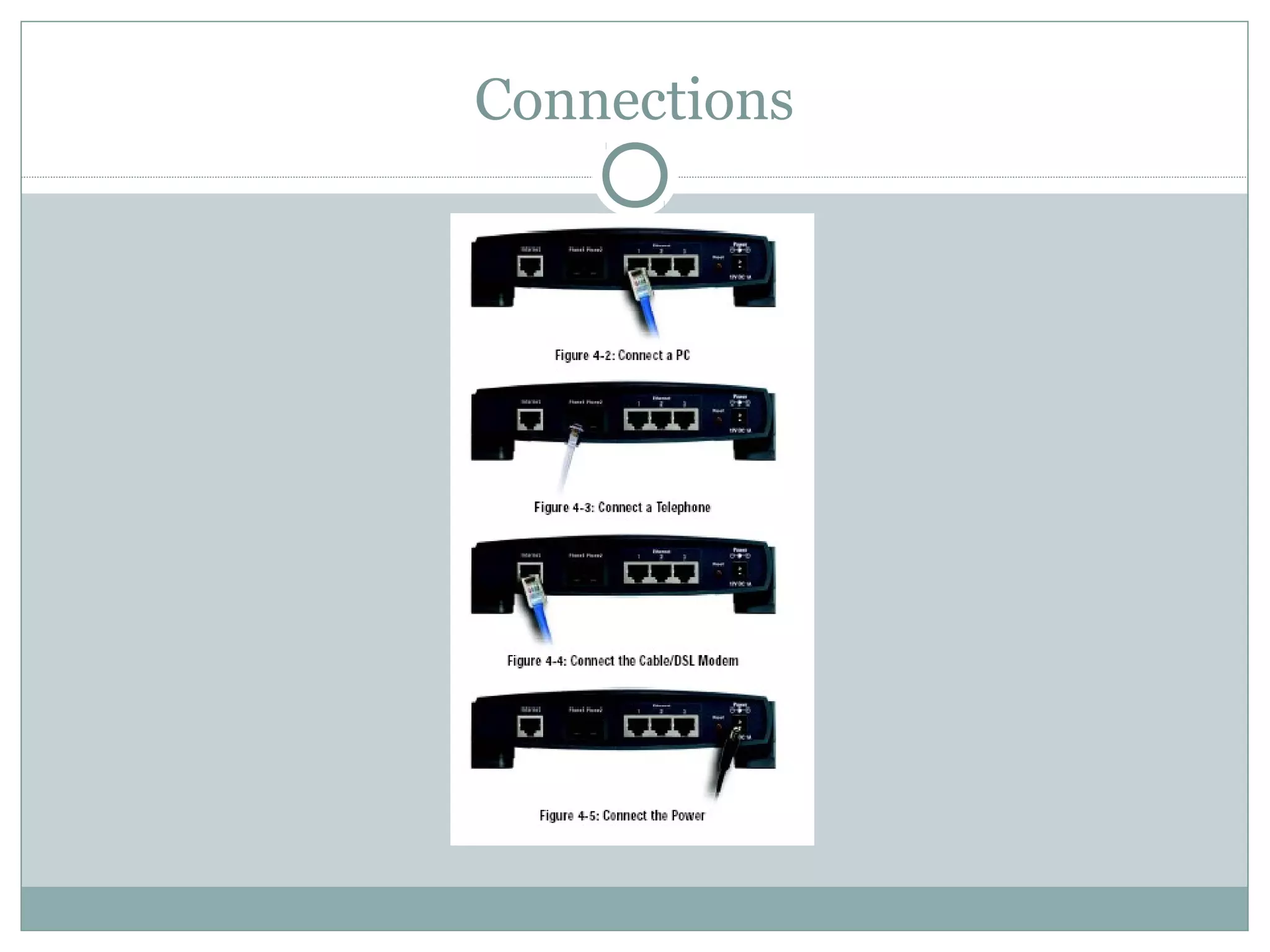
Connections
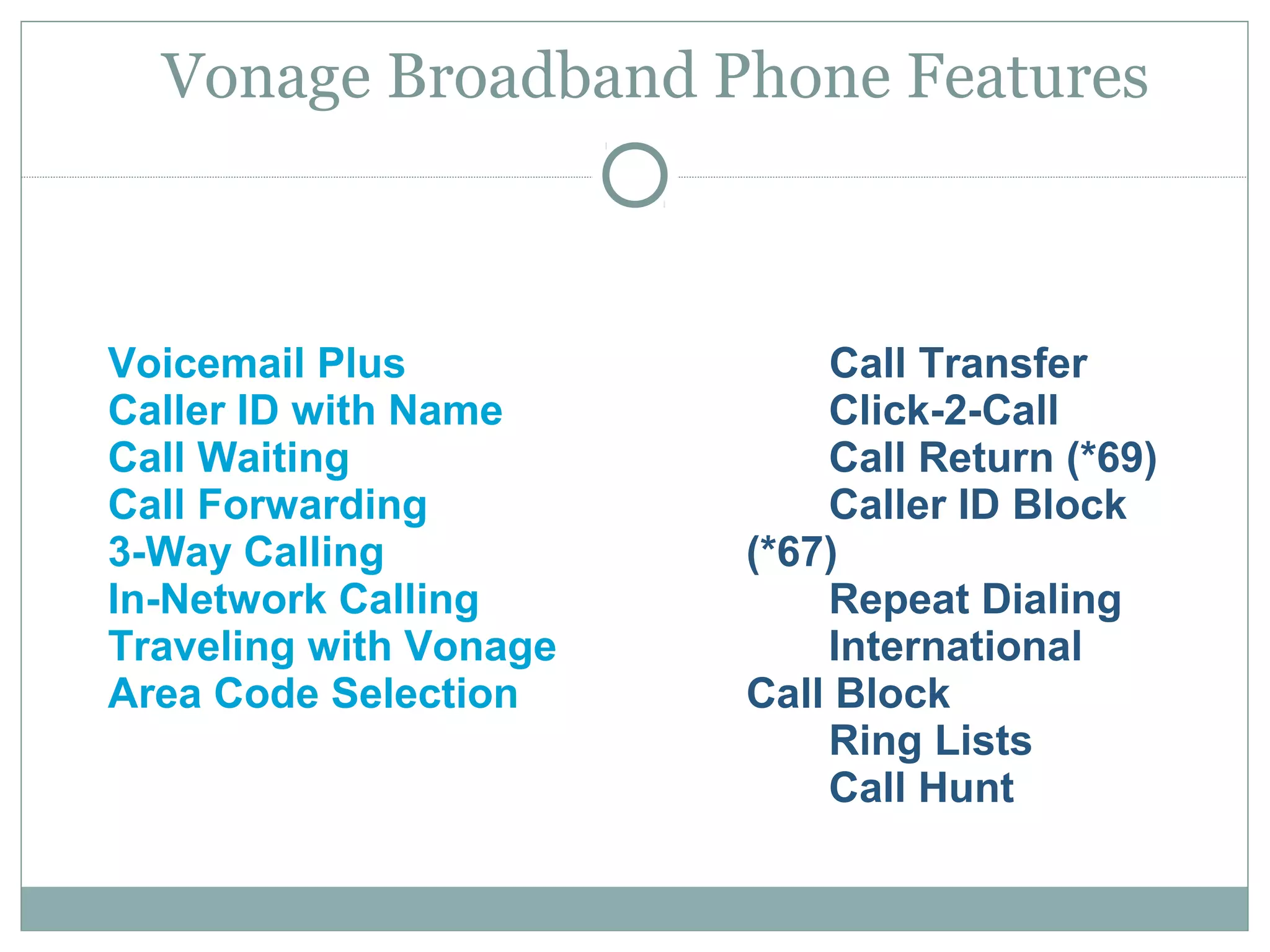
Vonage Broadband Phone Features 
Voicemail Plus 
Caller ID with Name 
Call Waiting 
Call Forwarding 
3-Way Calling 
In-Network Calling 
Traveling with Vonage 
Area Code Selection 
Call Transfer 
Click-2-Call 
Call Return (*69) 
Caller ID Block 
(*67) 
Repeat Dialing 
International 
Call Block 
Ring Lists 
Call Hunt
Analog Telephone Adapter (ATA) 
Manufacturers 
CISCO 
AT&T 
Linksys
A Note on Implementation Problems 
Some of the adapters may not work properly when 
used in conjunction with a NAT 
Some vendors may lock the ATA meaning that it 
would only work with their service 
 A fee may have to be paid to unlock the ATA
Soft Phones 
Soft phones do not require an ATA for connection 
They connect through the computer 
 It can be used for example with a notebook computer to 
facilitate mobility
Residential Broadband Phone 
Companies 
Vonage 
AT&T CallVantage 
VoicePulse 
Packet8 
VocalTec
IP Standard Setting Bodies 
IETF 
ITU
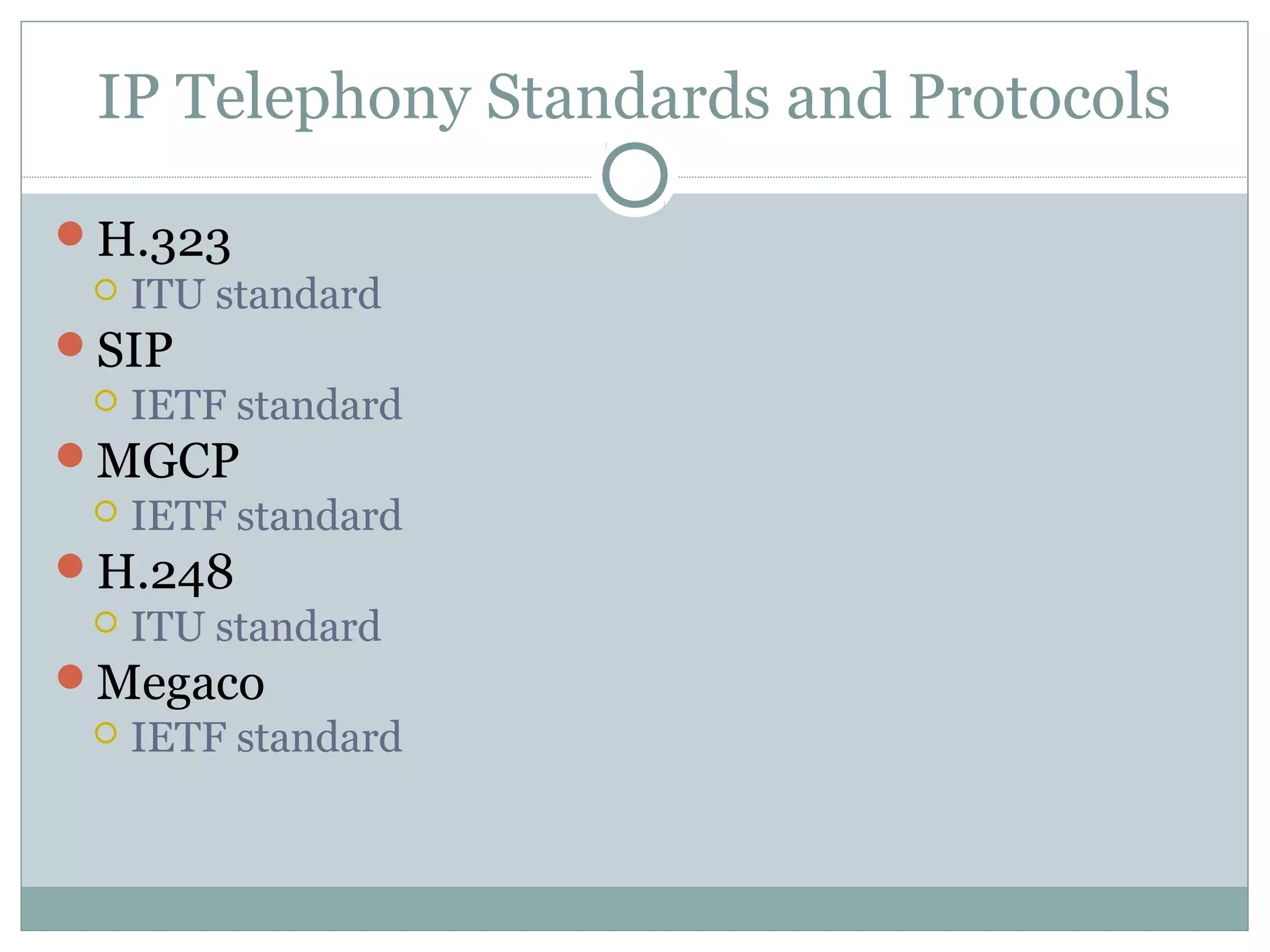
IP Telephony Standards and Protocols 
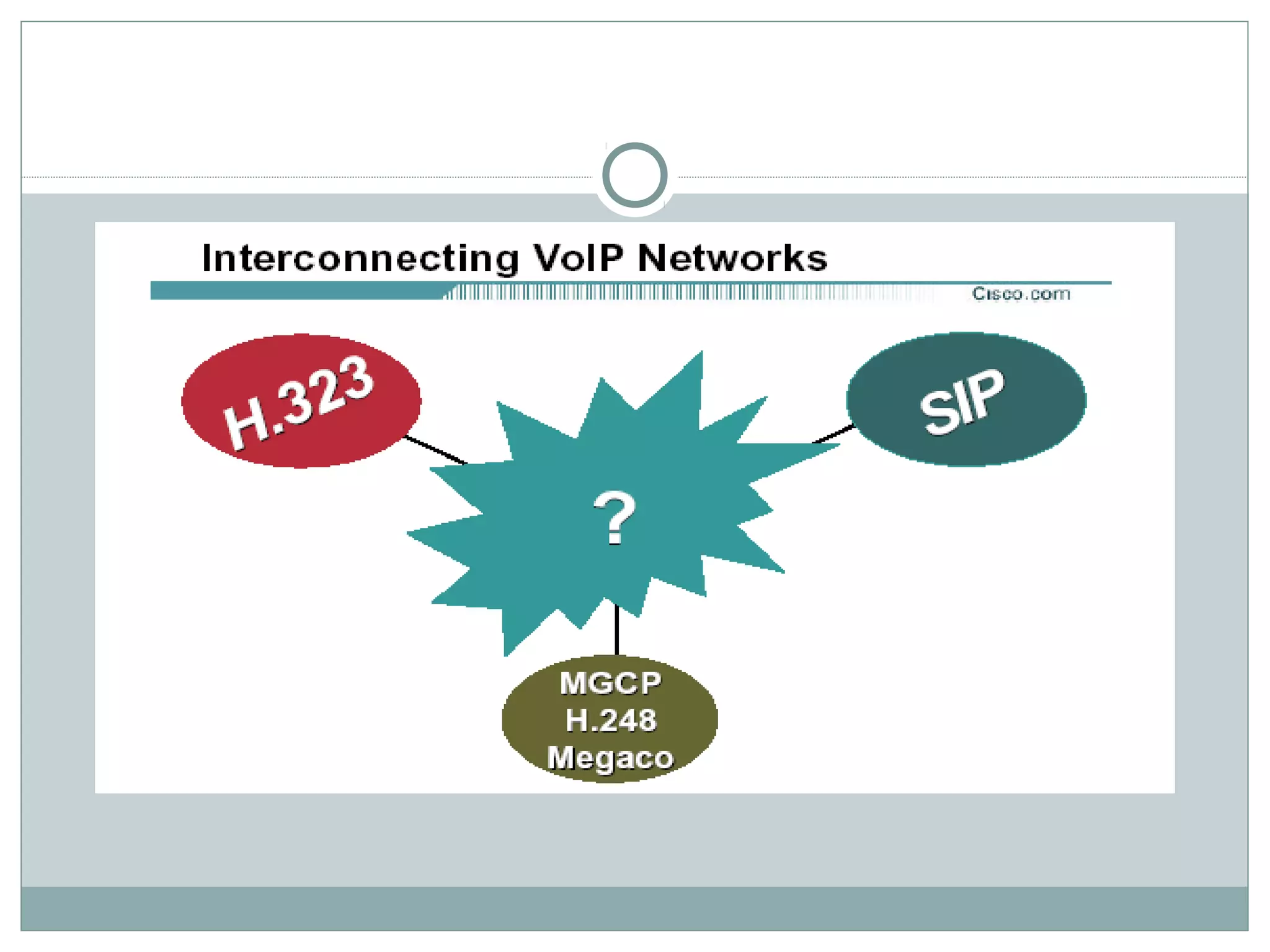
H.323 
 ITU standard 
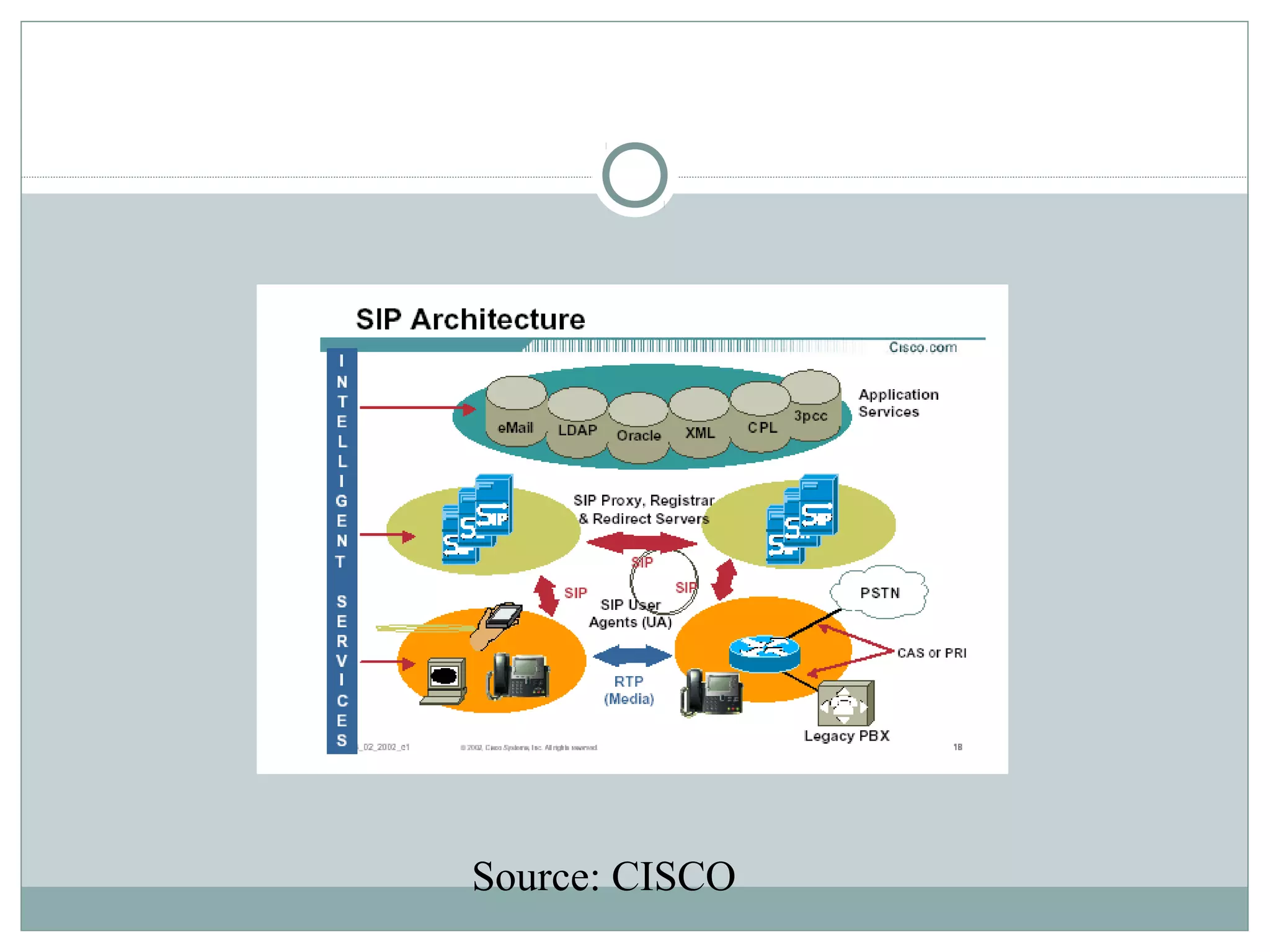
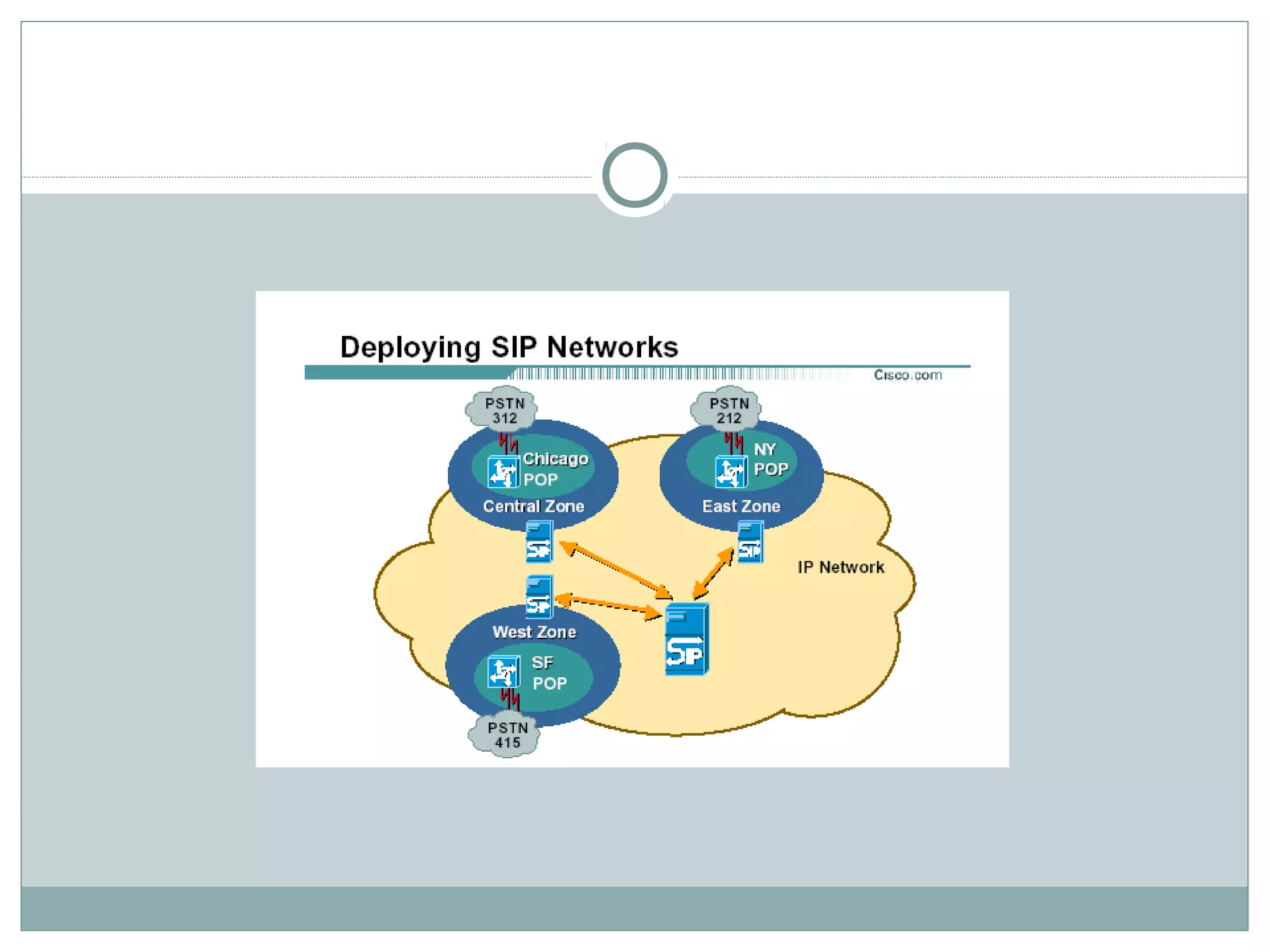
SIP 
 IETF standard 
MGCP 
 IETF standard 
H.248 
 ITU standard 
Megaco 
 IETF standard
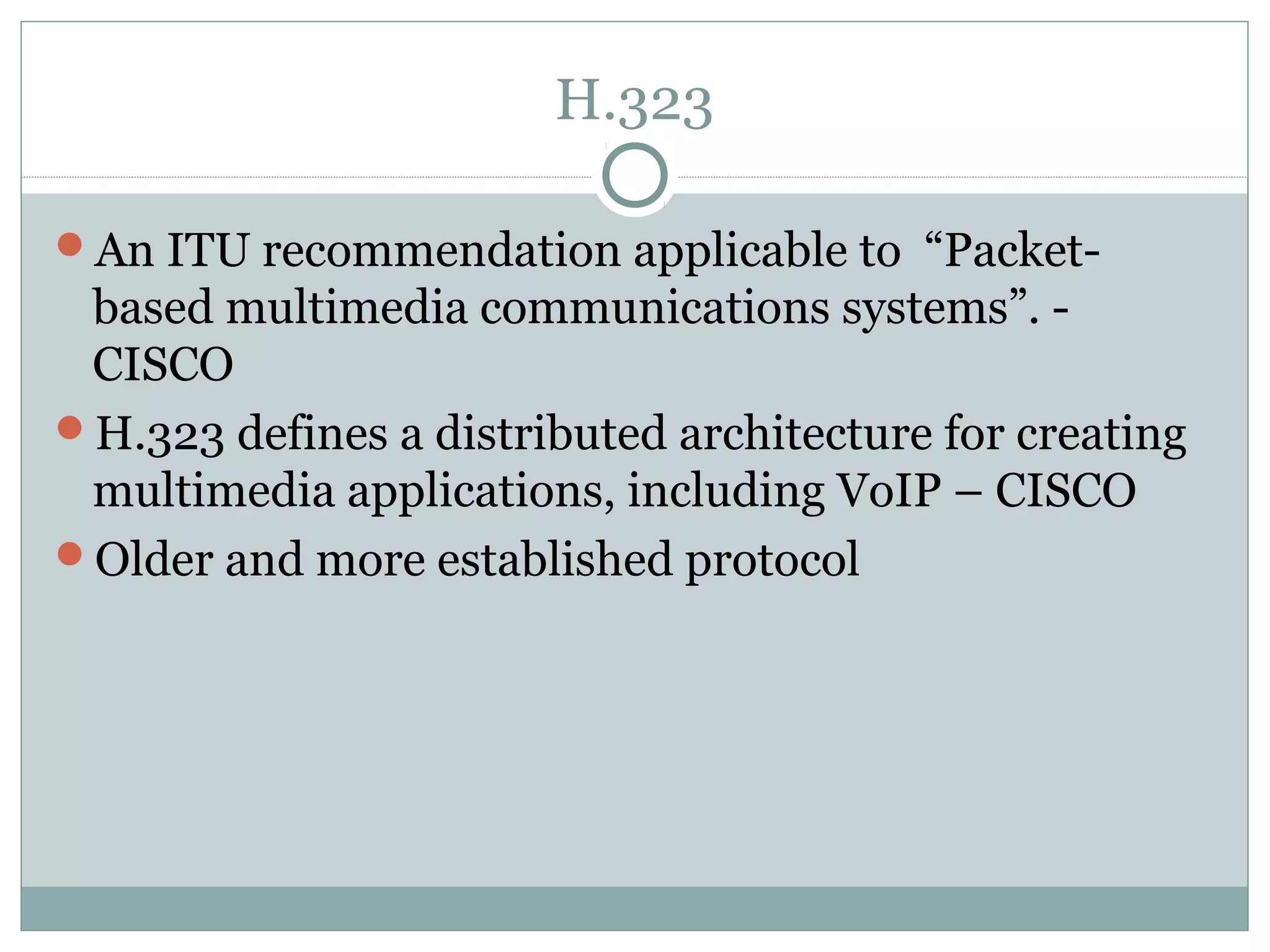
H.323 
An ITU recommendation applicable to “Packet-based 
multimedia communications systems”. - 
CISCO 
H.323 defines a distributed architecture for creating 
multimedia applications, including VoIP – CISCO 
Older and more established protocol
H.323 Components 
Source: CISCO
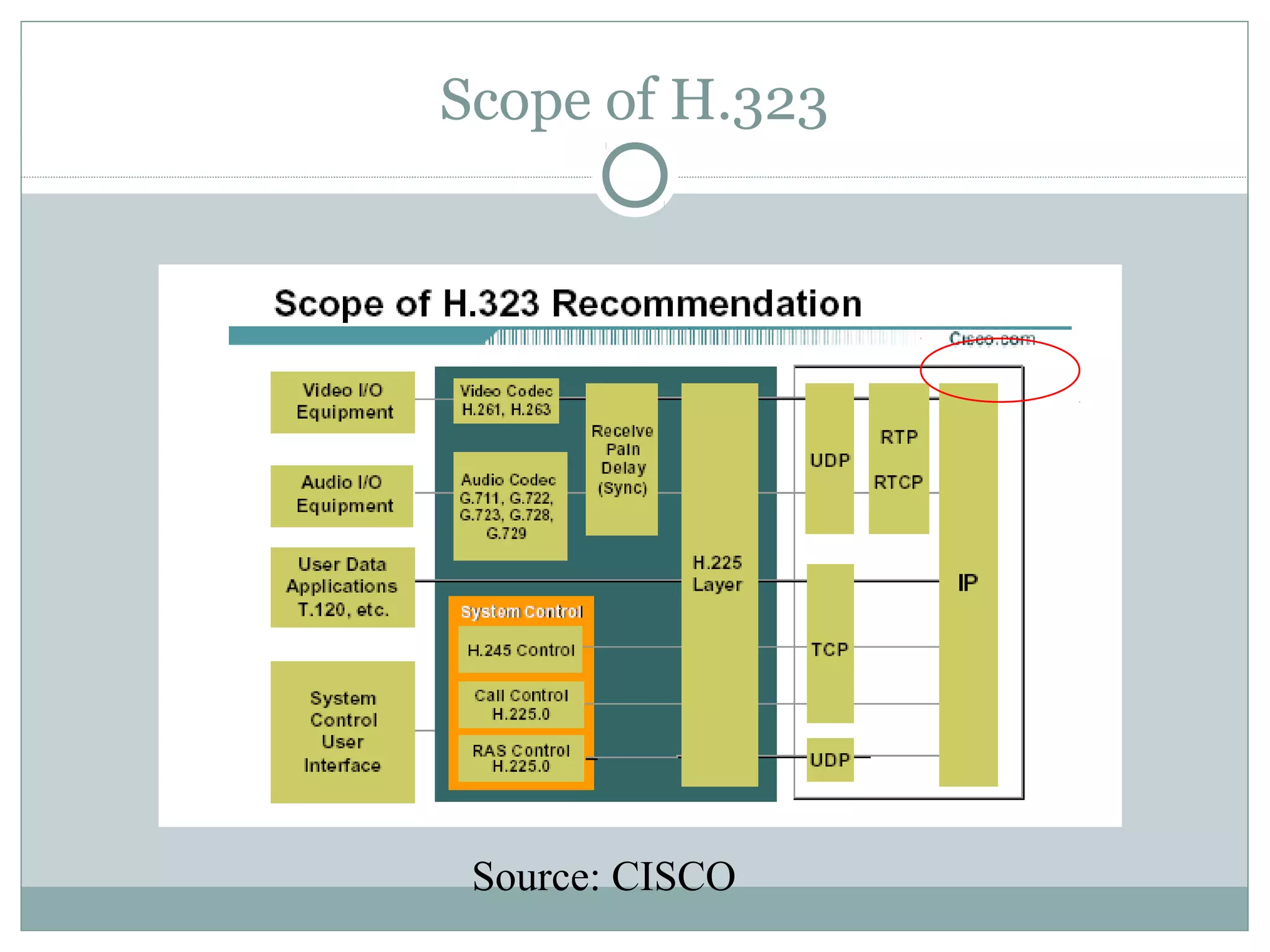
Scope of H.323 
Source: CISCO
Deployment of H.323 Network 
Source: CISCO
Source: CISCO
Other Protocols 
RTP 
 Real-time Transport Protocol 
 Responsible for end-to-end delivery of real-time data such as 
audio and video 
RTCP 
 Real-time Transport Control Protocol 
 The optional companion protocol to RTP that furnishes 
information about the quality of data delivered by RTP
Summary 
Implementations based on the three different 
protocols will be in use 
All three will be implemented with IP as the common 
core 
H.323 is the older implementation that may give way 
to SIP 
 Backed by CISCO
Read more on Tom’s page about locability etc. 
Read Juniper networks to talk more about VoIP 
protocols.

Introduction to VoIP

  • 1.
    Voice Over IP(VoIP): Internet Telephony PPT BY AADARSH SRIVASTAVA
  • 2.
    VoIP Definition Theuse of IP networks, namely the LAN and WAN, to carry voice
  • 3.
    Internet Telephony Theuse of the Internet that was originally designed to carry computer data to carry voice  A packet switched network Voice was originally carried over circuit switched networks  PSTN
  • 4.
    Related Issues Voiceover Frame Relay Voice over ATM
  • 5.
    Further Evolution Mediatransmission over IP  Audio  Image  Video
  • 6.
    VoIP Basic Functions Signaling Database services  Mapping addresses (IP to Phone numbers) etc. Call connect and disconnect (bearer control) CODEC operations  For encapsulating voice into data packets
  • 7.
    Some Codecs Source:Juniper Networks
  • 8.
    VoIP Components Servers  For processing IP calls and manage interaction with PBX etc. End-point devices such as phones Media and VoIP gateways IP network Source: Juniper Networks
  • 9.
    Overcoming the Challenges Latency Jitter Bandwidth Packet loss Reliability Scalability Security Features Interoperability Switch over cost
  • 10.
    Latency Latency isthe time taken for a packet to arrive at its destination  Packet switching overhead  Congestion Latency may result in voice synchronization problems
  • 11.
    Jitter Jitter isthe delay experienced in receiving a packet when a packet is expected to arrive at the end point at a certain time
  • 12.
    Bandwidth When bandwidthis shared between voice and computer data, certain bandwidth may have to be allocated for voice communication on a network
  • 13.
    Packet Loss Packetloss in unavoidable It can be minimally tolerated in voice transmission  It should not, in the first place, distort the audio
  • 14.
    Reliability Because thecomputer network is used, the reliability of the network will have an impact on the telephony service  In the analog telephone industry, reliability of 99.999 percent uptime is required  The above is known as five nines VoIP networks can achieve over 98 percent reliability ?
  • 15.
    Scalability Ability toadd more telephony equipment as the company grows  Network bandwidth and other issues may have an effect on scalability
  • 16.
    Security As VoIPuses the Internet, for example, it is vulnerable to the same type as security risks  Hacking  Denial of service  Eavesdropping
  • 17.
    Features IP telephonyneed to match and, in the long run, exceed the features provided by the PSTN  Call waiting  Three way calling etc.
  • 18.
    Interoperability IP telephonyequipment manufactured by different vendors must be able to talk to each other  Standardized protocols are needed
  • 19.
    Migration Cost Thecost of migrating from legacy PBX to IP PBX
  • 20.
    Facing the Challenges Many of the challenges listed have now been addressed by effective network performance management and standardized protocols
  • 21.
    Network Performance Management Addresses the following issues:  Latency  Reliability  Security
  • 22.
  • 23.
  • 24.
    Gateways and Gatekeepers Gateway equipment performs the task of allowing non-IP equipment to talk to IP equipment Gatekeepers manage the calls within a particular zone Both items will be present in a H.323 network
  • 25.
    Other Terminology FXS  Foreign Exchange Station) FXO  Foreign Exchange Office
  • 26.
    FXS A devicethat connects on one side to an analog equipment and other side to the Internet A simple example is the ATA (Analog Telephone Adapter) that connects an analog phone to the Interent
  • 27.
    FXO An interfacebetween the PSTN and the local equipment that would also connect to the Internet An example use would be to have a telephone that connects to the Internet and, at the same time, has a connection to the PSTN as well  There are equipment that will automatically switch to the PSTN if for some reason the VoIP connection does not function
  • 28.
  • 29.
  • 30.
    Also known asATA – Analog Telephone Adapter Source: QTelNet
  • 31.
  • 32.
  • 33.
  • 34.
  • 35.
  • 36.
  • 37.
  • 38.
  • 39.
  • 40.
    Modes of InternetTelephony PC-to-PC PC-to-Phone Phone-to-Phone Note: In the above listing phones can be either analog or digital phones
  • 41.
    Case 1: PCto PC Connection Made over the internet for voice connection Sample product:  Net2Phone  NetMeeting Calls are free
  • 42.
  • 43.
    Case 2: PCto Phone Connection Made over the Internet for connecting PC to phones Sample Product:  Net2Phone Need to pay for the calls but they are relatively inexpensive  Cheaper compared to phone to phone calls made over the Internet
  • 44.
    Procedure 1. Downloadour FREE software 2. Create a Username and Password 3. Select the amount of money you want to add to your account 4. Login to the software 5. Make PC2Phone calls and send faxes - Net2Phone
  • 45.
  • 46.
    Features PC2PC PC2Phone PC2Fax Instant messaging
  • 47.
  • 48.
    Case 3: Phoneto Phone Connection Phone to phone calls are made over the Internet A special phone will connect to a hub or switch on the network
  • 49.
  • 50.
  • 51.
    Vonage Broadband PhoneFeatures Voicemail Plus Caller ID with Name Call Waiting Call Forwarding 3-Way Calling In-Network Calling Traveling with Vonage Area Code Selection Call Transfer Click-2-Call Call Return (*69) Caller ID Block (*67) Repeat Dialing International Call Block Ring Lists Call Hunt
  • 52.
    Analog Telephone Adapter(ATA) Manufacturers CISCO AT&T Linksys
  • 53.
    A Note onImplementation Problems Some of the adapters may not work properly when used in conjunction with a NAT Some vendors may lock the ATA meaning that it would only work with their service  A fee may have to be paid to unlock the ATA
  • 54.
    Soft Phones Softphones do not require an ATA for connection They connect through the computer  It can be used for example with a notebook computer to facilitate mobility
  • 55.
    Residential Broadband Phone Companies Vonage AT&T CallVantage VoicePulse Packet8 VocalTec
  • 56.
    IP Standard SettingBodies IETF ITU
  • 57.
    IP Telephony Standardsand Protocols H.323  ITU standard SIP  IETF standard MGCP  IETF standard H.248  ITU standard Megaco  IETF standard
  • 58.
    H.323 An ITUrecommendation applicable to “Packet-based multimedia communications systems”. - CISCO H.323 defines a distributed architecture for creating multimedia applications, including VoIP – CISCO Older and more established protocol
  • 59.
  • 60.
    Scope of H.323 Source: CISCO
  • 61.
    Deployment of H.323Network Source: CISCO
  • 62.
  • 65.
    Other Protocols RTP  Real-time Transport Protocol  Responsible for end-to-end delivery of real-time data such as audio and video RTCP  Real-time Transport Control Protocol  The optional companion protocol to RTP that furnishes information about the quality of data delivered by RTP
  • 66.
    Summary Implementations basedon the three different protocols will be in use All three will be implemented with IP as the common core H.323 is the older implementation that may give way to SIP  Backed by CISCO
  • 67.
    Read more onTom’s page about locability etc. Read Juniper networks to talk more about VoIP protocols.