FIT2234 – Group Research Project Assignment


   Steve Camapgna
     Eric Kennedy
       Tyler O’Brien
          Tommy Neeposh
             Nitin Anand
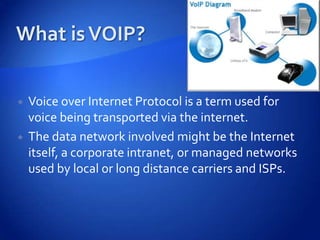
   Voice over Internet Protocol is a term used for
    voice being transported via the internet.
   The data network involved might be the Internet
    itself, a corporate intranet, or managed networks
    used by local or long distance carriers and ISPs.
   VoIP (Voice over Internet Protocol) is a term used
    for voice being transported via the internet. The
    data network involved might be the Internet
    itself, a corporate intranet, or managed networks
    used by local or long distance carriers and ISPs.
   The protocols used to carry the signal over the IP
    network are commonly referred to as Voice over
    IP. VoIP is a new technology, but it builds upon
    existing digital processing
    All digital audio systems including digital phone,
     perform three functions on the audio signal they
     receive:
1)    Digitize it which means it is converted into
      computer data .
2)    Compress it to reduce the amount of data needing
      to be stored
3)    Transmit it to the intended destination thereafter,
      when a person speaks his or her own voice changes
      in power and tone during the utterance.
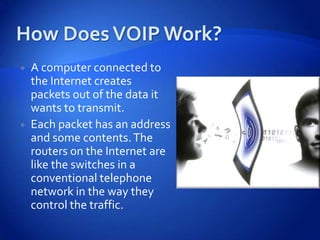
   A computer connected to
    the Internet creates
    packets out of the data it
    wants to transmit.
   Each packet has an address
    and some contents. The
    routers on the Internet are
    like the switches in a
    conventional telephone
    network in the way they
    control the traffic.
   They examine the destination address of every
    packet that arrives and then they send that
    packet onward to its destination using the most
    efficient route at that instant.
   Each router only forwards a packet one step, to
    the next router. Every packet leaving its origin
    may travel by a different path to get to its
    destination.
   The packets may arrive out of order. If the receiver
    plays them out of order, it might be hard to
    understand the speech. But VoIP devices and
    software re-arrange the packets so that they are
    played in the proper order.
   VoIP uses digital audio processing techniques and
    add to them the Internet's method of transmission.
   VoIP is a promising technology because it allows for
    the integration of voice, text, video, and other media
    on the same network.
   In 2005, Skype became one of the largest VoIP
    providers in the world having had over one million
    people subscribe.
   On December 31st, 2008, the Federal
    Communications Commission said that just over 21
    million people were subscribed to a VoIP service via
    telephone and cable companies such as Vonage.
   Most of the 162 million wired connections in the
    United States are residential which translates into 13
    percent.
   Most of the 162 million wired connections in the
    United States are residential which translates
    into 13 percent.
   Only 1 percent of those VoIP lines served
    businesses. 141 million of these are copper wired
    systems and are responsible for 87 percent of the
    lines (48% residential, 39% business accounts).
   VoIP represents only a small percentage of the
    landline phone subscriptions.
   There are many different VOIP although Nextiva
    is the top rated provider.
   Nextiva has one of the lowest monthly rates
    sitting at $21.95 and after reading many reviews
    the general consensus among VoIP users is that
    they love it.
   Nextivia has five star ratings across the boards in
    terms of price, ease of use, and customer
    satisfaction.
   CEO of a company named EFX - John Floyd, said that
    after switching to Nextiva, they now have ten phones, an
    automated attendant, a dedicated T-1 for internet, twice
    as many employees, and that their monthly cost in
    communications and infrastructure charges is still $500
    less than before.
   He goes on to say that the call quality is great and his
    customers are very happy regarding the ease of access
    to a representative.
   Saves a great deal of cost to communicate within
    and outside of the company.
   Since a VoIP service uses bandwidth through a DSL,
    3G or Wi-Fi IP, the need for telephone wires and the
    like are unnecessary.
   Being compatible with networks using 3G and Wi-Fi,
    make VoIP services very portable, meaning that you
    are able to use these services on your internet
    phone, smartphone, laptop, and even your tablet on
    the go.
   Connections can be made PC-to-PC, PC-to-
    phone, PC-to-tablet and so on. Skype has
    recently developed an application for Android OS
    making it all the more portable.
   As well as portability, VoIP services can transmit
    more than one call over the same bandwidth
    connection which would be convenient for a
    small office operating under one IP address.
   VoIP programs rely on electricity. This is a
    disadvantage because if there is a power outage, the
    call will be dropped and the service will not work
    until the power source is reinstated.
   If you were to dial a 911 call and could not tell the
    operator your location, they would be unable to
    locate you as they would be able to with a traditional
    telephone or cellular phone.
   The final disadvantage is actually fairly easily fixed.
    Since data packets cumulatively contain a single file
    and since VoIP services run in real-time, the data
    packets risk being jumbled or misplaced if the server
    is too busy. However, as stated, this can be easily
    mended by creating dedicated data paths for
    individual calls.
   There is a bright future lined up ahead for VoIP.
   Many companies are coming out offering
    improved VoIP technology at lower costs.
   With global recession taking place, business
    owners are becoming more attracted to the
    commercial advantages of using voice over IP
    services.
   VoIP providers can offer services 30-60% less
    over traditional communication services.
   There is a higher level of acceptance towards
    VoIP developing as it is being used more and
    more in businesses and households.
   This is due to the fact that word of mouth is
    getting around about the advantages and cost
    savings in VoIP, especially in long distance
    communication.
   In the near future there will be a new level of innovation
    and integration between VoIP and web-based
    applications.
   Example: ability to add telephony functions to your TV.
    When you receive a phone call at home, the TV will
    pause the live broadcast and show you the details of the
    caller and allow you to accept it or send it to voicemail by
    using the remote control.
   Example: “lone-worker” application which can allow a
    supervisor to contact each employee on their mobile
    phone to display location and safety status of employees
    working alone.
   VoIP has evolved a long way from its beginning
    to the underlying technology for just about all
    new voice communication services today.
   As more opportunities of VoIP service integration
    are explored we will see a great deal more of
    VoIP in the years ahead.
Thank you for listening to our presentation!


          Made by:
                  Steve Camapgna
                      Eric Kennedy
                         Tyler O’Brien
                            Tommy Neeposh
                                  Nitin Anand

VOIP Presentation

  • 1.
    FIT2234 – GroupResearch Project Assignment Steve Camapgna Eric Kennedy Tyler O’Brien Tommy Neeposh Nitin Anand
  • 2.
    Voice over Internet Protocol is a term used for voice being transported via the internet.  The data network involved might be the Internet itself, a corporate intranet, or managed networks used by local or long distance carriers and ISPs.
  • 3.
    VoIP (Voice over Internet Protocol) is a term used for voice being transported via the internet. The data network involved might be the Internet itself, a corporate intranet, or managed networks used by local or long distance carriers and ISPs.  The protocols used to carry the signal over the IP network are commonly referred to as Voice over IP. VoIP is a new technology, but it builds upon existing digital processing
  • 4.
    All digital audio systems including digital phone, perform three functions on the audio signal they receive: 1) Digitize it which means it is converted into computer data . 2) Compress it to reduce the amount of data needing to be stored 3) Transmit it to the intended destination thereafter, when a person speaks his or her own voice changes in power and tone during the utterance.
  • 5.
    A computer connected to the Internet creates packets out of the data it wants to transmit.  Each packet has an address and some contents. The routers on the Internet are like the switches in a conventional telephone network in the way they control the traffic.
  • 6.
    They examine the destination address of every packet that arrives and then they send that packet onward to its destination using the most efficient route at that instant.  Each router only forwards a packet one step, to the next router. Every packet leaving its origin may travel by a different path to get to its destination.
  • 7.
    The packets may arrive out of order. If the receiver plays them out of order, it might be hard to understand the speech. But VoIP devices and software re-arrange the packets so that they are played in the proper order.  VoIP uses digital audio processing techniques and add to them the Internet's method of transmission.  VoIP is a promising technology because it allows for the integration of voice, text, video, and other media on the same network.
  • 8.
    In 2005, Skype became one of the largest VoIP providers in the world having had over one million people subscribe.  On December 31st, 2008, the Federal Communications Commission said that just over 21 million people were subscribed to a VoIP service via telephone and cable companies such as Vonage.  Most of the 162 million wired connections in the United States are residential which translates into 13 percent.
  • 9.
    Most of the 162 million wired connections in the United States are residential which translates into 13 percent.  Only 1 percent of those VoIP lines served businesses. 141 million of these are copper wired systems and are responsible for 87 percent of the lines (48% residential, 39% business accounts).  VoIP represents only a small percentage of the landline phone subscriptions.
  • 10.
    There are many different VOIP although Nextiva is the top rated provider.  Nextiva has one of the lowest monthly rates sitting at $21.95 and after reading many reviews the general consensus among VoIP users is that they love it.  Nextivia has five star ratings across the boards in terms of price, ease of use, and customer satisfaction.
  • 11.
    CEO of a company named EFX - John Floyd, said that after switching to Nextiva, they now have ten phones, an automated attendant, a dedicated T-1 for internet, twice as many employees, and that their monthly cost in communications and infrastructure charges is still $500 less than before.  He goes on to say that the call quality is great and his customers are very happy regarding the ease of access to a representative.
  • 12.
    Saves a great deal of cost to communicate within and outside of the company.  Since a VoIP service uses bandwidth through a DSL, 3G or Wi-Fi IP, the need for telephone wires and the like are unnecessary.  Being compatible with networks using 3G and Wi-Fi, make VoIP services very portable, meaning that you are able to use these services on your internet phone, smartphone, laptop, and even your tablet on the go.
  • 13.
    Connections can be made PC-to-PC, PC-to- phone, PC-to-tablet and so on. Skype has recently developed an application for Android OS making it all the more portable.  As well as portability, VoIP services can transmit more than one call over the same bandwidth connection which would be convenient for a small office operating under one IP address.
  • 14.
    VoIP programs rely on electricity. This is a disadvantage because if there is a power outage, the call will be dropped and the service will not work until the power source is reinstated.  If you were to dial a 911 call and could not tell the operator your location, they would be unable to locate you as they would be able to with a traditional telephone or cellular phone.
  • 15.
    The final disadvantage is actually fairly easily fixed. Since data packets cumulatively contain a single file and since VoIP services run in real-time, the data packets risk being jumbled or misplaced if the server is too busy. However, as stated, this can be easily mended by creating dedicated data paths for individual calls.
  • 16.
    There is a bright future lined up ahead for VoIP.  Many companies are coming out offering improved VoIP technology at lower costs.  With global recession taking place, business owners are becoming more attracted to the commercial advantages of using voice over IP services.  VoIP providers can offer services 30-60% less over traditional communication services.
  • 17.
    There is a higher level of acceptance towards VoIP developing as it is being used more and more in businesses and households.  This is due to the fact that word of mouth is getting around about the advantages and cost savings in VoIP, especially in long distance communication.
  • 18.
    In the near future there will be a new level of innovation and integration between VoIP and web-based applications.  Example: ability to add telephony functions to your TV. When you receive a phone call at home, the TV will pause the live broadcast and show you the details of the caller and allow you to accept it or send it to voicemail by using the remote control.  Example: “lone-worker” application which can allow a supervisor to contact each employee on their mobile phone to display location and safety status of employees working alone.
  • 19.
    VoIP has evolved a long way from its beginning to the underlying technology for just about all new voice communication services today.  As more opportunities of VoIP service integration are explored we will see a great deal more of VoIP in the years ahead.
  • 20.
    Thank you forlistening to our presentation! Made by: Steve Camapgna Eric Kennedy Tyler O’Brien Tommy Neeposh Nitin Anand