


TECHNOLOGY
o Technology is the evolution of an idea.
o It’s the thinking of a man or woman who sees before
them an opportunity to improve a process, or to create a
device or object that facilitates, improves or aids
something or someone else.
o Technology is about a unique inspiration given the remit
of creativity and the notion to express that idea as
something real and tangible.
o However, the motives for this spark of creativity aren’t
always as laudable and arguably lamentable.
WHAT IS TECHNOLOGY ?
Wheels
Transport
Circuit
Computers
Cell phones
Medical
Security
Industries
Future
Drawbacks
Prathamesh
Akash
Anand
Prashant
Narsingh
Suresh
Joshua
Kunal
Sandeep
Veepin
-
-
-
-
-
-
-
-
-
-

 Up till now it is still a mystery
as to who invented the
wheel and when the wheel
was invented.
 It was made by joining
planks of wood together.
 It was a roller made of wood.
WHEEL

WHEEL
FIRST STAGE
 Early man placed roller
beneath heavy objects
so that they could move
it easily.
SECOND STAGE
 Then they began to place
runners under a heavy
load which they
discovered would make it
easier for the load to drag.
 This was the invention of
sledge.

WHEEL
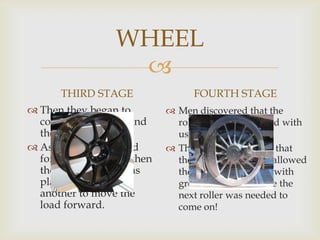
THIRD STAGE
 Then they began to
combine the roller and
the sledge.
 As the sledge moved
forward first roller then
the second roller was
placed one after
another to move the
load forward.
FOURTH STAGE
 Men discovered that the
rollers became grooved with
use.
 They soon discovered that
these deeper grooves allowed
the sledge to advance with
greater distance before the
next roller was needed to
come on!

WHEEL
FIFTH STAGE
 The roller where
changed into wheels.
 The first wooden carts
where made.
SIXTH STAGE
 A slight improvement
was made to the cart.
 Axel were drilled
through the frame of
the cart.
 Axel and wheel were
separated.

WHEEL
 Today we see that the wheel has gone a great transformation from a
simple one made of wood to the pneumatic rubber tyres that we see
on vehicles today.
 The wheel is probably the most important mechanical inventions of
all times.
 Nearly every machine built since the beginning of the industrial
revolution has or needs wheels.
 Its hard to imagine any mechanized system that would be possible
without the wheel.
 From tiny match gears to automobiles, jet engines and computer disk
drives the principle is same.
TRANSPORT
 It is the
movement of
people, cattle, ani
mals and goods
from one location
to another.
TRANSPORT
• It is the most
common way of
transport in
olden days.
• It is the least
expensive way of
transport.
TRANSPORT
An engine or
motor is a
machine designed
to convert energy
into useful
mechanical
motion.
TRANSPORT
 Ship transport is
watercraft
carrying people ,
passengers or
goods.
 Sea transport
has been the
largest carrier of
goods and people
throughout
recorded history.
TRANSPORT
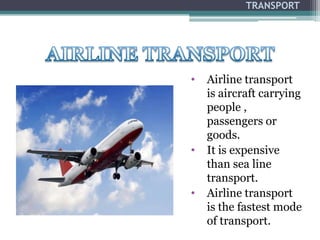
• Airline transport
is aircraft carrying
people ,
passengers or
goods.
• It is expensive
than sea line
transport.
• Airline transport
is the fastest mode
of transport.
CIRCUITS
o An electrical circuit is a closed loop formed by a power source, wires, a fuse, a
load, and a switch.
o When the switch is turned on, the electrical circuit is complete and current
flows from the negative terminal of the power source, through the wire to the
load, to the positive terminal.
o Any device that consumes the energy flowing through a circuit and converts
that energy into work is called a load.
o A light bulb is one example of a load; it consumes the electricity from a circuit
and converts it into work — heat and light.
THERE ARE THREE TYPES OF CIRCUITS.
The history of computer development is often
referred to in reference to the different generations of
computing devices.
 Each generation of computer is characterized by a
major technological development that fundamentally
changed the way computers operate, resulting in
increasingly smaller, cheaper, more powerful and
more efficient and reliable devices.
*First Generation (1940-1956)=
Vacuum Tubes
*The first computers used vacuum
tubes for circuitry and magnetic
drums for memory, and were
often enormous, taking up entire
rooms.
*They were very expensive to
operate and in addition to using
a great deal of
electricity, generated a lot of
heat, which was often the cause
of malfunctions.
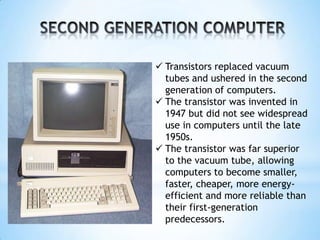
 Transistors replaced vacuum
tubes and ushered in the second
generation of computers.
 The transistor was invented in
1947 but did not see widespread
use in computers until the late
1950s.
 The transistor was far superior
to the vacuum tube, allowing
computers to become smaller,
faster, cheaper, more energy-
efficient and more reliable than
their first-generation
predecessors.
 The development of the
integrated circuit was
the hallmark of the third
generation of
computers.
 Transistors were
miniaturized and placed
on silicon chips, called
semiconductors, which
drastically increased the
speed and efficiency of
computers.
• The microprocessor brought
the fourth generation of
computers, as thousands of
integrated circuits were built
onto a single silicon chip.
• Microprocessors also
moved out of the realm of
desktop computers and into
many areas of life as more
and more everyday
products began to use
microprocessors.
o Fifth generation computing devices, based on artificial
intelligence, are still in development, though there are
some applications, such as voice recognition, that are
being used today.
o The use of parallel processing and superconductors is
helping to make artificial intelligence a reality.
o Quantum computation and molecular and nanotechnology
will radically change the face of computers in years to
come.
o The goal of fifth-generation computing is to develop
devices that respond to natural language input and are
capable of learning and self-organization.
 Cell phone technology is based on RADIO
technology and this was developed in
1940.
 The first official cell was used by Sweden
police in 1946
 First Generation (1G)
 Second Generation (2G)
 Third Generation (3G)
 Forth Generation (4G)
 First generation mobile had ability to transfer
call from one place to another while traveling .
 The first cellular network of first generation
was launched in japan in the year 1979 .
 Second generation was launched in the early 90,s
 This generation phones had digital network .
 The second generation network provide internet
and sums facilities .
SECOND GENERATION (2G)
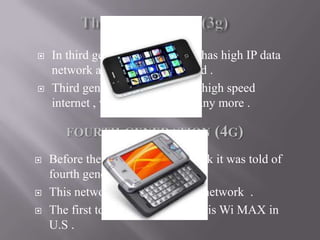
 In third generation network it has high IP data
network and mobile broadband .
 Third generation network has high speed
internet , video calling and many more .
 Before the launch of 3G network it was told of
fourth generation .
 This network is faster than 3G network .
 The first to provide this service is Wi MAX in
U.S .
FOURTH GENERATION (4G)
• Medical equipment is designed to aid in the diagnosis,
monitoring or treatment of medical conditions.
• Biomedical Equipment Technician or BMET knows how to
operate on the equipments.
• Classification:
Diagnostic equipment, such as ultrasound, MRI.
Therapeutic Equipment such as medical laser, infusion
pumps.
Medical monitors allow medical staff to measure a
patient's medical state.
Medical laboratory equipment like DNA analysis.
MEDICAL TECHNOLOGY
These are devices that constantly monitor certain vital
parameters of the human body such as pulse rate, heart beat
etc.
1950’s: Himmelstein and Scheiner invented the Cardiotachoschope
The Cardiotachoscope
 CRT view for ECG waveform.
 Alarm for high and low heart rates - Cardiophones.
 Heart rate indicator.
With time, devices started integrating like : Defibrillator & Monitor
with Integrated Non-invasive Pacing.
Physiological Monitors
Some Physiological Monitors
Electrodyne PM-65 Dallons Duo Trace Oscilloscope Burdick Memory Monitor
Spacelabs PC Express
1733: First recorded blood pressure measurement by Reverend
Stephen Hales
1847: Carl Ludwig’s Kymograph used catheters to inserted into
artery for blood pressure measurement.
Blood Pressure Measurement and Monitors
Kymograph
• U shaped Manometer tube connected
to a brass pipe inserted into the artery
• 1855: First non invasive method which
used inflatable cuffs
•1896: The first sphygmomanometer was
invented
Sphygmomanometer
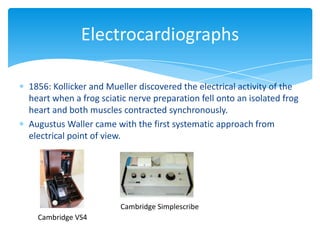
1856: Kollicker and Mueller discovered the electrical activity of the
heart when a frog sciatic nerve preparation fell onto an isolated frog
heart and both muscles contracted synchronously.
Augustus Waller came with the first systematic approach from
electrical point of view.
Electrocardiographs
Cambridge VS4
Cambridge Simplescribe
 SECURITY IS THE
PROTECTION OF
INFORMATION ASSETS
THROUGH THE USE OF
TECHNOLOGICAL
PROCESSES.
 IN ANCIENT TIMES
THERE WERE NO
SECURITY SYSTEMS
AS SUCH WHICH WE
FIND IN TODAYS
TECHNOLOGICAL
LIFESTYLES.
 A GROWING BRANCH OF
CCTV CAMERAS IS INTERNET
PROTOCOL CAMERAS.
 IP CAMERAS USE THE
INTERNET PROTOCOL USED
BY MOST LOCAL AREA
NETWORKS TO TRANSMIT
VIDEO ACROSS DATA
NETWORKS IN DIGITAL FORM.
 IP CAN BE TRANSMITTED
ACROSS THE PUBLIC
INTERNET, ALLOWING USERS
TO VIEW THEIR CAMERA.
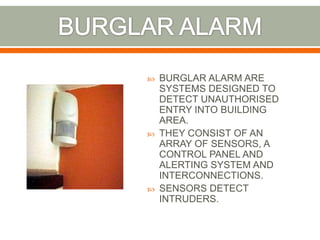
 BURGLAR ALARM ARE
SYSTEMS DESIGNED TO
DETECT UNAUTHORISED
ENTRY INTO BUILDING
AREA.
 THEY CONSIST OF AN
ARRAY OF SENSORS, A
CONTROL PANEL AND
ALERTING SYSTEM AND
INTERCONNECTIONS.
 SENSORS DETECT
INTRUDERS.
 Many consumers are
turning to wireless security
cameras for home
surveillance also.
 Wireless cameras do
not require a video cable
for video/audio
transmission, simply a
cable for power. Wireless
cameras are also easy and
inexpensive to install.
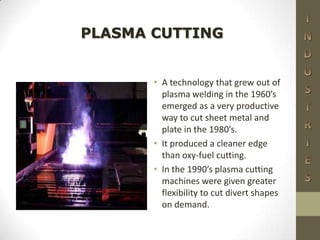
• A technology that grew out of
plasma welding in the 1960’s
emerged as a very productive
way to cut sheet metal and
plate in the 1980’s.
• It produced a cleaner edge
than oxy-fuel cutting.
• In the 1990’s plasma cutting
machines were given greater
flexibility to cut divert shapes
on demand.
PLASMA CUTTING
ELECTRICITY GENERATION
• The fundamentals
principles of electricity
generation were
discovered during the
1820’s and early 1830’s
by British scientist
Michael faraday.
• His basic method is still
used.
• Electricity has been
generated at central
stations since 1881
with the use of coal,
solar energy, tidal
energy, wind energy
and geothermal
sources.
LASER BRIDGE
• The first laser bridge for
embroidery machinery was
invented and realized in
1998 by “GMI S.R.L” of
Vittorio Veneto(ITALY).
• In 2010 “GMI” has reached
its third generation of laser
bridge with more
technologically
advancement offering new
3D laser head technology.
FUTURE CAR
 Landstorm concept is a vehicle
that is designed for
future, when airborne vehicles
will not be much effective to
reach a particular area because
of frequent natural disasters
which is the result of
future global warming.
 It is equipped with a collection
of hidden gadgets or
compartments and the ability to
interchange the pods located on
its back.
FUTURE LCD SCREEN
 Citizen Japan has unveiled a new
LCD technology -- called "memory
liquid crystal" -- that retains the
image even when turned off.
 Basically, its inorganic membrane
and angled orientation keep the
crystals frozen without needing
power.
 Practical applications would
include watches and mobile phone
displays.
FUTURE
Robots that were developed as
a means to enrich people’s
everyday lives have had so
much going on.
They are morphing from simple
industrial robots into intelligent
service providers through robot
technology convergence in
varied areas such as
education, medical
care, silver, national
defence, construction and
maritime fields.
DRAWBACKS OF TECHNOLOGY
0 Though we welcome
these blessing of
technology we have
to consider the outer
of the picture also .
0 Man has not been
able to face the
problem created by
inventions of
technology and to
stop the misuse or
harmful
consequences of
scientific inventions.
TECH-WARS
0 Again technology has put in
our hands such fiendish
weapons as the nuclear
bombs the guided missiles
and means of chemical and
biological warfare .
0 We are in danger of
destroying ourselves with
these monstrous means
which ironically , are out
own creations.
DRAWBACKS OF TECHNOLOGY
0 Machine have made available to
man plenty of leisure instead of
using leisure for creation and
recreation man is misusing it to
get cheap and vulgar
entertainment which destroys his
physical and mental health.
0 Rightly used technology can
bring heaven on earth wrongly
used it can turn this earth into
hell by destroying civilization.
Technology
Technology
Technology

Technology

  • 1.
  • 2.
    o Technology isthe evolution of an idea. o It’s the thinking of a man or woman who sees before them an opportunity to improve a process, or to create a device or object that facilitates, improves or aids something or someone else. o Technology is about a unique inspiration given the remit of creativity and the notion to express that idea as something real and tangible. o However, the motives for this spark of creativity aren’t always as laudable and arguably lamentable. WHAT IS TECHNOLOGY ?
  • 3.
  • 4.
      Up tillnow it is still a mystery as to who invented the wheel and when the wheel was invented.  It was made by joining planks of wood together.  It was a roller made of wood. WHEEL
  • 5.
     WHEEL FIRST STAGE  Earlyman placed roller beneath heavy objects so that they could move it easily. SECOND STAGE  Then they began to place runners under a heavy load which they discovered would make it easier for the load to drag.  This was the invention of sledge.
  • 6.
     WHEEL THIRD STAGE  Thenthey began to combine the roller and the sledge.  As the sledge moved forward first roller then the second roller was placed one after another to move the load forward. FOURTH STAGE  Men discovered that the rollers became grooved with use.  They soon discovered that these deeper grooves allowed the sledge to advance with greater distance before the next roller was needed to come on!
  • 7.
     WHEEL FIFTH STAGE  Theroller where changed into wheels.  The first wooden carts where made. SIXTH STAGE  A slight improvement was made to the cart.  Axel were drilled through the frame of the cart.  Axel and wheel were separated.
  • 8.
     WHEEL  Today wesee that the wheel has gone a great transformation from a simple one made of wood to the pneumatic rubber tyres that we see on vehicles today.  The wheel is probably the most important mechanical inventions of all times.  Nearly every machine built since the beginning of the industrial revolution has or needs wheels.  Its hard to imagine any mechanized system that would be possible without the wheel.  From tiny match gears to automobiles, jet engines and computer disk drives the principle is same.
  • 10.
    TRANSPORT  It isthe movement of people, cattle, ani mals and goods from one location to another.
  • 11.
    TRANSPORT • It isthe most common way of transport in olden days. • It is the least expensive way of transport.
  • 12.
    TRANSPORT An engine or motoris a machine designed to convert energy into useful mechanical motion.
  • 13.
    TRANSPORT  Ship transportis watercraft carrying people , passengers or goods.  Sea transport has been the largest carrier of goods and people throughout recorded history.
  • 14.
    TRANSPORT • Airline transport isaircraft carrying people , passengers or goods. • It is expensive than sea line transport. • Airline transport is the fastest mode of transport.
  • 15.
    CIRCUITS o An electricalcircuit is a closed loop formed by a power source, wires, a fuse, a load, and a switch. o When the switch is turned on, the electrical circuit is complete and current flows from the negative terminal of the power source, through the wire to the load, to the positive terminal. o Any device that consumes the energy flowing through a circuit and converts that energy into work is called a load. o A light bulb is one example of a load; it consumes the electricity from a circuit and converts it into work — heat and light.
  • 16.
    THERE ARE THREETYPES OF CIRCUITS.
  • 17.
    The history ofcomputer development is often referred to in reference to the different generations of computing devices.  Each generation of computer is characterized by a major technological development that fundamentally changed the way computers operate, resulting in increasingly smaller, cheaper, more powerful and more efficient and reliable devices.
  • 18.
    *First Generation (1940-1956)= VacuumTubes *The first computers used vacuum tubes for circuitry and magnetic drums for memory, and were often enormous, taking up entire rooms. *They were very expensive to operate and in addition to using a great deal of electricity, generated a lot of heat, which was often the cause of malfunctions.
  • 19.
     Transistors replacedvacuum tubes and ushered in the second generation of computers.  The transistor was invented in 1947 but did not see widespread use in computers until the late 1950s.  The transistor was far superior to the vacuum tube, allowing computers to become smaller, faster, cheaper, more energy- efficient and more reliable than their first-generation predecessors.
  • 20.
     The developmentof the integrated circuit was the hallmark of the third generation of computers.  Transistors were miniaturized and placed on silicon chips, called semiconductors, which drastically increased the speed and efficiency of computers.
  • 21.
    • The microprocessorbrought the fourth generation of computers, as thousands of integrated circuits were built onto a single silicon chip. • Microprocessors also moved out of the realm of desktop computers and into many areas of life as more and more everyday products began to use microprocessors.
  • 22.
    o Fifth generationcomputing devices, based on artificial intelligence, are still in development, though there are some applications, such as voice recognition, that are being used today. o The use of parallel processing and superconductors is helping to make artificial intelligence a reality. o Quantum computation and molecular and nanotechnology will radically change the face of computers in years to come. o The goal of fifth-generation computing is to develop devices that respond to natural language input and are capable of learning and self-organization.
  • 23.
     Cell phonetechnology is based on RADIO technology and this was developed in 1940.  The first official cell was used by Sweden police in 1946  First Generation (1G)  Second Generation (2G)  Third Generation (3G)  Forth Generation (4G)
  • 24.
     First generationmobile had ability to transfer call from one place to another while traveling .  The first cellular network of first generation was launched in japan in the year 1979 .  Second generation was launched in the early 90,s  This generation phones had digital network .  The second generation network provide internet and sums facilities . SECOND GENERATION (2G)
  • 25.
     In thirdgeneration network it has high IP data network and mobile broadband .  Third generation network has high speed internet , video calling and many more .  Before the launch of 3G network it was told of fourth generation .  This network is faster than 3G network .  The first to provide this service is Wi MAX in U.S . FOURTH GENERATION (4G)
  • 27.
    • Medical equipmentis designed to aid in the diagnosis, monitoring or treatment of medical conditions. • Biomedical Equipment Technician or BMET knows how to operate on the equipments. • Classification: Diagnostic equipment, such as ultrasound, MRI. Therapeutic Equipment such as medical laser, infusion pumps. Medical monitors allow medical staff to measure a patient's medical state. Medical laboratory equipment like DNA analysis. MEDICAL TECHNOLOGY
  • 28.
    These are devicesthat constantly monitor certain vital parameters of the human body such as pulse rate, heart beat etc. 1950’s: Himmelstein and Scheiner invented the Cardiotachoschope The Cardiotachoscope  CRT view for ECG waveform.  Alarm for high and low heart rates - Cardiophones.  Heart rate indicator. With time, devices started integrating like : Defibrillator & Monitor with Integrated Non-invasive Pacing. Physiological Monitors
  • 29.
    Some Physiological Monitors ElectrodynePM-65 Dallons Duo Trace Oscilloscope Burdick Memory Monitor Spacelabs PC Express
  • 30.
    1733: First recordedblood pressure measurement by Reverend Stephen Hales 1847: Carl Ludwig’s Kymograph used catheters to inserted into artery for blood pressure measurement. Blood Pressure Measurement and Monitors Kymograph • U shaped Manometer tube connected to a brass pipe inserted into the artery • 1855: First non invasive method which used inflatable cuffs •1896: The first sphygmomanometer was invented Sphygmomanometer
  • 31.
    1856: Kollicker andMueller discovered the electrical activity of the heart when a frog sciatic nerve preparation fell onto an isolated frog heart and both muscles contracted synchronously. Augustus Waller came with the first systematic approach from electrical point of view. Electrocardiographs Cambridge VS4 Cambridge Simplescribe
  • 32.
     SECURITY ISTHE PROTECTION OF INFORMATION ASSETS THROUGH THE USE OF TECHNOLOGICAL PROCESSES.  IN ANCIENT TIMES THERE WERE NO SECURITY SYSTEMS AS SUCH WHICH WE FIND IN TODAYS TECHNOLOGICAL LIFESTYLES.
  • 33.
     A GROWINGBRANCH OF CCTV CAMERAS IS INTERNET PROTOCOL CAMERAS.  IP CAMERAS USE THE INTERNET PROTOCOL USED BY MOST LOCAL AREA NETWORKS TO TRANSMIT VIDEO ACROSS DATA NETWORKS IN DIGITAL FORM.  IP CAN BE TRANSMITTED ACROSS THE PUBLIC INTERNET, ALLOWING USERS TO VIEW THEIR CAMERA.
  • 34.
     BURGLAR ALARMARE SYSTEMS DESIGNED TO DETECT UNAUTHORISED ENTRY INTO BUILDING AREA.  THEY CONSIST OF AN ARRAY OF SENSORS, A CONTROL PANEL AND ALERTING SYSTEM AND INTERCONNECTIONS.  SENSORS DETECT INTRUDERS.
  • 35.
     Many consumersare turning to wireless security cameras for home surveillance also.  Wireless cameras do not require a video cable for video/audio transmission, simply a cable for power. Wireless cameras are also easy and inexpensive to install.
  • 36.
    • A technologythat grew out of plasma welding in the 1960’s emerged as a very productive way to cut sheet metal and plate in the 1980’s. • It produced a cleaner edge than oxy-fuel cutting. • In the 1990’s plasma cutting machines were given greater flexibility to cut divert shapes on demand. PLASMA CUTTING
  • 37.
    ELECTRICITY GENERATION • Thefundamentals principles of electricity generation were discovered during the 1820’s and early 1830’s by British scientist Michael faraday. • His basic method is still used. • Electricity has been generated at central stations since 1881 with the use of coal, solar energy, tidal energy, wind energy and geothermal sources.
  • 38.
    LASER BRIDGE • Thefirst laser bridge for embroidery machinery was invented and realized in 1998 by “GMI S.R.L” of Vittorio Veneto(ITALY). • In 2010 “GMI” has reached its third generation of laser bridge with more technologically advancement offering new 3D laser head technology.
  • 39.
    FUTURE CAR  Landstormconcept is a vehicle that is designed for future, when airborne vehicles will not be much effective to reach a particular area because of frequent natural disasters which is the result of future global warming.  It is equipped with a collection of hidden gadgets or compartments and the ability to interchange the pods located on its back.
  • 40.
    FUTURE LCD SCREEN Citizen Japan has unveiled a new LCD technology -- called "memory liquid crystal" -- that retains the image even when turned off.  Basically, its inorganic membrane and angled orientation keep the crystals frozen without needing power.  Practical applications would include watches and mobile phone displays. FUTURE
  • 42.
    Robots that weredeveloped as a means to enrich people’s everyday lives have had so much going on. They are morphing from simple industrial robots into intelligent service providers through robot technology convergence in varied areas such as education, medical care, silver, national defence, construction and maritime fields.
  • 44.
    DRAWBACKS OF TECHNOLOGY 0Though we welcome these blessing of technology we have to consider the outer of the picture also . 0 Man has not been able to face the problem created by inventions of technology and to stop the misuse or harmful consequences of scientific inventions.
  • 45.
    TECH-WARS 0 Again technologyhas put in our hands such fiendish weapons as the nuclear bombs the guided missiles and means of chemical and biological warfare . 0 We are in danger of destroying ourselves with these monstrous means which ironically , are out own creations.
  • 46.
    DRAWBACKS OF TECHNOLOGY 0Machine have made available to man plenty of leisure instead of using leisure for creation and recreation man is misusing it to get cheap and vulgar entertainment which destroys his physical and mental health. 0 Rightly used technology can bring heaven on earth wrongly used it can turn this earth into hell by destroying civilization.