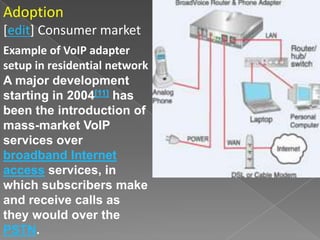
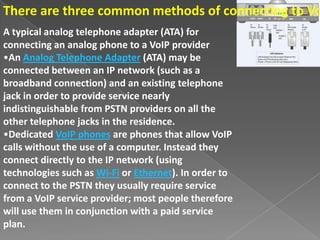
Voice over Internet Protocol (VoIP), is a technology that allows you to make voice calls using a broadband Internet connection instead of a regular (or analog) phone line. Some VoIP services may only allow you to call other people using the same service, but others may allow you to call anyone who has a telephone number - including local, long distance, mobile, and international numbers. Also, while some VoIP services only work over your computer or a special VoIP phone, other services allow you to use a traditional phone connected to a VoIP adapter.
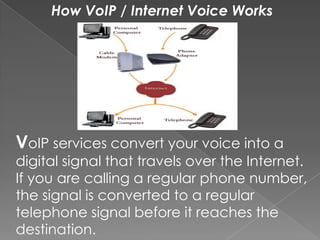
How VoIP / Internet Voice WorksVoIP services convert your voice into a digital signal that travels over the Internet. If you are calling a regular phone number, the signal is converted to a regular telephone signal before it reaches the destination.
If I have VoIP service, who can I call?Depending upon your service, you might be limited only to other subscribers to the service, or you may be able to call anyone who has a telephone number - including local, long distance, mobile, and international numbers. If you are calling someone who has a regular analog phone, that person does not need any special equipment to talk to you. Some VoIP services may allow you to speak with more than one person at a time.
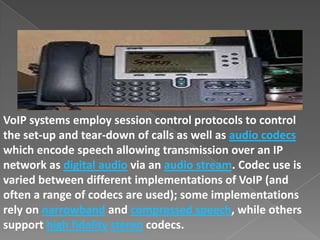
VoIP systems employ session control protocols to control the set-up and tear-down of calls as well as audio codecs which encode speech allowing transmission over an IP network as digital audio via an audio stream. Codec use is varied between different implementations of VoIP (and often a range of codecs are used); some implementations rely on narrowband and compressed speech, while others support high fidelitystereocodecs.
 History1974 — The Institute of Electrical and Electronic Engineers (IEEE) published a paper                  	titled "A Protocol for Packet Network Interconnection."
1981 — IPv4 is described in RFC 791.
1985 — The National Science Foundation commissions the creation of NSFNET.
1995 — VocalTec releases the first commercial Internet phone software.
1996 —
ITU-T begins development of standards for the transmission and signaling of voice communications over Internet Protocol networks with the H.323 standard.
US telecommunication companies petition the US Congress to ban Internet phone technology.
1997 — Level 3 began development of its first softswitch, a term they coined in 1998.
1999 —
The Session Initiation Protocol (SIP) specification RFC 2543 is released
Mark Spencer of Digium develops the first open sourcePrivate branch exchange (PBX) software (Asterisk).
2004 — Commercial VoIP service providers proliferate]

Kartik Powerpoit

  • 1.
    Voice over InternetProtocol (VoIP), is a technology that allows you to make voice calls using a broadband Internet connection instead of a regular (or analog) phone line. Some VoIP services may only allow you to call other people using the same service, but others may allow you to call anyone who has a telephone number - including local, long distance, mobile, and international numbers. Also, while some VoIP services only work over your computer or a special VoIP phone, other services allow you to use a traditional phone connected to a VoIP adapter.
  • 2.
    How VoIP /Internet Voice WorksVoIP services convert your voice into a digital signal that travels over the Internet. If you are calling a regular phone number, the signal is converted to a regular telephone signal before it reaches the destination.
  • 3.
    If I haveVoIP service, who can I call?Depending upon your service, you might be limited only to other subscribers to the service, or you may be able to call anyone who has a telephone number - including local, long distance, mobile, and international numbers. If you are calling someone who has a regular analog phone, that person does not need any special equipment to talk to you. Some VoIP services may allow you to speak with more than one person at a time.
  • 4.
    VoIP systems employsession control protocols to control the set-up and tear-down of calls as well as audio codecs which encode speech allowing transmission over an IP network as digital audio via an audio stream. Codec use is varied between different implementations of VoIP (and often a range of codecs are used); some implementations rely on narrowband and compressed speech, while others support high fidelitystereocodecs.
  • 5.
    History1974 — TheInstitute of Electrical and Electronic Engineers (IEEE) published a paper titled "A Protocol for Packet Network Interconnection."
  • 6.
    1981 — IPv4 isdescribed in RFC 791.
  • 7.
    1985 — The NationalScience Foundation commissions the creation of NSFNET.
  • 8.
    1995 — VocalTec releasesthe first commercial Internet phone software.
  • 9.
  • 10.
    ITU-T begins developmentof standards for the transmission and signaling of voice communications over Internet Protocol networks with the H.323 standard.
  • 11.
    US telecommunication companiespetition the US Congress to ban Internet phone technology.
  • 12.
    1997 — Level 3began development of its first softswitch, a term they coined in 1998.
  • 13.
  • 14.
    The Session InitiationProtocol (SIP) specification RFC 2543 is released
  • 15.
    Mark Spencer ofDigium develops the first open sourcePrivate branch exchange (PBX) software (Asterisk).
  • 16.
    2004 — Commercial VoIPservice providers proliferate]