VOIP & Asterisk introduction  ir. Zaccone Carmelo Expert en Télécommunications et Technologies de l'Information Agence Wallonne des Télécommunications  www.awt.be Avenue de Stassart, 16  Tél.:  +32 81 77.80.76 B-5000 NAMUR  www.linkedin.com/in/zaccone Professional users of Free & Open Source Software  October 9 & 10 2007: Asterisk and VoIP Event
Preamble Who’s AWT ?
AWT in a nutshell:   an agency of the  Belgian Walloon Government Convergence and diffusion center for  ICT in the Walloon Region of Belgium  (« all online» strategy). The AWT produces, gathers and federates ICT contents and services. The portal is at the same time a project of contents and a technical demonstration   The AWT  has huge knowledge in the fields of online publication and information dissemination ICT reference Newsletter ( size 9-10k ) AWT Portal : 3,5 millions pages seen/year ( be 66%,  fr 19%, us 1%, ca 2%, other fr 10%,rest 2% )
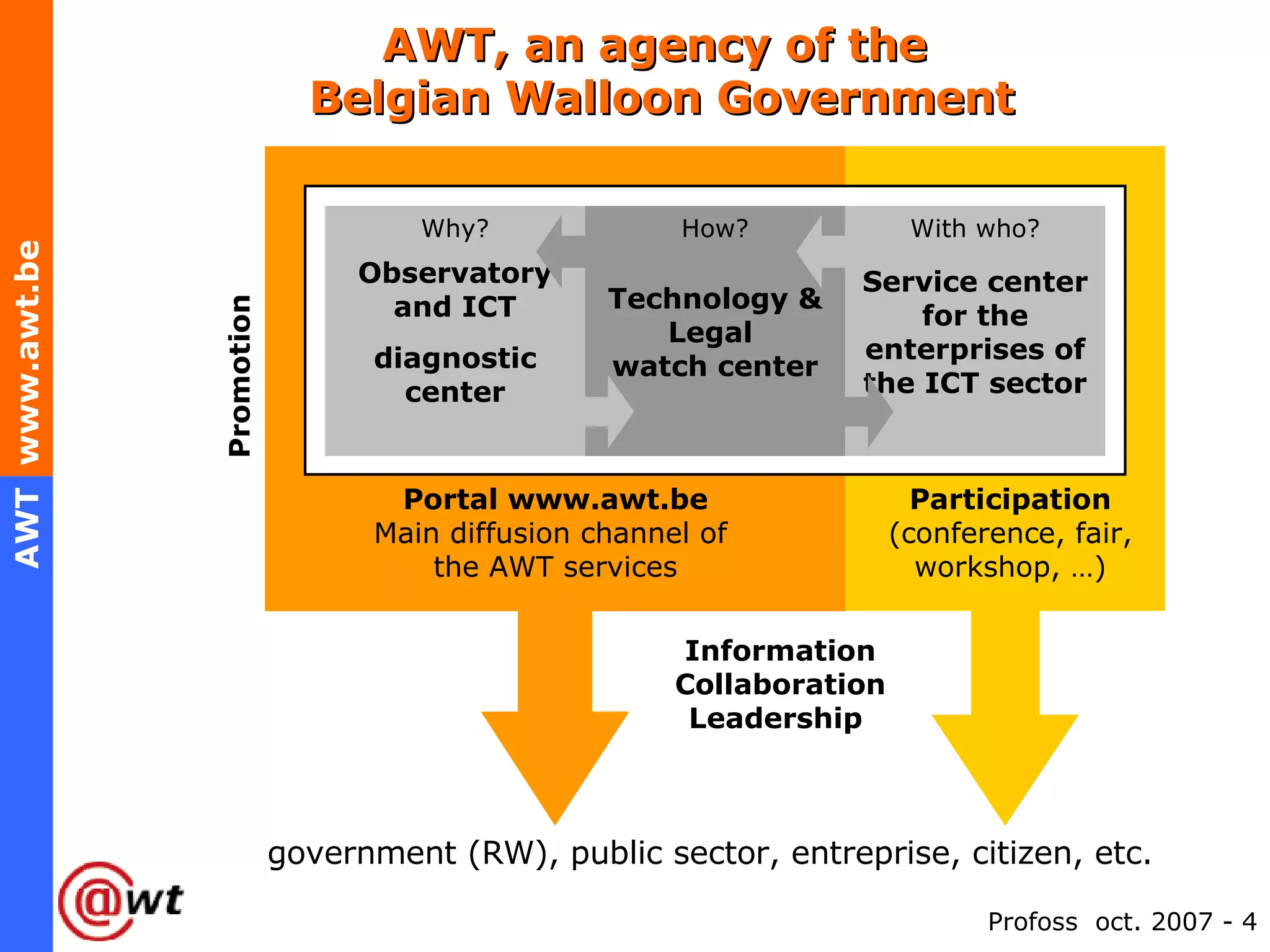
AWT, an agency of the  Belgian Walloon Government Observatory and ICT diagnostic center Technology & Legal  watch center Service center for the enterprises of the ICT sector Information Collaboration Leadership  Portal www.awt.be Main diffusion channel of  the AWT services Participation (conference, fair, workshop, …) government (RW), public sector, entreprise, citizen, etc. Promotion Why? How? With who?
Telephony Analog or digital? PSTN or converging ?
How telephony operates Simple definition: « Art to correspond through long distances using sound » 1   « Telephony is the establishment of a link, by the instantaneous transmission of remote sound, between two or several interlocutors having the need to establish a vocal communication. » Voice is a sound, therefore: appears itself as a sound wave is transmitted naturally, by the propagation of a vibration (over the air or a material) is transmitted artificially, by the propagation of an electric signal (analogical or digital) captured thru a microphone restored thru loudspeaker 1  © Sciences de Bouillet, 1750
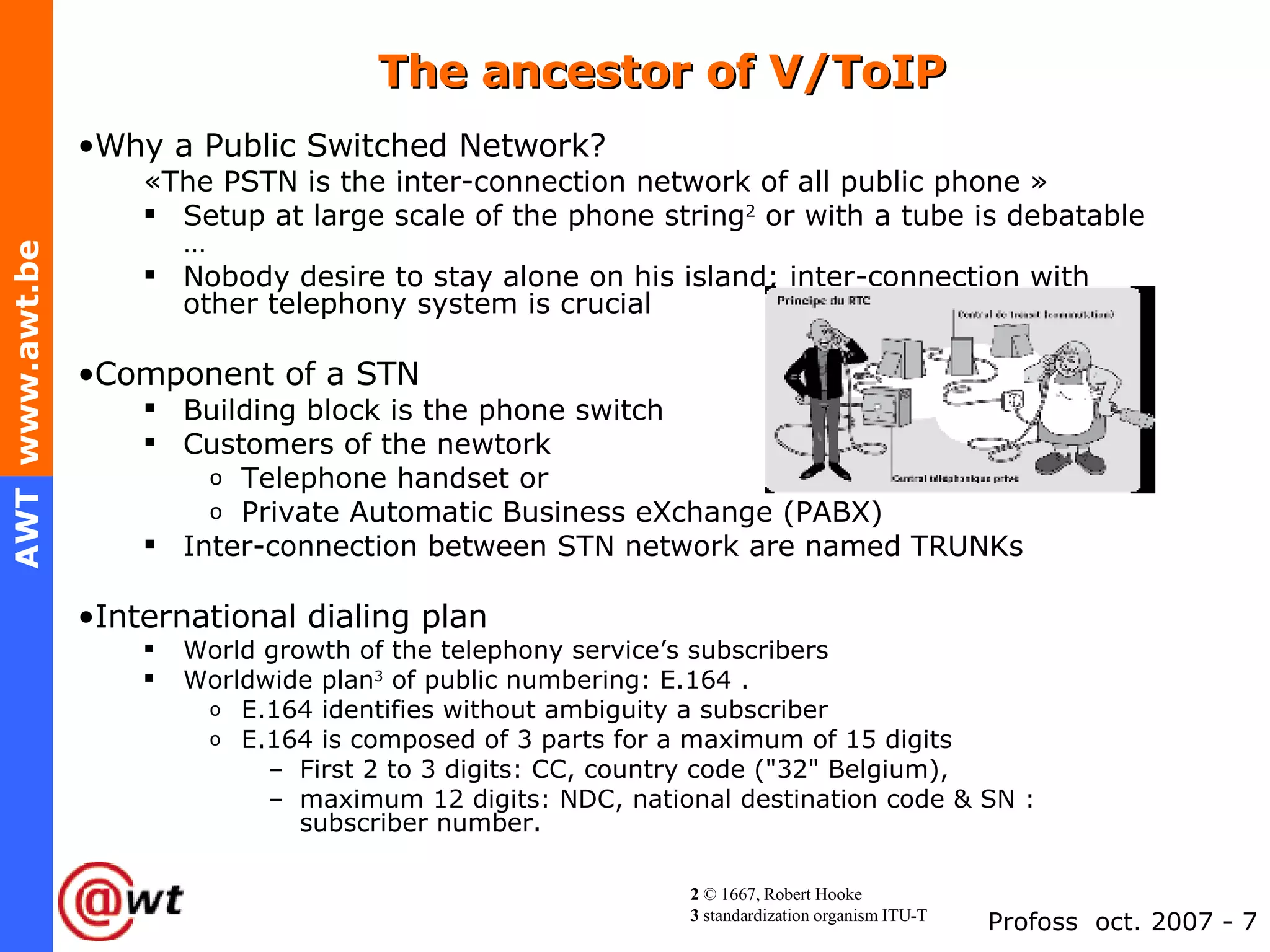
The ancestor of V/ToIP Why a Public Switched Network? «The PSTN is the inter-connection network of all public phone »  Setup at large scale of the phone string 2  or with a tube is debatable … Nobody desire to stay alone on his island; inter-connection with other telephony system is crucial Component of a STN Building block is the phone switch Customers of the newtork  Telephone handset or  Private Automatic Business eXchange (PABX) Inter-connection between STN network are named TRUNKs International dialing plan World growth of the telephony service’s subscribers Worldwide plan 3  of public numbering: E.164 . E.164 identifies without ambiguity a subscriber E.164 is composed of 3 parts for a maximum of 15 digits First 2 to 3 digits: CC, country code ("32" Belgium), maximum 12 digits: NDC, national destination code & SN : subscriber number. 2  © 1667, Robert Hooke 3  standardization organism ITU-T
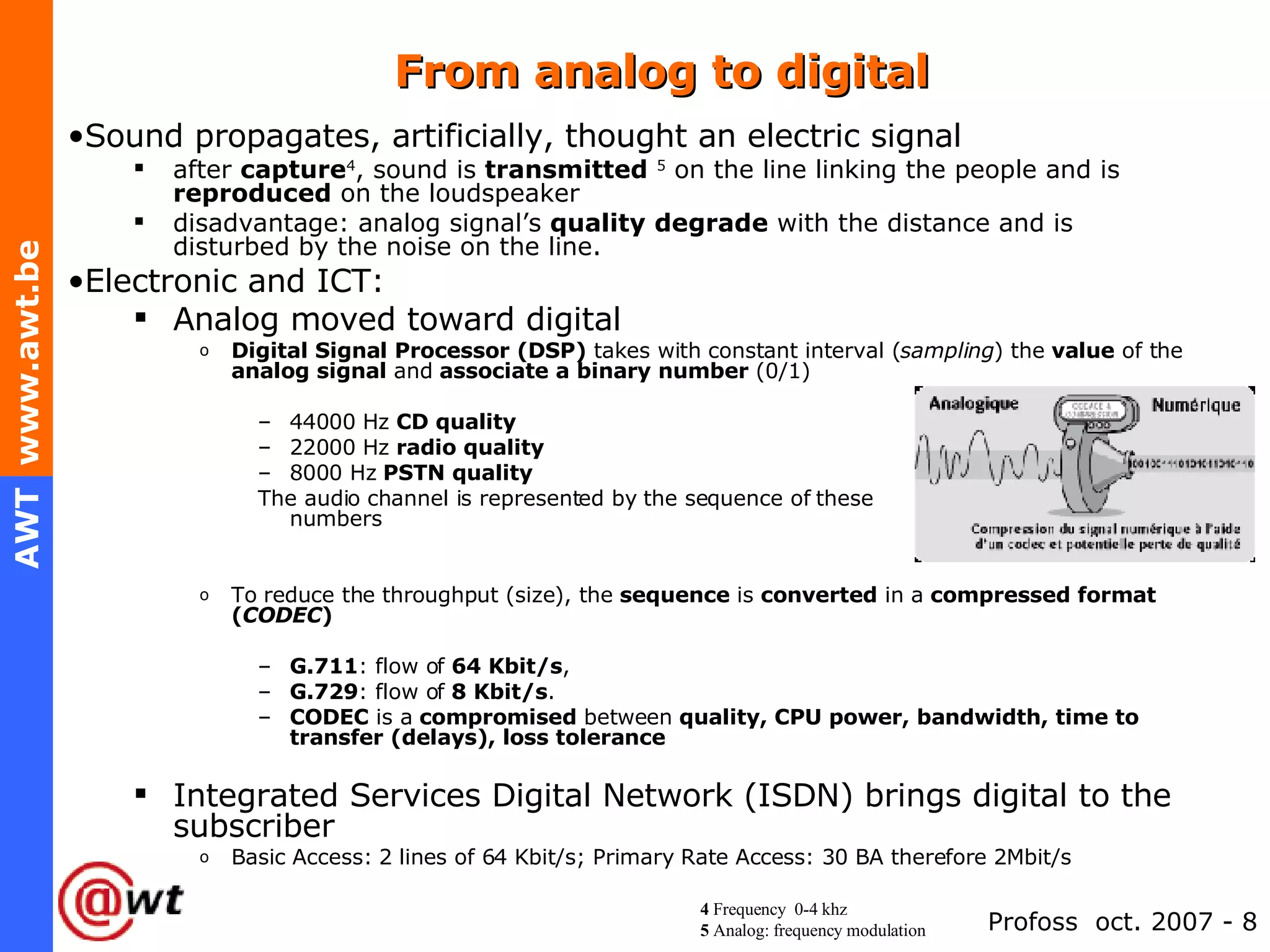
From analog to digital Sound propagates, artificially, thought an electric signal after  capture 4 , sound is  transmitted   5  on the line linking the people and is  reproduced  on the loudspeaker disadvantage: analog signal’s  quality   degrade  with the distance and is disturbed by the noise on the line. Electronic and ICT: Analog moved toward digital  Digital Signal Processor (DSP)  takes with constant interval ( sampling ) the  value  of the  analog signal  and  associate a binary number  (0/1) 44000 Hz  CD quality 22000 Hz  radio quality 8000 Hz  PSTN quality The audio channel is represented by the sequence of these  numbers To reduce the throughput (size), the  sequence  is  converted  in a  compressed format ( CODEC ) G.711 : flow of  64 Kbit/s , G.729 : flow of  8 Kbit/s . CODEC  is a  compromised  between  quality, CPU power, bandwidth, time to transfer (delays), loss tolerance Integrated Services Digital Network (ISDN) brings digital to the subscriber Basic Access: 2 lines of 64 Kbit/s; Primary Rate Access: 30 BA therefore 2Mbit/s 4  Frequency  0-4 khz 5  Analog: frequency modulation
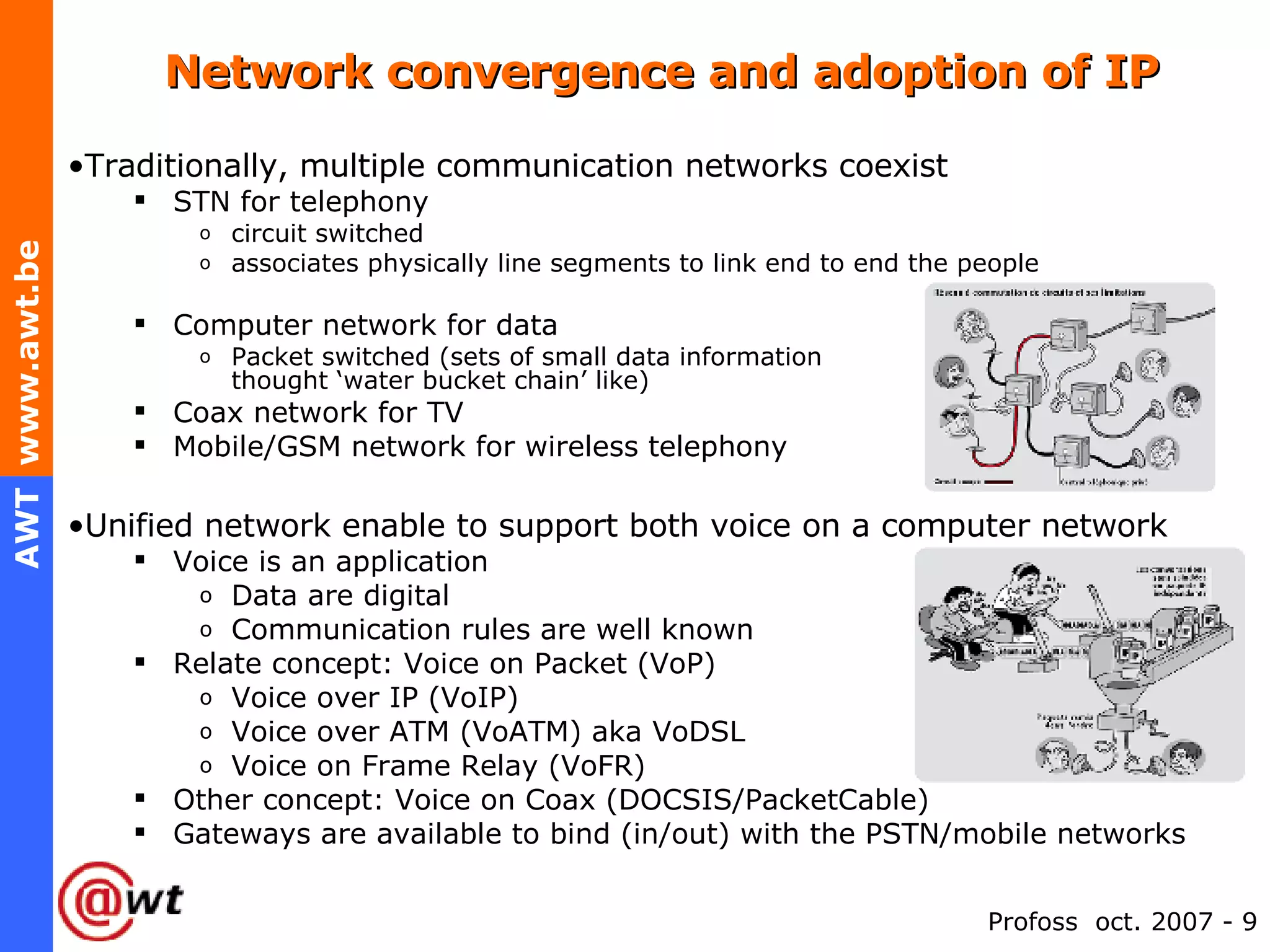
Network convergence and adoption of IP Traditionally, multiple communication networks coexist STN for telephony circuit switched associates physically line segments to link end to end the people Computer network for data Packet switched (sets of small data information  thought ‘water bucket chain’ like) Coax network for TV Mobile/GSM network for wireless telephony Unified network enable to support both voice on a computer network Voice is an application Data are digital Communication rules are well known Relate concept: Voice on Packet (VoP) Voice over IP (VoIP) Voice over ATM (VoATM) aka VoDSL Voice on Frame Relay (VoFR) Other concept: Voice on Coax (DOCSIS/PacketCable) Gateways are available to bind (in/out) with the PSTN/mobile networks
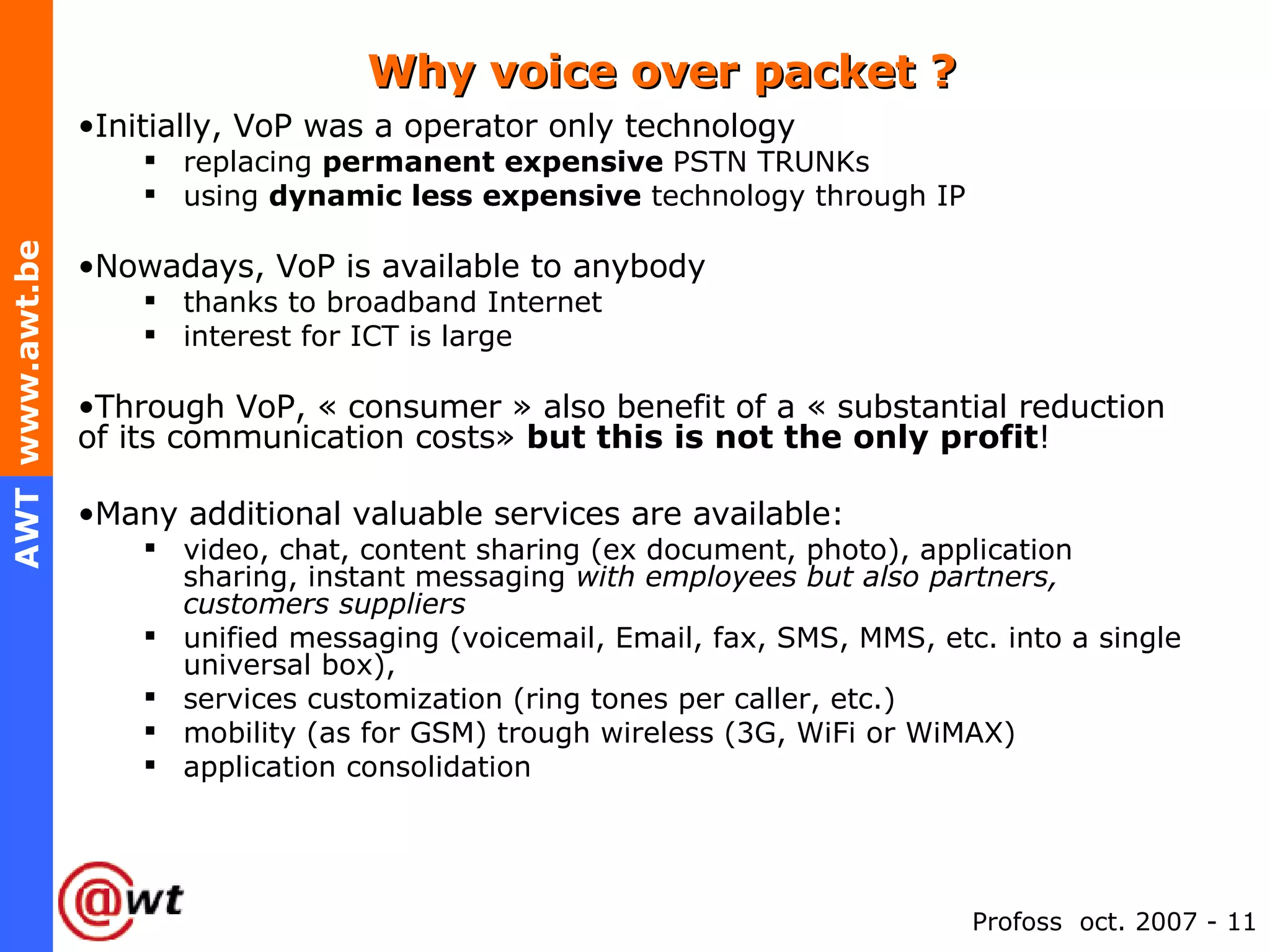
Success factors Migrating to voice over packet ? Removing the PBX for IP telephony ? When to replace the PBX ?
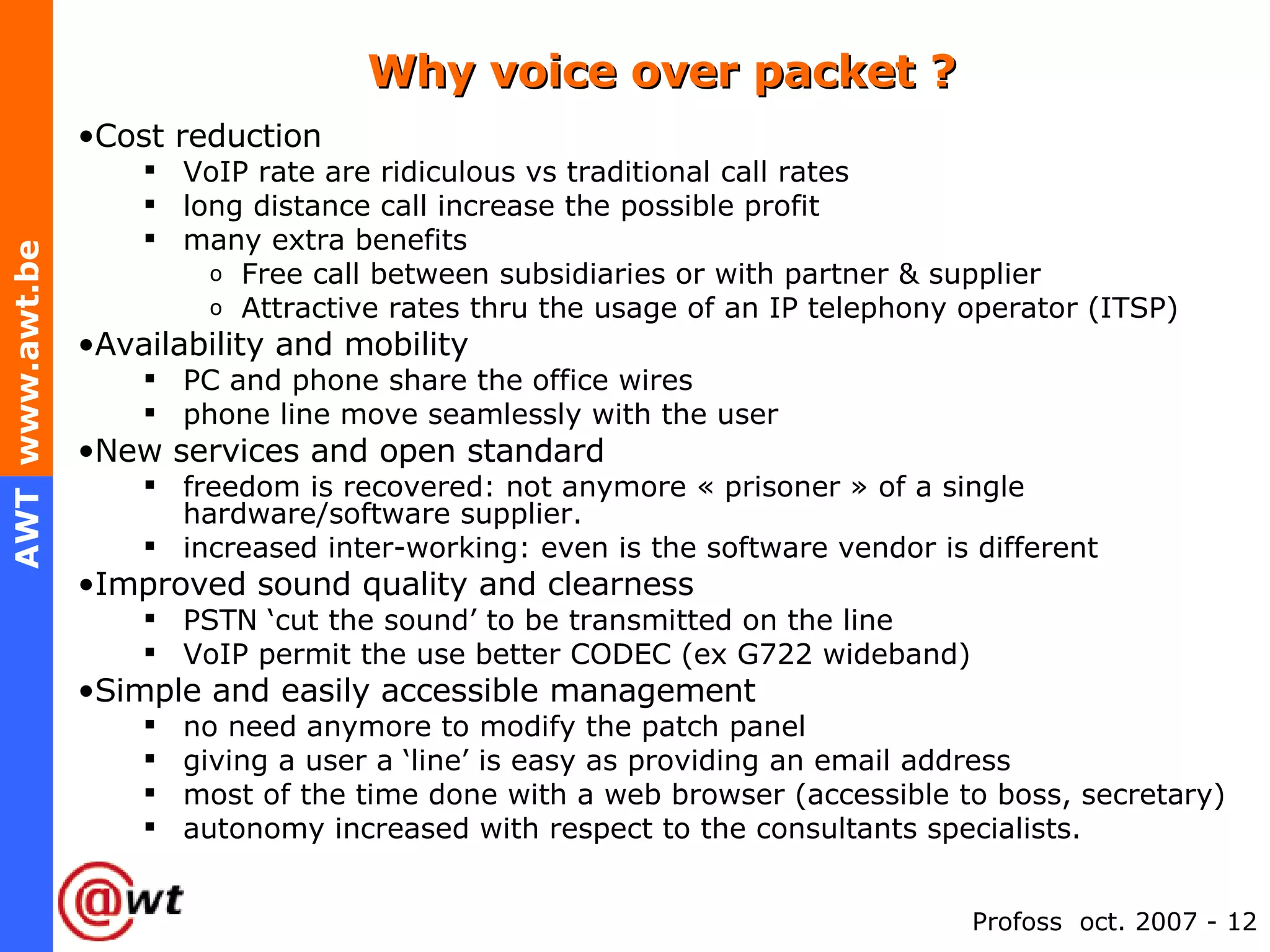
Why voice over packet ? Initially, VoP was a operator only technology replacing  permanent expensive  PSTN TRUNKs using  dynamic less expensive  technology through IP Nowadays, VoP is available to anybody thanks to broadband Internet interest for ICT is large Through VoP, « consumer » also benefit of a « substantial reduction of its communication costs»  but this is not the only profit ! Many additional valuable services are available: video, chat, content sharing (ex document, photo), application sharing, instant messaging  with employees but also partners, customers suppliers unified messaging (voicemail, Email, fax, SMS, MMS, etc. into a single universal box), services customization (ring tones per caller, etc.) mobility (as for GSM) trough wireless (3G, WiFi or WiMAX) application consolidation
Why voice over packet ? Cost reduction VoIP rate are ridiculous vs traditional call rates long distance call increase the possible profit many extra benefits Free call between subsidiaries or with partner & supplier Attractive rates thru the usage of an IP telephony operator (ITSP) Availability and mobility PC and phone share the office wires phone line move seamlessly with the user New services and open standard freedom is recovered: not anymore « prisoner » of a single hardware/software supplier. increased inter-working: even is the software vendor is different Improved sound quality and clearness PSTN ‘cut the sound’ to be transmitted on the line VoIP permit the use better CODEC (ex G722 wideband) Simple and easily accessible management no need anymore to modify the patch panel giving a user a ‘line’ is easy as providing an email address most of the time done with a web browser (accessible to boss, secretary) autonomy increased with respect to the consultants specialists.
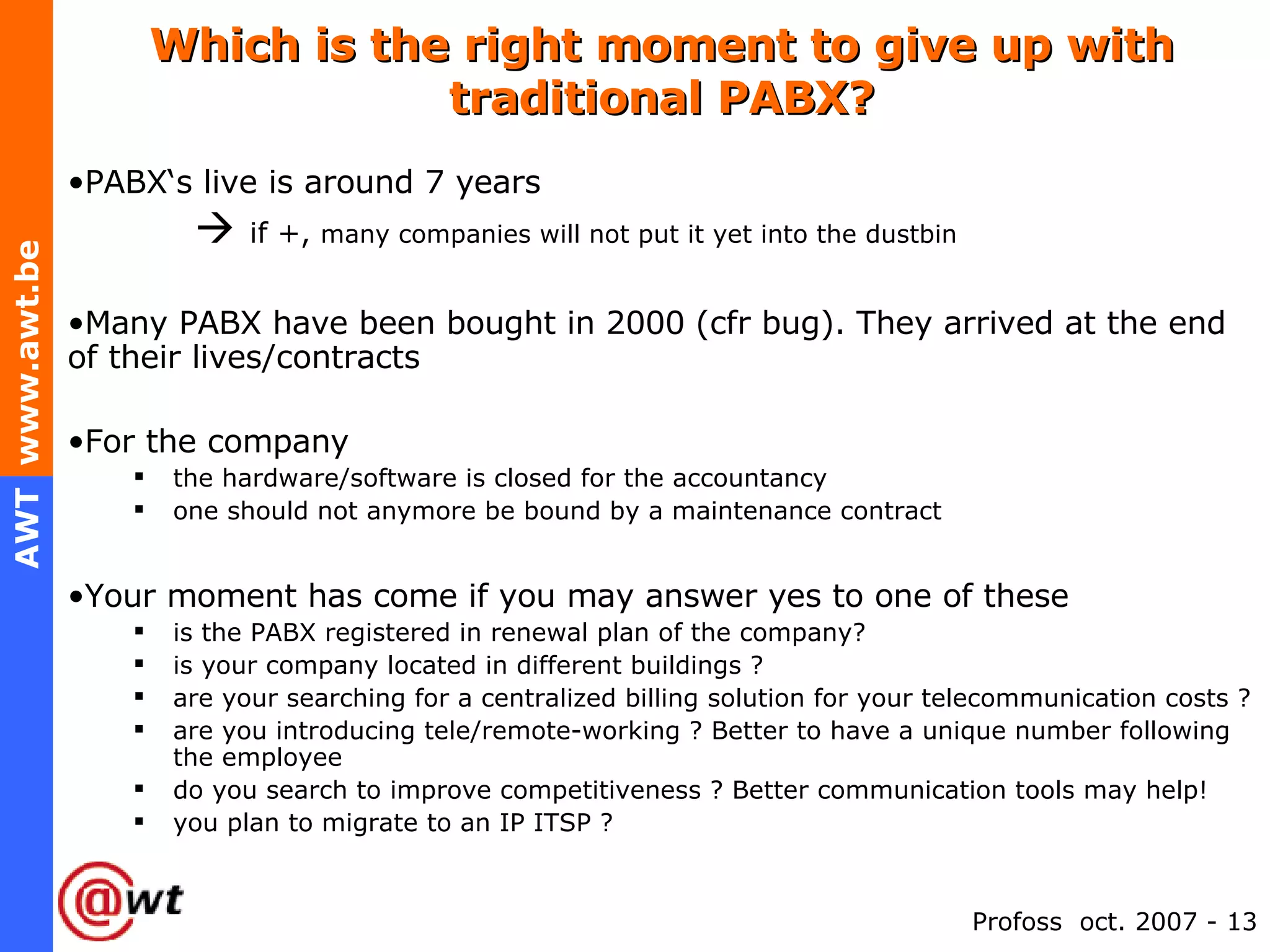
Which is the right moment to give up with traditional PABX? PABX‘s live is around 7 years    if +,  many companies will not put it yet into the dustbin Many PABX have been bought in 2000 (cfr bug). They arrived at the end of their lives/contracts For the company the hardware/software is closed for the accountancy one should not anymore be bound by a maintenance contract Your moment has come if you may answer yes to one of these is the PABX registered in renewal plan of the company?  is your company located in different buildings ? are your searching for a centralized billing solution for your telecommunication costs ? are you introducing tele/remote-working ? Better to have a unique number following the employee do you search to improve competitiveness ? Better communication tools may help! you plan to migrate to an IP ITSP ?
What is IP telephony ? Distinction between VoIP, trunking, ToIP, Internet Telephony, … The « bridges » between IP & PSTN worlds
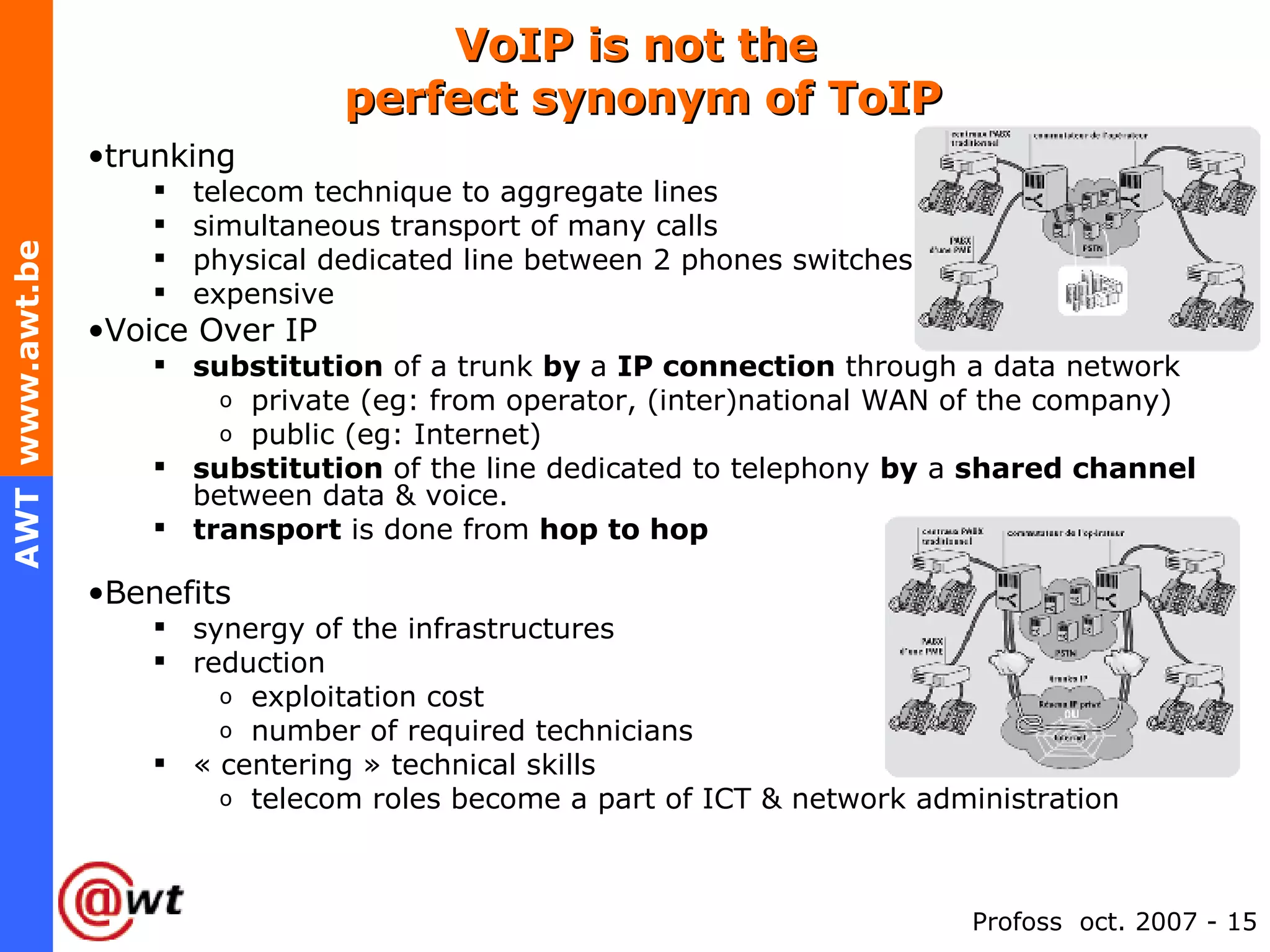
VoIP is not the  perfect synonym of ToIP trunking telecom technique to aggregate lines simultaneous transport of many calls physical dedicated line between 2 phones switches expensive  Voice Over IP substitution  of a trunk  by  a  IP connection  through a data network private (eg: from operator, (inter)national WAN of the company) public (eg: Internet) substitution  of the line dedicated to telephony  by  a  shared channel  between data & voice. transport  is done from  hop to hop Benefits synergy of the infrastructures reduction  exploitation cost  number of required technicians « centering » technical skills telecom roles become a part of ICT & network administration
VoIP is not the  perfect synonym of ToIP Telephony over IP « ultimate  » stage in the  migration  to ‘all IP’ transport  with packet is done  end to end Important strep towards the notion of  services convergence replace   traditional telephone by a « IP phone » the hardware  PBX  by a  Server Software 9  or an  IPpbx  (running on an OS: Windows, Linux, Unix,…) Characteristics of ToIP. one replace phone jack (RJ11) with a network plug (RJ45) analog/digital interface by an interface using IP protocol traditional signaling (SS7, ISDN) by voice over IP (H.323, SIP, IAX) (vendor specific) phone headset a new phone terminal  a software (softphone) usable on a PC, PDA, Smartphone,…   9 also named SoftSwitch
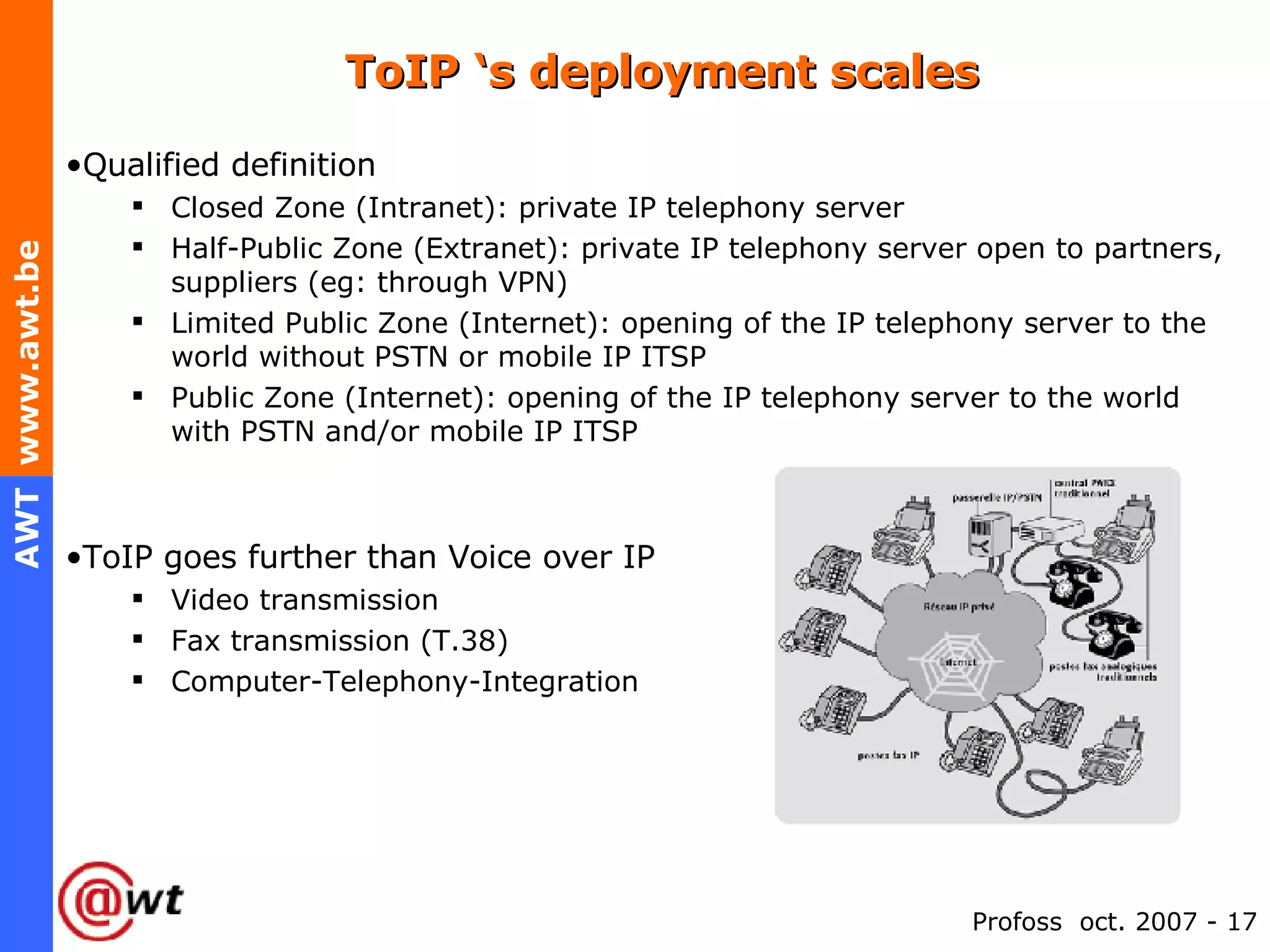
ToIP ‘s deployment scales Qualified definition Closed Zone (Intranet): private IP telephony server Half-Public Zone (Extranet): private IP telephony server open to partners, suppliers (eg: through VPN) Limited Public Zone (Internet): opening of the IP telephony server to the world without PSTN or mobile IP ITSP Public Zone (Internet): opening of the IP telephony server to the world with PSTN and/or mobile IP ITSP ToIP goes further than Voice over IP  Video transmission Fax transmission (T.38) Computer-Telephony-Integration
New phone headset IP Telephony: Hardphone Softphone Analogue Telephone Adapter (ATA)
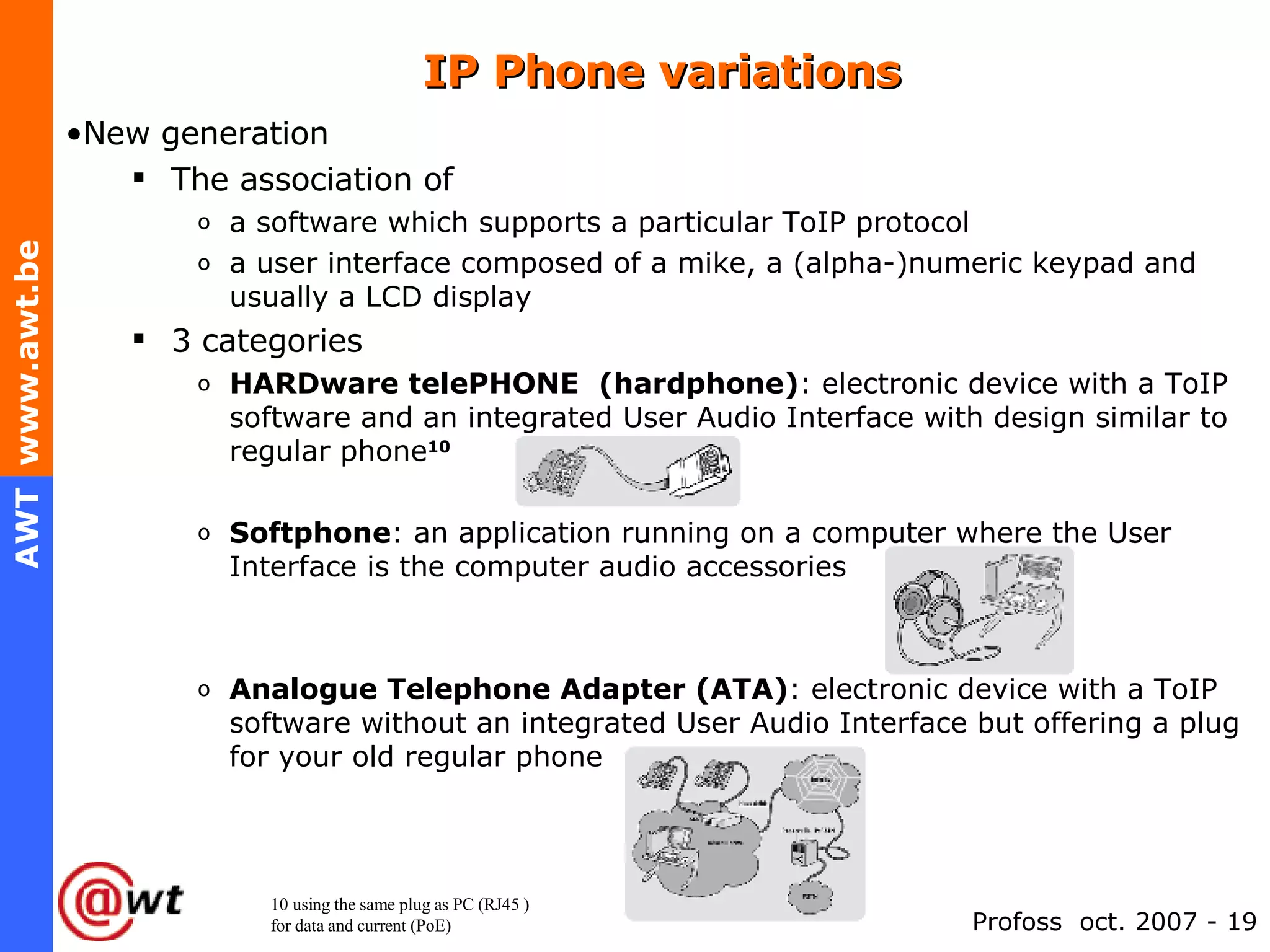
IP Phone variations New generation  The association of a software which supports a particular ToIP protocol  a user interface composed of a mike, a (alpha-)numeric keypad and usually a LCD display 3 categories HARDware telePHONE  (hardphone) : electronic device with a ToIP software and an integrated User Audio Interface with design similar to regular phone 10 Softphone : an application running on a computer where the User Interface is the computer audio accessories Analogue Telephone Adapter (ATA) : electronic device with a ToIP software without an integrated User Audio Interface but offering a plug for your old regular phone 10 using the same plug as PC (RJ45 )  for data and current (PoE)
Telephony application Operation of this application Securing this application Potential of the application:  Computer Telephony Integration (CTI)
Operation principles IP communication establishment is realized in two steps: reciprocal presentation of the phone application setting up the media(s) stream channel(s) Numerous techniques to achieve the first step proprietary :  many solutions appeared in the 90’s with the Internet protocol not recognized as worldwide standard often lack of interoperability: user is confined is his community protocol may be publicly available ( eg IAX, Jingle ) or totally private ( eg Skype, MSN ) standardized: the software is compliant with a well known and defined protocol ( eg H.323, SIP ) interoperability: user in one community may contact whoever in other compliant communities international organization bodies:  ITU-T: telecom oriented, specification must be bought IETF: Internet philosophy, specification is free broader availability and choice of products/softwares Broader dimension than simply voice! Additional media: video,  white board,  written text (chat/im) whatever useful application: presentation, co-browsing A simple voice call become an collaboration session    with a rich media experience
First step: Network parameter exchange At the user level, Mutual exchange of the “digital identity” traditional phone number (E.164), virtual identity: nickname, loginname real firstname or name, email address, All of these may be taken from a directory (LDAP, MS AD) At the application level Mutual exchange 11  of endpoints network information what is the IP address of your communication software? what are the TCP/UDP ports your communication software uses for audio, video, text messages, etc ? Technical term is «call signaling » Many signaling protocol have been created SIP: Session Initiation Protocol, IAX, Inter Asterisk eXchange H.323: Packet-based multimedia  communications architecture, Net2Phone, Skype, MSN, Jingle, Megaco / H.248: Media Gateway Control protocol, SCCP: Cisco Skinny Client Control Protocol, etc 11 If peer is on PSTN/mobile, parameter (IP & ports) are those from the gateway
Internet sharing (PAT/NAT) is a problem Network Address Translation (NAT):   public IP size < number of stations on the LAN a LAN station is temporary FULLY publicly available (like dialup in the 90’s)  Network Address Port Translation (PAT) all LAN’s stations share the SAME public IP address a LAN station is temporary publicly available with limitation Some ports may be  already allocated  to another LAN station! Problem occurs if the following private IP address are used 10.0.0.0/8 172.16.0.0/12 192.168.0.0/16 169.254.0.0/16  Negotiated network parameters are only valid on the private LAN Impossible to communicate with the outside (partner, supplier, low cost ITSP) Solutions Using public IP address on all phone: get more public address (IPv6) Forcing old fashioned methodology (all calls through a single box such an IPpbx) Using ‘technical tricks’ Using dynamic hostname resolution (DynDNS,…) Dedicated technologies: IETF STUN: Simple Traversal of UDP through NATs IETF (work in progress) ICE: Interactive Connectivity Establishment1 UPnP: Universal Plug and Play  IETF MIDCOM :  Middlebox Communication, Firewall Control Protocol
Second step: The communication itself After technical parameters exchange, media transport application(s) takes the relay Medias may have different requirement real time (audio, video, presentation sharing) asynchronous (IM, chat) Transport technology missions are to transform the media using a CODEC to create the IP packets to send to realize the transmission of these IP packets to the destination to reorder these IP packets after reception to detect and resolve packet loss etc Real time transport technologies: Real-Time Protocol (RTP): data, audio, video Real-Time Control Protocol (RTCP): ensuring QoS for RTP Compressed Real Time Protocol (cRTP) or Enhanced Compressed Real Time Protocol (ecRTP): RTP alternative  for slow network (GPRS/UMTS) Secure Real-Time Protocol (sRTP) & Secure Real-Time Control Protocol (sRTCP): RTP/RTCP with confidentiality
Security challenges in IP telephony Identification/Authentication. Avoiding tool frauds usurpation of the identity of the participants that the communication be torn down by someone else altered by someone else (headers, session description, etc) deviated to someone else  Confidentiality. Avoiding that by someone non authorized   collect some data (subjet/time/duration of the call, participants) capture and listen  to the communication streams (wiretapping) Quality of Service avoiding conversation’s or video’s quality degrades avoiding that the communication does finish suddenly ensuring that the communication can be established
Securing IP telephony V/ToIP has become an application!    vulnerable to the same problems as the other network’ softwares Possible attack’ scenarios attacks against the operating system (OS) underlying the voice or multi-media software (IPphone, ATA, gateway, …) attacks against the weaknesses within the configurations Default password  attacks against protocol vulnerabilities attacks against software’s bugs attacks against the networks reducing performances (throughput, CPU load, memory overload) scrambling of a wiki network attacks against the servers which host the telephony services reducing performances,  Installation of virus, spy Non solicited calls: SPam over Internet Telephony (SPIT) Important roles to take care (emergency call, geographic localization, …)
What are the protections ? Many techniques are available OS security enforcement network security enforcement quality ensured software development  QoS network technologies ISO 17999 guidelines Some basic advices using VPN or SSL when data cross over a non trusted network (ex Internet) defining distinct VLANs to separate data and voice traffic within the same switch protecting the media with encryption such SecureRTP  protecting the network with firewall, IDS, IDP configuring and managing correctly the IP Phones defining a call policy « dial plan » (usage rules) keeping an eyes on security news updates and patching software when necessary protecting again power outage with UPS on the switch to enssure « Power over Ethernet »
Computer Telephony Integration (CTI)  Traditional telephony is not only making/receiving calls supplementary services are associated call transfer to another phone message waiting indication second call notification & pickup calling line identification number (CLIP) presentation of the caller name audio answering machine & voice mail A « good » ToIP should offer at least the same features go further into the integration with other application of the enterprise Next Generation Services universal access to the user or the enterprise address book gather and display context specific information (customer account) video answering machine & video mail, redirection to other communication channels (email, web site) LAN or world (roaming) wide mobility of the phone centralize maintenance of a distributed system gateway broker: service to select the most appropriate exit point collaboration work: application sharing, web-conferencing, instant file exchange
IP telephony has many flavors Proprietary norm or well established standard? Enterprises' deployment models?  Hosted, In-House, Centrex,… IP pbx or  the « metamorphosis » of an electronic component into a software… Technology model for today’s voice & tomorrow’s multimedia
Proprietary norm or  well established standard? Proprietary norm “  Is a way of realizing a service usually restrictive, exclusive, subjected to constraints and for which the ‘receipt’ is often a trade secret. ” Usage of such norm often causes the birth of closed communities A standard or open norm does not mean that source code of the software should be published to third party,  mean that the software respects the operations defined by the specification written by a well established organism/consortium Therefore, a point to clarify   « open standard must not be confused with the concept of open source» Open norm’s assets: « the federation of services »  by using such norm, different communities may communicate with each other similar to the forwarding of a mail from me@XXX.be to you@YYY.be
Deployment models «The deployment scenarios of a Voice (presence and instant messaging) over IP solution may be compared to the installation of an Internet messaging system (email)» Alternative choices: Keep ownership of the solution installing the V/ToIP server in the enterprise network (LAN/DMZ)  Multi sites enterprise may decide to place a server into each geographical establishment of the company only in the headquarter of the company housing of the de V/ToIP server in a datacenter Access to associated PSTN bridging services thru gateway located in strategic establishment of the company thru IP bridging services offered by an telecom operator or an ITSP Renting of the solution subscribing to the services of an telecom operator or an ITSP: Centrex mode pay per use/seat characteristics hosting of the V/ToIP server in a datacenter access to the provider PSTN bridging services
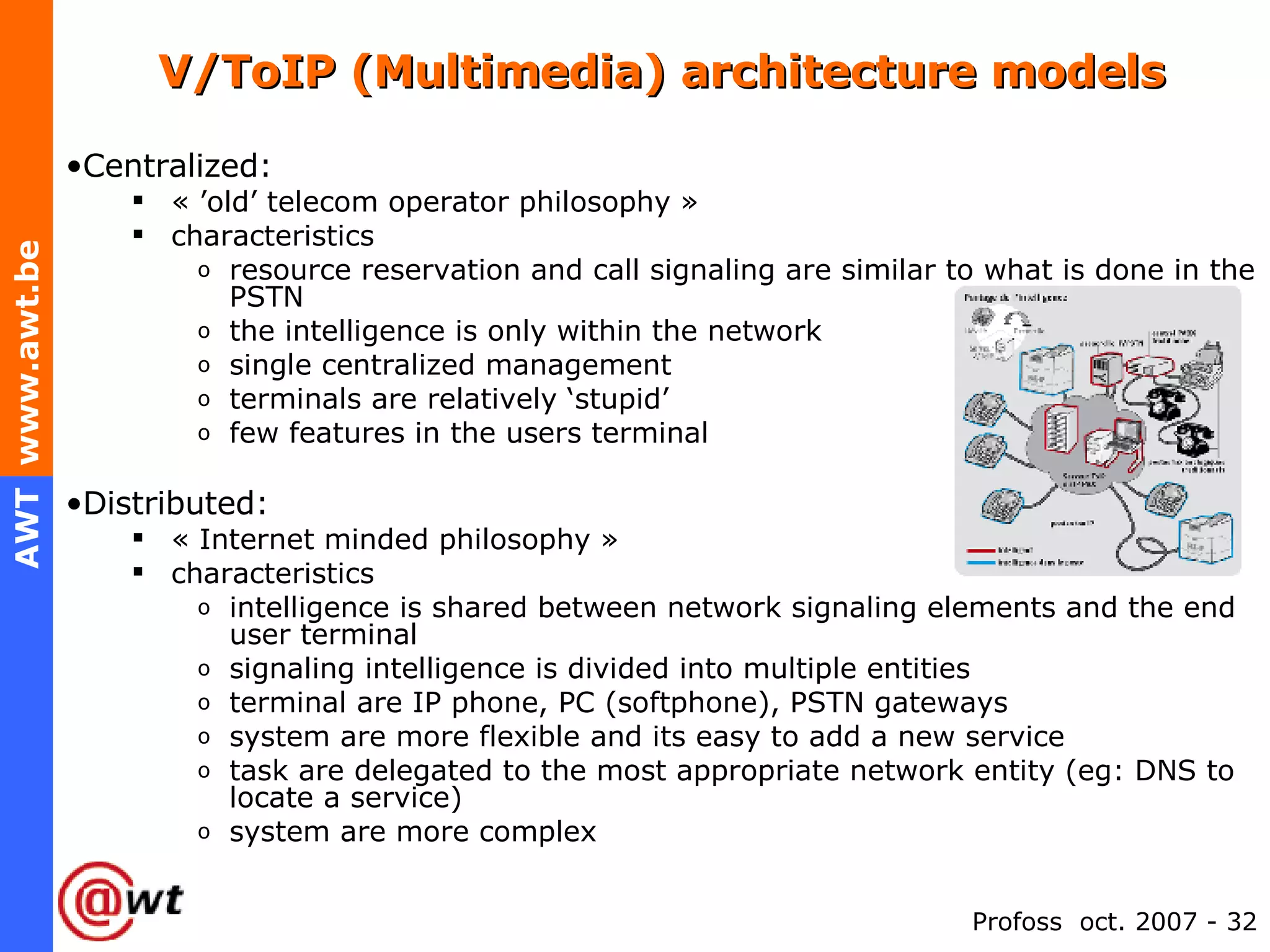
V/ToIP (Multimedia) architecture models Centralized:  « ’old’ telecom operator philosophy » characteristics resource reservation and call signaling are similar to what is done in the PSTN the intelligence is only within the network single centralized management terminals are relatively ‘stupid’ few features in the users terminal Distributed:  « Internet minded philosophy » characteristics intelligence is shared between network signaling elements and the end user terminal signaling intelligence is divided into multiple entities terminal are IP phone, PC (softphone), PSTN gateways system are more flexible and its easy to add a new service task are delegated to the most appropriate network entity (eg: DNS to locate a service)  system are more complex
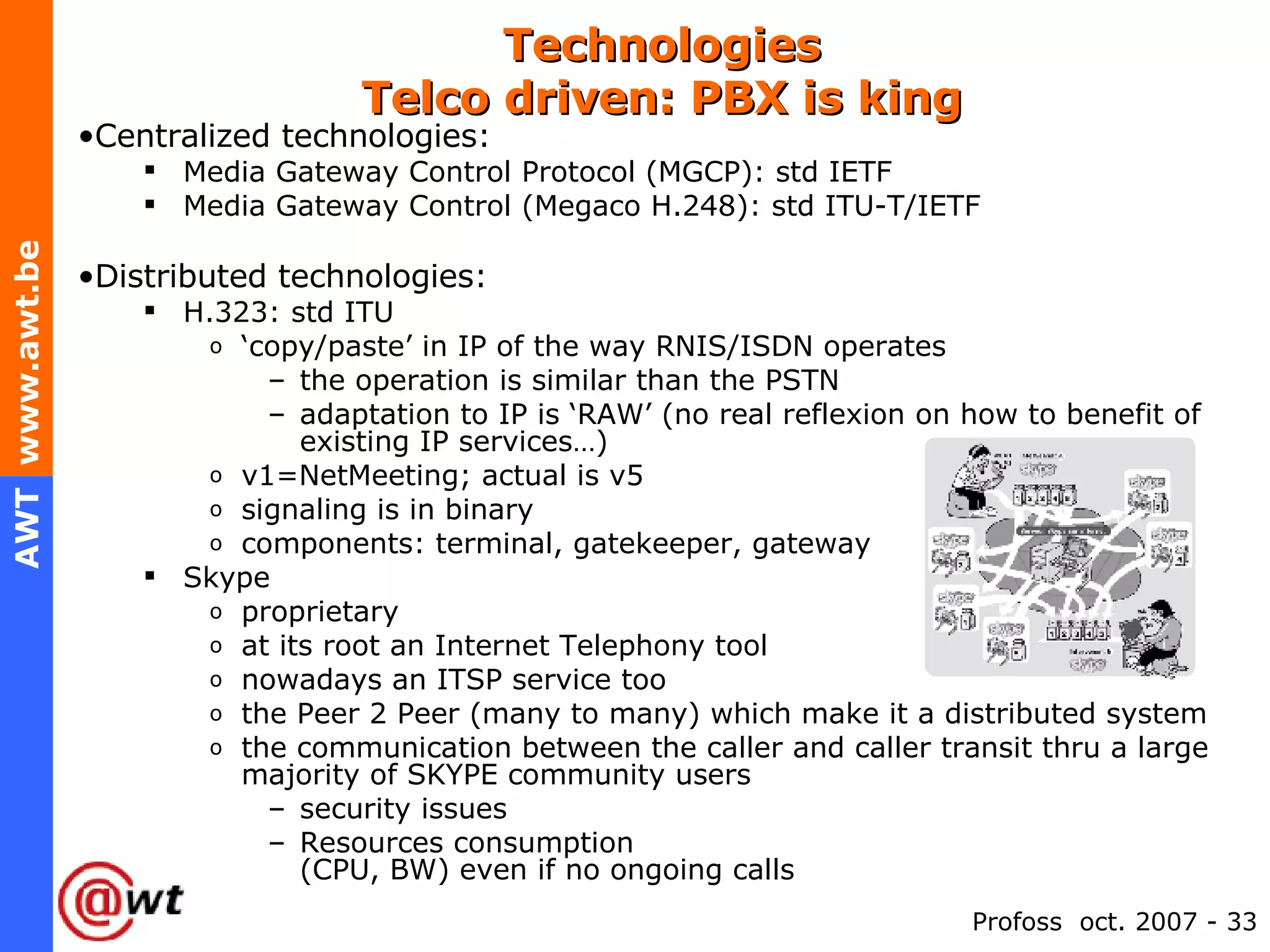
Technologies Telco driven: PBX is king Centralized technologies: Media Gateway Control Protocol (MGCP): std IETF Media Gateway Control (Megaco H.248): std ITU-T/IETF Distributed technologies: H.323: std ITU ‘ copy/paste’ in IP of the way RNIS/ISDN operates the operation is similar than the PSTN adaptation to IP is ‘RAW’ (no real reflexion on how to benefit of existing IP services…) v1=NetMeeting; actual is v5 signaling is in binary components: terminal, gatekeeper, gateway Skype proprietary at its root an Internet Telephony tool nowadays an ITSP service too the Peer 2 Peer (many to many) which make it a distributed system the communication between the caller and caller transit thru a large majority of SKYPE community users security issues Resources consumption  (CPU, BW) even if no ongoing calls
IP pbx Technology  Traditional PBX is made of Electronics component and telephony ASICs A Foreign eXchange Subscriber (FXS) jack for EACH telephone lines Telecom services Functions: ISDN, SS7,QSIG (inter-PBX, userline) Interconnection norms EuroISDN, Lucent 5E, National ISDN2, … Voice servers (IVR, voicebox) Unique features (proprietary ?)  to the brand of the PABX! An IP PBX is Still qualified as traditional vs ToIP. Follows the old TELCO philosophy First evolution: ‘simple’ PABX  with an ethernet card to bind to IP. To enable a software interface client on PC (preferences, call logs,…), TAPI 14  norm  a integration with ICT Listening voice email from PC  Dialling from a software keypad or an address book but call ends to telephone a link (BA/PRA) to an IP telephony provider trunk Nowadays, a full application to install on a server PC (Small Form Factor) A PABX software Telecom extension boards (BA/PRA, E1/T1, …) Obviously an ethernet card for IP trunks (H.323 initially, SIP and IAX now) ToIP lines (H.323 initially, SIP now and some IAX) DSP to carry voice from regular phone to IP phone and vice versa Hard disk for voice mail storage Actors Majors following the market; IP cards and new software for ‘old’ PBX: Alcatel-Lucent, Avaya, Siemens, TIPtel, Ericsson,... Telephony news comers are also strongly present: Cisco (CallManager <=5),  …. Open Source Asterisk and all its ‘customisations’ 14  Telephony Application Programming Interface:  fonction CTI sous MS Windows
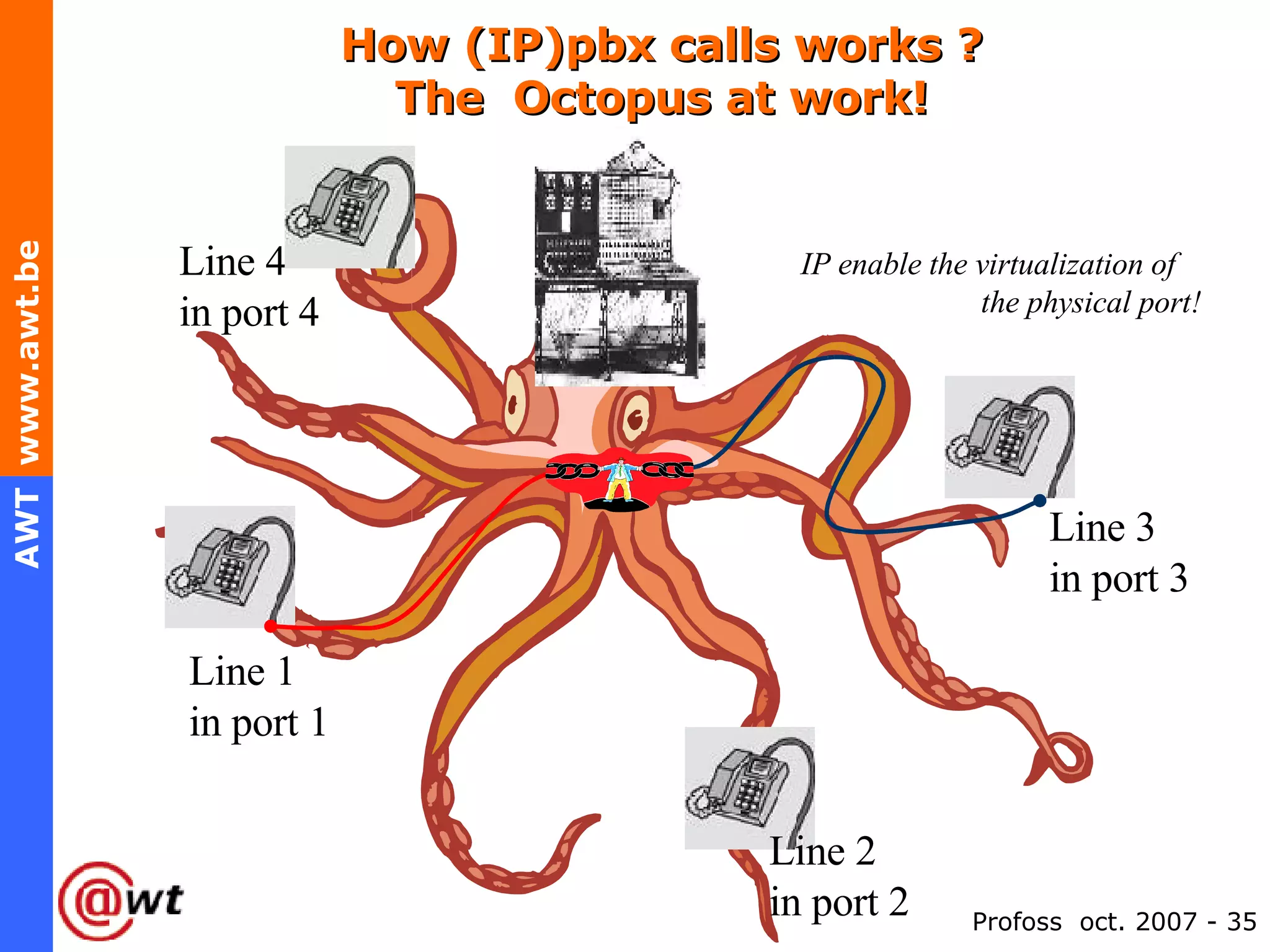
How (IP)pbx calls works ? The  Octopus at work! Line 1  in port 1 Line 2 in port 2 Line 3  in port 3 Line 4  in port 4 IP enable the virtualization of  the physical port!
Asterisk in a slide… An IPPBX open source software created by Mark Spencer and is now sponsored by Digium   (manufactures analog and digital interface cards work particularly well with Asterisk, long-term profit motive) Asterisk is currently in its 1.4 stable release, and supports a very impressive range of features:  Full support for analog, digital (T1, E1, PRI) and IP telephone interfaces (SIP, IAX and H.323 via external library) Improved FoIP support Support for VoIP and analog telephone handsets thru boards interface card Ability to run in generic Linux servers or Mac OS X  Extensive list of built-in call management features (e.g. call transfer, three-way calling, all of the usual telephony functions of a PBX) Meet Me dial-in conferencing Fully configurable extension numbering (dial plan) Automated call distribution (for customer contact centers) Music on hold from a local recording or live MP3 or G.711 audio stream Unlimited extensibility through AGI (Asterisk Gateway Interface): developers may build custom CGI programs that control the telephone system Interactive Voice Respond system (IVR) Voice mail Act as a glue toward many proprietary protocol (Skype, Skynny, MSN , etc) Full LGPL source code Need a synergy with a SIP proxy solution (SER,OpenSER, SIPFoundry ?) in open source in order to become a full fledge next gen Open Source Communication solution. NB: Some OS IPtel players have understood eg: carrierclass.net
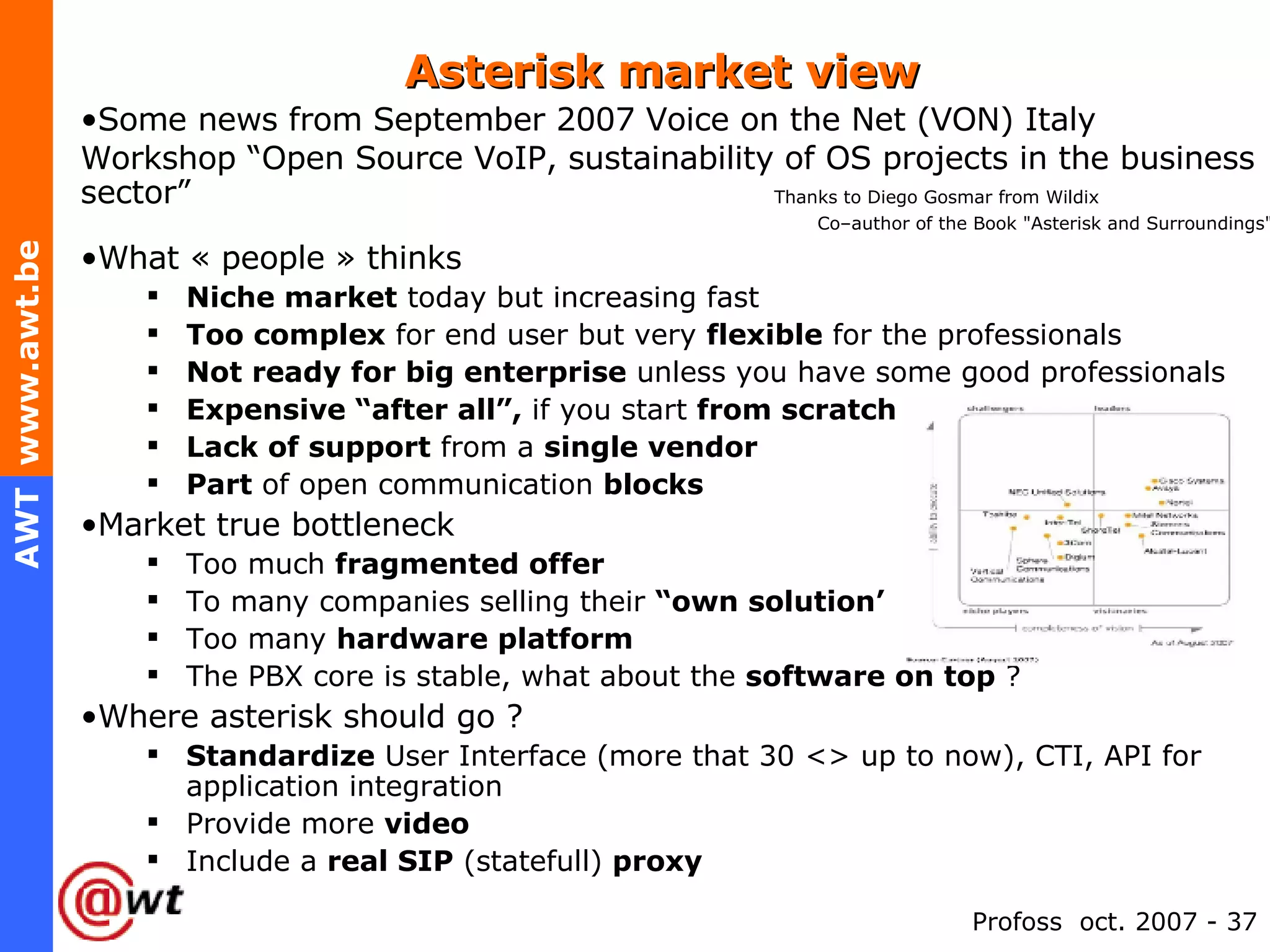
Asterisk market view Some news from September 2007 Voice on the Net (VON) Italy Workshop “Open Source VoIP, sustainability of OS projects in the business sector”  Thanks to Diego Gosmar from Wildix Co–author of the Book &quot;Asterisk and Surroundings&quot; What « people » thinks Niche market  today but increasing fast Too complex  for end user but very  flexible  for the professionals Not ready for big enterprise  unless you have some good professionals Expensive “after all”,  if you start  from scratch Lack of support  from a  single vendor Part  of open communication  blocks Market true bottleneck Too much  fragmented offer To many companies selling their  “own solution’ Too many  hardware platform The PBX core is stable, what about the  software on top  ? Where asterisk should go ? Standardize  User Interface (more that 30 <> up to now), CTI, API for application integration Provide more  video Include a  real SIP  (statefull)  proxy
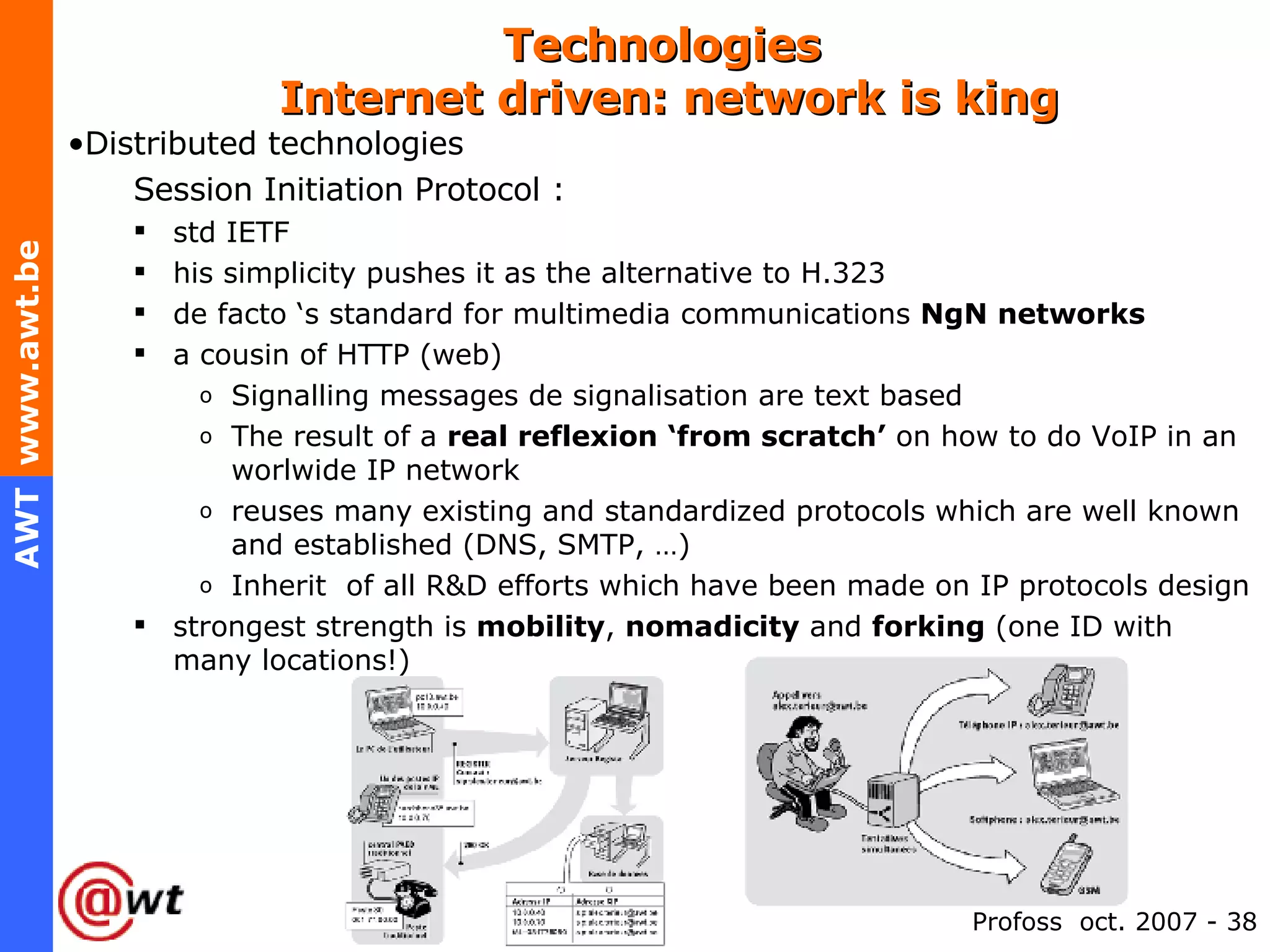
Technologies   Internet driven: network is king Distributed technologies Session Initiation Protocol :  std IETF his simplicity pushes it as the alternative to H.323 de facto ‘s standard for multimedia communications  NgN networks a cousin of HTTP (web) Signalling messages de signalisation are text based The result of a  real reflexion ‘from scratch’  on how to do VoIP in an worlwide IP network reuses many existing and standardized protocols which are well known and established (DNS, SMTP, …) Inherit  of all R&D efforts which have been made on IP protocols design strongest strength is  mobility ,  nomadicity  and  forking  (one ID with many locations!)
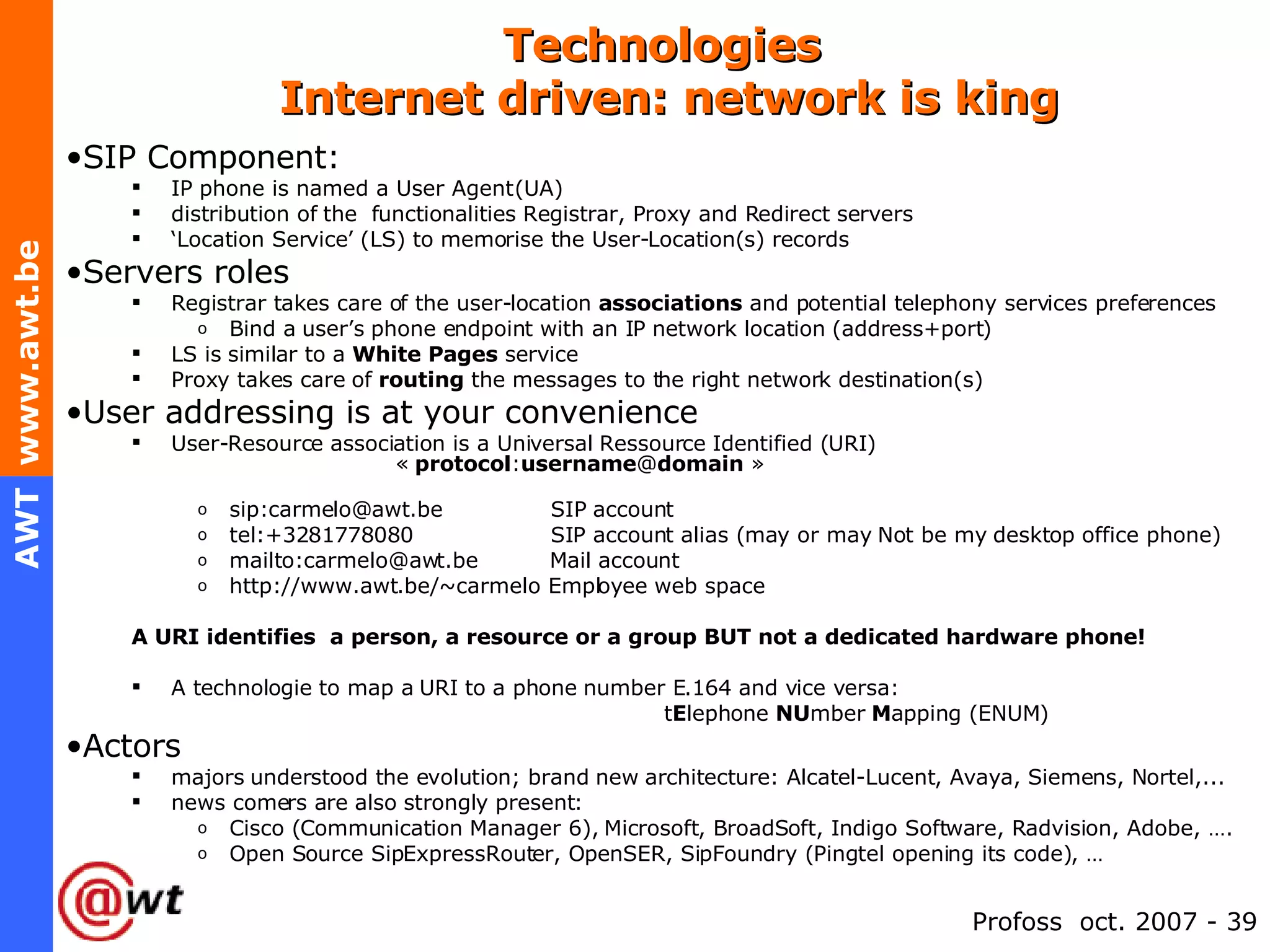
Technologies   Internet driven: network is king SIP Component: IP phone is named a User Agent (UA) distribution of the  functionalities Registrar, Proxy and Redirect servers ‘ Location Service’ (LS) to memorise the User-Location(s) records Servers roles Registrar takes care of the user-location  associations  and potential telephony services preferences Bind a user’s phone endpoint with an IP network location (address+port) LS is similar to a  White Pages  service Proxy takes care of  routing  the messages to the right network destination(s) User addressing is at your convenience User-Resource association is a Universal Ressource Identified (URI)    «  protocol : username @ domain  » sip:carmelo@awt.be  SIP account tel:+3281778080  SIP account alias (may or may Not be my desktop office phone) mailto:carmelo@awt.be  Mail account http://www.awt.be/~carmelo Employee web space A URI identifies  a person, a resource or a group BUT not a dedicated hardware phone! A technologie to map a URI to a phone number E.164 and vice versa:  t E lephone  NU mber  M apping (ENUM) Actors majors understood the evolution; brand new architecture: Alcatel-Lucent, Avaya, Siemens, Nortel,... news comers are also strongly present: Cisco (Communication Manager 6), Microsoft, BroadSoft, Indigo Software, Radvision, Adobe, …. Open Source SipExpressRouter, OpenSER, SipFoundry (Pingtel opening its code), …
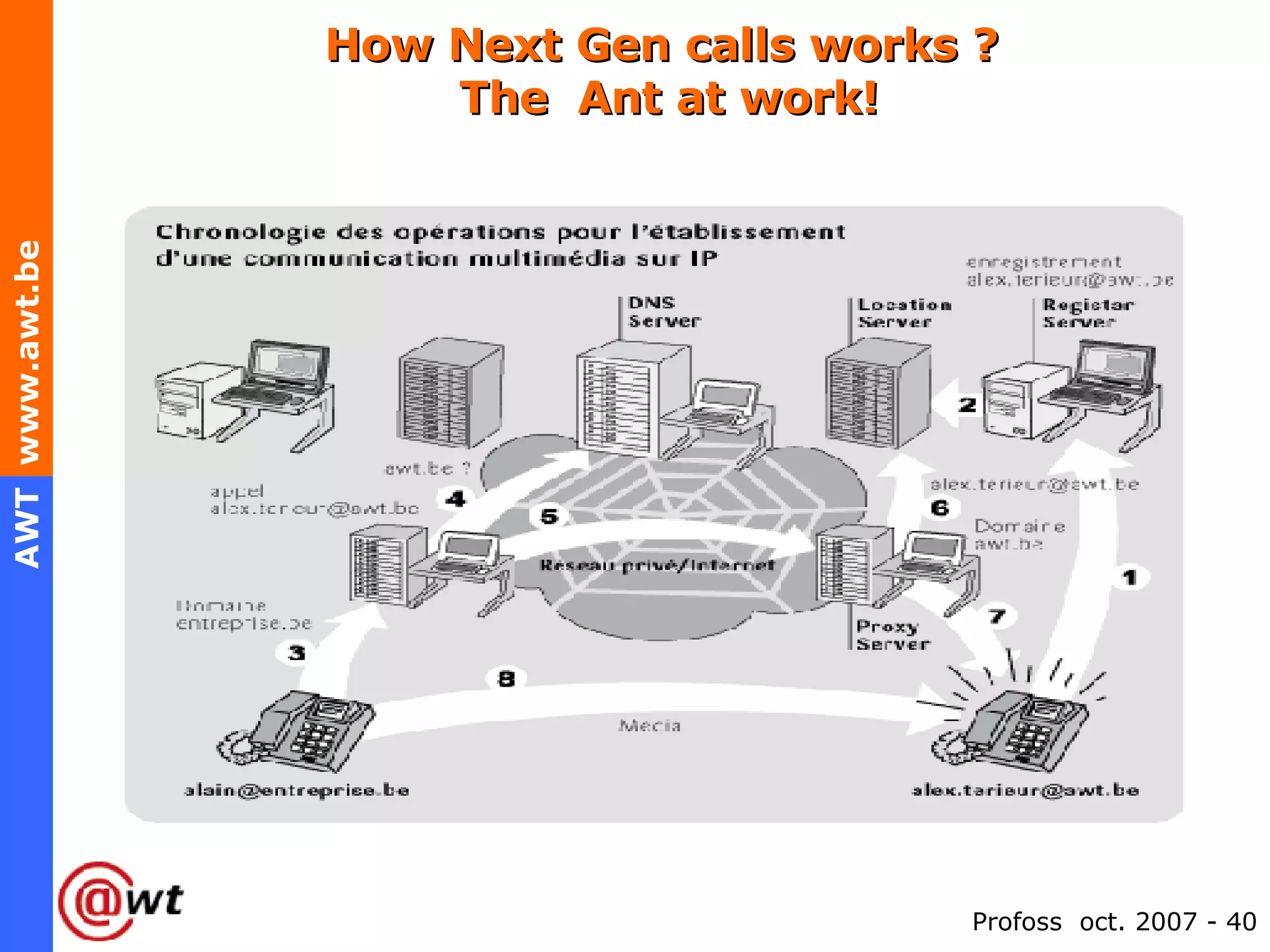
How Next Gen calls works ?  The  Ant at work!
IPtel economy in the RW… Mainly SIP, then IAX and some MGCP/MEGACO veterans! Least cost routing  (Hidden DID) Premium cost routing  (DID showed & availability of some Belgian E.164 : +32) DID free or with fee Pre-paid or post-paid models With or without voicemail All in one service on a ‘price per seat’ AXIS  (+ calls cost) With or without SLA QoS if controlled network (ex Win, Bilan, Telenet, Verizon, … ) Network in between the customer and the PSTN gateway Network in between the customer premises QoS is still a challenge for ITSP Need to negotiate a contract with Internet service providers (DiffServ, RSVP, MPLS, …) to better server customers Professional and residential services offers Many IP Phone. Usual vendors  (Alcatel, Siemens, Cisco, D-Link)  & mass import  (Grandstream, Snom, Funkwerk, Swissvoice, Tornado, Lancom, …)   Many Softphone  (free, with fee, open source or not  :Gizmo, Ekiga, Windows Messenger, X-Pro, Eyebeam, Bria, etc) Fax over IP (FAX T.38/T.30) support is still very poor. (often transport thru the voice channel but with related issues…)
IPtel actors in the RW… Traditional players (Cisco, Alcatel, Nortel, Avaya, …) Challengers  Open Source standard (H.323/SIP) ou non (IAX) Tree categories:  knowledge in open source but no real knowledge of the « voice application »  knowledge in open source and REAL knowledge of the « voice application »  knowledge in open source and REAL knowledge of the « voice application » AND open source certifications (Redhat, Suse, Asterisk, etc) Many in Asterisk Escaux (Wavre), Eyepea (Sainte), Novacom (Mons), Alterys (Verviers), PacketNet (Schoten), WeePee (Greembergen), SYNsip (Hamme-Mille), Asixtel (Wauthier Braine ), … Two categories of Asterisk player Base Asterisk with or without third party GUI  Asterisk with self developed ‘custom extension’ (GUI or other) Many less with SER, OpenSER, Sipfoundry/sipX, trixbox, CallWeaver (OpenPBX.org), FreeSWITCH , Yate, Bayonne, etc Novacom (Mons), SYNsip (Hamme-Mille) Close Source Radvision (H.323/SIP/SIMPLE) Quintum/Worldcall (H.323/SIP) Indigo Software (SIP/SIMPLE) Visionaries actors Computer/Web Telephony Integration Presence management & collaboration tools Many product resellers (Softphone, IP Phone, gateway, ATA)
Conclusion Key advices from the AWT in the domain of IP Telephony
Advices from the AWT ToIP should not be considered as « the » new gadget to possess .  It’s an evolution which requires a serious study. Ideal moment to think about a migration to the new voice technology is to benefit of a positive situation such as the necessity to replace the PBX  ToIP is closely linked to the reduction of the voice communication bill. However this is not necessary the most important point to consider. Improvement of the company organisation and of the quality of the labour are very important factors. With this in mind, ToIP is in perfect synergy with the concept of professional mobility according to which the Office and it’s facilities do follow the employee in his travel. The usage of a worldwide well established standard is the warranty of a long lasting migration’s investment .   Similarly, the introduction of a brand new telephony system should also consider the close integration and collaboration with the computing applications or services of the company. Quality of Service and computer security of the system and of the communication MUST be central to the choices of a new ToIP infrastucture. An enterprise could not accept to reduce the quality and stability of its call or that that confidential information may be intercepted by unauthorised entities Resources on www.AWT.be  White papers:  « La téléphonie sur IP » «  Les VLAN Ethernet» News Focus « Quel est l'état du marché de la téléphonie IP? » Files:   «Business mobile » « Guide sécurité informatique »

A W T Profoss VoIP & Asterisk

  • 1.
    VOIP & Asteriskintroduction ir. Zaccone Carmelo Expert en Télécommunications et Technologies de l'Information Agence Wallonne des Télécommunications www.awt.be Avenue de Stassart, 16 Tél.: +32 81 77.80.76 B-5000 NAMUR www.linkedin.com/in/zaccone Professional users of Free & Open Source Software October 9 & 10 2007: Asterisk and VoIP Event
  • 2.
  • 3.
    AWT in anutshell: an agency of the Belgian Walloon Government Convergence and diffusion center for ICT in the Walloon Region of Belgium (« all online» strategy). The AWT produces, gathers and federates ICT contents and services. The portal is at the same time a project of contents and a technical demonstration The AWT has huge knowledge in the fields of online publication and information dissemination ICT reference Newsletter ( size 9-10k ) AWT Portal : 3,5 millions pages seen/year ( be 66%, fr 19%, us 1%, ca 2%, other fr 10%,rest 2% )
  • 4.
    AWT, an agencyof the Belgian Walloon Government Observatory and ICT diagnostic center Technology & Legal watch center Service center for the enterprises of the ICT sector Information Collaboration Leadership Portal www.awt.be Main diffusion channel of the AWT services Participation (conference, fair, workshop, …) government (RW), public sector, entreprise, citizen, etc. Promotion Why? How? With who?
  • 5.
    Telephony Analog ordigital? PSTN or converging ?
  • 6.
    How telephony operatesSimple definition: « Art to correspond through long distances using sound » 1 « Telephony is the establishment of a link, by the instantaneous transmission of remote sound, between two or several interlocutors having the need to establish a vocal communication. » Voice is a sound, therefore: appears itself as a sound wave is transmitted naturally, by the propagation of a vibration (over the air or a material) is transmitted artificially, by the propagation of an electric signal (analogical or digital) captured thru a microphone restored thru loudspeaker 1 © Sciences de Bouillet, 1750
  • 7.
    The ancestor ofV/ToIP Why a Public Switched Network? «The PSTN is the inter-connection network of all public phone » Setup at large scale of the phone string 2 or with a tube is debatable … Nobody desire to stay alone on his island; inter-connection with other telephony system is crucial Component of a STN Building block is the phone switch Customers of the newtork Telephone handset or Private Automatic Business eXchange (PABX) Inter-connection between STN network are named TRUNKs International dialing plan World growth of the telephony service’s subscribers Worldwide plan 3 of public numbering: E.164 . E.164 identifies without ambiguity a subscriber E.164 is composed of 3 parts for a maximum of 15 digits First 2 to 3 digits: CC, country code (&quot;32&quot; Belgium), maximum 12 digits: NDC, national destination code & SN : subscriber number. 2 © 1667, Robert Hooke 3 standardization organism ITU-T
  • 8.
    From analog todigital Sound propagates, artificially, thought an electric signal after capture 4 , sound is transmitted 5 on the line linking the people and is reproduced on the loudspeaker disadvantage: analog signal’s quality degrade with the distance and is disturbed by the noise on the line. Electronic and ICT: Analog moved toward digital Digital Signal Processor (DSP) takes with constant interval ( sampling ) the value of the analog signal and associate a binary number (0/1) 44000 Hz CD quality 22000 Hz radio quality 8000 Hz PSTN quality The audio channel is represented by the sequence of these numbers To reduce the throughput (size), the sequence is converted in a compressed format ( CODEC ) G.711 : flow of 64 Kbit/s , G.729 : flow of 8 Kbit/s . CODEC is a compromised between quality, CPU power, bandwidth, time to transfer (delays), loss tolerance Integrated Services Digital Network (ISDN) brings digital to the subscriber Basic Access: 2 lines of 64 Kbit/s; Primary Rate Access: 30 BA therefore 2Mbit/s 4 Frequency 0-4 khz 5 Analog: frequency modulation
  • 9.
    Network convergence andadoption of IP Traditionally, multiple communication networks coexist STN for telephony circuit switched associates physically line segments to link end to end the people Computer network for data Packet switched (sets of small data information thought ‘water bucket chain’ like) Coax network for TV Mobile/GSM network for wireless telephony Unified network enable to support both voice on a computer network Voice is an application Data are digital Communication rules are well known Relate concept: Voice on Packet (VoP) Voice over IP (VoIP) Voice over ATM (VoATM) aka VoDSL Voice on Frame Relay (VoFR) Other concept: Voice on Coax (DOCSIS/PacketCable) Gateways are available to bind (in/out) with the PSTN/mobile networks
  • 10.
    Success factors Migratingto voice over packet ? Removing the PBX for IP telephony ? When to replace the PBX ?
  • 11.
    Why voice overpacket ? Initially, VoP was a operator only technology replacing permanent expensive PSTN TRUNKs using dynamic less expensive technology through IP Nowadays, VoP is available to anybody thanks to broadband Internet interest for ICT is large Through VoP, « consumer » also benefit of a « substantial reduction of its communication costs» but this is not the only profit ! Many additional valuable services are available: video, chat, content sharing (ex document, photo), application sharing, instant messaging with employees but also partners, customers suppliers unified messaging (voicemail, Email, fax, SMS, MMS, etc. into a single universal box), services customization (ring tones per caller, etc.) mobility (as for GSM) trough wireless (3G, WiFi or WiMAX) application consolidation
  • 12.
    Why voice overpacket ? Cost reduction VoIP rate are ridiculous vs traditional call rates long distance call increase the possible profit many extra benefits Free call between subsidiaries or with partner & supplier Attractive rates thru the usage of an IP telephony operator (ITSP) Availability and mobility PC and phone share the office wires phone line move seamlessly with the user New services and open standard freedom is recovered: not anymore « prisoner » of a single hardware/software supplier. increased inter-working: even is the software vendor is different Improved sound quality and clearness PSTN ‘cut the sound’ to be transmitted on the line VoIP permit the use better CODEC (ex G722 wideband) Simple and easily accessible management no need anymore to modify the patch panel giving a user a ‘line’ is easy as providing an email address most of the time done with a web browser (accessible to boss, secretary) autonomy increased with respect to the consultants specialists.
  • 13.
    Which is theright moment to give up with traditional PABX? PABX‘s live is around 7 years  if +, many companies will not put it yet into the dustbin Many PABX have been bought in 2000 (cfr bug). They arrived at the end of their lives/contracts For the company the hardware/software is closed for the accountancy one should not anymore be bound by a maintenance contract Your moment has come if you may answer yes to one of these is the PABX registered in renewal plan of the company? is your company located in different buildings ? are your searching for a centralized billing solution for your telecommunication costs ? are you introducing tele/remote-working ? Better to have a unique number following the employee do you search to improve competitiveness ? Better communication tools may help! you plan to migrate to an IP ITSP ?
  • 14.
    What is IPtelephony ? Distinction between VoIP, trunking, ToIP, Internet Telephony, … The « bridges » between IP & PSTN worlds
  • 15.
    VoIP is notthe perfect synonym of ToIP trunking telecom technique to aggregate lines simultaneous transport of many calls physical dedicated line between 2 phones switches expensive Voice Over IP substitution of a trunk by a IP connection through a data network private (eg: from operator, (inter)national WAN of the company) public (eg: Internet) substitution of the line dedicated to telephony by a shared channel between data & voice. transport is done from hop to hop Benefits synergy of the infrastructures reduction exploitation cost number of required technicians « centering » technical skills telecom roles become a part of ICT & network administration
  • 16.
    VoIP is notthe perfect synonym of ToIP Telephony over IP « ultimate  » stage in the migration to ‘all IP’ transport with packet is done end to end Important strep towards the notion of services convergence replace traditional telephone by a « IP phone » the hardware PBX by a Server Software 9 or an IPpbx (running on an OS: Windows, Linux, Unix,…) Characteristics of ToIP. one replace phone jack (RJ11) with a network plug (RJ45) analog/digital interface by an interface using IP protocol traditional signaling (SS7, ISDN) by voice over IP (H.323, SIP, IAX) (vendor specific) phone headset a new phone terminal a software (softphone) usable on a PC, PDA, Smartphone,… 9 also named SoftSwitch
  • 17.
    ToIP ‘s deploymentscales Qualified definition Closed Zone (Intranet): private IP telephony server Half-Public Zone (Extranet): private IP telephony server open to partners, suppliers (eg: through VPN) Limited Public Zone (Internet): opening of the IP telephony server to the world without PSTN or mobile IP ITSP Public Zone (Internet): opening of the IP telephony server to the world with PSTN and/or mobile IP ITSP ToIP goes further than Voice over IP Video transmission Fax transmission (T.38) Computer-Telephony-Integration
  • 18.
    New phone headsetIP Telephony: Hardphone Softphone Analogue Telephone Adapter (ATA)
  • 19.
    IP Phone variationsNew generation The association of a software which supports a particular ToIP protocol a user interface composed of a mike, a (alpha-)numeric keypad and usually a LCD display 3 categories HARDware telePHONE (hardphone) : electronic device with a ToIP software and an integrated User Audio Interface with design similar to regular phone 10 Softphone : an application running on a computer where the User Interface is the computer audio accessories Analogue Telephone Adapter (ATA) : electronic device with a ToIP software without an integrated User Audio Interface but offering a plug for your old regular phone 10 using the same plug as PC (RJ45 ) for data and current (PoE)
  • 20.
    Telephony application Operationof this application Securing this application Potential of the application: Computer Telephony Integration (CTI)
  • 21.
    Operation principles IPcommunication establishment is realized in two steps: reciprocal presentation of the phone application setting up the media(s) stream channel(s) Numerous techniques to achieve the first step proprietary : many solutions appeared in the 90’s with the Internet protocol not recognized as worldwide standard often lack of interoperability: user is confined is his community protocol may be publicly available ( eg IAX, Jingle ) or totally private ( eg Skype, MSN ) standardized: the software is compliant with a well known and defined protocol ( eg H.323, SIP ) interoperability: user in one community may contact whoever in other compliant communities international organization bodies: ITU-T: telecom oriented, specification must be bought IETF: Internet philosophy, specification is free broader availability and choice of products/softwares Broader dimension than simply voice! Additional media: video, white board, written text (chat/im) whatever useful application: presentation, co-browsing A simple voice call become an collaboration session with a rich media experience
  • 22.
    First step: Networkparameter exchange At the user level, Mutual exchange of the “digital identity” traditional phone number (E.164), virtual identity: nickname, loginname real firstname or name, email address, All of these may be taken from a directory (LDAP, MS AD) At the application level Mutual exchange 11 of endpoints network information what is the IP address of your communication software? what are the TCP/UDP ports your communication software uses for audio, video, text messages, etc ? Technical term is «call signaling » Many signaling protocol have been created SIP: Session Initiation Protocol, IAX, Inter Asterisk eXchange H.323: Packet-based multimedia communications architecture, Net2Phone, Skype, MSN, Jingle, Megaco / H.248: Media Gateway Control protocol, SCCP: Cisco Skinny Client Control Protocol, etc 11 If peer is on PSTN/mobile, parameter (IP & ports) are those from the gateway
  • 23.
    Internet sharing (PAT/NAT)is a problem Network Address Translation (NAT): public IP size < number of stations on the LAN a LAN station is temporary FULLY publicly available (like dialup in the 90’s) Network Address Port Translation (PAT) all LAN’s stations share the SAME public IP address a LAN station is temporary publicly available with limitation Some ports may be already allocated to another LAN station! Problem occurs if the following private IP address are used 10.0.0.0/8 172.16.0.0/12 192.168.0.0/16 169.254.0.0/16 Negotiated network parameters are only valid on the private LAN Impossible to communicate with the outside (partner, supplier, low cost ITSP) Solutions Using public IP address on all phone: get more public address (IPv6) Forcing old fashioned methodology (all calls through a single box such an IPpbx) Using ‘technical tricks’ Using dynamic hostname resolution (DynDNS,…) Dedicated technologies: IETF STUN: Simple Traversal of UDP through NATs IETF (work in progress) ICE: Interactive Connectivity Establishment1 UPnP: Universal Plug and Play IETF MIDCOM : Middlebox Communication, Firewall Control Protocol
  • 24.
    Second step: Thecommunication itself After technical parameters exchange, media transport application(s) takes the relay Medias may have different requirement real time (audio, video, presentation sharing) asynchronous (IM, chat) Transport technology missions are to transform the media using a CODEC to create the IP packets to send to realize the transmission of these IP packets to the destination to reorder these IP packets after reception to detect and resolve packet loss etc Real time transport technologies: Real-Time Protocol (RTP): data, audio, video Real-Time Control Protocol (RTCP): ensuring QoS for RTP Compressed Real Time Protocol (cRTP) or Enhanced Compressed Real Time Protocol (ecRTP): RTP alternative for slow network (GPRS/UMTS) Secure Real-Time Protocol (sRTP) & Secure Real-Time Control Protocol (sRTCP): RTP/RTCP with confidentiality
  • 25.
    Security challenges inIP telephony Identification/Authentication. Avoiding tool frauds usurpation of the identity of the participants that the communication be torn down by someone else altered by someone else (headers, session description, etc) deviated to someone else Confidentiality. Avoiding that by someone non authorized collect some data (subjet/time/duration of the call, participants) capture and listen to the communication streams (wiretapping) Quality of Service avoiding conversation’s or video’s quality degrades avoiding that the communication does finish suddenly ensuring that the communication can be established
  • 26.
    Securing IP telephonyV/ToIP has become an application!  vulnerable to the same problems as the other network’ softwares Possible attack’ scenarios attacks against the operating system (OS) underlying the voice or multi-media software (IPphone, ATA, gateway, …) attacks against the weaknesses within the configurations Default password attacks against protocol vulnerabilities attacks against software’s bugs attacks against the networks reducing performances (throughput, CPU load, memory overload) scrambling of a wiki network attacks against the servers which host the telephony services reducing performances, Installation of virus, spy Non solicited calls: SPam over Internet Telephony (SPIT) Important roles to take care (emergency call, geographic localization, …)
  • 27.
    What are theprotections ? Many techniques are available OS security enforcement network security enforcement quality ensured software development QoS network technologies ISO 17999 guidelines Some basic advices using VPN or SSL when data cross over a non trusted network (ex Internet) defining distinct VLANs to separate data and voice traffic within the same switch protecting the media with encryption such SecureRTP protecting the network with firewall, IDS, IDP configuring and managing correctly the IP Phones defining a call policy « dial plan » (usage rules) keeping an eyes on security news updates and patching software when necessary protecting again power outage with UPS on the switch to enssure « Power over Ethernet »
  • 28.
    Computer Telephony Integration(CTI) Traditional telephony is not only making/receiving calls supplementary services are associated call transfer to another phone message waiting indication second call notification & pickup calling line identification number (CLIP) presentation of the caller name audio answering machine & voice mail A « good » ToIP should offer at least the same features go further into the integration with other application of the enterprise Next Generation Services universal access to the user or the enterprise address book gather and display context specific information (customer account) video answering machine & video mail, redirection to other communication channels (email, web site) LAN or world (roaming) wide mobility of the phone centralize maintenance of a distributed system gateway broker: service to select the most appropriate exit point collaboration work: application sharing, web-conferencing, instant file exchange
  • 29.
    IP telephony hasmany flavors Proprietary norm or well established standard? Enterprises' deployment models? Hosted, In-House, Centrex,… IP pbx or the « metamorphosis » of an electronic component into a software… Technology model for today’s voice & tomorrow’s multimedia
  • 30.
    Proprietary norm or well established standard? Proprietary norm “  Is a way of realizing a service usually restrictive, exclusive, subjected to constraints and for which the ‘receipt’ is often a trade secret. ” Usage of such norm often causes the birth of closed communities A standard or open norm does not mean that source code of the software should be published to third party, mean that the software respects the operations defined by the specification written by a well established organism/consortium Therefore, a point to clarify « open standard must not be confused with the concept of open source» Open norm’s assets: « the federation of services » by using such norm, different communities may communicate with each other similar to the forwarding of a mail from me@XXX.be to you@YYY.be
  • 31.
    Deployment models «Thedeployment scenarios of a Voice (presence and instant messaging) over IP solution may be compared to the installation of an Internet messaging system (email)» Alternative choices: Keep ownership of the solution installing the V/ToIP server in the enterprise network (LAN/DMZ) Multi sites enterprise may decide to place a server into each geographical establishment of the company only in the headquarter of the company housing of the de V/ToIP server in a datacenter Access to associated PSTN bridging services thru gateway located in strategic establishment of the company thru IP bridging services offered by an telecom operator or an ITSP Renting of the solution subscribing to the services of an telecom operator or an ITSP: Centrex mode pay per use/seat characteristics hosting of the V/ToIP server in a datacenter access to the provider PSTN bridging services
  • 32.
    V/ToIP (Multimedia) architecturemodels Centralized: « ’old’ telecom operator philosophy » characteristics resource reservation and call signaling are similar to what is done in the PSTN the intelligence is only within the network single centralized management terminals are relatively ‘stupid’ few features in the users terminal Distributed: « Internet minded philosophy » characteristics intelligence is shared between network signaling elements and the end user terminal signaling intelligence is divided into multiple entities terminal are IP phone, PC (softphone), PSTN gateways system are more flexible and its easy to add a new service task are delegated to the most appropriate network entity (eg: DNS to locate a service) system are more complex
  • 33.
    Technologies Telco driven:PBX is king Centralized technologies: Media Gateway Control Protocol (MGCP): std IETF Media Gateway Control (Megaco H.248): std ITU-T/IETF Distributed technologies: H.323: std ITU ‘ copy/paste’ in IP of the way RNIS/ISDN operates the operation is similar than the PSTN adaptation to IP is ‘RAW’ (no real reflexion on how to benefit of existing IP services…) v1=NetMeeting; actual is v5 signaling is in binary components: terminal, gatekeeper, gateway Skype proprietary at its root an Internet Telephony tool nowadays an ITSP service too the Peer 2 Peer (many to many) which make it a distributed system the communication between the caller and caller transit thru a large majority of SKYPE community users security issues Resources consumption (CPU, BW) even if no ongoing calls
  • 34.
    IP pbx Technology Traditional PBX is made of Electronics component and telephony ASICs A Foreign eXchange Subscriber (FXS) jack for EACH telephone lines Telecom services Functions: ISDN, SS7,QSIG (inter-PBX, userline) Interconnection norms EuroISDN, Lucent 5E, National ISDN2, … Voice servers (IVR, voicebox) Unique features (proprietary ?) to the brand of the PABX! An IP PBX is Still qualified as traditional vs ToIP. Follows the old TELCO philosophy First evolution: ‘simple’ PABX with an ethernet card to bind to IP. To enable a software interface client on PC (preferences, call logs,…), TAPI 14 norm a integration with ICT Listening voice email from PC Dialling from a software keypad or an address book but call ends to telephone a link (BA/PRA) to an IP telephony provider trunk Nowadays, a full application to install on a server PC (Small Form Factor) A PABX software Telecom extension boards (BA/PRA, E1/T1, …) Obviously an ethernet card for IP trunks (H.323 initially, SIP and IAX now) ToIP lines (H.323 initially, SIP now and some IAX) DSP to carry voice from regular phone to IP phone and vice versa Hard disk for voice mail storage Actors Majors following the market; IP cards and new software for ‘old’ PBX: Alcatel-Lucent, Avaya, Siemens, TIPtel, Ericsson,... Telephony news comers are also strongly present: Cisco (CallManager <=5), …. Open Source Asterisk and all its ‘customisations’ 14 Telephony Application Programming Interface: fonction CTI sous MS Windows
  • 35.
    How (IP)pbx callsworks ? The Octopus at work! Line 1 in port 1 Line 2 in port 2 Line 3 in port 3 Line 4 in port 4 IP enable the virtualization of the physical port!
  • 36.
    Asterisk in aslide… An IPPBX open source software created by Mark Spencer and is now sponsored by Digium (manufactures analog and digital interface cards work particularly well with Asterisk, long-term profit motive) Asterisk is currently in its 1.4 stable release, and supports a very impressive range of features: Full support for analog, digital (T1, E1, PRI) and IP telephone interfaces (SIP, IAX and H.323 via external library) Improved FoIP support Support for VoIP and analog telephone handsets thru boards interface card Ability to run in generic Linux servers or Mac OS X Extensive list of built-in call management features (e.g. call transfer, three-way calling, all of the usual telephony functions of a PBX) Meet Me dial-in conferencing Fully configurable extension numbering (dial plan) Automated call distribution (for customer contact centers) Music on hold from a local recording or live MP3 or G.711 audio stream Unlimited extensibility through AGI (Asterisk Gateway Interface): developers may build custom CGI programs that control the telephone system Interactive Voice Respond system (IVR) Voice mail Act as a glue toward many proprietary protocol (Skype, Skynny, MSN , etc) Full LGPL source code Need a synergy with a SIP proxy solution (SER,OpenSER, SIPFoundry ?) in open source in order to become a full fledge next gen Open Source Communication solution. NB: Some OS IPtel players have understood eg: carrierclass.net
  • 37.
    Asterisk market viewSome news from September 2007 Voice on the Net (VON) Italy Workshop “Open Source VoIP, sustainability of OS projects in the business sector” Thanks to Diego Gosmar from Wildix Co–author of the Book &quot;Asterisk and Surroundings&quot; What « people » thinks Niche market today but increasing fast Too complex for end user but very flexible for the professionals Not ready for big enterprise unless you have some good professionals Expensive “after all”, if you start from scratch Lack of support from a single vendor Part of open communication blocks Market true bottleneck Too much fragmented offer To many companies selling their “own solution’ Too many hardware platform The PBX core is stable, what about the software on top ? Where asterisk should go ? Standardize User Interface (more that 30 <> up to now), CTI, API for application integration Provide more video Include a real SIP (statefull) proxy
  • 38.
    Technologies Internet driven: network is king Distributed technologies Session Initiation Protocol : std IETF his simplicity pushes it as the alternative to H.323 de facto ‘s standard for multimedia communications NgN networks a cousin of HTTP (web) Signalling messages de signalisation are text based The result of a real reflexion ‘from scratch’ on how to do VoIP in an worlwide IP network reuses many existing and standardized protocols which are well known and established (DNS, SMTP, …) Inherit of all R&D efforts which have been made on IP protocols design strongest strength is mobility , nomadicity and forking (one ID with many locations!)
  • 39.
    Technologies Internet driven: network is king SIP Component: IP phone is named a User Agent (UA) distribution of the functionalities Registrar, Proxy and Redirect servers ‘ Location Service’ (LS) to memorise the User-Location(s) records Servers roles Registrar takes care of the user-location associations and potential telephony services preferences Bind a user’s phone endpoint with an IP network location (address+port) LS is similar to a White Pages service Proxy takes care of routing the messages to the right network destination(s) User addressing is at your convenience User-Resource association is a Universal Ressource Identified (URI) «  protocol : username @ domain  » sip:carmelo@awt.be SIP account tel:+3281778080 SIP account alias (may or may Not be my desktop office phone) mailto:carmelo@awt.be Mail account http://www.awt.be/~carmelo Employee web space A URI identifies a person, a resource or a group BUT not a dedicated hardware phone! A technologie to map a URI to a phone number E.164 and vice versa: t E lephone NU mber M apping (ENUM) Actors majors understood the evolution; brand new architecture: Alcatel-Lucent, Avaya, Siemens, Nortel,... news comers are also strongly present: Cisco (Communication Manager 6), Microsoft, BroadSoft, Indigo Software, Radvision, Adobe, …. Open Source SipExpressRouter, OpenSER, SipFoundry (Pingtel opening its code), …
  • 40.
    How Next Gencalls works ? The Ant at work!
  • 41.
    IPtel economy inthe RW… Mainly SIP, then IAX and some MGCP/MEGACO veterans! Least cost routing (Hidden DID) Premium cost routing (DID showed & availability of some Belgian E.164 : +32) DID free or with fee Pre-paid or post-paid models With or without voicemail All in one service on a ‘price per seat’ AXIS (+ calls cost) With or without SLA QoS if controlled network (ex Win, Bilan, Telenet, Verizon, … ) Network in between the customer and the PSTN gateway Network in between the customer premises QoS is still a challenge for ITSP Need to negotiate a contract with Internet service providers (DiffServ, RSVP, MPLS, …) to better server customers Professional and residential services offers Many IP Phone. Usual vendors (Alcatel, Siemens, Cisco, D-Link) & mass import (Grandstream, Snom, Funkwerk, Swissvoice, Tornado, Lancom, …) Many Softphone (free, with fee, open source or not :Gizmo, Ekiga, Windows Messenger, X-Pro, Eyebeam, Bria, etc) Fax over IP (FAX T.38/T.30) support is still very poor. (often transport thru the voice channel but with related issues…)
  • 42.
    IPtel actors inthe RW… Traditional players (Cisco, Alcatel, Nortel, Avaya, …) Challengers Open Source standard (H.323/SIP) ou non (IAX) Tree categories: knowledge in open source but no real knowledge of the « voice application » knowledge in open source and REAL knowledge of the « voice application » knowledge in open source and REAL knowledge of the « voice application » AND open source certifications (Redhat, Suse, Asterisk, etc) Many in Asterisk Escaux (Wavre), Eyepea (Sainte), Novacom (Mons), Alterys (Verviers), PacketNet (Schoten), WeePee (Greembergen), SYNsip (Hamme-Mille), Asixtel (Wauthier Braine ), … Two categories of Asterisk player Base Asterisk with or without third party GUI Asterisk with self developed ‘custom extension’ (GUI or other) Many less with SER, OpenSER, Sipfoundry/sipX, trixbox, CallWeaver (OpenPBX.org), FreeSWITCH , Yate, Bayonne, etc Novacom (Mons), SYNsip (Hamme-Mille) Close Source Radvision (H.323/SIP/SIMPLE) Quintum/Worldcall (H.323/SIP) Indigo Software (SIP/SIMPLE) Visionaries actors Computer/Web Telephony Integration Presence management & collaboration tools Many product resellers (Softphone, IP Phone, gateway, ATA)
  • 43.
    Conclusion Key advicesfrom the AWT in the domain of IP Telephony
  • 44.
    Advices from theAWT ToIP should not be considered as « the » new gadget to possess . It’s an evolution which requires a serious study. Ideal moment to think about a migration to the new voice technology is to benefit of a positive situation such as the necessity to replace the PBX ToIP is closely linked to the reduction of the voice communication bill. However this is not necessary the most important point to consider. Improvement of the company organisation and of the quality of the labour are very important factors. With this in mind, ToIP is in perfect synergy with the concept of professional mobility according to which the Office and it’s facilities do follow the employee in his travel. The usage of a worldwide well established standard is the warranty of a long lasting migration’s investment . Similarly, the introduction of a brand new telephony system should also consider the close integration and collaboration with the computing applications or services of the company. Quality of Service and computer security of the system and of the communication MUST be central to the choices of a new ToIP infrastucture. An enterprise could not accept to reduce the quality and stability of its call or that that confidential information may be intercepted by unauthorised entities Resources on www.AWT.be White papers: « La téléphonie sur IP » «  Les VLAN Ethernet» News Focus « Quel est l'état du marché de la téléphonie IP? » Files:   «Business mobile » « Guide sécurité informatique »