VoIP
(Voice over Internet Protocol)
July 06, 2019 (Saturday)
Dhaka International University
Md. Arif Hossain
Dept of EETE;
Semester: 12th;
Batch: 31st (eve);
Roll no: 33
Dhaka International University
2
 Abstract
 What is VoIP?
 How VoIP Works?
 VoIP Equipment
 VoIP Architecture
Contents
 VoIP Comparative study in BD, Asia, Europe, Australia, USA
Dhaka International University
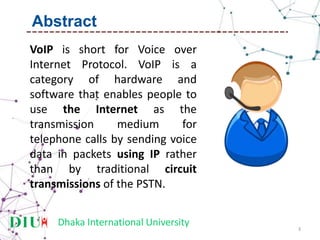
VoIP is short for Voice over
Internet Protocol. VoIP is a
category of hardware and
software that enables people to
use the Internet as the
transmission medium for
telephone calls by sending voice
data in packets using IP rather
than by traditional circuit
transmissions of the PSTN.
3
Abstract
Dhaka International University
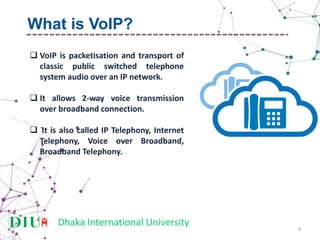
 VoIP is packetisation and transport of
classic public switched telephone
system audio over an IP network.
 It allows 2-way voice transmission
over broadband connection.
 It is also called IP Telephony, Internet
Telephony, Voice over Broadband,
Broadband Telephony.
4
What is VoIP?
Dhaka International University
Voice over Internet Protocol (VoIP) is referred to as and
broadly includes Voice over Broadband (VoB),Voice over
Digital Subscriber Line (DSL), Voice over Internet (VoI),
Voice over Wireless Local Area, Network and Internet
telephony.
5
ITU Definition for VoIP ?
Dhaka International University
• VoIP services convert your voice into a digital signal that travels
over the Internet.
• If you are calling a regular phone number, the signal is converted to
a regular telephone signal before it reaches the destination.
• VoIP can allow you to make a call directly from a computer, a
special VoIP phone, or a traditional phone connected to a special
adapter.
• In addition, wireless "hot spots" in locations such as airports, parks,
and cafes allow you to connect to the Internet and may enable you
to use VoIP service wirelessly.
6
How VoIP/Internet Voice Works?
Dhaka International University 7
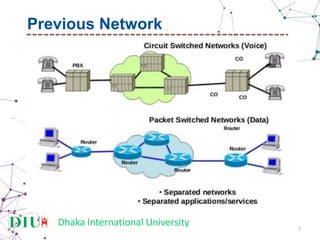
Previous Network
Dhaka International University 8
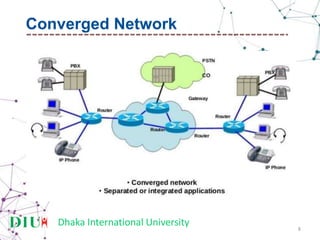
Converged Network
Dhaka International University
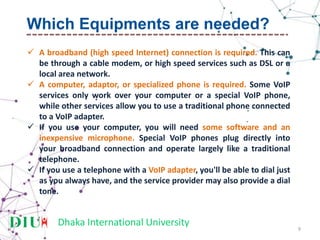
 A broadband (high speed Internet) connection is required. This can
be through a cable modem, or high speed services such as DSL or a
local area network.
 A computer, adaptor, or specialized phone is required. Some VoIP
services only work over your computer or a special VoIP phone,
while other services allow you to use a traditional phone connected
to a VoIP adapter.
 If you use your computer, you will need some software and an
inexpensive microphone. Special VoIP phones plug directly into
your broadband connection and operate largely like a traditional
telephone.
 If you use a telephone with a VoIP adapter, you'll be able to dial just
as you always have, and the service provider may also provide a dial
tone.
9
Which Equipments are needed?
Dhaka International University
 For businesses: Security at a lower cost
 For consumers: Significantly lower costs
 For service providers: Lower investment, capital and operating costs
for operators, it can be through :
Reductions in the bandwidth required to send any given voice
message; and
 Economies of scale;
 The possibility of converged services running over one
network (as opposed to multiple, older legacy networks).
 Also it can be Enhanced innovation, New business models and Entry
into new markets for service providers.
10
VoIP strengthen factors
Dhaka International University 11
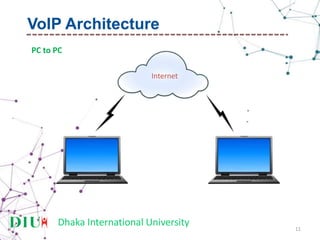
VoIP Architecture
PC to PC
Internet
Dhaka International University 12
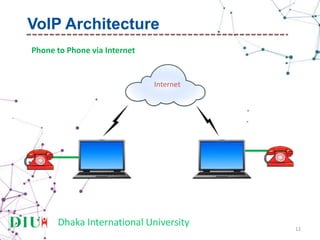
VoIP Architecture
Phone to Phone via Internet
Internet
Dhaka International University 13
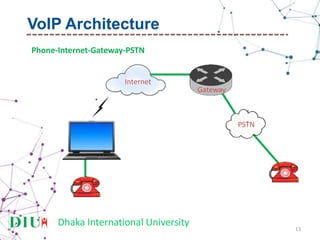
VoIP Architecture
Phone-Internet-Gateway-PSTN
Internet
PSTN
Gateway
Dhaka International University 14
VoIP Architecture
PSTN-Gateway-Internet-Gateway-PSTN
Internet
Gateway
Gateway
PSTN
PSTN
Dhaka International University
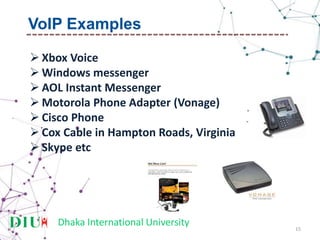
 Xbox Voice
 Windows messenger
 AOL Instant Messenger
 Motorola Phone Adapter (Vonage)
 Cisco Phone
 Cox Cable in Hampton Roads, Virginia
 Skype etc
15
VoIP Examples
Dhaka International University
 VoIP is legal and requires a specific VoIP license. The regulator, the Bangladesh
Telecommunication Regulatory Commission (BTRC), has issued “Regulatory
and Licensing Guidelines For Invitation of Applications for Issuing VoIP Licenses
for VoIP services in Bangladesh” on 21 September 2006.
 License Awarding Process- Bidding.
 The licensed operators have to use BTTB’s 26 VoIP platforms to be set up at four
places — Dhaka, Chittagong, Sylhet, and Bogra — for monitoring voice traffic.
 According to BTRC Total Number of VoIP Service Provider Licensee is 880.
 For formation regarding VSP please log on to http://www.btrc.gov.bd/
16
VoIP in Bangladesh
Dhaka International University
 The Telecom Regulatory Authority of India (TRAI) provided its recommendations
to Government on Internet telephony on 20 February 2002 to foster
competition, improve 27 options and prices for the consumers and provide
technological flexibility to the providers while maintaining QoS.
 VoIP has been legal since 1 April 2002. Facility-based operators can provide
Internet telephony and use VoIP technology to manage their networks, subject
to QoS considerations.
 TRAI issued regulations on quality for VoIP ILD calls, differentiating between toll
quality and below-toll quality in November 2002.
 TRAI has recommended that: the one-way end-to-end delay should in no case
exceed 150 µseconds; that variability (jitter) should be less than 5%; and that
packet loss should not exceed 1%.
 Tariffs for toll quality service offered by facility-based operators should be the
same as for equivalent PSTN-based services. The tariffs of VoIP services offered
by ISPs over the public Internet are not regulated, as this is an application of a
Value-Added Service.
17
VoIP in India
Dhaka International University
 The Australian Government notes services with different levels of integration:
• Peer-to-peer VoIP services for on-net calls (not connected to the PSTN)
provided online, requiring the user to have a separately-sourced
broadband connection;
• VoIP over broadband services provide interconnection with other types of
voice services (typically provided by online providers with the user having a
separately-sourced broadband connection);
• Vertically-integrated VoIP services offering interconnection with other
voice services, bundled with both a broadband connection and ISP service;
• Corporate or enterprise VoIP services providing the highest QoS of all the
VoIP service types, with interconnection to other types of voice services.
18
VoIP in Australia
Dhaka International University
 VoIP permitted. Most VoIP services connected to the public network are
considered a standard telephone service and will attract regulatory obligations
(not P2P services).
 The Australian Communications and Media Authority (ACMA) issued a
Discussion Paper on Regulatory Issues Associated with Provision of Voice
Services Using Internet Protocol in Australia in October 2004 and held public
consultations on VoIP service regulation throughout 2004.
 VoIP is used extensively in corporate networks, while broadband suppliers are
now offering VoIP to the residential market. Australian providers of VoIP
recognize that current regulatory arrangements for voice services and existing
consumer safeguards apply to their services.
19
VoIP in Australia (Contd.)
Dhaka International University
 The United States is not treating VoIP as a traditional telephone service, but as
a computer based ‘information service’ (as defined by the 1996
Telecommunication Act that distinguishes telephone services from information
services), that is relatively unregulated.
 USA has adopted a liberalized approach to VoIP, which is considered an Internet
application/Information Service. There are no licensing requirements, but a
Universal Service contribution is required.
 The FCC is examining issues for ‘IP-enabled services’ including VoIP addressing
social issues (e.g. Universal Service) and the classification of services for
regulatory purposes.
 In 2005, the FCC changed regulation so that VoIP services connected to the
PSTN must provide access to emergency services.
20
VoIP in USA
Dhaka International University
 VoIP is permitted, with no need for a license for the provision of VoIP services
over the Internet. PTS over VoIP is subject to voice telephony licensing
requirements, if managed VoIP traffic forms part of the core network of a PTS
operator.
 The Austrian regulator RTR 33 conducted a consultation on the numbering for
VoIP services. VoIP service providers are subject to loose regulations. These
services have only to be notified, according to the Telecommunications Act.
 The incumbent announced its cooperation with a US-based VoIP carrier
establishing an IP interconnection.
21
VoIP in Austria
Dhaka International University
 No specific regulations apply to VoIP providers. VoIP services were not officially
offered on the market, until as recently as mid-2003.
 IP telephony over the Internet is not covered by the Danish Telecom regulation,
with IP telephony considered as content. Other forms of IP telephony which do
constitute telecom services can be provided under Danish telecom regulation
without any license requirements.
 The Danish regulator NTA conducted a consultation on the numbering for VoIP
services. Consumer protection rules are an obligation for all telecom service
providers.
22
VoIP in Denmark
Dhaka International University
 Under the EU regulatory framework of July 2003, players (including VoIP
providers) are free to enter the market for electronic communications services
without prior authorization, provided they abide by the conditions of the
general authorization applicable in each Member State.
 VoIP providers will face obligations under the EU framework depending on the
service, rather than the technology used to provide it. The EU aims to adopt a
light regulatory touch, taking into account the emerging nature of the
technology, whilst preserving consumer interests (e.g. access to emergency
services).
 The EU issued an Information and Consultation Document on the Treatment of
VoIP under the EU Regulatory Framework in June 2004.
23
VoIP in EU
Dhaka International University
For more information regarding VoIP and it’s current situation in different
countries please follow the link:
[1]. https://www.itu.int/osg/spu/ni/voice/papers/FoV-VoIP-Biggs-Draft.pdf
[2]. Afghanistan Telecom Regulatory Authority (ATRA)
[3]. https://www.slideshare.net/habib_786/voice-over-ip-voip-26670219
[4]. http://www.btrc.gov.bd/
[5]. https://en.wikipedia.org/wiki/Voice_over_IP
24
References
Dhaka International University 25
Dhaka International University 26

VoIP

  • 1.
    VoIP (Voice over InternetProtocol) July 06, 2019 (Saturday) Dhaka International University Md. Arif Hossain Dept of EETE; Semester: 12th; Batch: 31st (eve); Roll no: 33
  • 2.
    Dhaka International University 2 Abstract  What is VoIP?  How VoIP Works?  VoIP Equipment  VoIP Architecture Contents  VoIP Comparative study in BD, Asia, Europe, Australia, USA
  • 3.
    Dhaka International University VoIPis short for Voice over Internet Protocol. VoIP is a category of hardware and software that enables people to use the Internet as the transmission medium for telephone calls by sending voice data in packets using IP rather than by traditional circuit transmissions of the PSTN. 3 Abstract
  • 4.
    Dhaka International University VoIP is packetisation and transport of classic public switched telephone system audio over an IP network.  It allows 2-way voice transmission over broadband connection.  It is also called IP Telephony, Internet Telephony, Voice over Broadband, Broadband Telephony. 4 What is VoIP?
  • 5.
    Dhaka International University Voiceover Internet Protocol (VoIP) is referred to as and broadly includes Voice over Broadband (VoB),Voice over Digital Subscriber Line (DSL), Voice over Internet (VoI), Voice over Wireless Local Area, Network and Internet telephony. 5 ITU Definition for VoIP ?
  • 6.
    Dhaka International University •VoIP services convert your voice into a digital signal that travels over the Internet. • If you are calling a regular phone number, the signal is converted to a regular telephone signal before it reaches the destination. • VoIP can allow you to make a call directly from a computer, a special VoIP phone, or a traditional phone connected to a special adapter. • In addition, wireless "hot spots" in locations such as airports, parks, and cafes allow you to connect to the Internet and may enable you to use VoIP service wirelessly. 6 How VoIP/Internet Voice Works?
  • 7.
  • 8.
    Dhaka International University8 Converged Network
  • 9.
    Dhaka International University A broadband (high speed Internet) connection is required. This can be through a cable modem, or high speed services such as DSL or a local area network.  A computer, adaptor, or specialized phone is required. Some VoIP services only work over your computer or a special VoIP phone, while other services allow you to use a traditional phone connected to a VoIP adapter.  If you use your computer, you will need some software and an inexpensive microphone. Special VoIP phones plug directly into your broadband connection and operate largely like a traditional telephone.  If you use a telephone with a VoIP adapter, you'll be able to dial just as you always have, and the service provider may also provide a dial tone. 9 Which Equipments are needed?
  • 10.
    Dhaka International University For businesses: Security at a lower cost  For consumers: Significantly lower costs  For service providers: Lower investment, capital and operating costs for operators, it can be through : Reductions in the bandwidth required to send any given voice message; and  Economies of scale;  The possibility of converged services running over one network (as opposed to multiple, older legacy networks).  Also it can be Enhanced innovation, New business models and Entry into new markets for service providers. 10 VoIP strengthen factors
  • 11.
    Dhaka International University11 VoIP Architecture PC to PC Internet
  • 12.
    Dhaka International University12 VoIP Architecture Phone to Phone via Internet Internet
  • 13.
    Dhaka International University13 VoIP Architecture Phone-Internet-Gateway-PSTN Internet PSTN Gateway
  • 14.
    Dhaka International University14 VoIP Architecture PSTN-Gateway-Internet-Gateway-PSTN Internet Gateway Gateway PSTN PSTN
  • 15.
    Dhaka International University Xbox Voice  Windows messenger  AOL Instant Messenger  Motorola Phone Adapter (Vonage)  Cisco Phone  Cox Cable in Hampton Roads, Virginia  Skype etc 15 VoIP Examples
  • 16.
    Dhaka International University VoIP is legal and requires a specific VoIP license. The regulator, the Bangladesh Telecommunication Regulatory Commission (BTRC), has issued “Regulatory and Licensing Guidelines For Invitation of Applications for Issuing VoIP Licenses for VoIP services in Bangladesh” on 21 September 2006.  License Awarding Process- Bidding.  The licensed operators have to use BTTB’s 26 VoIP platforms to be set up at four places — Dhaka, Chittagong, Sylhet, and Bogra — for monitoring voice traffic.  According to BTRC Total Number of VoIP Service Provider Licensee is 880.  For formation regarding VSP please log on to http://www.btrc.gov.bd/ 16 VoIP in Bangladesh
  • 17.
    Dhaka International University The Telecom Regulatory Authority of India (TRAI) provided its recommendations to Government on Internet telephony on 20 February 2002 to foster competition, improve 27 options and prices for the consumers and provide technological flexibility to the providers while maintaining QoS.  VoIP has been legal since 1 April 2002. Facility-based operators can provide Internet telephony and use VoIP technology to manage their networks, subject to QoS considerations.  TRAI issued regulations on quality for VoIP ILD calls, differentiating between toll quality and below-toll quality in November 2002.  TRAI has recommended that: the one-way end-to-end delay should in no case exceed 150 µseconds; that variability (jitter) should be less than 5%; and that packet loss should not exceed 1%.  Tariffs for toll quality service offered by facility-based operators should be the same as for equivalent PSTN-based services. The tariffs of VoIP services offered by ISPs over the public Internet are not regulated, as this is an application of a Value-Added Service. 17 VoIP in India
  • 18.
    Dhaka International University The Australian Government notes services with different levels of integration: • Peer-to-peer VoIP services for on-net calls (not connected to the PSTN) provided online, requiring the user to have a separately-sourced broadband connection; • VoIP over broadband services provide interconnection with other types of voice services (typically provided by online providers with the user having a separately-sourced broadband connection); • Vertically-integrated VoIP services offering interconnection with other voice services, bundled with both a broadband connection and ISP service; • Corporate or enterprise VoIP services providing the highest QoS of all the VoIP service types, with interconnection to other types of voice services. 18 VoIP in Australia
  • 19.
    Dhaka International University VoIP permitted. Most VoIP services connected to the public network are considered a standard telephone service and will attract regulatory obligations (not P2P services).  The Australian Communications and Media Authority (ACMA) issued a Discussion Paper on Regulatory Issues Associated with Provision of Voice Services Using Internet Protocol in Australia in October 2004 and held public consultations on VoIP service regulation throughout 2004.  VoIP is used extensively in corporate networks, while broadband suppliers are now offering VoIP to the residential market. Australian providers of VoIP recognize that current regulatory arrangements for voice services and existing consumer safeguards apply to their services. 19 VoIP in Australia (Contd.)
  • 20.
    Dhaka International University The United States is not treating VoIP as a traditional telephone service, but as a computer based ‘information service’ (as defined by the 1996 Telecommunication Act that distinguishes telephone services from information services), that is relatively unregulated.  USA has adopted a liberalized approach to VoIP, which is considered an Internet application/Information Service. There are no licensing requirements, but a Universal Service contribution is required.  The FCC is examining issues for ‘IP-enabled services’ including VoIP addressing social issues (e.g. Universal Service) and the classification of services for regulatory purposes.  In 2005, the FCC changed regulation so that VoIP services connected to the PSTN must provide access to emergency services. 20 VoIP in USA
  • 21.
    Dhaka International University VoIP is permitted, with no need for a license for the provision of VoIP services over the Internet. PTS over VoIP is subject to voice telephony licensing requirements, if managed VoIP traffic forms part of the core network of a PTS operator.  The Austrian regulator RTR 33 conducted a consultation on the numbering for VoIP services. VoIP service providers are subject to loose regulations. These services have only to be notified, according to the Telecommunications Act.  The incumbent announced its cooperation with a US-based VoIP carrier establishing an IP interconnection. 21 VoIP in Austria
  • 22.
    Dhaka International University No specific regulations apply to VoIP providers. VoIP services were not officially offered on the market, until as recently as mid-2003.  IP telephony over the Internet is not covered by the Danish Telecom regulation, with IP telephony considered as content. Other forms of IP telephony which do constitute telecom services can be provided under Danish telecom regulation without any license requirements.  The Danish regulator NTA conducted a consultation on the numbering for VoIP services. Consumer protection rules are an obligation for all telecom service providers. 22 VoIP in Denmark
  • 23.
    Dhaka International University Under the EU regulatory framework of July 2003, players (including VoIP providers) are free to enter the market for electronic communications services without prior authorization, provided they abide by the conditions of the general authorization applicable in each Member State.  VoIP providers will face obligations under the EU framework depending on the service, rather than the technology used to provide it. The EU aims to adopt a light regulatory touch, taking into account the emerging nature of the technology, whilst preserving consumer interests (e.g. access to emergency services).  The EU issued an Information and Consultation Document on the Treatment of VoIP under the EU Regulatory Framework in June 2004. 23 VoIP in EU
  • 24.
    Dhaka International University Formore information regarding VoIP and it’s current situation in different countries please follow the link: [1]. https://www.itu.int/osg/spu/ni/voice/papers/FoV-VoIP-Biggs-Draft.pdf [2]. Afghanistan Telecom Regulatory Authority (ATRA) [3]. https://www.slideshare.net/habib_786/voice-over-ip-voip-26670219 [4]. http://www.btrc.gov.bd/ [5]. https://en.wikipedia.org/wiki/Voice_over_IP 24 References
  • 25.
  • 26.

Editor's Notes

  • #17 REGULATORY STATUS OF VOIP BY REGION
  • #18 REGULATORY STATUS OF VOIP BY REGION