Area Traffic Control System implementation at Pune  by V. Muralidharan  Additional Director, Head CIG C-DAC, Thiruvananthapuram 695033  Email: murali@cdactvm.in
Area Traffic Control System Area traffic control system are traffic responsive system that use data from vehicle detectors and optimize traffic signal settings to reduce vehicle delays and stops  The system operates in a closed loop, evaluating the real time demand and properly updating network signal timings
The Indian Scenario Most of the traffic signal controllers installed across the Country are first generation, fixed time controllers Only two cities (New Delhi and Pune) has the  Area Traffic Control System (ATCS) New Delhi - 63 Junction (imported from UK) Pune - 38 Junctions (developed by C-DAC)  Even this is a very small percentage
Disadvantages of Fixed time traffic signal controllers The timing plans are based on historical data, which may not be an accurate reflection of typical conditions The timing plans rapidly age and the benefits achieved decrease The system cannot respond to unpredictable events
Result of fixed time controller Wasted Green time Unresolved Queues Minor Accidents at the intersection
Major building blocks of ATCS Traffic Signal Controller Vehicle Detectors Communication Network Application Software Central Control Station
Traffic Signal Controller
Vehicle Detection (Balgandharv Chowk, Pune) Stop line Loop for Straight going traffic Exit Loop for Right turning traffic
ArTIC #1 ArTIC #2 ArTIC #3 ArTIC #n CCR Detector Detector Detector Detector Communication network DETCTOR CONTROLLER CETRAL CONTROL STATION ATCS SOFTWARE
Central Control Station (CCS)
Challenges in implementing ATCS on Indian roads Traffic is not lane following A vehicle entering the approach (upstream) on a particular lane need not maintain the same at the intersection High mix of traffic Uncontrolled side roads and on-street parking Obtaining a correct measure of traffic count is highly complex  Data loss due to power failure Network failure Availability of funds
Homogeneous, lane following traffic Typical flow on Indian Roads (A scene from Pune)
Typical Indian Road Condition There is not, physically, as much road space and roads are not always planned and designed for efficient traffic use The roads are called upon to perform a wide variety of functions which includes non-traffic use  for example, the co-existence of market stalls and through traffic on the same road space Segregated footpaths are often poorly provided or used for other purposes, forcing pedestrians to use the roadway Vehicle growth rates are very high Vehicle mix can cover a wide range of types and characteristics, from bicycles and bullock-carts to articulated trucks
On Street Parking A typical parking pattern seen on Laxmi Road
Typical corridors ( Laxmi Road, Pune)
Addressing the Challenges C-DAC developed a Composite Signal Control Strategy (CoSiCoSt) for distributed network model that address all typical Indian road conditions Strategies are built into the system to guard against network failure, power failure etc. Distributed control give high scalability. Phased implementation of the system is possible based on funds availability
C-DAC ATCS Model Central Control Station (CCS) Stop line Detector Traffic Signal Controller Signal Lights Average Occupancy Signal Timings (Prediction) Signal Control Feedback (Signal Timings executed against the prediction)
Characteristics of C-DAC ATCS The average occupancy information is collected by the Traffic Signal Controller from the vehicle sensors at stop-line and exit at the respective intersections Signal timings for the intersection is generated by the traffic signal controller Lead time required for the decision to terminate or continue a green is typically 1 to 2 Sec. Green time executed at the intersection is intimated the to CC for audit and update CC computes the limits for green time for every approach for all the intersections in the network, based on the demand trend analysis Traffic signal controller is given autonomy to terminate the green prematurely, if the demand does not satisfy the CC predicted value  The traffic signal controllers can operate in vehicle actuation during communication failure or isolated mode Scalable from independent intersection-to-corridor control with distributed time synchronization-to-ATCS
CoSiCoSt Network Model New Timings & Preferences Demand Intersection Controller Split Optimizer Split time modifier  Translation Plan Detector Stage Timing, Stage Saturation, Speed info Performance Index / Offset Route Selection & Offset Optimizer Current Timings Preferences & Observations Area Optimizer Weights & Bias
Scalability Vehicle Actuated Traffic Signal Controller  / Urban Traffic Controller System (UTCS) Vehicle Actuated Corridor Control ATCS Camera SCMS VMS SCMS – Service Crew Monitoring System  VMS – Variable Message Signs
ArTIC #1 ArTIC #2 ArTIC #3 ArTIC #38 Camera Camera CCR Detector Detector Detector Detector GSM NETWORK SCMS SCMS Variable Message Sign Variable Message Sign Leased line Network (Data, Control & Video) Pune ATCS Configuration
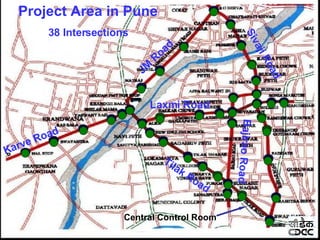
Project Area in Pune 38 Intersections Karve Road JM Road Laxmi Road Sivaji Road Tilak  Road Bajirao  Road Central Control Room ATCS Pune Project Area
Project Area in Pune 38 Intersections Karve Road JM Road Laxmi Road Sivaji Road Tilak Road Bajirao Road Central Control Room
Variable Message Sign (Swargate, Pune)
Service Crew Monitoring System
Photographs from Surveillance Camera Alka Talkies Junction, Pune
Corridor performance report
Traffic Flow
Time space diagram
Impact Analysis of ATCS in Pune M/s. Consulting Engineering Services (India) Pvt. Ltd., Mumbai Pre and Post implementation study Controller supply and installation M/s Webel Mediatronics Ltd., Kolkata 38 controllers and 136 vehicle sensor loops
Measure of Effectives (MoEs) considered for evaluation of impact of ATCS  Average Travel Speed  Average Delay  Average Saving in Fuel Average Saving in Time
Summary of these MoEs  Average travel speed increase of  - 2% to 12%  Reduction in average delay of  - 11% to 30%  Estimated annual fuel savings in the year 2006 is about - Rs. 4.77 Crores Estimated annual time saving benefits in the year 2006 is about - Rs. 0.83 Crores  Total annual saving in the year 2006 is about Rs. 5.60 Crores Over all Increase in the Traffic Volume is  9.06%
ATCS Pune Project Jointly funded by DIT and Pune Municipal Corporation Duration - 30 Months (January 2004 to June 2006) Project Cost - Rs.597.68L
Further Implementation Jaipur One corridor (9 junctions) on pilot scale Implementation in final stage. Expected to be fully functional by the end of January 2007 Ahmedabad Three corridors (31 junctions) on pilot scale Detailed project report being prepared by M/s. Webel Mediatronics Ltd., Kolkata
Agencies come forward for ATCS Technology M/s. Webel Mediatronics Ltd., Kolkata M/s. KELTRON, Thiruvananthapuram M/s. Bharat Electronics Ltd., Bangalore
Patents A method for synchronizing Heterogeneous Road Traffic and System thereof  #1087/CHE/2005 dated 08/08/05 System and Method for Vehicle Identification #1201/CHE/2005 dated 29/08/05 Distributed Time Synchronization of Road Traffic Signal Controllers using GPS   IP 2069/AFS/pgv (K&S Partners ref.)
Paper Publishing   A Composite Signal Control Strategy for Indian Roads, Indian Highways, August 2006 issue of The Indian Roads Congress, New Delhi
Paper Presentation 7 th  International Workshop Transportation Planning & Implementation Methodologies for Developing Countries: Infrastructure Systems Topic Real-time Adaptive Traffic Control Systems for Indian Cities – Challenges and Solutions,Indian Institute of Technology Bombay,3 rd  December 2006
Thank You

Vmuralidharan

  • 1.
    Area Traffic ControlSystem implementation at Pune by V. Muralidharan Additional Director, Head CIG C-DAC, Thiruvananthapuram 695033 Email: murali@cdactvm.in
  • 2.
    Area Traffic ControlSystem Area traffic control system are traffic responsive system that use data from vehicle detectors and optimize traffic signal settings to reduce vehicle delays and stops The system operates in a closed loop, evaluating the real time demand and properly updating network signal timings
  • 3.
    The Indian ScenarioMost of the traffic signal controllers installed across the Country are first generation, fixed time controllers Only two cities (New Delhi and Pune) has the Area Traffic Control System (ATCS) New Delhi - 63 Junction (imported from UK) Pune - 38 Junctions (developed by C-DAC) Even this is a very small percentage
  • 4.
    Disadvantages of Fixedtime traffic signal controllers The timing plans are based on historical data, which may not be an accurate reflection of typical conditions The timing plans rapidly age and the benefits achieved decrease The system cannot respond to unpredictable events
  • 5.
    Result of fixedtime controller Wasted Green time Unresolved Queues Minor Accidents at the intersection
  • 6.
    Major building blocksof ATCS Traffic Signal Controller Vehicle Detectors Communication Network Application Software Central Control Station
  • 7.
  • 8.
    Vehicle Detection (BalgandharvChowk, Pune) Stop line Loop for Straight going traffic Exit Loop for Right turning traffic
  • 9.
    ArTIC #1 ArTIC#2 ArTIC #3 ArTIC #n CCR Detector Detector Detector Detector Communication network DETCTOR CONTROLLER CETRAL CONTROL STATION ATCS SOFTWARE
  • 10.
  • 11.
    Challenges in implementingATCS on Indian roads Traffic is not lane following A vehicle entering the approach (upstream) on a particular lane need not maintain the same at the intersection High mix of traffic Uncontrolled side roads and on-street parking Obtaining a correct measure of traffic count is highly complex Data loss due to power failure Network failure Availability of funds
  • 12.
    Homogeneous, lane followingtraffic Typical flow on Indian Roads (A scene from Pune)
  • 13.
    Typical Indian RoadCondition There is not, physically, as much road space and roads are not always planned and designed for efficient traffic use The roads are called upon to perform a wide variety of functions which includes non-traffic use for example, the co-existence of market stalls and through traffic on the same road space Segregated footpaths are often poorly provided or used for other purposes, forcing pedestrians to use the roadway Vehicle growth rates are very high Vehicle mix can cover a wide range of types and characteristics, from bicycles and bullock-carts to articulated trucks
  • 14.
    On Street ParkingA typical parking pattern seen on Laxmi Road
  • 15.
    Typical corridors (Laxmi Road, Pune)
  • 16.
    Addressing the ChallengesC-DAC developed a Composite Signal Control Strategy (CoSiCoSt) for distributed network model that address all typical Indian road conditions Strategies are built into the system to guard against network failure, power failure etc. Distributed control give high scalability. Phased implementation of the system is possible based on funds availability
  • 17.
    C-DAC ATCS ModelCentral Control Station (CCS) Stop line Detector Traffic Signal Controller Signal Lights Average Occupancy Signal Timings (Prediction) Signal Control Feedback (Signal Timings executed against the prediction)
  • 18.
    Characteristics of C-DACATCS The average occupancy information is collected by the Traffic Signal Controller from the vehicle sensors at stop-line and exit at the respective intersections Signal timings for the intersection is generated by the traffic signal controller Lead time required for the decision to terminate or continue a green is typically 1 to 2 Sec. Green time executed at the intersection is intimated the to CC for audit and update CC computes the limits for green time for every approach for all the intersections in the network, based on the demand trend analysis Traffic signal controller is given autonomy to terminate the green prematurely, if the demand does not satisfy the CC predicted value The traffic signal controllers can operate in vehicle actuation during communication failure or isolated mode Scalable from independent intersection-to-corridor control with distributed time synchronization-to-ATCS
  • 19.
    CoSiCoSt Network ModelNew Timings & Preferences Demand Intersection Controller Split Optimizer Split time modifier Translation Plan Detector Stage Timing, Stage Saturation, Speed info Performance Index / Offset Route Selection & Offset Optimizer Current Timings Preferences & Observations Area Optimizer Weights & Bias
  • 20.
    Scalability Vehicle ActuatedTraffic Signal Controller / Urban Traffic Controller System (UTCS) Vehicle Actuated Corridor Control ATCS Camera SCMS VMS SCMS – Service Crew Monitoring System VMS – Variable Message Signs
  • 21.
    ArTIC #1 ArTIC#2 ArTIC #3 ArTIC #38 Camera Camera CCR Detector Detector Detector Detector GSM NETWORK SCMS SCMS Variable Message Sign Variable Message Sign Leased line Network (Data, Control & Video) Pune ATCS Configuration
  • 22.
    Project Area inPune 38 Intersections Karve Road JM Road Laxmi Road Sivaji Road Tilak Road Bajirao Road Central Control Room ATCS Pune Project Area
  • 23.
    Project Area inPune 38 Intersections Karve Road JM Road Laxmi Road Sivaji Road Tilak Road Bajirao Road Central Control Room
  • 24.
    Variable Message Sign(Swargate, Pune)
  • 25.
  • 26.
    Photographs from SurveillanceCamera Alka Talkies Junction, Pune
  • 27.
  • 28.
  • 29.
  • 30.
    Impact Analysis ofATCS in Pune M/s. Consulting Engineering Services (India) Pvt. Ltd., Mumbai Pre and Post implementation study Controller supply and installation M/s Webel Mediatronics Ltd., Kolkata 38 controllers and 136 vehicle sensor loops
  • 31.
    Measure of Effectives(MoEs) considered for evaluation of impact of ATCS Average Travel Speed Average Delay Average Saving in Fuel Average Saving in Time
  • 32.
    Summary of theseMoEs Average travel speed increase of - 2% to 12% Reduction in average delay of - 11% to 30% Estimated annual fuel savings in the year 2006 is about - Rs. 4.77 Crores Estimated annual time saving benefits in the year 2006 is about - Rs. 0.83 Crores Total annual saving in the year 2006 is about Rs. 5.60 Crores Over all Increase in the Traffic Volume is 9.06%
  • 33.
    ATCS Pune ProjectJointly funded by DIT and Pune Municipal Corporation Duration - 30 Months (January 2004 to June 2006) Project Cost - Rs.597.68L
  • 34.
    Further Implementation JaipurOne corridor (9 junctions) on pilot scale Implementation in final stage. Expected to be fully functional by the end of January 2007 Ahmedabad Three corridors (31 junctions) on pilot scale Detailed project report being prepared by M/s. Webel Mediatronics Ltd., Kolkata
  • 35.
    Agencies come forwardfor ATCS Technology M/s. Webel Mediatronics Ltd., Kolkata M/s. KELTRON, Thiruvananthapuram M/s. Bharat Electronics Ltd., Bangalore
  • 36.
    Patents A methodfor synchronizing Heterogeneous Road Traffic and System thereof #1087/CHE/2005 dated 08/08/05 System and Method for Vehicle Identification #1201/CHE/2005 dated 29/08/05 Distributed Time Synchronization of Road Traffic Signal Controllers using GPS IP 2069/AFS/pgv (K&S Partners ref.)
  • 37.
    Paper Publishing A Composite Signal Control Strategy for Indian Roads, Indian Highways, August 2006 issue of The Indian Roads Congress, New Delhi
  • 38.
    Paper Presentation 7th International Workshop Transportation Planning & Implementation Methodologies for Developing Countries: Infrastructure Systems Topic Real-time Adaptive Traffic Control Systems for Indian Cities – Challenges and Solutions,Indian Institute of Technology Bombay,3 rd December 2006
  • 39.