“INTELLIGENT TRANSPORTATION
SYSTEM"
PRESENTED BY:
Thakkar Jayshiv M.
2017-2018
CIVIL ENGINEERING DEPARTMENT
PARUL INSTITUTE OF ENGINEERING AND TECHNOLOGY , VADODARA
1
FACULTY SUPERVISOR
Mr. Siddharth Gupte
Asst. Prof.
Civil Engg. Dept.
PIET Vadodara
CONTENTS
 What is ITS?
 Problems in transportation
 Necessity of ITS
 Background Situation and Significance of promoting ITS
 Application of ITS
 Merits and Demerits of ITS
 Conclusion
2
Introduction
 Intelligent Transportation System are advanced
applications aim to provide innovative services related to
different modes of transport and traffic management.
 ITS enables various users to be better informed make safer ,
and smarter use of transport networks.
 ITS system in which information and communication
technologies are applied in the field of road transport,
including infrastructure, vehicles and users , and in traffic
management and mobility management.
3
What does ITS offer
Allows improved use of existing infrastructure by:
 Providing a better understanding of the transport network
-Live traffic and travel information-quick response
 Providing new methods to manage the network
-improved traffic signals and vehicle priority
 Providing new services to the public
-travel information to make journeys easier and more
pleasant
4
Problems in Transportation
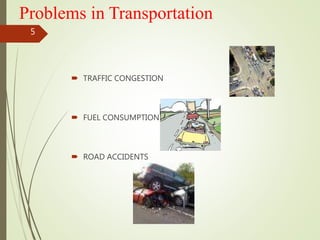
 TRAFFIC CONGESTION
 FUEL CONSUMPTION
 ROAD ACCIDENTS
5
Necessity of ITS
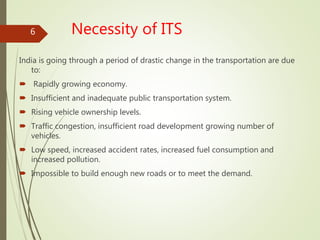
India is going through a period of drastic change in the transportation are due
to:
 Rapidly growing economy.
 Insufficient and inadequate public transportation system.
 Rising vehicle ownership levels.
 Traffic congestion, insufficient road development growing number of
vehicles.
 Low speed, increased accident rates, increased fuel consumption and
increased pollution.
 Impossible to build enough new roads or to meet the demand.
6
7
Background Situation and
Significance of promoting ITS
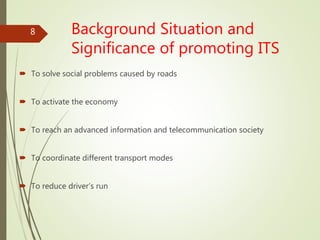
 To solve social problems caused by roads
 To activate the economy
 To reach an advanced information and telecommunication society
 To coordinate different transport modes
 To reduce driver’s run
8
9
Application of ITS
 Electronic toll collection(ETC)
 Emergency vehicle notification system
 Cordon zones with congestion system
 Global positioning system(GPS)
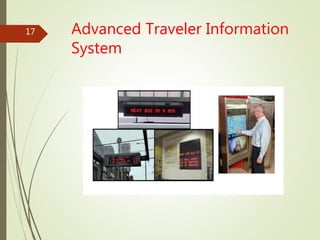
 Advanced traveler information system(ATIS)
 In vehicle transit information system
 Automatic passenger counter
10
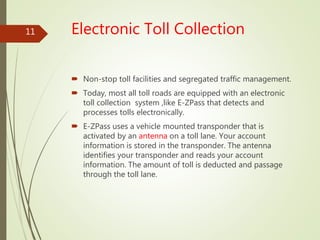
Electronic Toll Collection
 Non-stop toll facilities and segregated traffic management.
 Today, most all toll roads are equipped with an electronic
toll collection system ,like E-ZPass that detects and
processes tolls electronically.
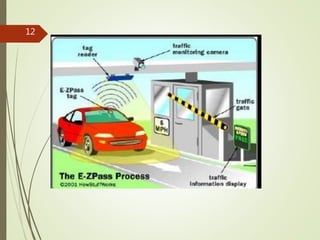
 E-ZPass uses a vehicle mounted transponder that is
activated by an antenna on a toll lane. Your account
information is stored in the transponder. The antenna
identifies your transponder and reads your account
information. The amount of toll is deducted and passage
through the toll lane.
11
12
Emergency vehicle notification
system
 The in-vehicle eCall is an emergency call generated either
manually by the vehicle occupants or automatically via
activation of in-vehicle sensors after an accident.
 When activated, the in-vehicle eCall device will establish an
emergency call carrying both voice and data directly to the
nearest emergency point.
 The voice call enables the vehicle occupant to communicate
with the trained eCall operator.
13
Cordon zones with congestion
pricing
 Cordon zones have been implemented in Singapore,
Stockholm, and London, where a congestion charge or fee
is collected from vehicles entering a congested city centre.
 This fee or toll is charged automatically using electronic toll
collection or automatic number plate recognition, since
stopping the users at conventional toll booths would cause
long queues, long delays, and even gridlock.
 The main objective of this charge is to reduce traffic
congestion within the cordon area.
14
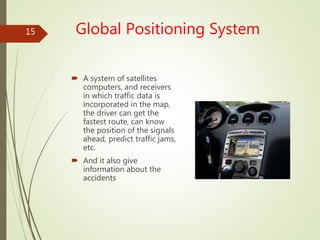
Global Positioning System
 A system of satellites
computers, and receivers
in which traffic data is
incorporated in the map,
the driver can get the
fastest route, can know
the position of the signals
ahead, predict traffic jams,
etc.
 And it also give
information about the
accidents
15
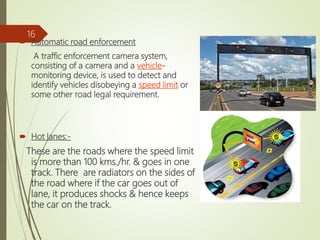
 Automatic road enforcement
A traffic enforcement camera system,
consisting of a camera and a vehicle-
monitoring device, is used to detect and
identify vehicles disobeying a speed limit or
some other road legal requirement.
 Hot lanes:-
These are the roads where the speed limit
is more than 100 kms./hr. & goes in one
track. There are radiators on the sides of
the road where if the car goes out of
lane, it produces shocks & hence keeps
the car on the track.
16
Advanced Traveler Information
System
17
Automatic Passenger Counter
 The APC automatically records the number of passengers,
time and location of each stop as passengers get on and off
the bus
 The APC can collect data, with a reduction in time, cost and
effort by means of infrared beams at the doors or pressure
sensitive mats on the steps.
 With the information provided by the APCs, transit planners
can make changes to routes and schedules that better serve
the transportation needs of their community.
18
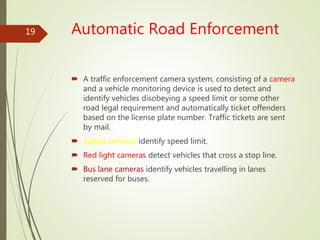
Automatic Road Enforcement
 A traffic enforcement camera system, consisting of a camera
and a vehicle monitoring device is used to detect and
identify vehicles disobeying a speed limit or some other
road legal requirement and automatically ticket offenders
based on the license plate number. Traffic tickets are sent
by mail.
 Speed cameras identify speed limit.
 Red light cameras detect vehicles that cross a stop line.
 Bus lane cameras identify vehicles travelling in lanes
reserved for buses.
19
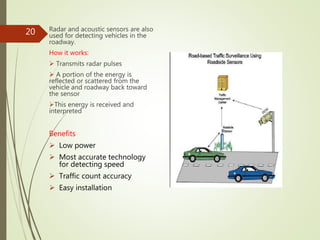
Radar and acoustic sensors are also
used for detecting vehicles in the
roadway.
How it works:
 Transmits radar pulses
 A portion of the energy is
reflected or scattered from the
vehicle and roadway back toward
the sensor
This energy is received and
interpreted
Benefits
 Low power
 Most accurate technology
for detecting speed
 Traffic count accuracy
 Easy installation
20
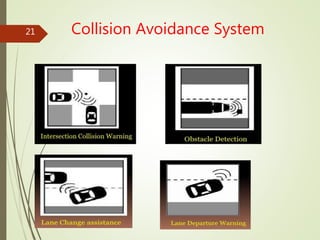
Collision Avoidance System21
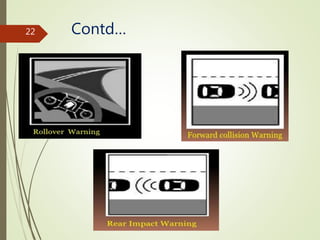
Contd…22
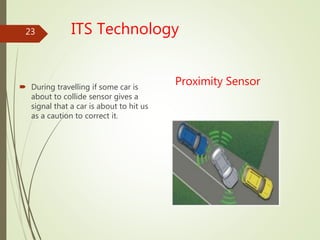
ITS Technology
Proximity Sensor During travelling if some car is
about to collide sensor gives a
signal that a car is about to hit us
as a caution to correct it.
23
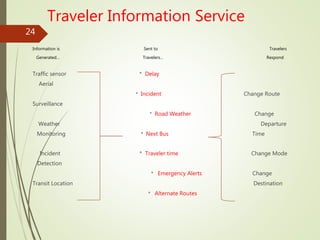
Traveler Information Service
Information is Sent to Travelers
Generated… Travelers… Respond
Traffic sensor * Delay
Aerial
* Incident Change Route
Surveillance
* Road Weather Change
Weather Departure
Monitoring * Next Bus Time
Incident * Traveler time Change Mode
Detection
* Emergency Alerts Change
Transit Location Destination
* Alternate Routes
24
Advantages of ITS
 Improve safety
 Better traffic flow
 Lower travel cost
 Better environmental quality
 Increased customer satisfaction
 Greater user acceptance
 Better travel information
 Better planning information
 Decreasing of probability of congestion occurance
25
Disadvantages
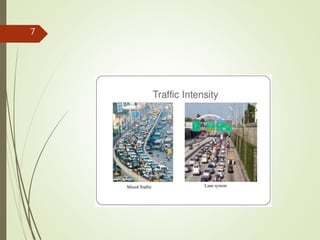
 Difficult to use in mixed traffic
 Preliminary difficulties in understanding
 ITS equipments are costly
 The control system software could be hacked by hackers.
26
Conclusion
 The use of ITS in some developed countries like America,
Japan and England has give them high progress in the field
of transportation.
 The traffic congestions, rate of road accidents, wastage of
fuels will decreased to a large extend.
 This gives the people of the country a more economic mean
of transportation with advanced of transit
 Hence it can be implemented in our country and can prove
to be the solution of the traffic problems including traffic
congestion, air pollution and traffic accidents.
27
28
29

Intelligent Transportation System

  • 1.
    “INTELLIGENT TRANSPORTATION SYSTEM" PRESENTED BY: ThakkarJayshiv M. 2017-2018 CIVIL ENGINEERING DEPARTMENT PARUL INSTITUTE OF ENGINEERING AND TECHNOLOGY , VADODARA 1 FACULTY SUPERVISOR Mr. Siddharth Gupte Asst. Prof. Civil Engg. Dept. PIET Vadodara
  • 2.
    CONTENTS  What isITS?  Problems in transportation  Necessity of ITS  Background Situation and Significance of promoting ITS  Application of ITS  Merits and Demerits of ITS  Conclusion 2
  • 3.
    Introduction  Intelligent TransportationSystem are advanced applications aim to provide innovative services related to different modes of transport and traffic management.  ITS enables various users to be better informed make safer , and smarter use of transport networks.  ITS system in which information and communication technologies are applied in the field of road transport, including infrastructure, vehicles and users , and in traffic management and mobility management. 3
  • 4.
    What does ITSoffer Allows improved use of existing infrastructure by:  Providing a better understanding of the transport network -Live traffic and travel information-quick response  Providing new methods to manage the network -improved traffic signals and vehicle priority  Providing new services to the public -travel information to make journeys easier and more pleasant 4
  • 5.
    Problems in Transportation TRAFFIC CONGESTION  FUEL CONSUMPTION  ROAD ACCIDENTS 5
  • 6.
    Necessity of ITS Indiais going through a period of drastic change in the transportation are due to:  Rapidly growing economy.  Insufficient and inadequate public transportation system.  Rising vehicle ownership levels.  Traffic congestion, insufficient road development growing number of vehicles.  Low speed, increased accident rates, increased fuel consumption and increased pollution.  Impossible to build enough new roads or to meet the demand. 6
  • 7.
  • 8.
    Background Situation and Significanceof promoting ITS  To solve social problems caused by roads  To activate the economy  To reach an advanced information and telecommunication society  To coordinate different transport modes  To reduce driver’s run 8
  • 9.
  • 10.
    Application of ITS Electronic toll collection(ETC)  Emergency vehicle notification system  Cordon zones with congestion system  Global positioning system(GPS)  Advanced traveler information system(ATIS)  In vehicle transit information system  Automatic passenger counter 10
  • 11.
    Electronic Toll Collection Non-stop toll facilities and segregated traffic management.  Today, most all toll roads are equipped with an electronic toll collection system ,like E-ZPass that detects and processes tolls electronically.  E-ZPass uses a vehicle mounted transponder that is activated by an antenna on a toll lane. Your account information is stored in the transponder. The antenna identifies your transponder and reads your account information. The amount of toll is deducted and passage through the toll lane. 11
  • 12.
  • 13.
    Emergency vehicle notification system The in-vehicle eCall is an emergency call generated either manually by the vehicle occupants or automatically via activation of in-vehicle sensors after an accident.  When activated, the in-vehicle eCall device will establish an emergency call carrying both voice and data directly to the nearest emergency point.  The voice call enables the vehicle occupant to communicate with the trained eCall operator. 13
  • 14.
    Cordon zones withcongestion pricing  Cordon zones have been implemented in Singapore, Stockholm, and London, where a congestion charge or fee is collected from vehicles entering a congested city centre.  This fee or toll is charged automatically using electronic toll collection or automatic number plate recognition, since stopping the users at conventional toll booths would cause long queues, long delays, and even gridlock.  The main objective of this charge is to reduce traffic congestion within the cordon area. 14
  • 15.
    Global Positioning System A system of satellites computers, and receivers in which traffic data is incorporated in the map, the driver can get the fastest route, can know the position of the signals ahead, predict traffic jams, etc.  And it also give information about the accidents 15
  • 16.
     Automatic roadenforcement A traffic enforcement camera system, consisting of a camera and a vehicle- monitoring device, is used to detect and identify vehicles disobeying a speed limit or some other road legal requirement.  Hot lanes:- These are the roads where the speed limit is more than 100 kms./hr. & goes in one track. There are radiators on the sides of the road where if the car goes out of lane, it produces shocks & hence keeps the car on the track. 16
  • 17.
  • 18.
    Automatic Passenger Counter The APC automatically records the number of passengers, time and location of each stop as passengers get on and off the bus  The APC can collect data, with a reduction in time, cost and effort by means of infrared beams at the doors or pressure sensitive mats on the steps.  With the information provided by the APCs, transit planners can make changes to routes and schedules that better serve the transportation needs of their community. 18
  • 19.
    Automatic Road Enforcement A traffic enforcement camera system, consisting of a camera and a vehicle monitoring device is used to detect and identify vehicles disobeying a speed limit or some other road legal requirement and automatically ticket offenders based on the license plate number. Traffic tickets are sent by mail.  Speed cameras identify speed limit.  Red light cameras detect vehicles that cross a stop line.  Bus lane cameras identify vehicles travelling in lanes reserved for buses. 19
  • 20.
    Radar and acousticsensors are also used for detecting vehicles in the roadway. How it works:  Transmits radar pulses  A portion of the energy is reflected or scattered from the vehicle and roadway back toward the sensor This energy is received and interpreted Benefits  Low power  Most accurate technology for detecting speed  Traffic count accuracy  Easy installation 20
  • 21.
  • 22.
  • 23.
    ITS Technology Proximity SensorDuring travelling if some car is about to collide sensor gives a signal that a car is about to hit us as a caution to correct it. 23
  • 24.
    Traveler Information Service Informationis Sent to Travelers Generated… Travelers… Respond Traffic sensor * Delay Aerial * Incident Change Route Surveillance * Road Weather Change Weather Departure Monitoring * Next Bus Time Incident * Traveler time Change Mode Detection * Emergency Alerts Change Transit Location Destination * Alternate Routes 24
  • 25.
    Advantages of ITS Improve safety  Better traffic flow  Lower travel cost  Better environmental quality  Increased customer satisfaction  Greater user acceptance  Better travel information  Better planning information  Decreasing of probability of congestion occurance 25
  • 26.
    Disadvantages  Difficult touse in mixed traffic  Preliminary difficulties in understanding  ITS equipments are costly  The control system software could be hacked by hackers. 26
  • 27.
    Conclusion  The useof ITS in some developed countries like America, Japan and England has give them high progress in the field of transportation.  The traffic congestions, rate of road accidents, wastage of fuels will decreased to a large extend.  This gives the people of the country a more economic mean of transportation with advanced of transit  Hence it can be implemented in our country and can prove to be the solution of the traffic problems including traffic congestion, air pollution and traffic accidents. 27
  • 28.
  • 29.