
GOVERNMENT POLYTECHNIC AMRAVATI
(An Autonomous Institute of Maharashtra State )
SEMINAR ON
“INTELLIGENT TRANSPORTATION SYSTEM”
Submitted By:
Qazi Usama Khalid
ID:12CE036
FINAL YEAR CIVIL 1ST
Shift
Guided By:
Dr. S.J.Nikam
Lecturer
Civil engineering
department
• Introduction
• Background Situation and Significance of
Promoting ITS
• Intelligent Transportation Technologies
• Intelligent Transportation Applications
• Benefits of Intelligent Transportation System
• References
Presentation Outline
Introduction
ITS is an emerging transportation system which
is comprised of an advanced information and
telecommunications network for users, roads and
vehicles.
ITS is the integrated application of advanced
Technologies using electronics, computers,
communications, and advanced sensors. These
applications provide travellers with important
information while improving the safety and efficiency
of the transportation system.
Background Situation of Promoting ITS
 To Solve Social Problems caused by Road
 To activate the Economy
 To reach an Advanced Information and
Tele – communication Society
 To Co-ordinate different Transport Modes
 To reduce Driver’s run
Advantages of Promoting ITS
 Breakthrough for Solving Road
Transport Problems
 Creation of New Industries
 Leader of an Advanced Information
and Telecommunications
Intelligent Transportation Technologies
(1) Wireless Communications :
Dedicated Short-Range Communications
(DSRC) :
It offers communication between the vehicle
and the roadside in specific locations (for
example toll plazas) Applications such as
Electronic Fee Collection (EFC) will operate
over DSRC. It is a sub-set of the RFID -
technology (Radio-frequency identification).
Continuous Air interface Long and
Medium range (CALM) provides continuous
communications between a vehicle and the
roadside using a variety of communication
media, including cellular and infra-red links.
Continuous Air interface Long and Medium
range (CALM) :
CALM will provide a range of applications,
including vehicle safety and information, as
well as entertainment for driver and
passengers.
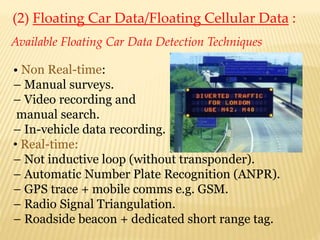
(2) Floating Car Data/Floating Cellular Data :
Available Floating Car Data Detection Techniques
• Non Real-time:
– Manual surveys.
– Video recording and
manual search.
– In-vehicle data recording.
• Real-time:
– Not inductive loop (without transponder).
– Automatic Number Plate Recognition (ANPR).
– GPS trace + mobile comms e.g. GSM.
– Radio Signal Triangulation.
– Roadside beacon + dedicated short range tag.
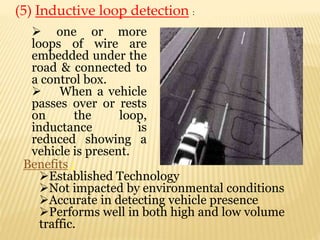
(5) Inductive loop detection :
 one or more
loops of wire are
embedded under the
road & connected to
a control box.
 When a vehicle
passes over or rests
on the loop,
inductance is
reduced showing a
vehicle is present.
Benefits :
Established Technology
Not impacted by environmental conditions
Accurate in detecting vehicle presence
Performs well in both high and low volume
traffic.
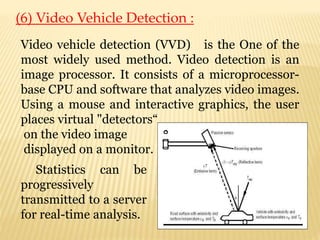
(6) Video Vehicle Detection :
Video vehicle detection (VVD) is the One of the
most widely used method. Video detection is an
image processor. It consists of a microprocessor-
base CPU and software that analyzes video images.
Using a mouse and interactive graphics, the user
places virtual "detectors“
on the video image
displayed on a monitor.
Statistics can be
progressively
transmitted to a server
for real-time analysis.
Intelligent Transportation Applications
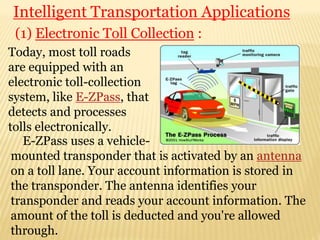
(1) Electronic Toll Collection :
Today, most toll roads
are equipped with an
electronic toll-collection
system, like E-ZPass, that
detects and processes
tolls electronically.
E-ZPass uses a vehicle-
mounted transponder that is activated by an antenna
on a toll lane. Your account information is stored in
the transponder. The antenna identifies your
transponder and reads your account information. The
amount of the toll is deducted and you're allowed
through.
(2) Emergency vehicle notification systems :
Intelligent transportation systems
particularly the FCD (Floating Car Data )
model can also be used to provide
advance warning to motorists of traffic
jams, accidents and other emergency
situations. This system can then provide
alternative routes or recommendations to
motorists so as to avoid congestion and
travel delays.
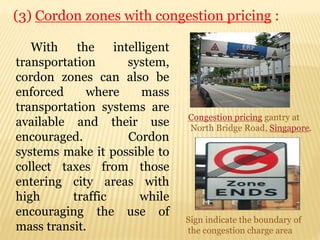
(3) Cordon zones with congestion pricing :
With the intelligent
transportation system,
cordon zones can also be
enforced where mass
transportation systems are
available and their use
encouraged. Cordon
systems make it possible to
collect taxes from those
entering city areas with
high traffic while
encouraging the use of
mass transit.
Sign indicate the boundary of
the congestion charge area
Congestion pricing gantry at
North Bridge Road, Singapore.
A traffic enforcement camera system,
consisting of a camera and a vehicle-monitoring
device, is used to detect and identify vehicles
disobeying a speed limit or some other road
legal requirement and automatically ticket
offenders based on the license plate number.
Traffic tickets are sent by mail. For Exam :-
(4) Automatic Road Enforcement :
o Speed cameras identify speed limit.
o Red light cameras detect vehicles that
cross a stop line.
o Bus lane cameras identify vehicles
traveling in lanes reserved for buses.
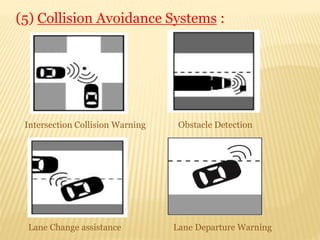
(5) Collision Avoidance Systems :
Intersection Collision Warning Obstacle Detection
Lane Change assistance Lane Departure Warning
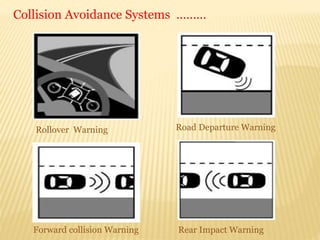
Collision Avoidance Systems ………
Rollover Warning Road Departure Warning
Forward collision Warning Rear Impact Warning
(6) Emergency Management Services :
When an incident occurs, the nearest emergency
service vehicle is located electronically and
dispatched to the scene. Highway managers then
alert other drivers of the incident through dynamic
message signs. These services reduce response
times, help save lives, and reduce the occurrence of
secondary incidents.
Emergency Management
Services are greatly
enhanced by traffic control
centers that continually
monitor roadway conditions.
 Time Savings
 Better emergency response times and services
 Reduced Crashes and Fatalities
 Cost Avoidance
 Increased Customer Satisfaction
 Energy and Environmental Benefits
 Decreasing of probability of congestion occurrence
Benefits of ITS :
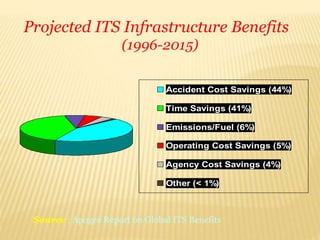
Accident Cost Savings (44%)
Time Savings (41%)
Emissions/Fuel (6%)
Operating Cost Savings (5%)
Agency Cost Savings (4%)
Other (< 1%)
Projected ITS Infrastructure Benefits
(1996-2015)
Source : Apogee Report on Global ITS Benefits
References :
www.wikipedia.com
www.answers.com
www.howstuffworks.com
www.tech-faq.com
www.thetravelinsider.info
http://www.itsoverview.its.dot.
http://www.transport systems.com
http://www.mountain-plains.org
Intelligent Transportation System

Intelligent Transportation System

  • 1.
    GOVERNMENT POLYTECHNIC AMRAVATI (AnAutonomous Institute of Maharashtra State ) SEMINAR ON “INTELLIGENT TRANSPORTATION SYSTEM” Submitted By: Qazi Usama Khalid ID:12CE036 FINAL YEAR CIVIL 1ST Shift Guided By: Dr. S.J.Nikam Lecturer Civil engineering department
  • 2.
    • Introduction • BackgroundSituation and Significance of Promoting ITS • Intelligent Transportation Technologies • Intelligent Transportation Applications • Benefits of Intelligent Transportation System • References Presentation Outline
  • 3.
    Introduction ITS is anemerging transportation system which is comprised of an advanced information and telecommunications network for users, roads and vehicles. ITS is the integrated application of advanced Technologies using electronics, computers, communications, and advanced sensors. These applications provide travellers with important information while improving the safety and efficiency of the transportation system.
  • 4.
    Background Situation ofPromoting ITS  To Solve Social Problems caused by Road  To activate the Economy  To reach an Advanced Information and Tele – communication Society  To Co-ordinate different Transport Modes  To reduce Driver’s run
  • 5.
    Advantages of PromotingITS  Breakthrough for Solving Road Transport Problems  Creation of New Industries  Leader of an Advanced Information and Telecommunications
  • 6.
    Intelligent Transportation Technologies (1)Wireless Communications : Dedicated Short-Range Communications (DSRC) : It offers communication between the vehicle and the roadside in specific locations (for example toll plazas) Applications such as Electronic Fee Collection (EFC) will operate over DSRC. It is a sub-set of the RFID - technology (Radio-frequency identification).
  • 7.
    Continuous Air interfaceLong and Medium range (CALM) provides continuous communications between a vehicle and the roadside using a variety of communication media, including cellular and infra-red links. Continuous Air interface Long and Medium range (CALM) : CALM will provide a range of applications, including vehicle safety and information, as well as entertainment for driver and passengers.
  • 8.
    (2) Floating CarData/Floating Cellular Data : Available Floating Car Data Detection Techniques • Non Real-time: – Manual surveys. – Video recording and manual search. – In-vehicle data recording. • Real-time: – Not inductive loop (without transponder). – Automatic Number Plate Recognition (ANPR). – GPS trace + mobile comms e.g. GSM. – Radio Signal Triangulation. – Roadside beacon + dedicated short range tag.
  • 9.
    (5) Inductive loopdetection :  one or more loops of wire are embedded under the road & connected to a control box.  When a vehicle passes over or rests on the loop, inductance is reduced showing a vehicle is present. Benefits : Established Technology Not impacted by environmental conditions Accurate in detecting vehicle presence Performs well in both high and low volume traffic.
  • 10.
    (6) Video VehicleDetection : Video vehicle detection (VVD) is the One of the most widely used method. Video detection is an image processor. It consists of a microprocessor- base CPU and software that analyzes video images. Using a mouse and interactive graphics, the user places virtual "detectors“ on the video image displayed on a monitor. Statistics can be progressively transmitted to a server for real-time analysis.
  • 11.
    Intelligent Transportation Applications (1)Electronic Toll Collection : Today, most toll roads are equipped with an electronic toll-collection system, like E-ZPass, that detects and processes tolls electronically. E-ZPass uses a vehicle- mounted transponder that is activated by an antenna on a toll lane. Your account information is stored in the transponder. The antenna identifies your transponder and reads your account information. The amount of the toll is deducted and you're allowed through.
  • 12.
    (2) Emergency vehiclenotification systems : Intelligent transportation systems particularly the FCD (Floating Car Data ) model can also be used to provide advance warning to motorists of traffic jams, accidents and other emergency situations. This system can then provide alternative routes or recommendations to motorists so as to avoid congestion and travel delays.
  • 13.
    (3) Cordon zoneswith congestion pricing : With the intelligent transportation system, cordon zones can also be enforced where mass transportation systems are available and their use encouraged. Cordon systems make it possible to collect taxes from those entering city areas with high traffic while encouraging the use of mass transit. Sign indicate the boundary of the congestion charge area Congestion pricing gantry at North Bridge Road, Singapore.
  • 14.
    A traffic enforcementcamera system, consisting of a camera and a vehicle-monitoring device, is used to detect and identify vehicles disobeying a speed limit or some other road legal requirement and automatically ticket offenders based on the license plate number. Traffic tickets are sent by mail. For Exam :- (4) Automatic Road Enforcement : o Speed cameras identify speed limit. o Red light cameras detect vehicles that cross a stop line. o Bus lane cameras identify vehicles traveling in lanes reserved for buses.
  • 15.
    (5) Collision AvoidanceSystems : Intersection Collision Warning Obstacle Detection Lane Change assistance Lane Departure Warning
  • 16.
    Collision Avoidance Systems……… Rollover Warning Road Departure Warning Forward collision Warning Rear Impact Warning
  • 17.
    (6) Emergency ManagementServices : When an incident occurs, the nearest emergency service vehicle is located electronically and dispatched to the scene. Highway managers then alert other drivers of the incident through dynamic message signs. These services reduce response times, help save lives, and reduce the occurrence of secondary incidents. Emergency Management Services are greatly enhanced by traffic control centers that continually monitor roadway conditions.
  • 18.
     Time Savings Better emergency response times and services  Reduced Crashes and Fatalities  Cost Avoidance  Increased Customer Satisfaction  Energy and Environmental Benefits  Decreasing of probability of congestion occurrence Benefits of ITS :
  • 19.
    Accident Cost Savings(44%) Time Savings (41%) Emissions/Fuel (6%) Operating Cost Savings (5%) Agency Cost Savings (4%) Other (< 1%) Projected ITS Infrastructure Benefits (1996-2015) Source : Apogee Report on Global ITS Benefits
  • 20.