
INTELLIGENT
TRANSPORTATION
SYSTEM
PRESENTED BY,
AGLAIA
What is ITS?
The term Intelligent Transportation Systems (ITS) refers to information and
communication technology, applied to transport infrastructure and vehicles,
that improve transport outcomes such as:
Transport Safety
 Transport Productivity
 Travel Reliability
Social Equity
 Environmental Performance
 Network Operation Resilience
Applications of ITS
 Emergency Vehicle Notification Systems
 Automatic Road Enforcement
 Variable Speed Limits
 Collision Avoidance Systems
 Dynamic Traffic Light Sequence
Collision avoidance system/pre crash
system
 It is an automobile safety system designed to prevent or reduce the
severity of a collision.
 It uses radar ,laser and camera to detect an imminent crash.
 GPS sensors can detect fixed dangers such as approaching stop signs
through a location database.
 Once an impending collision is detected, these systems provide a warning
to the driver.
 When the collision becomes imminent, they take action autonomously
without any driver input (by braking or steering or both).
 Collision avoidance by braking is appropriate at low vehicle speeds (e.g.
below 50 km/h (31 mph)), while collision avoidance by steering may be
more appropriate at higher vehicle speeds if lanes are clear.
 Cars with collision avoidance may also be equipped with adaptive cruise
control, using the same forward-looking sensors.
 Autonomous: the system acts independently of the driver to avoid or
mitigate the accident.
 Emergency: the system will intervene only in a critical situation.
 Braking: the system tries to avoid the accident by applying the brakes.
Features
 Pedestrian detection
 Lane assist
 Blind spot alert
 Hill hold control
 Cornering Brake Control
 Forward Collision Warning
 Cornering brake control
 Evasive Steering Assist Adaptive
Headlights
 Reverse automatic braking
Control System of CAS
 An audible warning
 Light braking & seat-belt retraction.
 Strong braking & seat-belt retraction.
Warning devices
 Visual head-up displays: warnings are displayed on the windshield in the
driver's field of view.
 Audio/Voice signals: auditory signals appear to be less intrusive on
driving tasks.
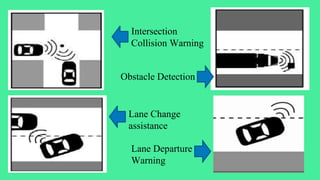
Intersection
Collision Warning
Obstacle Detection
Lane Change
assistance
Lane Departure
Warning
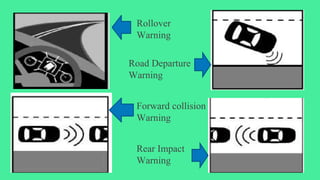
Rollover
Warning
Road Departure
Warning
Forward collision
Warning
Rear Impact
Warning
THANK YOU
For more…. Mail to aglaiaconnect2018@gmail.com

Intelligent transportation system

  • 1.
  • 2.
    What is ITS? Theterm Intelligent Transportation Systems (ITS) refers to information and communication technology, applied to transport infrastructure and vehicles, that improve transport outcomes such as: Transport Safety  Transport Productivity  Travel Reliability Social Equity  Environmental Performance  Network Operation Resilience
  • 3.
    Applications of ITS Emergency Vehicle Notification Systems  Automatic Road Enforcement  Variable Speed Limits  Collision Avoidance Systems  Dynamic Traffic Light Sequence
  • 4.
    Collision avoidance system/precrash system  It is an automobile safety system designed to prevent or reduce the severity of a collision.  It uses radar ,laser and camera to detect an imminent crash.  GPS sensors can detect fixed dangers such as approaching stop signs through a location database.
  • 5.
     Once animpending collision is detected, these systems provide a warning to the driver.  When the collision becomes imminent, they take action autonomously without any driver input (by braking or steering or both).
  • 6.
     Collision avoidanceby braking is appropriate at low vehicle speeds (e.g. below 50 km/h (31 mph)), while collision avoidance by steering may be more appropriate at higher vehicle speeds if lanes are clear.  Cars with collision avoidance may also be equipped with adaptive cruise control, using the same forward-looking sensors.
  • 7.
     Autonomous: thesystem acts independently of the driver to avoid or mitigate the accident.  Emergency: the system will intervene only in a critical situation.  Braking: the system tries to avoid the accident by applying the brakes.
  • 8.
    Features  Pedestrian detection Lane assist  Blind spot alert  Hill hold control  Cornering Brake Control  Forward Collision Warning  Cornering brake control  Evasive Steering Assist Adaptive Headlights  Reverse automatic braking
  • 9.
    Control System ofCAS  An audible warning  Light braking & seat-belt retraction.  Strong braking & seat-belt retraction.
  • 10.
    Warning devices  Visualhead-up displays: warnings are displayed on the windshield in the driver's field of view.  Audio/Voice signals: auditory signals appear to be less intrusive on driving tasks.
  • 11.
    Intersection Collision Warning Obstacle Detection LaneChange assistance Lane Departure Warning
  • 12.
  • 13.
    THANK YOU For more….Mail to aglaiaconnect2018@gmail.com