AIM:-
To Deploy Intelligent Transport System ITS, which has a high visibility
and leadership role within the Transportation sector.
OBJECTIVIES:-
 To maximize the performance of the transportation network and to
move towards performance based funding for transportation
systems.
 To adapt and innovate Techniques to suit the contrasting traffic
characteristics of Kakinada town.
SCOPE AND LIMITATIONS:-
 Scope is related to the introduction of ITS.
 Study is limited to the selected town.
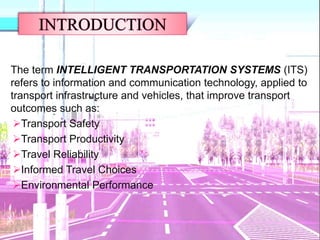
The term INTELLIGENT TRANSPORTATION SYSTEMS (ITS)
refers to information and communication technology, applied to
transport infrastructure and vehicles, that improve transport
outcomes such as:
Transport Safety
Transport Productivity
Travel Reliability
Informed Travel Choices
Environmental Performance
Automatic Vehicle Monitoring
Driver Monitoring
Vehicle Systems Monitoring
 Passenger boarding and loading
 Fuel-usage rate
Electronic Fare Collection
 Electronic ticket issuing machine
 Smart-card and card recharger
 Smart-card validator and display
 SMS or bar-code on smart-phone
 Bar-code reader
Vehicle Identification
 Automatic number plate recognition
Travel Information Displays
 Public display on vehicles
 Voice announcement systems
 Infotainment systems
 Public display at terminals and stops
Surveillance Equipment
 Static video cameras
 Remote-controlled video cameras
Communications
 Between the vehicle systems
 Vehicle to and from control center
 Vehicle to and from stop/shelter
 Data communication between facilities
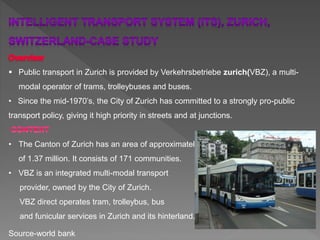
 Public transport in Zurich is provided by Verkehrsbetriebe zurich(VBZ), a multi-
modal operator of trams, trolleybuses and buses.
• Since the mid-1970’s, the City of Zurich has committed to a strongly pro-public
transport policy, giving it high priority in streets and at junctions.
• The Canton of Zurich has an area of approximately 1,700 sq. km and a population
of 1.37 million. It consists of 171 communities.
• VBZ is an integrated multi-modal transport
provider, owned by the City of Zurich.
VBZ direct operates tram, trolleybus, bus
and funicular services in Zurich and its hinterland.
Source-world bank
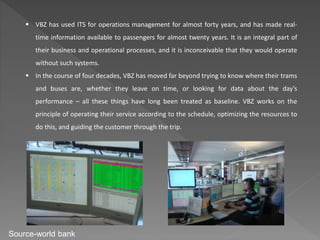
 VBZ has used ITS for operations management for almost forty years, and has made real-
time information available to passengers for almost twenty years. It is an integral part of
their business and operational processes, and it is inconceivable that they would operate
without such systems.
 In the course of four decades, VBZ has moved far beyond trying to know where their trams
and buses are, whether they leave on time, or looking for data about the day’s
performance – all these things have long been treated as baseline. VBZ works on the
principle of operating their service according to the schedule, optimizing the resources to
do this, and guiding the customer through the trip.
Source-world bank
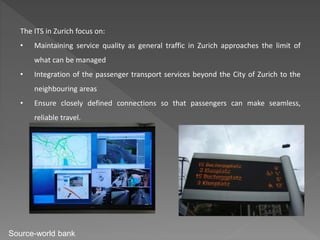
The ITS in Zurich focus on:
• Maintaining service quality as general traffic in Zurich approaches the limit of
what can be managed
• Integration of the passenger transport services beyond the City of Zurich to the
neighbouring areas
• Ensure closely defined connections so that passengers can make seamless,
reliable travel.
Source-world bank
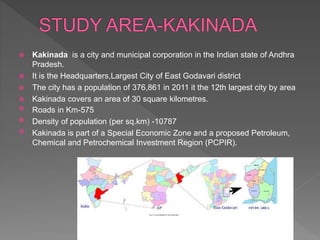
 Kakinada is a city and municipal corporation in the Indian state of Andhra
Pradesh.
 It is the Headquarters,Largest City of East Godavari district
 The city has a population of 376,861 in 2011 it the 12th largest city by area
 Kakinada covers an area of 30 square kilometres.
 Roads in Km-575
 Density of population (per sq.km) -10787
 Kakinada is part of a Special Economic Zone and a proposed Petroleum,
Chemical and Petrochemical Investment Region (PCPIR).
 AUTOMATIC VEHICLE LOCATION (AVL)
The intended use of the AVL system is to improve the quality of
passenger information and to assist staff in performing better route
supervision and control to assure bus schedule adherence.
WORKING OF AVL
 During morning peak hours, one direction lanes of
roads are over congested and opposite lanes are with a
few vehicles. Whereas in evening hours condition is just
reversed.
 To tackle this problem, there should be controllable
gates/barriers through ITS command centre just before
the undivided road/flyover/tunnel.
 There should be LED message boards, CCTVs,
controlled by the ITS command centre at proper
distances from the end and start point.
 http://www.ssatp.org/sites/ssatp/files/publications/Toolkits/ITS%20Toolkit%
20content/its-technologies.html
 https://coeut.iitm.ac.in/ITS_synthesis.pdf
 http://ec.europa.eu/transport/themes/its/index_en.htm
 http://www.its.dot.gov/

intelligent transportation system

  • 2.
    AIM:- To Deploy IntelligentTransport System ITS, which has a high visibility and leadership role within the Transportation sector. OBJECTIVIES:-  To maximize the performance of the transportation network and to move towards performance based funding for transportation systems.  To adapt and innovate Techniques to suit the contrasting traffic characteristics of Kakinada town. SCOPE AND LIMITATIONS:-  Scope is related to the introduction of ITS.  Study is limited to the selected town.
  • 3.
    The term INTELLIGENTTRANSPORTATION SYSTEMS (ITS) refers to information and communication technology, applied to transport infrastructure and vehicles, that improve transport outcomes such as: Transport Safety Transport Productivity Travel Reliability Informed Travel Choices Environmental Performance
  • 4.
    Automatic Vehicle Monitoring DriverMonitoring Vehicle Systems Monitoring  Passenger boarding and loading  Fuel-usage rate Electronic Fare Collection  Electronic ticket issuing machine  Smart-card and card recharger  Smart-card validator and display  SMS or bar-code on smart-phone  Bar-code reader Vehicle Identification  Automatic number plate recognition
  • 5.
    Travel Information Displays Public display on vehicles  Voice announcement systems  Infotainment systems  Public display at terminals and stops Surveillance Equipment  Static video cameras  Remote-controlled video cameras Communications  Between the vehicle systems  Vehicle to and from control center  Vehicle to and from stop/shelter  Data communication between facilities
  • 6.
     Public transportin Zurich is provided by Verkehrsbetriebe zurich(VBZ), a multi- modal operator of trams, trolleybuses and buses. • Since the mid-1970’s, the City of Zurich has committed to a strongly pro-public transport policy, giving it high priority in streets and at junctions. • The Canton of Zurich has an area of approximately 1,700 sq. km and a population of 1.37 million. It consists of 171 communities. • VBZ is an integrated multi-modal transport provider, owned by the City of Zurich. VBZ direct operates tram, trolleybus, bus and funicular services in Zurich and its hinterland. Source-world bank
  • 7.
     VBZ hasused ITS for operations management for almost forty years, and has made real- time information available to passengers for almost twenty years. It is an integral part of their business and operational processes, and it is inconceivable that they would operate without such systems.  In the course of four decades, VBZ has moved far beyond trying to know where their trams and buses are, whether they leave on time, or looking for data about the day’s performance – all these things have long been treated as baseline. VBZ works on the principle of operating their service according to the schedule, optimizing the resources to do this, and guiding the customer through the trip. Source-world bank
  • 8.
    The ITS inZurich focus on: • Maintaining service quality as general traffic in Zurich approaches the limit of what can be managed • Integration of the passenger transport services beyond the City of Zurich to the neighbouring areas • Ensure closely defined connections so that passengers can make seamless, reliable travel. Source-world bank
  • 9.
     Kakinada isa city and municipal corporation in the Indian state of Andhra Pradesh.  It is the Headquarters,Largest City of East Godavari district  The city has a population of 376,861 in 2011 it the 12th largest city by area  Kakinada covers an area of 30 square kilometres.  Roads in Km-575  Density of population (per sq.km) -10787  Kakinada is part of a Special Economic Zone and a proposed Petroleum, Chemical and Petrochemical Investment Region (PCPIR).
  • 12.
     AUTOMATIC VEHICLELOCATION (AVL) The intended use of the AVL system is to improve the quality of passenger information and to assist staff in performing better route supervision and control to assure bus schedule adherence. WORKING OF AVL
  • 13.
     During morningpeak hours, one direction lanes of roads are over congested and opposite lanes are with a few vehicles. Whereas in evening hours condition is just reversed.  To tackle this problem, there should be controllable gates/barriers through ITS command centre just before the undivided road/flyover/tunnel.  There should be LED message boards, CCTVs, controlled by the ITS command centre at proper distances from the end and start point.
  • 14.