TITLE:  The Kobe earthquake 1995 AIM: To complete a detailed account  of the Kobe earthquake including  primary and secondary effects
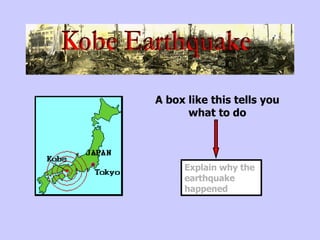
Explain why the earthquake happened A box like this tells you what to do
On Tuesday,  January 17th 1995 , at 5.46 a.m.  an earthquake of  magnitude 7.2  on the  Richter Scale  struck  Kobe.  This region is the second most populated area after Tokyo, with a population of  10 million. The ground shook for only 20 seconds but in that short time over 5,000 people died, over 300,000 people became homeless and damage worth £100 billion was caused to roads, houses, factories and infrastructure (gas, electric, water, sewerage, phone cables, etc). Make a  FACT FILE  of the information above Date  Time  Magnitude  Duration  Impact/Effects
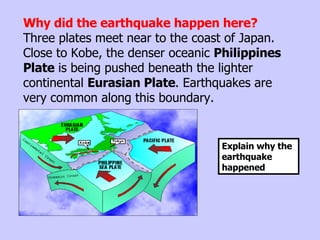
Why did the earthquake happen here? Three plates meet near to the coast of Japan. Close to Kobe, the denser oceanic  Philippines Plate  is being pushed beneath the lighter continental  Eurasian Plate . Earthquakes are very common along this boundary.  Explain why the earthquake happened
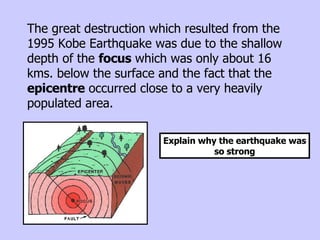
The great destruction which resulted from the 1995 Kobe Earthquake was due to the shallow depth of the  focus  which was only about 16 kms. below the surface and the fact that the  epicentre  occurred close to a very heavily populated area.  Explain why the earthquake was so strong
The Effects of the Earthquake: The immediate effects of the earthquake are known as  primary effects . They include the collapse of buildings, bridges and roads resulting from the shaking of the crust.  Explain what is meant by  primary effects Describe the  PRIMARY EFFECTS  from the following TEN slides
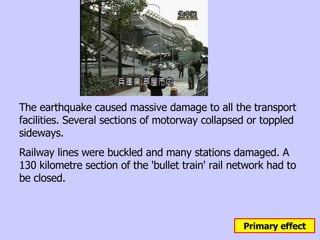
The earthquake caused massive damage to all the transport facilities. Several sections of motorway collapsed or toppled sideways. Railway lines were buckled and many stations damaged. A 130 kilometre section of the 'bullet train' rail network had to be closed.  Primary effect
Primary effect
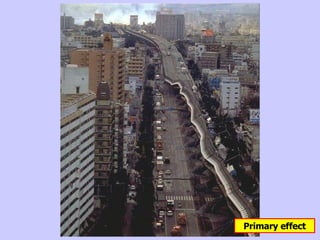
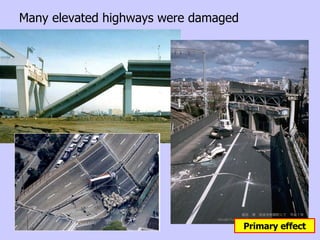
Many elevated highways were damaged Primary effect
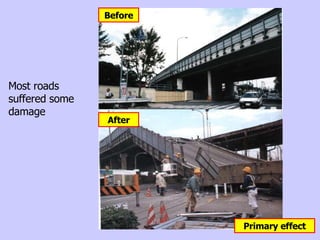
Before After Most roads suffered some damage Primary effect
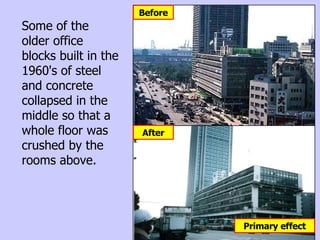
Some of the older office blocks built in the 1960's of steel and concrete  collapsed in the middle so that a whole floor was crushed by the rooms above.  Before After Primary effect
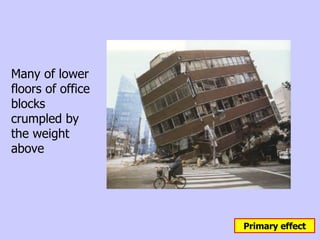
Primary effect Many of lower floors of office blocks crumpled by the weight above
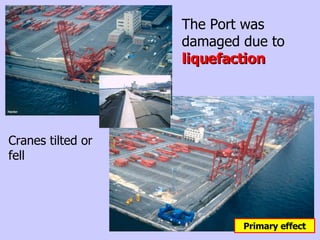
` The Port was damaged due to  liquefaction Cranes tilted or fell Primary effect
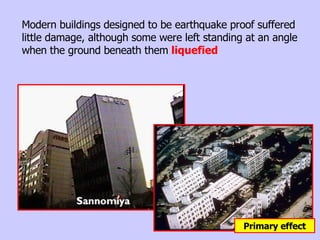
Modern buildings designed to be earthquake proof suffered little damage, although some were left standing at an angle when the ground beneath them  liquefied Primary effect
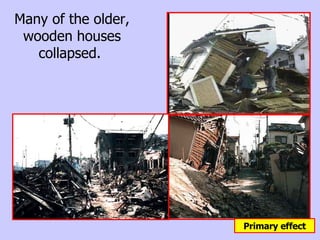
Many of the older, wooden houses collapsed.  Primary effect
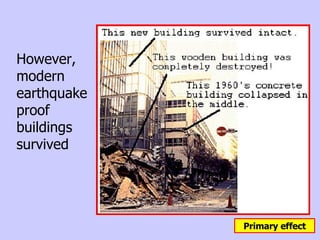
However, modern earthquake proof buildings survived Primary effect
The  secondary effects  are those that follow an earthquake such as fires, congestion and chaos on the roads, the closure of businesses and the problem of homelessness. Explain what is meant by  Secondary effects Describe the  PRIMARY EFFECTS  from the following pictures
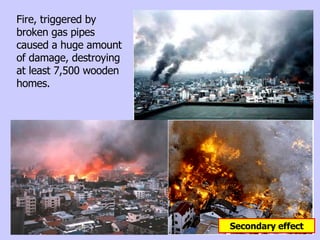
Fire, triggered by broken gas pipes caused a huge amount of damage, destroying at least 7,500 wooden homes. Secondary effect
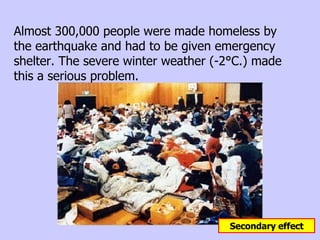
Almost 300,000 people were made homeless by the earthquake and had to be given emergency shelter. The severe winter weather (-2°C.) made this a serious problem.  Secondary effect
Water, electricity, gas services were fully working in six months  The railways were back in service in 7 months  After three weeks most phones lines were working A year after the earthquake, 80% of the port was working  By January 1999, 134,000 housing units had been built.  After fourteen months all collapsed bridges were repaired . What proof is there that the Japanese were able to repair the City of Kobe quickly after the earthquake  Putting things right after the earthquake
HOMEWORK Research your own earthquake try to find out similar information  Present your findings on one sheet of paper TIME  One week

Kobe Earthquake

  • 1.
    TITLE: TheKobe earthquake 1995 AIM: To complete a detailed account of the Kobe earthquake including primary and secondary effects
  • 2.
    Explain why theearthquake happened A box like this tells you what to do
  • 3.
    On Tuesday, January 17th 1995 , at 5.46 a.m. an earthquake of magnitude 7.2 on the Richter Scale struck Kobe. This region is the second most populated area after Tokyo, with a population of 10 million. The ground shook for only 20 seconds but in that short time over 5,000 people died, over 300,000 people became homeless and damage worth £100 billion was caused to roads, houses, factories and infrastructure (gas, electric, water, sewerage, phone cables, etc). Make a FACT FILE of the information above Date Time Magnitude Duration Impact/Effects
  • 4.
    Why did theearthquake happen here? Three plates meet near to the coast of Japan. Close to Kobe, the denser oceanic Philippines Plate is being pushed beneath the lighter continental Eurasian Plate . Earthquakes are very common along this boundary. Explain why the earthquake happened
  • 5.
    The great destructionwhich resulted from the 1995 Kobe Earthquake was due to the shallow depth of the focus which was only about 16 kms. below the surface and the fact that the epicentre occurred close to a very heavily populated area. Explain why the earthquake was so strong
  • 6.
    The Effects ofthe Earthquake: The immediate effects of the earthquake are known as primary effects . They include the collapse of buildings, bridges and roads resulting from the shaking of the crust. Explain what is meant by primary effects Describe the PRIMARY EFFECTS from the following TEN slides
  • 7.
    The earthquake causedmassive damage to all the transport facilities. Several sections of motorway collapsed or toppled sideways. Railway lines were buckled and many stations damaged. A 130 kilometre section of the 'bullet train' rail network had to be closed. Primary effect
  • 8.
  • 9.
    Many elevated highwayswere damaged Primary effect
  • 10.
    Before After Mostroads suffered some damage Primary effect
  • 11.
    Some of theolder office blocks built in the 1960's of steel and concrete collapsed in the middle so that a whole floor was crushed by the rooms above. Before After Primary effect
  • 12.
    Primary effect Manyof lower floors of office blocks crumpled by the weight above
  • 13.
    ` The Portwas damaged due to liquefaction Cranes tilted or fell Primary effect
  • 14.
    Modern buildings designedto be earthquake proof suffered little damage, although some were left standing at an angle when the ground beneath them liquefied Primary effect
  • 15.
    Many of theolder, wooden houses collapsed. Primary effect
  • 16.
    However, modern earthquakeproof buildings survived Primary effect
  • 17.
    The secondaryeffects are those that follow an earthquake such as fires, congestion and chaos on the roads, the closure of businesses and the problem of homelessness. Explain what is meant by Secondary effects Describe the PRIMARY EFFECTS from the following pictures
  • 18.
    Fire, triggered bybroken gas pipes caused a huge amount of damage, destroying at least 7,500 wooden homes. Secondary effect
  • 19.
    Almost 300,000 peoplewere made homeless by the earthquake and had to be given emergency shelter. The severe winter weather (-2°C.) made this a serious problem. Secondary effect
  • 20.
    Water, electricity, gasservices were fully working in six months The railways were back in service in 7 months After three weeks most phones lines were working A year after the earthquake, 80% of the port was working By January 1999, 134,000 housing units had been built. After fourteen months all collapsed bridges were repaired . What proof is there that the Japanese were able to repair the City of Kobe quickly after the earthquake Putting things right after the earthquake
  • 21.
    HOMEWORK Research yourown earthquake try to find out similar information Present your findings on one sheet of paper TIME One week