Intelligence Transport System 
Himanshi Singh
Contents 
 Introduction 
 Why ITS? 
 Intelligent Transport Technologies 
 ITS Application 
 Ecall 
 Automatic Road Enforcement 
 Benefits of ITS 
 Collosion Avoidance System 
 Vedio illustrating ITS
Introduction 
 The term Intelligent Transportation Systems 
(ITS) refers to information and communication 
technology, applied to transport infrastructure 
and vehicles, that improve transport outcomes 
such as: 
◦ Transport Safety 
◦ Transport Productivity 
◦ Travel Reliability 
◦ Informed Travel Choices 
◦ Social Equity 
◦ Environmental Performance 
◦ Network Operation Resilience
ITS, but why? 
 Interest in ITS comes from the problems caused by 
traffic congestion and a synergy of new information 
technology for simulation, real-time control, and 
communications networks. 
 Many of the proposed ITS systems also involve 
surveillance of the roadways. 
 Further, ITS can play a role in the rapid mass 
evacuation of people in urban centers after large 
casualty events such as a result of a natural 
disaster or threat.
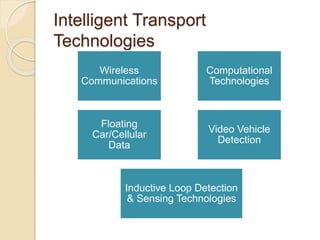
Intelligent Transport 
Technologies 
Wireless 
Communications 
Computational 
Technologies 
Floating 
Car/Cellular 
Data 
Video Vehicle 
Detection 
Inductive Loop Detection 
& Sensing Technologies
Wireless Communications 
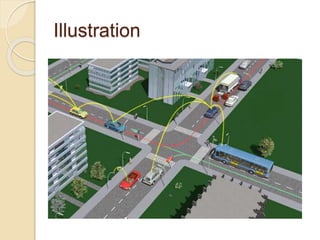
 Radio modem communication on UHF and VHF 
frequencies are widely used for short and long 
range communication within ITS. 
 Short-range communications (less than 450 
meters) can be accomplished using IEEE 802.11 
protocols. 
 Longer range communications have been 
proposed using infrastructure networks such as 
WiMAX (IEEE 802.16), Global System for Mobile 
Communications (GSM), or 3G.
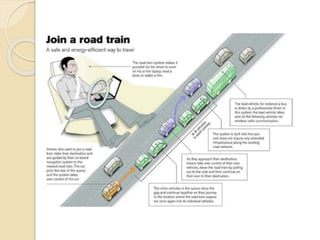
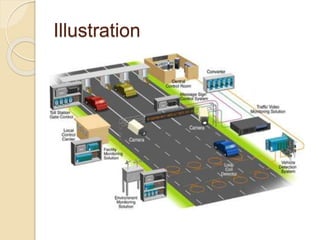
Illustration
Computational Technologies 
 A typical vehicle in the early 2000s would have 
between 20 and 100 individual networked 
microcontroller/Programmable logic controller 
modules with non-real-time operating systems. 
 The current trend is toward fewer, more costly 
microprocessor modules with hardware memory 
management and Real-Time Operating Systems. 
 The new embedded system platforms allow for 
more sophisticated software applications to be 
implemented, including model-based process 
control, artificial intelligence, and ubiquitous 
computing.
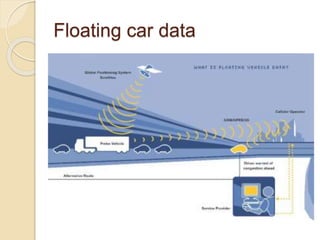
Floating Car/Celullar data 
 "Floating car" or "probe" data collection is a set of 
relatively low-cost methods for obtaining travel time 
and speed data for vehicles traveling along streets, 
highways, freeways, and other transportation 
routes. 
 Broadly speaking, three methods have been used 
to obtain the raw data: 
 Triangulation Method 
 Vehicle Re-Identification 
 GPS Based Methods
Cntd. 
Floating car data technology provides advantages 
over other methods of traffic measurement: 
 Less expensive than sensors or cameras 
 More coverage (potentially including all locations 
and streets) 
 Faster to set up and less maintenance 
 Works in all weather conditions, including heavy 
rain
Floating car data
Triangulation Method 
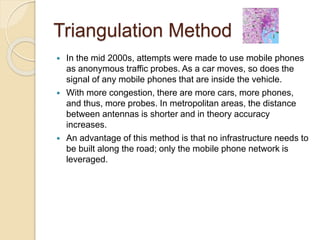
 In the mid 2000s, attempts were made to use mobile phones 
as anonymous traffic probes. As a car moves, so does the 
signal of any mobile phones that are inside the vehicle. 
 With more congestion, there are more cars, more phones, 
and thus, more probes. In metropolitan areas, the distance 
between antennas is shorter and in theory accuracy 
increases. 
 An advantage of this method is that no infrastructure needs to 
be built along the road; only the mobile phone network is 
leveraged.
Vechile re-identification 
◦ This method requires sets of detectors mounted 
along the road. In this technique, a unique serial 
number for a device in the vehicle is detected at one 
location and then detected again (re-identified) further 
down the road. Travel times and speed are calculated 
by comparing the time at which a specific device is 
detected by pairs of sensors. 
GPS Based Methods. 
◦ An increasing number of vehicles are equipped with in-vehicle 
GPS (satellite navigation) systems that have two-way 
communication with a traffic data provider. Position 
readings from these vehicles are used to compute vehicle 
speeds.
Sensing Technologies 
 Technological advances in telecommunications 
and information technology, coupled with state-of- 
the-art microchip, RFID , and inexpensive 
intelligent beacon sensing technologies, have 
enhanced the technical capabilities that will 
facilitate motorist safety benefits for intelligent 
transportation systems globally. 
 Sensing systems for ITS are vehicle- and 
infrastructure-based networked systems.
Illustration
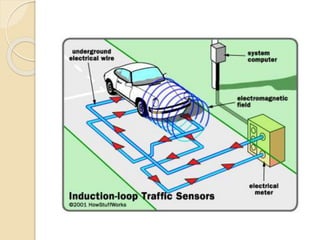
Inductive Loop Detection 
 Inductive loops can be placed in a roadbed to 
detect vehicles as they pass through the loop's 
magnetic field. 
 While more sophisticated sensors estimate the 
speed, length, and weight of vehicles and the 
distance between them. 
 Loops can be placed in a single lane or across 
multiple lanes, and they work with very slow or 
stopped vehicles as well as vehicles moving at 
high-speed.
Video Vehicle Detection 
 Traffic flow measurement and automatic incident 
detection using video cameras is another form of 
vehicle detection. This type of system is known as 
a "non-intrusive" method of traffic detection. 
 Video from black-and-white or color cameras is fed 
into processors that analyze the changing 
characteristics of the video image as vehicles pass.
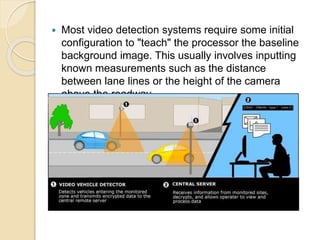
 Most video detection systems require some initial 
configuration to "teach" the processor the baseline 
background image. This usually involves inputting 
known measurements such as the distance 
between lane lines or the height of the camera 
above the roadway.
Intelligent Transport 
Applications 
 Emergency Vechile Notification System 
 Automatic Road Enforcement 
 Variable Speed Limits 
 Collision Avoidance Systems 
 Dynamic Traffic Light Sequence 
 Emergency Management Service
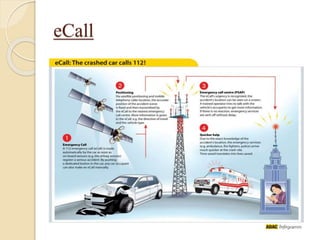
eCall
Automatic Road Enforcement 
 Speed cameras 
 Red light cameras 
 Bus lane cameras 
 Level crossing cameras 
 Double white line cameras 
 High-occupancy vehicle lane cameras
Benefits of ITS 
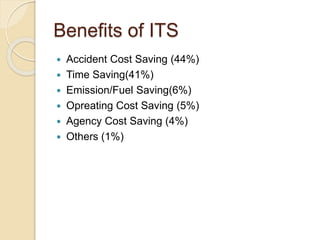
 Accident Cost Saving (44%) 
 Time Saving(41%) 
 Emission/Fuel Saving(6%) 
 Opreating Cost Saving (5%) 
 Agency Cost Saving (4%) 
 Others (1%)
Collision Avoidance System 
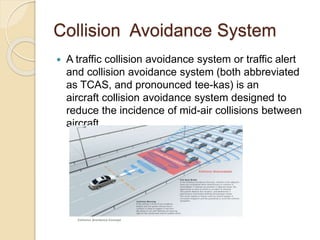
 A traffic collision avoidance system or traffic alert 
and collision avoidance system (both abbreviated 
as TCAS, and pronounced tee-kas) is an 
aircraft collision avoidance system designed to 
reduce the incidence of mid-air collisions between 
aircraft.
Video
Q & A?

Intelligent transport system himanshi

  • 1.
  • 2.
    Contents  Introduction  Why ITS?  Intelligent Transport Technologies  ITS Application  Ecall  Automatic Road Enforcement  Benefits of ITS  Collosion Avoidance System  Vedio illustrating ITS
  • 3.
    Introduction  Theterm Intelligent Transportation Systems (ITS) refers to information and communication technology, applied to transport infrastructure and vehicles, that improve transport outcomes such as: ◦ Transport Safety ◦ Transport Productivity ◦ Travel Reliability ◦ Informed Travel Choices ◦ Social Equity ◦ Environmental Performance ◦ Network Operation Resilience
  • 4.
    ITS, but why?  Interest in ITS comes from the problems caused by traffic congestion and a synergy of new information technology for simulation, real-time control, and communications networks.  Many of the proposed ITS systems also involve surveillance of the roadways.  Further, ITS can play a role in the rapid mass evacuation of people in urban centers after large casualty events such as a result of a natural disaster or threat.
  • 5.
    Intelligent Transport Technologies Wireless Communications Computational Technologies Floating Car/Cellular Data Video Vehicle Detection Inductive Loop Detection & Sensing Technologies
  • 6.
    Wireless Communications Radio modem communication on UHF and VHF frequencies are widely used for short and long range communication within ITS.  Short-range communications (less than 450 meters) can be accomplished using IEEE 802.11 protocols.  Longer range communications have been proposed using infrastructure networks such as WiMAX (IEEE 802.16), Global System for Mobile Communications (GSM), or 3G.
  • 7.
  • 8.
    Computational Technologies A typical vehicle in the early 2000s would have between 20 and 100 individual networked microcontroller/Programmable logic controller modules with non-real-time operating systems.  The current trend is toward fewer, more costly microprocessor modules with hardware memory management and Real-Time Operating Systems.  The new embedded system platforms allow for more sophisticated software applications to be implemented, including model-based process control, artificial intelligence, and ubiquitous computing.
  • 10.
    Floating Car/Celullar data  "Floating car" or "probe" data collection is a set of relatively low-cost methods for obtaining travel time and speed data for vehicles traveling along streets, highways, freeways, and other transportation routes.  Broadly speaking, three methods have been used to obtain the raw data:  Triangulation Method  Vehicle Re-Identification  GPS Based Methods
  • 11.
    Cntd. Floating cardata technology provides advantages over other methods of traffic measurement:  Less expensive than sensors or cameras  More coverage (potentially including all locations and streets)  Faster to set up and less maintenance  Works in all weather conditions, including heavy rain
  • 12.
  • 13.
    Triangulation Method In the mid 2000s, attempts were made to use mobile phones as anonymous traffic probes. As a car moves, so does the signal of any mobile phones that are inside the vehicle.  With more congestion, there are more cars, more phones, and thus, more probes. In metropolitan areas, the distance between antennas is shorter and in theory accuracy increases.  An advantage of this method is that no infrastructure needs to be built along the road; only the mobile phone network is leveraged.
  • 14.
    Vechile re-identification ◦This method requires sets of detectors mounted along the road. In this technique, a unique serial number for a device in the vehicle is detected at one location and then detected again (re-identified) further down the road. Travel times and speed are calculated by comparing the time at which a specific device is detected by pairs of sensors. GPS Based Methods. ◦ An increasing number of vehicles are equipped with in-vehicle GPS (satellite navigation) systems that have two-way communication with a traffic data provider. Position readings from these vehicles are used to compute vehicle speeds.
  • 15.
    Sensing Technologies Technological advances in telecommunications and information technology, coupled with state-of- the-art microchip, RFID , and inexpensive intelligent beacon sensing technologies, have enhanced the technical capabilities that will facilitate motorist safety benefits for intelligent transportation systems globally.  Sensing systems for ITS are vehicle- and infrastructure-based networked systems.
  • 16.
  • 17.
    Inductive Loop Detection  Inductive loops can be placed in a roadbed to detect vehicles as they pass through the loop's magnetic field.  While more sophisticated sensors estimate the speed, length, and weight of vehicles and the distance between them.  Loops can be placed in a single lane or across multiple lanes, and they work with very slow or stopped vehicles as well as vehicles moving at high-speed.
  • 19.
    Video Vehicle Detection  Traffic flow measurement and automatic incident detection using video cameras is another form of vehicle detection. This type of system is known as a "non-intrusive" method of traffic detection.  Video from black-and-white or color cameras is fed into processors that analyze the changing characteristics of the video image as vehicles pass.
  • 20.
     Most videodetection systems require some initial configuration to "teach" the processor the baseline background image. This usually involves inputting known measurements such as the distance between lane lines or the height of the camera above the roadway.
  • 21.
    Intelligent Transport Applications  Emergency Vechile Notification System  Automatic Road Enforcement  Variable Speed Limits  Collision Avoidance Systems  Dynamic Traffic Light Sequence  Emergency Management Service
  • 22.
  • 23.
    Automatic Road Enforcement  Speed cameras  Red light cameras  Bus lane cameras  Level crossing cameras  Double white line cameras  High-occupancy vehicle lane cameras
  • 24.
    Benefits of ITS  Accident Cost Saving (44%)  Time Saving(41%)  Emission/Fuel Saving(6%)  Opreating Cost Saving (5%)  Agency Cost Saving (4%)  Others (1%)
  • 25.
    Collision Avoidance System  A traffic collision avoidance system or traffic alert and collision avoidance system (both abbreviated as TCAS, and pronounced tee-kas) is an aircraft collision avoidance system designed to reduce the incidence of mid-air collisions between aircraft.
  • 26.
  • 27.