ADAPTIVE
TRAFFIC CONTROL SYSTEM
Nelson Kandel
BCE 3rd year
Pulchowk Campus
Presentation Outline
INTRODUCTION
PRESENT
DEVELOPMENTS
ADVANTAGES
FUTURE SCOPES
Traffic Control System
1
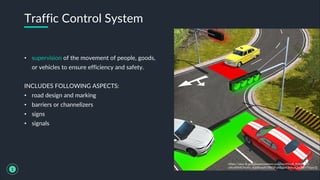
• supervision of the movement of people, goods,
or vehicles to ensure efficiency and safety.
INCLUDES FOLLOWING ASPECTS:
• road design and marking
• barriers or channelizers
• signs
• signals
Traffic Control System
https://play-lh.googleusercontent.com/emzYfny8_fEnhPqEQ
slXw9XMOVsXU_KjkBFewXI7BV3FuNEs-WJN4sxQocB6YTVpxcQ
1
Adaptive Traffic Control System (ATCS)
2
• automatically adapts the timings of traffic lights
based on real-time traffic conditions
• allows signals to interact with each other
• maximize vehicular movement and reduce
congestion
Adaptive Traffic Control System (ATCS)
2
https://www.efftronics.com/imgv2/smart-cities/smart-
transport/atcs/atcs-solution.png
How does ATCS Work?
3
• use of cameras/ sensors to acquire traffic data
• raw data processed to determine the vehicular clusters
• data evaluated to improve signal timings at a particular junction.
How does ATCS Work?
3
Present Development Status
4
• The comprehensive index method considers the delay, the number of
stops, and the length of queues to obtain the best overall efficiency of
the network.
Present Development Status
4
METHODS BASED ON MATHEMATICAL MODEL
• The comprehensive index method considers the delay, the number of
stops, and the length of queues to obtain the best overall efficiency of
the network.
• The green wave band method is designed to maximize the number of
nonstop platoons of the main line.
Present Development Status
4
METHODS BASED ON MATHEMATICAL MODEL
• Fuzzy Logic
• Genetic Algorithms and Ant Colony Optimization
• Artificial Neural Network (ANN)
• Reinforcement Learning Control
Present Development Status
5
METHODS BASED ON INTELLIGENT COMPUTING
Present Development Status
6
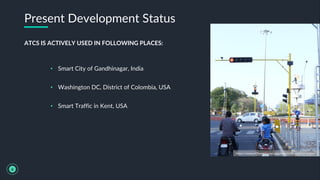
ATCS IS ACTIVELY USED IN FOLLOWING PLACES:
• Smart City of Gandhinagar, India
• Washington DC, District of Colombia, USA
• Smart Traffic in Kent, USA
https://www.efftronics.com/adaptive-traffic-control-system
Advantages over conventional practices
7
• Detecting congestion.
• Synchronizing activity between traffic lights.
• Updating traffic light timing in real time.
• Updating and informing drivers of ideal speeds.
• Reduce congestion and time spent on the road.
Advantages over conventional practices
7
Future Scopes of ATCS
8
• Emergency Vehicle Detection
• Signalless Road Network
• Automatic Fining
• Dynamic Route Guidance
Future Scopes of ATCS
8
• ATCS is exciting as well as rewarding topic to be adapted.
• It is a multidisciplinary topic.
• It may help a lot in regulating traffic in developing countries.
• Development of this technology is never ending anytime soon.
Conclusion:
9
• [1] Robertson, D. I. (1969). TRANSYT: a traffic network study tool.
• [2] Bell, Michael G.H. (1992). Future directions in traffic signal control. Transportation Research Part A:
Policy and Practice..
• [3] N. H. Gartner and C. Stamatiadis. (2002). Arterial-based control of traffic flow in urban grid networks,
Mathematical and Computer Modelling, vol. 35.
• [4] Pham, V. C., Alam, F., Potgieter, J., Fang, F. C., & Xu, W. L. (2013). Integrated fuzzy signal and
ramp-metering at a diamond interchange. Journal of Advanced Transportation, vol. 47
• [5] Yizhe Wang, Xiaoguang Yang, Hailun Liang, Yangdong Liu. (2018). A Review of the Self-Adaptive
Traffic Signal Control System Based on Future Traffic Environment, Journal of Advanced Transportation,
vol. 2018
• [6] Hoogendoorn, S. P., Knoop, V. L., & van Zuylen, H. J. (2008). Robust control of traffic networks under
uncertain conditions. Journal of advanced transportation, 42(3).
• [7] Zlatkovic, M., & Zhou, X. (2015). Integration of signal timing estimation model and dynamic traffic
assignment in feedback loops: system design and case study. Journal of Advanced Transportation, 49(6).
References
10

Adaptive Traffic Control System

  • 1.
    ADAPTIVE TRAFFIC CONTROL SYSTEM NelsonKandel BCE 3rd year Pulchowk Campus
  • 2.
  • 3.
  • 4.
    • supervision ofthe movement of people, goods, or vehicles to ensure efficiency and safety. INCLUDES FOLLOWING ASPECTS: • road design and marking • barriers or channelizers • signs • signals Traffic Control System https://play-lh.googleusercontent.com/emzYfny8_fEnhPqEQ slXw9XMOVsXU_KjkBFewXI7BV3FuNEs-WJN4sxQocB6YTVpxcQ 1
  • 5.
    Adaptive Traffic ControlSystem (ATCS) 2
  • 6.
    • automatically adaptsthe timings of traffic lights based on real-time traffic conditions • allows signals to interact with each other • maximize vehicular movement and reduce congestion Adaptive Traffic Control System (ATCS) 2 https://www.efftronics.com/imgv2/smart-cities/smart- transport/atcs/atcs-solution.png
  • 7.
  • 8.
    • use ofcameras/ sensors to acquire traffic data • raw data processed to determine the vehicular clusters • data evaluated to improve signal timings at a particular junction. How does ATCS Work? 3
  • 9.
  • 10.
    • The comprehensiveindex method considers the delay, the number of stops, and the length of queues to obtain the best overall efficiency of the network. Present Development Status 4 METHODS BASED ON MATHEMATICAL MODEL
  • 11.
    • The comprehensiveindex method considers the delay, the number of stops, and the length of queues to obtain the best overall efficiency of the network. • The green wave band method is designed to maximize the number of nonstop platoons of the main line. Present Development Status 4 METHODS BASED ON MATHEMATICAL MODEL
  • 12.
    • Fuzzy Logic •Genetic Algorithms and Ant Colony Optimization • Artificial Neural Network (ANN) • Reinforcement Learning Control Present Development Status 5 METHODS BASED ON INTELLIGENT COMPUTING
  • 13.
    Present Development Status 6 ATCSIS ACTIVELY USED IN FOLLOWING PLACES: • Smart City of Gandhinagar, India • Washington DC, District of Colombia, USA • Smart Traffic in Kent, USA https://www.efftronics.com/adaptive-traffic-control-system
  • 14.
  • 15.
    • Detecting congestion. •Synchronizing activity between traffic lights. • Updating traffic light timing in real time. • Updating and informing drivers of ideal speeds. • Reduce congestion and time spent on the road. Advantages over conventional practices 7
  • 16.
  • 17.
    • Emergency VehicleDetection • Signalless Road Network • Automatic Fining • Dynamic Route Guidance Future Scopes of ATCS 8
  • 18.
    • ATCS isexciting as well as rewarding topic to be adapted. • It is a multidisciplinary topic. • It may help a lot in regulating traffic in developing countries. • Development of this technology is never ending anytime soon. Conclusion: 9
  • 19.
    • [1] Robertson,D. I. (1969). TRANSYT: a traffic network study tool. • [2] Bell, Michael G.H. (1992). Future directions in traffic signal control. Transportation Research Part A: Policy and Practice.. • [3] N. H. Gartner and C. Stamatiadis. (2002). Arterial-based control of traffic flow in urban grid networks, Mathematical and Computer Modelling, vol. 35. • [4] Pham, V. C., Alam, F., Potgieter, J., Fang, F. C., & Xu, W. L. (2013). Integrated fuzzy signal and ramp-metering at a diamond interchange. Journal of Advanced Transportation, vol. 47 • [5] Yizhe Wang, Xiaoguang Yang, Hailun Liang, Yangdong Liu. (2018). A Review of the Self-Adaptive Traffic Signal Control System Based on Future Traffic Environment, Journal of Advanced Transportation, vol. 2018 • [6] Hoogendoorn, S. P., Knoop, V. L., & van Zuylen, H. J. (2008). Robust control of traffic networks under uncertain conditions. Journal of advanced transportation, 42(3). • [7] Zlatkovic, M., & Zhou, X. (2015). Integration of signal timing estimation model and dynamic traffic assignment in feedback loops: system design and case study. Journal of Advanced Transportation, 49(6). References 10