Dr. H P Koringa
Interview Questions for VLSI Job
VLSI Questions
1. What is setup and hold time
2. What is race around condition
3. What is set and hold time violation
4. Difference between RAM and FIFO
5. What is critical path
6. What is false path
7. What is metastability in logic design
8. What is meaning of GLITCH and JITTER
9. What is SOC
10. Advantages of FPGA over ASIC
VLSI Questions
11. What is CDC (clock domain crossing)
12. What is LUT in FPGA
13. How 2:1 mux implemented in FPGA
14. Use of PARAMETER in verilog
15. Constraints in VLSI design (time, area and power)
16. Importance of sensitivity list in HDL
17. Testing vs verification
18. Transistor vs FET
19. Difference between latch and flip-flop
20. Combination vs sequential logic
21. Moore vs mealy
22. Draw frequency divider (by 2) using D FF
VLSI Questions
23. Design T FF using D FF
24. Design counter using D FF
25. Design mod counter using D FF
26. Types of counter
27. What is johnson counter and its use
28. 2’s complement and its use
29. Draw AND, OR, NAND, XOR using MUX
30. Race around condition in JK flip-flop
31. CMOS basic
32. What is propagation delay
VLSI Questions
33. What is the static and dynamic hazard in logic
design
34. Draw a logic for given task
35. CPLD basic (PLA, PAL)
36. Signed and unsigned number
37. Design 4:1 using 2:1 mux
38. Design adder using MUX
39. Draw FSM diagram for up and down counter
40. What is clock skew
41. Difference between EEPROM and FLASH
42. Synchronous counter vs asynchronous counter
VLSI Questions
43. FSM for sequence detector for overlapping and non
overlapping condition
44. Draw parity generator
45. Draw circuit for random generator
46. How the frequency of the logic can be increase
47. How to avoid set up and hold time violation
48. What is SLACK in digital design
49. What is Static timing analysis
50. Difference between NOT and BUFFER
51. Draw logic circuit from state diagram
52. FSM for given sequence detector
53. Draw output waveform for given logic circuit having
different delay of logic gates.
VLSI Questions
54. Advantage of CMOS implementation
55. What is strong and weak logic
56. Why NAND based implementation is preferred
compare to NOR based in CMOS
57. What is substract bias effect
58. How to avoid race around condition
59. What is semi and full custom design
Verilog Questions
1. Difference between synchronous and asynchronous
RESET
2. Difference between inter and intra assignment delay
3. What is Gate delay, wire delay, transport delay,
inertial delay, contamination delay
4. Why delay are not synthesizable
5. What is synthesis and what are constraints
6. Verilog Vs RTL code
7. What is RTL code
8. VLSI Design flow
9. ASIC design flow
10. FPGA Design flow
Verilog Questions
1. What is testbench
2. What are verilog construct that are not
synthesizable
3. Where not synthesizable constructs are used
4. What is FPGA and why it used
5. Different FPGA board
6. Difference between ASIC and FPGA
7. Difference between DSP and FPGA implementation
8. What is NETLIST
9. What is difference between technology dependent
and technology independent design
10. What is an IC
11. Difference between TASK and FUNCTION
Verilog Questions
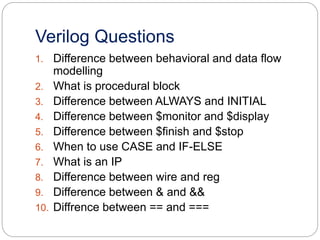
1. Difference between behavioral and data flow
modelling
2. What is procedural block
3. Difference between ALWAYS and INITIAL
4. Difference between $monitor and $display
5. Difference between $finish and $stop
6. When to use CASE and IF-ELSE
7. What is an IP
8. Difference between wire and reg
9. Difference between & and &&
10. Diffrence between == and ===
Verilog Questions
1. Default value of reg and wire
2. Difference between VECTOR and ARRAY
3. What is ZERO delay in verilog
4. Case vs casex vs casez
5. Use of repeat in verilog
6. Use of forever in verilog
7. Difference between repeat and forever
8. Generate clock of 10ns using loop
9. Types of ASIC
10. Difference between function and formal
verification
Verilog Questions
1. Generate clock havinf 20ns and 25% duty cycle
2. What is clock gating
3. What is clock skew
4. What is FSM
5. Difference between mealy and moore FSM
Wish you all the
best

VLSI Domain interview questions.pptx

  • 1.
    Dr. H PKoringa Interview Questions for VLSI Job
  • 2.
    VLSI Questions 1. Whatis setup and hold time 2. What is race around condition 3. What is set and hold time violation 4. Difference between RAM and FIFO 5. What is critical path 6. What is false path 7. What is metastability in logic design 8. What is meaning of GLITCH and JITTER 9. What is SOC 10. Advantages of FPGA over ASIC
  • 3.
    VLSI Questions 11. Whatis CDC (clock domain crossing) 12. What is LUT in FPGA 13. How 2:1 mux implemented in FPGA 14. Use of PARAMETER in verilog 15. Constraints in VLSI design (time, area and power) 16. Importance of sensitivity list in HDL 17. Testing vs verification 18. Transistor vs FET 19. Difference between latch and flip-flop 20. Combination vs sequential logic 21. Moore vs mealy 22. Draw frequency divider (by 2) using D FF
  • 4.
    VLSI Questions 23. DesignT FF using D FF 24. Design counter using D FF 25. Design mod counter using D FF 26. Types of counter 27. What is johnson counter and its use 28. 2’s complement and its use 29. Draw AND, OR, NAND, XOR using MUX 30. Race around condition in JK flip-flop 31. CMOS basic 32. What is propagation delay
  • 5.
    VLSI Questions 33. Whatis the static and dynamic hazard in logic design 34. Draw a logic for given task 35. CPLD basic (PLA, PAL) 36. Signed and unsigned number 37. Design 4:1 using 2:1 mux 38. Design adder using MUX 39. Draw FSM diagram for up and down counter 40. What is clock skew 41. Difference between EEPROM and FLASH 42. Synchronous counter vs asynchronous counter
  • 6.
    VLSI Questions 43. FSMfor sequence detector for overlapping and non overlapping condition 44. Draw parity generator 45. Draw circuit for random generator 46. How the frequency of the logic can be increase 47. How to avoid set up and hold time violation 48. What is SLACK in digital design 49. What is Static timing analysis 50. Difference between NOT and BUFFER 51. Draw logic circuit from state diagram 52. FSM for given sequence detector 53. Draw output waveform for given logic circuit having different delay of logic gates.
  • 7.
    VLSI Questions 54. Advantageof CMOS implementation 55. What is strong and weak logic 56. Why NAND based implementation is preferred compare to NOR based in CMOS 57. What is substract bias effect 58. How to avoid race around condition 59. What is semi and full custom design
  • 8.
    Verilog Questions 1. Differencebetween synchronous and asynchronous RESET 2. Difference between inter and intra assignment delay 3. What is Gate delay, wire delay, transport delay, inertial delay, contamination delay 4. Why delay are not synthesizable 5. What is synthesis and what are constraints 6. Verilog Vs RTL code 7. What is RTL code 8. VLSI Design flow 9. ASIC design flow 10. FPGA Design flow
  • 9.
    Verilog Questions 1. Whatis testbench 2. What are verilog construct that are not synthesizable 3. Where not synthesizable constructs are used 4. What is FPGA and why it used 5. Different FPGA board 6. Difference between ASIC and FPGA 7. Difference between DSP and FPGA implementation 8. What is NETLIST 9. What is difference between technology dependent and technology independent design 10. What is an IC 11. Difference between TASK and FUNCTION
  • 10.
    Verilog Questions 1. Differencebetween behavioral and data flow modelling 2. What is procedural block 3. Difference between ALWAYS and INITIAL 4. Difference between $monitor and $display 5. Difference between $finish and $stop 6. When to use CASE and IF-ELSE 7. What is an IP 8. Difference between wire and reg 9. Difference between & and && 10. Diffrence between == and ===
  • 11.
    Verilog Questions 1. Defaultvalue of reg and wire 2. Difference between VECTOR and ARRAY 3. What is ZERO delay in verilog 4. Case vs casex vs casez 5. Use of repeat in verilog 6. Use of forever in verilog 7. Difference between repeat and forever 8. Generate clock of 10ns using loop 9. Types of ASIC 10. Difference between function and formal verification
  • 12.
    Verilog Questions 1. Generateclock havinf 20ns and 25% duty cycle 2. What is clock gating 3. What is clock skew 4. What is FSM 5. Difference between mealy and moore FSM
  • 13.
    Wish you allthe best