WELCOME
PRESENTED BY,
KIRAN DASANAL
( PALB7319 )
TOPIC NAME
• SYNTHESIS OF AMINO ACIDS.
1. Reduction of N2 to NH4.
2. Transamination.
3. Synthesis of amino acids by metabolic
precursors.
INTRODUCTION
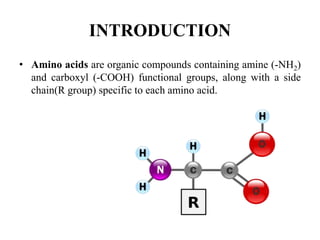
• Amino acids are organic compounds containing amine (-NH2)
and carboxyl (-COOH) functional groups, along with a side
chain(R group) specific to each amino acid.
CLASSIFICATION
• Nonpolar/hydrophobic aminoacids
glycine,alanine,valine,leucine,methionine,phenyalalanine,
proline
• polar/hydrophilic amino acids
serine, cysteine, tyrosine, glutamicacid, asparaticacid,
lysine,arginine
• Sulphur containing amino acids
Cystine, methionine, cysteine
Nutritionally essential
amino acids
Nutritionally non-essential
amino acids
Arginine Alanine
Histidine Asparagine
Isoleucine Aspartic acid
Leucine Cysteine
Lysine Glutamic acid
Methionine Glutamine
Phenylalanine Glycine
Threonine Proline
Tryptophan Serine
Valine Tyrosine
List of essential and non essential amino acids
SYNTHESIS OF AMINO ACIDS
• Amino acid synthesis is the set of biochemical processes
(metabolic pathways) by which the various amino acids are
produced from other compounds.
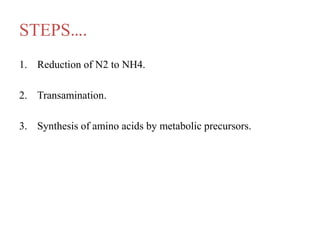
STEPS….
1. Reduction of N2 to NH4.
2. Transamination.
3. Synthesis of amino acids by metabolic precursors.
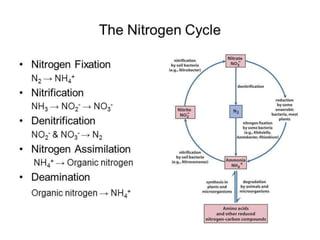
1) REDUCTION OF N2 TO NH4
• It is the first step during synthesis of amino acids.
• In which reduction of N2 TO NH4 takes place.
• The conversion of nitrogen to ammonia is a reduction reaction
which is exergonic in nature
• Biological fixation of nitrogen is carried out by a highly
conserved complex of proteins called nitrogenase complex.
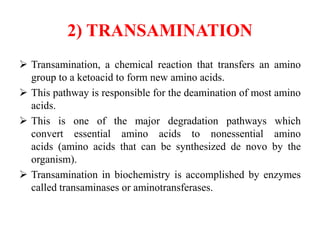
2) TRANSAMINATION
 Transamination, a chemical reaction that transfers an amino
group to a ketoacid to form new amino acids.
 This pathway is responsible for the deamination of most amino
acids.
 This is one of the major degradation pathways which
convert essential amino acids to nonessential amino
acids (amino acids that can be synthesized de novo by the
organism).
 Transamination in biochemistry is accomplished by enzymes
called transaminases or aminotransferases.
FOR EXAMPLE
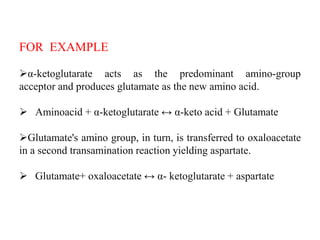
α-ketoglutarate acts as the predominant amino-group
acceptor and produces glutamate as the new amino acid.
 Aminoacid + α-ketoglutarate ↔ α-keto acid + Glutamate
Glutamate's amino group, in turn, is transferred to oxaloacetate
in a second transamination reaction yielding aspartate.
 Glutamate+ oxaloacetate ↔ α- ketoglutarate + aspartate
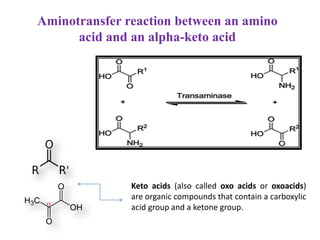
Aminotransfer reaction between an amino
acid and an alpha-keto acid
Keto acids (also called oxo acids or oxoacids)
are organic compounds that contain a carboxylic
acid group and a ketone group.
3) SYNTHESIS OF AMINO ACIDS
BY METABOLIC PRECURSORS
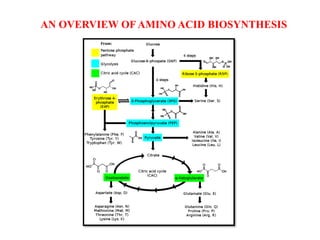
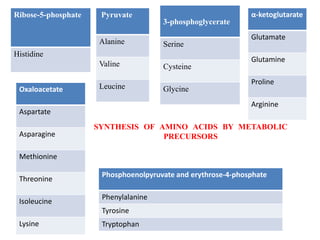
• All the 20 protein amino acids are derived from intermediates
in glycolysis, citric acid cycle or the pentose phosphate
pathway Nitrogen enters these pathways by way of glutamate
and glutamine.
• It is believed that the pathways in higher plants and animals
are similar, but comparatively less is known of the enzymes
involved.
AN OVERVIEW OF AMINO ACID BIOSYNTHESIS
3-phosphoglycerate
Serine
Cysteine
Glycine
Pyruvate
Alanine
Valine
Leucine
Ribose-5-phosphate
Histidine
α-ketoglutarate
Glutamate
Glutamine
Proline
Arginine
Oxaloacetate
Aspartate
Asparagine
Methionine
Threonine
Isoleucine
Lysine
Phosphoenolpyruvate and erythrose-4-phosphate
Phenylalanine
Tyrosine
Tryptophan
SYNTHESIS OF AMINO ACIDS BY METABOLIC
PRECURSORS
AMINO ACIDS CHEMICAL STRUCTURES
REFERENCES
• Baldwin E : An Introduction to Comparative Biochemistry.
4th ed. Cambridge University Press, New York. 1964.
• Bender DA: Amino Acid Metabolism. 2nd ed. Wiley-
Interscience, New York, 1985.
• Wikipedia
THANK YOU

Amino acid synthesis