
AN INTRODUCTION …
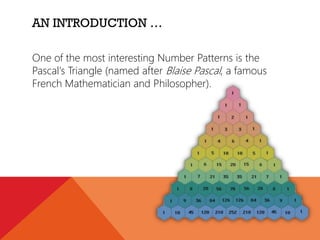
One of the most interesting Number Patterns is the
Pascal's Triangle (named after Blaise Pascal, a famous
French Mathematician and Philosopher).
CONSTRUCTION
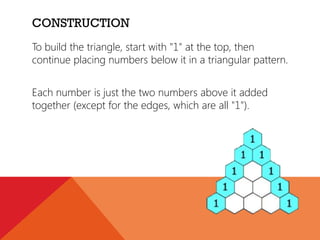
To build the triangle, start with "1" at the top, then
continue placing numbers below it in a triangular pattern.
Each number is just the two numbers above it added
together (except for the edges, which are all "1").
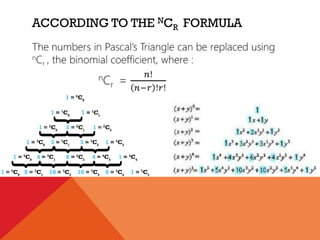
ACCORDING TO THE NCR FORMULA
DIAGONALS
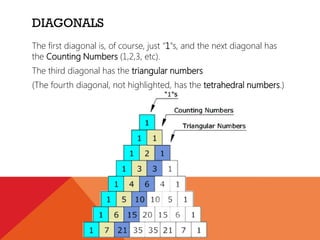
The first diagonal is, of course, just "1"s, and the next diagonal has
the Counting Numbers (1,2,3, etc).
The third diagonal has the triangular numbers

(The fourth diagonal, not highlighted, has the tetrahedral numbers.)
ODDS AND EVENS
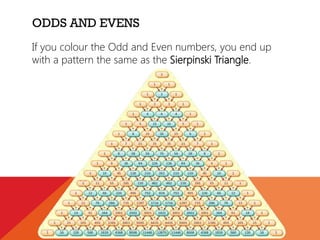
If you colour the Odd and Even numbers, you end up
with a pattern the same as the Sierpinski Triangle.
THE SIERPINSKI TRIANGLE
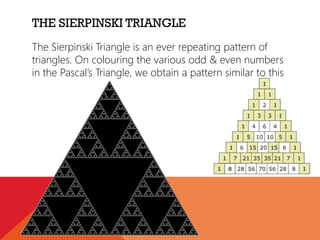
The Sierpinski Triangle is an ever repeating pattern of
triangles. On colouring the various odd & even numbers
in the Pascal’s Triangle, we obtain a pattern similar to this
HORIZONTAL SUMS

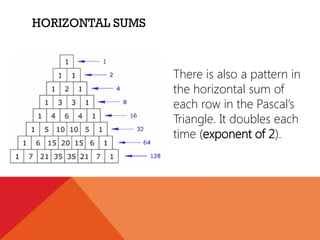
There is also a pattern in
the horizontal sum of
each row in the Pascal’s
Triangle. It doubles each
time (exponent of 2).
EXPONENTS OF 11
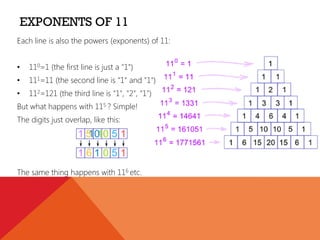
Each line is also the powers (exponents) of 11:
•

110=1 (the first line is just a "1")

•

111=11 (the second line is "1" and "1")

•

112=121 (the third line is "1", "2", "1")

But what happens with 115 ? Simple!
The digits just overlap, like this:

The same thing happens with 116 etc.
SQUARES
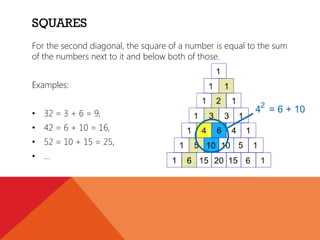
For the second diagonal, the square of a number is equal to the sum
of the numbers next to it and below both of those.

Examples:
• 32 = 3 + 6 = 9,
• 42 = 6 + 10 = 16,

• 52 = 10 + 15 = 25,
• …
THE FIBONACCI SEQUENCE
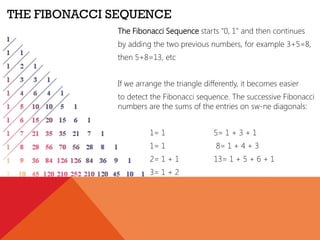
The Fibonacci Sequence starts "0, 1" and then continues
by adding the two previous numbers, for example 3+5=8,
then 5+8=13, etc
If we arrange the triangle differently, it becomes easier
to detect the Fibonacci sequence. The successive Fibonacci
numbers are the sums of the entries on sw-ne diagonals:
1= 1

5= 1 + 3 + 1

1= 1

8= 1 + 4 + 3

2= 1 + 1

13= 1 + 5 + 6 + 1

3= 1 + 2
PRIME NUMBERS
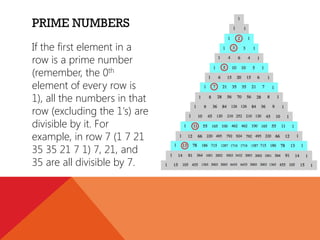
If the first element in a
row is a prime number
(remember, the 0th
element of every row is
1), all the numbers in that
row (excluding the 1's) are
divisible by it. For
example, in row 7 (1 7 21
35 35 21 7 1) 7, 21, and
35 are all divisible by 7.
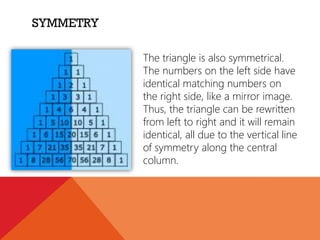
SYMMETRY
The triangle is also symmetrical.
The numbers on the left side have
identical matching numbers on
the right side, like a mirror image.
Thus, the triangle can be rewritten
from left to right and it will remain
identical, all due to the vertical line
of symmetry along the central
column.
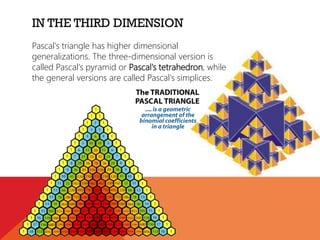
IN THE THIRD DIMENSION
Pascal's triangle has higher dimensional
generalizations. The three-dimensional version is
called Pascal's pyramid or Pascal's tetrahedron, while
the general versions are called Pascal's simplices.
Visualizing the pascal’s triangle

Visualizing the pascal’s triangle

  • 2.
    AN INTRODUCTION … Oneof the most interesting Number Patterns is the Pascal's Triangle (named after Blaise Pascal, a famous French Mathematician and Philosopher).
  • 3.
    CONSTRUCTION To build thetriangle, start with "1" at the top, then continue placing numbers below it in a triangular pattern. Each number is just the two numbers above it added together (except for the edges, which are all "1").
  • 4.
    ACCORDING TO THENCR FORMULA
  • 5.
    DIAGONALS The first diagonalis, of course, just "1"s, and the next diagonal has the Counting Numbers (1,2,3, etc). The third diagonal has the triangular numbers (The fourth diagonal, not highlighted, has the tetrahedral numbers.)
  • 6.
    ODDS AND EVENS Ifyou colour the Odd and Even numbers, you end up with a pattern the same as the Sierpinski Triangle.
  • 7.
    THE SIERPINSKI TRIANGLE TheSierpinski Triangle is an ever repeating pattern of triangles. On colouring the various odd & even numbers in the Pascal’s Triangle, we obtain a pattern similar to this
  • 8.
    HORIZONTAL SUMS There isalso a pattern in the horizontal sum of each row in the Pascal’s Triangle. It doubles each time (exponent of 2).
  • 9.
    EXPONENTS OF 11 Eachline is also the powers (exponents) of 11: • 110=1 (the first line is just a "1") • 111=11 (the second line is "1" and "1") • 112=121 (the third line is "1", "2", "1") But what happens with 115 ? Simple! The digits just overlap, like this: The same thing happens with 116 etc.
  • 10.
    SQUARES For the seconddiagonal, the square of a number is equal to the sum of the numbers next to it and below both of those. Examples: • 32 = 3 + 6 = 9, • 42 = 6 + 10 = 16, • 52 = 10 + 15 = 25, • …
  • 11.
    THE FIBONACCI SEQUENCE TheFibonacci Sequence starts "0, 1" and then continues by adding the two previous numbers, for example 3+5=8, then 5+8=13, etc If we arrange the triangle differently, it becomes easier to detect the Fibonacci sequence. The successive Fibonacci numbers are the sums of the entries on sw-ne diagonals: 1= 1 5= 1 + 3 + 1 1= 1 8= 1 + 4 + 3 2= 1 + 1 13= 1 + 5 + 6 + 1 3= 1 + 2
  • 12.
    PRIME NUMBERS If thefirst element in a row is a prime number (remember, the 0th element of every row is 1), all the numbers in that row (excluding the 1's) are divisible by it. For example, in row 7 (1 7 21 35 35 21 7 1) 7, 21, and 35 are all divisible by 7.
  • 13.
    SYMMETRY The triangle isalso symmetrical. The numbers on the left side have identical matching numbers on the right side, like a mirror image. Thus, the triangle can be rewritten from left to right and it will remain identical, all due to the vertical line of symmetry along the central column.
  • 14.
    IN THE THIRDDIMENSION Pascal's triangle has higher dimensional generalizations. The three-dimensional version is called Pascal's pyramid or Pascal's tetrahedron, while the general versions are called Pascal's simplices.