
Presented by :
PAWAN MISHRA
23
FASCINATING
MATHS FACTS
YOU’LL
PROBABLY
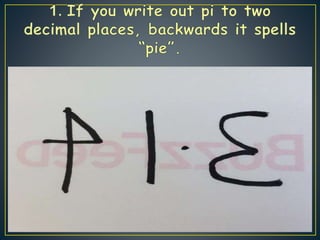
3.14 = PIE.
Because of
course it is.
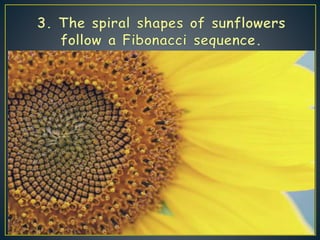
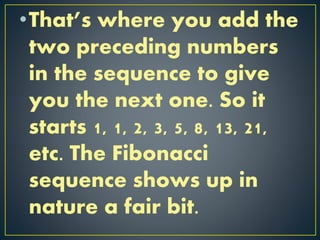
•That’s where you add the
two preceding numbers
in the sequence to give
you the next one. So it
starts 1, 1, 2, 3, 5, 8, 13, 21,
etc. The Fibonacci
sequence shows up in
nature a fair bit.
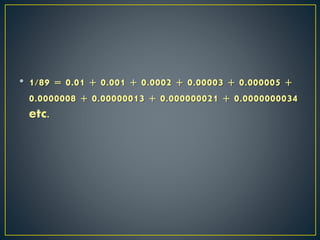
• 1/89 = 0.01 + 0.001 + 0.0002 + 0.00003 + 0.000005 +
0.0000008 + 0.00000013 + 0.000000021 + 0.0000000034
etc.
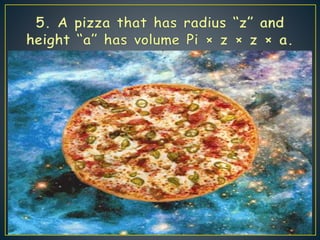
•Because the area of a circle
is Pi multiplied by the
radius squared (which can
be written out as Pi × z ×
z). Then you multiply by
the height to get the total
volume.
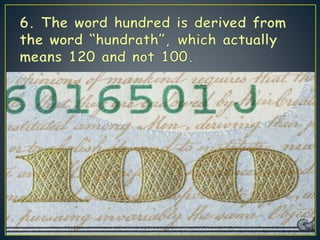
Hundrath is Old
Norse.
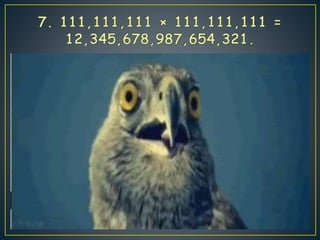
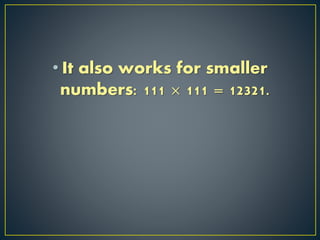
• It also works for smaller
numbers: 111 × 111 = 12321.
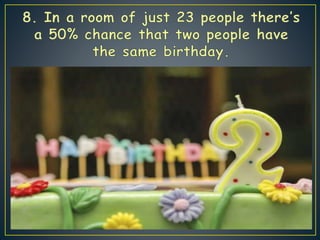
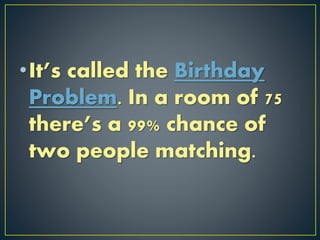
•It’s called the Birthday
Problem. In a room of 75
there’s a 99% chance of
two people matching.
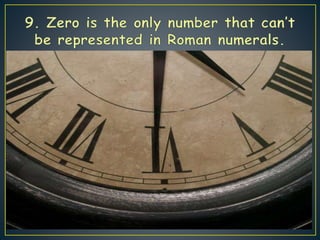
•The Latin word “nulla”
would have been used
instead.
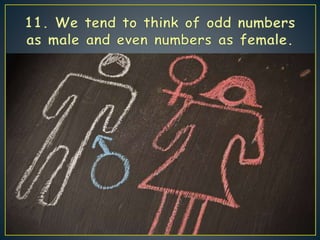
• This ancient belief was tested by James
Wilkie and Galen Bodenhausen of
Northwestern University. In his latest
book, Alex Bellos writes: “They showed
respondents randomly assigned pictures of
the faces of young babies, each next to a
three-digit number that was either odd-
odd-odd or even-even-even, and asked
them to guess the baby’s sex […]
Respondents were about 10 per cent more
likely to say that a baby paired with odd
numbers was a boy, than if the same baby
was paired with even numbers.
Proof.
According to Carl Sagan in the
original Cosmos series. A googolplex
is 10 to the power of a googol, or 10 to
the power of 10 to the power of
100. This website will write it out for
you (or start… it won’t ever finish
because your computer won’t have
enough memory).
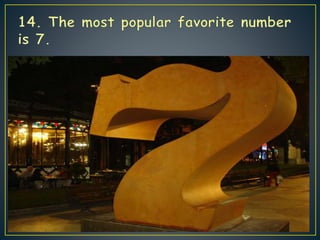
• Nearly 3000 people, around 10%
of the total asked, chose 7 as
their favourite number in
an online poll by Alex Bellos.
The second most popular was 3.
• It’s the only number below 10
you can’t multiply or divide and
keep within group. For
example, 5 you can multiply by
2 to get 10 (still within the 1-10
group), 6 and 8 you can divide
by 2.
• We have seven deadly sins, and
seven wonders of the world. Not to
mention colours of the rainbow,
pillars of wisdom, seas, dwarves,
days in the week…
• This might be because when these
things came about there were
celestial bodies visible in the sky (the
Sun, the Moon, Venus, Mercury, Mars,
Jupiter and Saturn).
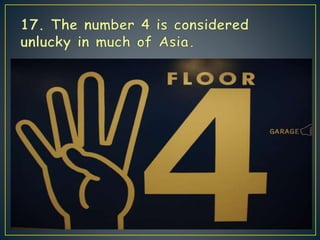
• That’s because the words for
“four” in Japanese, Cantonese,
Mandarin and Korean (shi, sei,
si, sa) sound the same as the
words in those languages for
death.
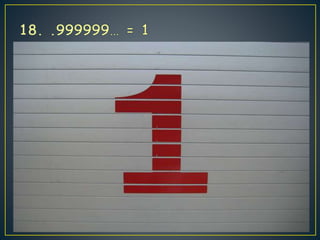
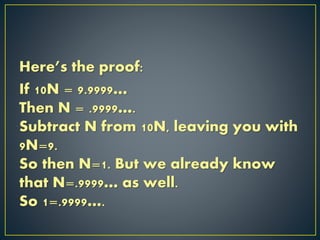
Here’s the proof:
If 10N = 9.9999…
Then N = .9999….
Subtract N from 10N, leaving you with
9N=9.
So then N=1. But we already know
that N=.9999… as well.
So 1=.9999….
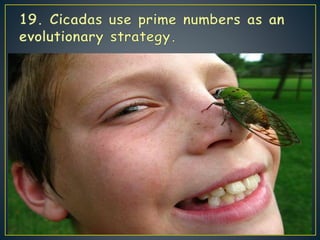
• Cicadas incubate underground for
long periods of time – 13 or 17 years
– before coming out to mate. 13 and
17 are both prime numbers. It’s
thought cicadas ended up in these
prime number life-cycles because it
meant they came into contact with
predators on more round numbered
life-cycles less often.
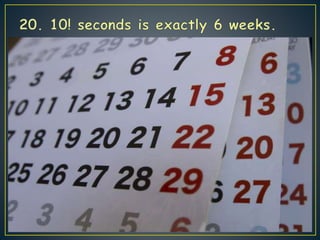
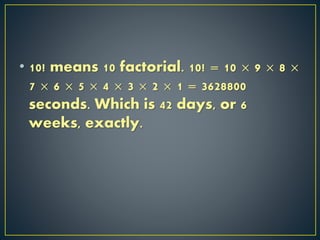
• 10! means 10 factorial. 10! = 10 × 9 × 8 ×
7 × 6 × 5 × 4 × 3 × 2 × 1 = 3628800
seconds. Which is 42 days, or 6
weeks, exactly.
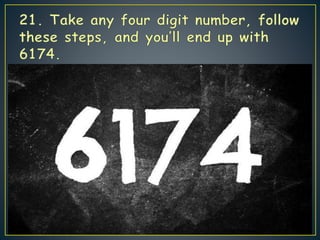
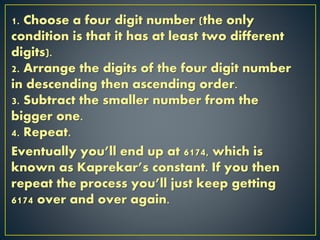
1. Choose a four digit number (the only
condition is that it has at least two different
digits).
2. Arrange the digits of the four digit number
in descending then ascending order.
3. Subtract the smaller number from the
bigger one.
4. Repeat.
Eventually you’ll end up at 6174, which is
known as Kaprekar’s constant. If you then
repeat the process you’ll just keep getting
6174 over and over again.
Maths fact
Maths fact

Maths fact

  • 1.
  • 2.
  • 4.
  • 6.
  • 8.
    •That’s where youadd the two preceding numbers in the sequence to give you the next one. So it starts 1, 1, 2, 3, 5, 8, 13, 21, etc. The Fibonacci sequence shows up in nature a fair bit.
  • 10.
    • 1/89 =0.01 + 0.001 + 0.0002 + 0.00003 + 0.000005 + 0.0000008 + 0.00000013 + 0.000000021 + 0.0000000034 etc.
  • 12.
    •Because the areaof a circle is Pi multiplied by the radius squared (which can be written out as Pi × z × z). Then you multiply by the height to get the total volume.
  • 14.
  • 16.
    • It alsoworks for smaller numbers: 111 × 111 = 12321.
  • 18.
    •It’s called theBirthday Problem. In a room of 75 there’s a 99% chance of two people matching.
  • 20.
    •The Latin word“nulla” would have been used instead.
  • 23.
    • This ancientbelief was tested by James Wilkie and Galen Bodenhausen of Northwestern University. In his latest book, Alex Bellos writes: “They showed respondents randomly assigned pictures of the faces of young babies, each next to a three-digit number that was either odd- odd-odd or even-even-even, and asked them to guess the baby’s sex […] Respondents were about 10 per cent more likely to say that a baby paired with odd numbers was a boy, than if the same baby was paired with even numbers.
  • 25.
  • 27.
    According to CarlSagan in the original Cosmos series. A googolplex is 10 to the power of a googol, or 10 to the power of 10 to the power of 100. This website will write it out for you (or start… it won’t ever finish because your computer won’t have enough memory).
  • 29.
    • Nearly 3000people, around 10% of the total asked, chose 7 as their favourite number in an online poll by Alex Bellos. The second most popular was 3.
  • 31.
    • It’s theonly number below 10 you can’t multiply or divide and keep within group. For example, 5 you can multiply by 2 to get 10 (still within the 1-10 group), 6 and 8 you can divide by 2.
  • 33.
    • We haveseven deadly sins, and seven wonders of the world. Not to mention colours of the rainbow, pillars of wisdom, seas, dwarves, days in the week… • This might be because when these things came about there were celestial bodies visible in the sky (the Sun, the Moon, Venus, Mercury, Mars, Jupiter and Saturn).
  • 35.
    • That’s becausethe words for “four” in Japanese, Cantonese, Mandarin and Korean (shi, sei, si, sa) sound the same as the words in those languages for death.
  • 37.
    Here’s the proof: If10N = 9.9999… Then N = .9999…. Subtract N from 10N, leaving you with 9N=9. So then N=1. But we already know that N=.9999… as well. So 1=.9999….
  • 39.
    • Cicadas incubateunderground for long periods of time – 13 or 17 years – before coming out to mate. 13 and 17 are both prime numbers. It’s thought cicadas ended up in these prime number life-cycles because it meant they came into contact with predators on more round numbered life-cycles less often.
  • 41.
    • 10! means10 factorial. 10! = 10 × 9 × 8 × 7 × 6 × 5 × 4 × 3 × 2 × 1 = 3628800 seconds. Which is 42 days, or 6 weeks, exactly.
  • 43.
    1. Choose afour digit number (the only condition is that it has at least two different digits). 2. Arrange the digits of the four digit number in descending then ascending order. 3. Subtract the smaller number from the bigger one. 4. Repeat. Eventually you’ll end up at 6174, which is known as Kaprekar’s constant. If you then repeat the process you’ll just keep getting 6174 over and over again.