MATHS 
PROJECT
NUMBER SYSTEMS
INTRODUCTION 
NATURAL NUMBERS 
WHOLE NUMBERS 
INTEGERS 
RATIONAL NUMBERS 
 FINDING RATIONAL NUMBERS 
IRRATIONAL NUMBERS 
 RATIONALISING DENOMINATORS 
 REAL NUMBERS 
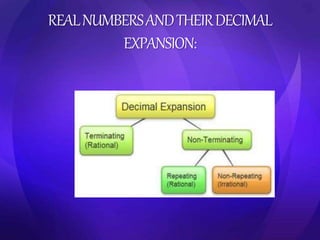
 REAL NUMBERS AND THEIR DECIMAL 
EXPANSION 
NUMBER LINES
INTRODUCTION : 
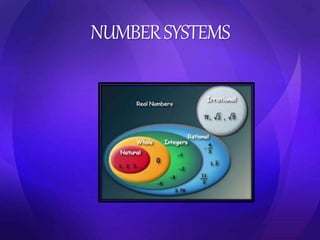
 It's the way we categorize numbers. There 
may be an infinite amount of them, but they all 
fall nicely in several ranges. 
The first group is part of the second, which is 
part of the third, which is part of the fourth, 
and the pattern continues.
NATURAL NUMBERS : 
Natural numbers (also called 
counting numbers) can be 
formed by repeated addition of 
the number 1. 
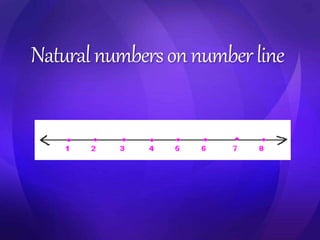
1, 2, 3, 4, 5, 6, 7... and so on
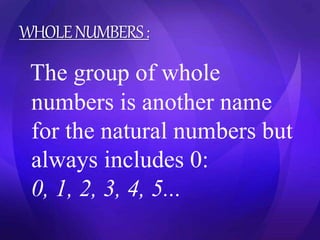
WHOLE NUMBERS : 
The group of whole 
numbers is another name 
for the natural numbers but 
always includes 0: 
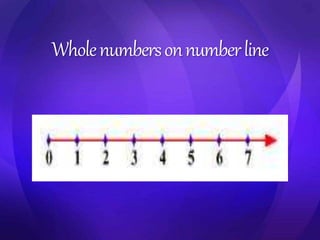
0, 1, 2, 3, 4, 5...
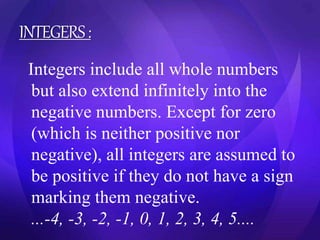
INTEGERS : 
Integers include all whole numbers 
but also extend infinitely into the 
negative numbers. Except for zero 
(which is neither positive nor 
negative), all integers are assumed to 
be positive if they do not have a sign 
marking them negative. 
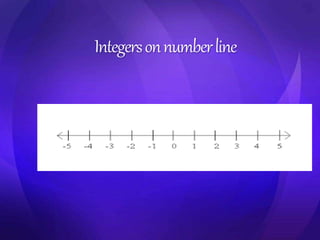
...-4, -3, -2, -1, 0, 1, 2, 3, 4, 5....
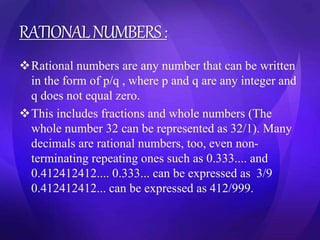
RATIONAL NUMBERS : 
Rational numbers are any number that can be written 
in the form of p/q , where p and q are any integer and 
q does not equal zero. 
This includes fractions and whole numbers (The 
whole number 32 can be represented as 32/1). Many 
decimals are rational numbers, too, even non-terminating 
repeating ones such as 0.333.... and 
0.412412412.... 0.333... can be expressed as 3/9 
0.412412412... can be expressed as 412/999.
Finding rational numbers between two numbers: 
There are two methods to find rational 
numbers. They are: 
 mid-value method 
 denominator method
finding rational numbers by mid-value method 
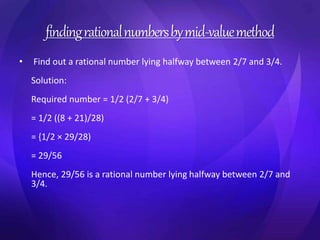
• Find out a rational number lying halfway between 2/7 and 3/4. 
Solution: 
Required number = 1/2 (2/7 + 3/4) 
= 1/2 ((8 + 21)/28) 
= {1/2 × 29/28) 
= 29/56 
Hence, 29/56 is a rational number lying halfway between 2/7 and 
3/4.
finding rational numbers by denominator mehod : 
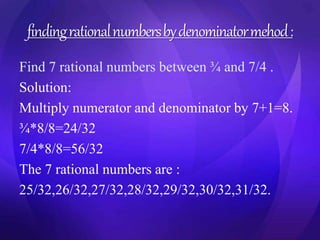
Find 7 rational numbers between ¾ and 7/4 . 
Solution: 
Multiply numerator and denominator by 7+1=8. 
¾*8/8=24/32 
7/4*8/8=56/32 
The 7 rational numbers are : 
25/32,26/32,27/32,28/32,29/32,30/32,31/32.
IRRATIONAL NUMBERS : 
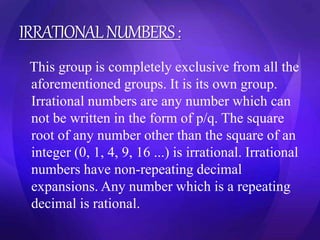
This group is completely exclusive from all the 
aforementioned groups. It is its own group. 
Irrational numbers are any number which can 
not be written in the form of p/q. The square 
root of any number other than the square of an 
integer (0, 1, 4, 9, 16 ...) is irrational. Irrational 
numbers have non-repeating decimal 
expansions. Any number which is a repeating 
decimal is rational.
Real nmbers: 
 The collections of rational and 
irrational numbers are known as real 
numbers. 
 The real numbers are “all the 
numbers” on the number line.
REAL NUMBERS AND THEIR DECIMAL 
EXPANSION:
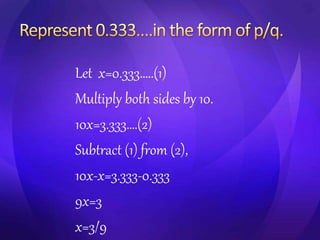
Let x=0.333…..(1) 
Multiply both sides by 10. 
10x=3.333….(2) 
Subtract (1) from (2), 
10x-x=3.333-0.333 
9x=3 
x=3/9
Number lines : 
Representation of 
natural numbers 
 whole numbers 
 integers 
 rational numbers 
 irrational numbers 
on number lines.
Natural numbers on number line
Whole numbers on number line
Integers on number line
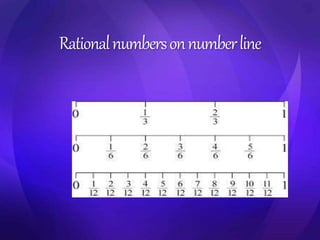
Rational numbers on number line
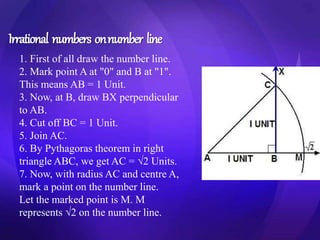
Irrational numbers on number line 
1. First of all draw the number line. 
2. Mark point A at "0" and B at "1". 
This means AB = 1 Unit. 
3. Now, at B, draw BX perpendicular 
to AB. 
4. Cut off BC = 1 Unit. 
5. Join AC. 
6. By Pythagoras theorem in right 
triangle ABC, we get AC = √2 Units. 
7. Now, with radius AC and centre A, 
mark a point on the number line. 
Let the marked point is M. M 
represents √2 on the number line.
Thank you

NUMBER SYSTEM

  • 1.
  • 2.
  • 3.
    INTRODUCTION NATURAL NUMBERS WHOLE NUMBERS INTEGERS RATIONAL NUMBERS  FINDING RATIONAL NUMBERS IRRATIONAL NUMBERS  RATIONALISING DENOMINATORS  REAL NUMBERS  REAL NUMBERS AND THEIR DECIMAL EXPANSION NUMBER LINES
  • 4.
    INTRODUCTION : It's the way we categorize numbers. There may be an infinite amount of them, but they all fall nicely in several ranges. The first group is part of the second, which is part of the third, which is part of the fourth, and the pattern continues.
  • 5.
    NATURAL NUMBERS : Natural numbers (also called counting numbers) can be formed by repeated addition of the number 1. 1, 2, 3, 4, 5, 6, 7... and so on
  • 6.
    WHOLE NUMBERS : The group of whole numbers is another name for the natural numbers but always includes 0: 0, 1, 2, 3, 4, 5...
  • 7.
    INTEGERS : Integersinclude all whole numbers but also extend infinitely into the negative numbers. Except for zero (which is neither positive nor negative), all integers are assumed to be positive if they do not have a sign marking them negative. ...-4, -3, -2, -1, 0, 1, 2, 3, 4, 5....
  • 8.
    RATIONAL NUMBERS : Rational numbers are any number that can be written in the form of p/q , where p and q are any integer and q does not equal zero. This includes fractions and whole numbers (The whole number 32 can be represented as 32/1). Many decimals are rational numbers, too, even non-terminating repeating ones such as 0.333.... and 0.412412412.... 0.333... can be expressed as 3/9 0.412412412... can be expressed as 412/999.
  • 9.
    Finding rational numbersbetween two numbers: There are two methods to find rational numbers. They are:  mid-value method  denominator method
  • 10.
    finding rational numbersby mid-value method • Find out a rational number lying halfway between 2/7 and 3/4. Solution: Required number = 1/2 (2/7 + 3/4) = 1/2 ((8 + 21)/28) = {1/2 × 29/28) = 29/56 Hence, 29/56 is a rational number lying halfway between 2/7 and 3/4.
  • 11.
    finding rational numbersby denominator mehod : Find 7 rational numbers between ¾ and 7/4 . Solution: Multiply numerator and denominator by 7+1=8. ¾*8/8=24/32 7/4*8/8=56/32 The 7 rational numbers are : 25/32,26/32,27/32,28/32,29/32,30/32,31/32.
  • 12.
    IRRATIONAL NUMBERS : This group is completely exclusive from all the aforementioned groups. It is its own group. Irrational numbers are any number which can not be written in the form of p/q. The square root of any number other than the square of an integer (0, 1, 4, 9, 16 ...) is irrational. Irrational numbers have non-repeating decimal expansions. Any number which is a repeating decimal is rational.
  • 14.
    Real nmbers: The collections of rational and irrational numbers are known as real numbers.  The real numbers are “all the numbers” on the number line.
  • 15.
    REAL NUMBERS ANDTHEIR DECIMAL EXPANSION:
  • 16.
    Let x=0.333…..(1) Multiplyboth sides by 10. 10x=3.333….(2) Subtract (1) from (2), 10x-x=3.333-0.333 9x=3 x=3/9
  • 17.
    Number lines : Representation of natural numbers  whole numbers  integers  rational numbers  irrational numbers on number lines.
  • 18.
    Natural numbers onnumber line
  • 19.
    Whole numbers onnumber line
  • 20.
  • 21.
  • 22.
    Irrational numbers onnumber line 1. First of all draw the number line. 2. Mark point A at "0" and B at "1". This means AB = 1 Unit. 3. Now, at B, draw BX perpendicular to AB. 4. Cut off BC = 1 Unit. 5. Join AC. 6. By Pythagoras theorem in right triangle ABC, we get AC = √2 Units. 7. Now, with radius AC and centre A, mark a point on the number line. Let the marked point is M. M represents √2 on the number line.
  • 23.